door lock OPEL COMBO D 2017.5 Owner's Guide
[x] Cancel search | Manufacturer: OPEL, Model Year: 2017.5, Model line: COMBO D, Model: OPEL COMBO D 2017.5Pages: 201, PDF Size: 4.76 MB
Page 138 of 201
136Driving and operatingNote
Depending on model, the sliding
side door may be fitted with a safety system that prevents the door from
being opened fully when the fuel
filler flap is open.
Sliding side door 3 26.
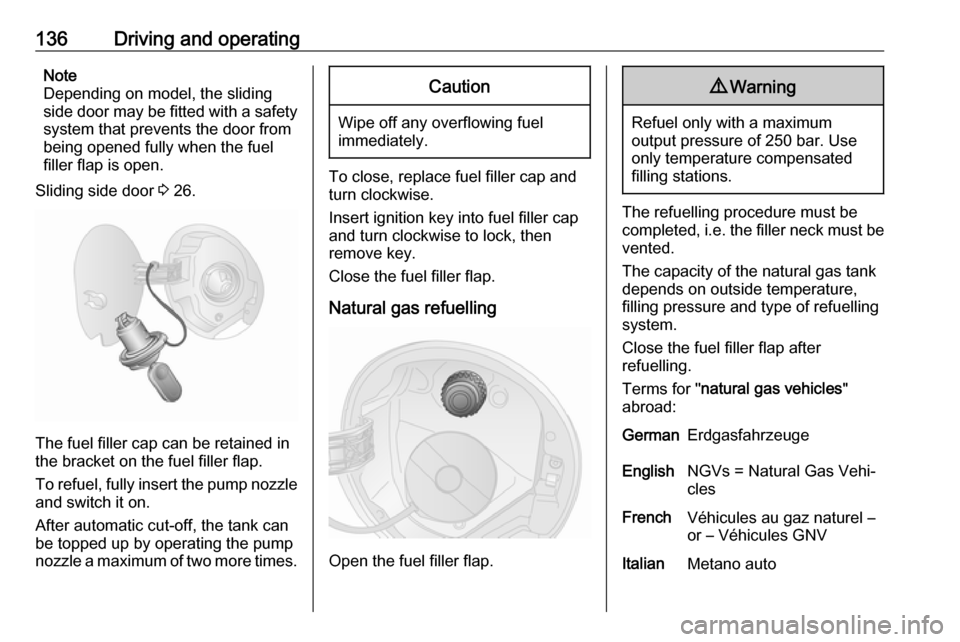
The fuel filler cap can be retained in
the bracket on the fuel filler flap.
To refuel, fully insert the pump nozzle
and switch it on.
After automatic cut-off, the tank can be topped up by operating the pump
nozzle a maximum of two more times.
Caution
Wipe off any overflowing fuel
immediately.
To close, replace fuel filler cap and
turn clockwise.
Insert ignition key into fuel filler cap
and turn clockwise to lock, then
remove key.
Close the fuel filler flap.
Natural gas refuelling
Open the fuel filler flap.
9 Warning
Refuel only with a maximum
output pressure of 250 bar. Use
only temperature compensated
filling stations.
The refuelling procedure must be
completed, i.e. the filler neck must be vented.
The capacity of the natural gas tank
depends on outside temperature,
filling pressure and type of refuelling
system.
Close the fuel filler flap after
refuelling.
Terms for " natural gas vehicles "
abroad:
GermanErdgasfahrzeugeEnglishNGVs = Natural Gas Vehi‐
clesFrenchVéhicules au gaz naturel –
or – Véhicules GNVItalianMetano auto
Page 143 of 201

Vehicle care141Caution
When transporting the vehicle on
a train or on a recovery vehicle, the
mud flaps might be damaged.
Vehicle storage
Storage for a long period of time
If the vehicle is to be stored for several months:
● Wash and wax the vehicle.
● Have the wax in the engine compartment and underbody
checked.
● Clean and preserve the rubber seals.
● Fill up fuel tank completely.
● Change the engine oil.
● Drain the washer fluid reservoir.
● Check the coolant antifreeze and
corrosion protection.
● Adjust tyre pressure to the value specified for full load.
● Park the vehicle in a dry, wellventilated place. Engage first or
reverse gear to prevent the
vehicle from rolling.
● Do not apply the parking brake.
● Open the bonnet, close all doors and lock the vehicle.
● Disconnect the clamp from the negative terminal of the vehicle
battery. Beware that all systems
are not functional, e.g. anti-theft
locking system.
Putting back into operation
When the vehicle is to be put back into operation:
● Connect the clamp to the negative terminal of the vehicle
battery. Activate the electronics
of the power windows.
● Check tyre pressure.
● Fill up the washer fluid reservoir.
● Check the engine oil level.
● Check the coolant level.
● Fit the number plates if necessary.End-of-life vehicle recovery
Information on end-of-life vehicle
recovery centres and the recycling of
end-of-life vehicles is available on our website. Only entrust this work to an
authorised recycling centre.
Natural gas vehicles must be recycled by a service centre authorised for
natural gas vehicles.
Page 154 of 201

152Vehicle careNumber plate lightTailgate
1. Insert screwdriver as indicated by
the arrows, press to the side and
release the bulb housing.
2. Turn the bulb holder anticlockwise
to remove from the bulb housing.
Remove the bulb by pulling.
3. Replace the bulb.
4. Insert bulb holder in bulb housing and rotate clockwise
5. Install the bulb housing ensuring it
engages correctly.
Rear doors
1. Insert screwdriver as indicated by
the arrows, press to the left and
release the bulb housing.
2. Press bulb slightly towards spring
clip and remove.
3. Replace the bulb.
4. Install the bulb housing ensuring it
engages correctly.
Page 195 of 201

Customer information193When using the vehicle, situations
may occur in which technical data
related to other information (accident report, damages on the vehicle,
witness statements etc.) may be
associated with a specific person -
possibly, with the assistance of an
expert.
Additional functions contractually
agreed upon with the client (e.g.
vehicle location in emergency cases)
allow the transmission of particular vehicle data from the vehicle.
Radio Frequency Identification (RFID)
RFID technology is used in some
vehicles for functions such as tyre
pressure monitoring and ignition
system security. It is also used in
connection with conveniences such
as radio remote controls for door
locking/unlocking and starting, and in-
vehicle transmitters for garage door
openers. RFID technology in Opel
vehicles does not use or record
personal information or link with any
other Opel system containing
personal information.
Page 197 of 201

195Chimes......................................... 95
Cigarette lighter ........................... 75
Climate control ............................. 16
Climate control systems .............106
Clock....................................... 72, 90
CNG............................................ 189
Collision damage repair ..............191
Control indicators.......................... 79
Control of the vehicle .................113
Controls ........................................ 70
Convex shape .............................. 30
Coolant and antifreeze ...............177
Cruise control ...................... 90, 130
Cupholders .................................. 61
D
Danger, Warnings and Cautions ...4
Date .............................................. 90
Daytime running lights ..........90, 100
Declaration of conformity ............191
Diesel particle filter ...............86, 120
Distance to next service ...............90
Door open .................................... 90
Doors ...................................... 26, 28
Drain fuel filter ............................. 89
Driver assistance systems ..........130
Driver Information Centre .............90
Driving characteristics and towing tips .............................. 138
Driving hints ................................ 113E
Eco mode (E).............................. 124
Electric adjustment ......................30
Electrical system......................... 154
Electronic climate control system 108
Electronic driving programmes ..124
Electronic Stability Control ..85, 129
Electronic Stability Control (ESC). 85
End-of-life vehicle recovery .......141
Engine compartment fuse box ...155
Engine coolant ........................... 144
Engine coolant temperature ........86
Engine coolant temperature gauge ....................................... 78
Engine data ............................... 182
Engine exhaust .......................... 120
Engine identification ...................180
Engine oil ...........143, 177, 181, 189
Engine oil pressure ......................87
ESC (Electronic Stability Control) 129
Event data recorders ..................192
Exit lighting ................................ 105
Extendable load compartment cover ................................... 63, 67
Exterior care .............................. 172
Exterior light ................................. 89
Exterior lighting ......................13, 99
Exterior mirrors ............................. 30F
Fault ........................................... 125
Fixed air vents ........................... 111
Fog light ....................................... 90
Fog lights ................................... 150
Folding front passenger seat ........38
Folding mirrors ............................. 31
Folding seats .......................... 41, 42
Front airbag system .....................52
Front fog lights ........................... 101
Front passenger seat Folding ...................................... 38
Table position ............................ 38
Front seats.................................... 36
Front storage ................................ 61
Front turn signal light ..................148
Fuel............................................. 134
Fuel consumption .........................90
Fuel consumption - CO 2-
Emissions ............................... 137
Fuel cut-off system .........81, 96, 115
Fuel for diesel engines ..............134
Fuel for natural gas operation ...134
Fuel for petrol engines ...............134
Fuel gauge ................................... 77
Fuel selector ................................ 77
Fuel system messages .........96, 115
Fuel tank ..................................... 189
Fuses ......................................... 154
Page 198 of 201

196GGauges ......................................... 76
Gear shifting ................................. 85
General information ...................138
Generic warning .............81, 96, 115
Glovebox ..................................... 61
Gross Vehicle Weight ...................67
H
Halogen headlights ....................148
Hand brake ................................. 127
Hazard warning flashers ............100
Headlamp washer......................... 72
Headlight flash ............................. 99
Headlight range adjustment ......100
Headlights..................................... 99
Headlights when driving abroad 100
Head restraint adjustment .............8
Head restraints ............................ 35
Heated mirrors ............................. 31
Heated rear window ..................... 34
Heating ........................................ 40
Heating and ventilation system . 106
High beam ............................. 89, 99
Hill start assist ...................... 85, 127
Horn ....................................... 14, 70
I Identification plate .....................180
Ignition switch positions .............114
Immobiliser ............................ 29, 89Indicators...................................... 76
Information displays...................... 90
Initial drive information.................... 6
Installing seats .............................. 42
Instrument cluster ........................76
Instrument panel fuse box .........156
Instrument panel illumination .....154
Instrument panel illumination control .................................... 102
Instrument panel overview ........... 10
Instrument panel storage ..............60
Interior care ............................... 175
Interior lighting ......................90, 102
Interior lights ...................... 103, 153
Interior mirrors .............................. 31
Introduction .................................... 3
ISOFIX .......................................... 55
J Jump starting ............................. 169
K Kerb weight................................... 67Key number .................................. 20
Keys ............................................. 20
Keys, locks ................................... 20
L
Language ..................................... 90
Lashing eyes ......................... 65, 67
Laying up the vehicle ..................146Light switch .................................. 99
Load compartment ................28, 62
Load compartment cover .............63
Load compartment grille ...............66
Load compartment lighting .........104
Loading ............................. 38, 41, 42
Loading information .............67, 187
Loadspace dimensions ...............187
Lock cylinders ............................... 20
Low engine oil level .....................88
Low fuel ....................................... 88
Luggage floor net .........................65
Lumbar support ............................ 37
M Malfunction indicator light ............83
Manual adjustment ......................30
Manual anti-dazzle ......................31
Manual door locks ........................22
Manual mode ............................. 124
Manual transmission .................. 121
Manual transmission automated 122
Manual windows ..........................32
Mirror adjustment ........................... 8
Misted light covers .....................102
Multifunction display .....................90
N
Natural gas ................................. 189
New vehicle running-in ..............114
Number plate light .....................152