heating OPEL COMBO D 2018 Manual user
[x] Cancel search | Manufacturer: OPEL, Model Year: 2018, Model line: COMBO D, Model: OPEL COMBO D 2018Pages: 203, PDF Size: 4.97 MB
Page 109 of 203

Climate control107Climate controlClimate control systems.............107
Heating and ventilation system 107
Air conditioning system ...........108
Electronic climate control system .................................... 109
Air vents ..................................... 111
Adjustable air vents .................111
Fixed air vents ......................... 112
Maintenance .............................. 112
Air intake ................................. 112
Pollen filter ............................... 112
Air conditioning regular operation ................................ 112
Service .................................... 112Climate control systems
Heating and ventilation system
Controls for: ● temperature
● fan speed
● air distribution
Heated rear window Ü 3 34.
Heated front seats ß 3 40.
Temperature
red:warmblue:coldHeating will not be fully effective until
the engine has reached normal
operating temperature.
Fan speed
Adjust the air flow by switching the fan
to the desired speed.
Air distributionM:to head areaL:to head area and foot wellK:to foot well and windscreenJ:to windscreen, front door
windows and foot wellV:to windscreen and front door
windows
Intermediate settings are possible.
Demisting and defrosting the
windows
● Set temperature control to warmest level.
● Set fan speed to highest level.
● Set air distribution control to V.
● Switch on heated rear window Ü.
Page 110 of 203

108Climate control● Open side air vents as requiredand direct them towards door
windows.
● For simultaneous warming of the
foot well, set air distribution
control to J.
Air conditioning system
Controls for: ● temperature
● fan speed
● air distribution
n:cooling4:air recirculationHeated rear window Ü 3 34.
Heated front seats ß 3 40.
Temperaturered:warmblue:cold
Heating will not be fully effective until
the engine has reached normal
operating temperature.
Fan speed
Adjust the air flow by switching the fan
to the desired speed.
Air distribution
M:to head areaL:to head area and foot wellK:to foot well and windscreenJ:to windscreen, front door
windows and foot wellV:to windscreen and front door
windows
Intermediate settings are possible.
Cooling n
Press n to switch on cooling.
Activation is indicated by the LED in
the button. Cooling is only functional
when the engine is running and
climate control fan is switched on.
Press n again to switch off cooling.
The air conditioning system cools and
dehumidifies (dries) the air when
outside temperature is above a
specific level. Therefore
condensation may form and drip from under the vehicle.
If no cooling or drying is required,
switch the cooling system off to save
fuel.
Activated cooling may inhibit
Autostops. Stop-start system 3 117.
Air recirculation system Press 4 to activate air recirculation
mode. Activation is indicated by the
LED in the button.
Press 4 again to deactivate air
recirculation mode.
Page 112 of 203

110Climate controlThe preselected temperature is
automatically regulated. In the
automatic mode the fan speed and air distribution automatically regulate the
air flow.
The system can be manually adapted by use of air distribution and air flow
controls.
The electronic climate control system
is only fully operational when the
engine is running.
For correct operation do not cover the
sensor on the instrument panel.
Automatic mode
Basic setting for maximum comfort: ● Press AUTO.
● Open all air vents.
● Cooling n on.
● Set desired temperature.
Temperature preselection
Temperatures can be set to the
desired value.
For reasons of comfort, change
temperature only in small increments.
Turn AUTO knob to adjust.clockwise:warmanticlockwise:cold
Heating will not be fully effective until
the engine has reached normal
operating temperature.
When the minimum temperature is
set below 16 ℃, the electronic climate
control system runs at maximum
cooling. LO appears in the display.
If the maximum temperature is set
above 32 ℃, the electronic climate
control system runs at maximum
heating. HI appears in the display.
Note
If A/C is switched on, reducing the
set cabin temperature can cause the
engine to restart from an Autostop or inhibit an Autostop.
Stop-start system 3 117.
Fan speed
The selected fan speed is indicated
with bars in the display.
Press ] or < to increase or decrease
the fan speed.
maximum fan
speed:all bars displayedminimum fan
speed:one bar displayed
Cooling n must be switched off
before fan can be deactivated.
To return to automatic fan speed: Press AUTO.
Demisting and defrosting the
windows
Press Ê.
Temperature and air distribution are
set automatically and the fan runs at
a high speed.
When the vehicle reaches normal
operating temperature the function
remains active for approx.
three minutes.
To return to automatic mode: press
n or AUTO .
Air distribution
Press R, S or 6.
LED in buttons illuminate.
Arrows shown in the display indicate
the distribution settings.
Page 114 of 203
112Climate controlSlide knob to the left to open vent.Direct the flow of air by swivelling the vent.
Slide knob to the right to close vent.
Fixed air vents Additional air vents are located
beneath the windscreen and door
windows and in the foot wells.Maintenance
Air intake
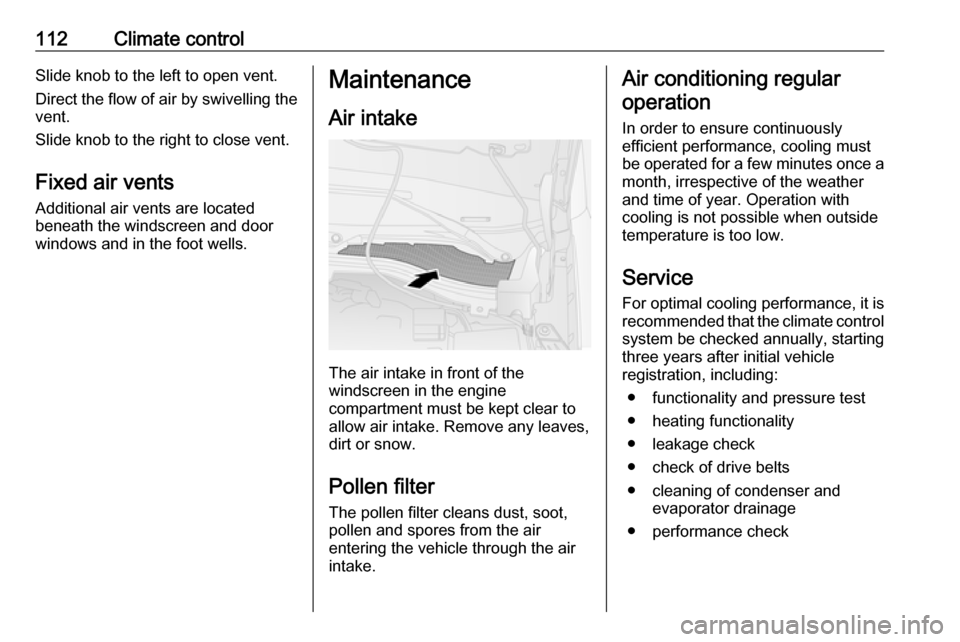
The air intake in front of the
windscreen in the engine
compartment must be kept clear to
allow air intake. Remove any leaves,
dirt or snow.
Pollen filter The pollen filter cleans dust, soot,
pollen and spores from the air
entering the vehicle through the air
intake.
Air conditioning regular
operation
In order to ensure continuously
efficient performance, cooling must
be operated for a few minutes once a
month, irrespective of the weather
and time of year. Operation with
cooling is not possible when outside
temperature is too low.
ServiceFor optimal cooling performance, it is
recommended that the climate control system be checked annually, starting
three years after initial vehicle
registration, including:
● functionality and pressure test
● heating functionality
● leakage check
● check of drive belts
● cleaning of condenser and evaporator drainage
● performance check
Page 117 of 203
Driving and operating115SteeringIf power steering assist is lost
because the engine stops or due to a
system malfunction, the vehicle can
be steered but may require increased
effort.Caution
Never leave the steering wheel on
full lock when the vehicle is
stationary, as this may damage
the power steering pump.
Starting and operating
New vehicle running-in Do not brake unnecessarily hard for
the first few journeys.
During the first drive, smoke may
occur because of wax and oil
evaporating off the exhaust system.
Park the vehicle in the open for a
while after the first drive and avoid
inhaling the fumes.
During the running-in period, fuel and engine oil consumption may be
higher.
Additionally, the cleaning process of
the diesel particle filter may take
place more often.
Diesel particle filter 3 121.
Autostop may be inhibited to allow for
charging of the vehicle battery.
Stop-start system 3 117.
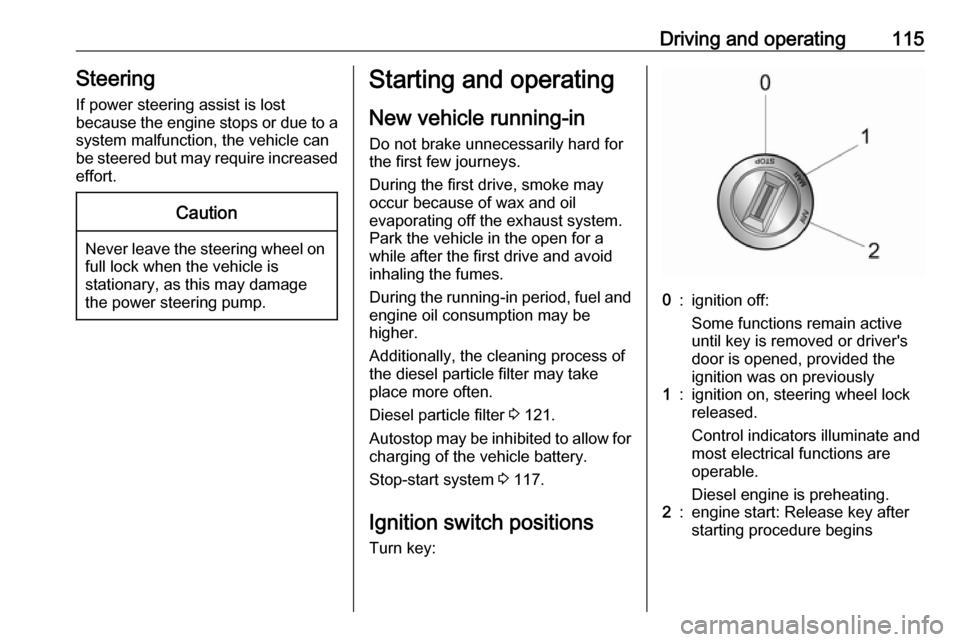
Ignition switch positions Turn key:0:ignition off:
Some functions remain active
until key is removed or driver's
door is opened, provided the
ignition was on previously1:ignition on, steering wheel lock
released.
Control indicators illuminate and
most electrical functions are
operable.
Diesel engine is preheating.2:engine start: Release key after
starting procedure begins
Page 118 of 203
116Driving and operatingSteering wheel lock
Remove key from ignition switch and
turn steering wheel until it engages.
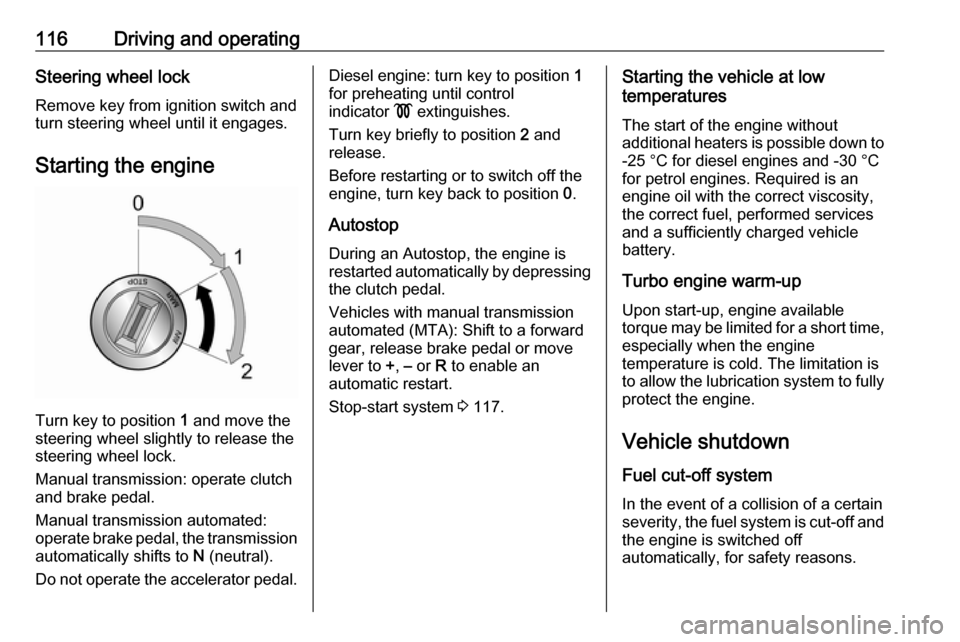
Starting the engine
Turn key to position 1 and move the
steering wheel slightly to release the
steering wheel lock.
Manual transmission: operate clutch
and brake pedal.
Manual transmission automated:
operate brake pedal, the transmission
automatically shifts to N (neutral).
Do not operate the accelerator pedal.
Diesel engine: turn key to position 1
for preheating until control
indicator ! extinguishes.
Turn key briefly to position 2 and
release.
Before restarting or to switch off the
engine, turn key back to position 0.
Autostop During an Autostop, the engine is
restarted automatically by depressing
the clutch pedal.
Vehicles with manual transmission
automated (MTA): Shift to a forward
gear, release brake pedal or move
lever to +, – or R to enable an
automatic restart.
Stop-start system 3 117.Starting the vehicle at low
temperatures
The start of the engine without
additional heaters is possible down to -25 °С for diesel engines and -30 °C
for petrol engines. Required is an engine oil with the correct viscosity,
the correct fuel, performed services
and a sufficiently charged vehicle
battery.
Turbo engine warm-up Upon start-up, engine available
torque may be limited for a short time, especially when the engine
temperature is cold. The limitation is
to allow the lubrication system to fully
protect the engine.
Vehicle shutdown
Fuel cut-off system In the event of a collision of a certain
severity, the fuel system is cut-off and
the engine is switched off
automatically, for safety reasons.
Page 120 of 203
118Driving and operatingDeactivation
Deactivate the stop-start system
manually by pressing ^ in the centre
console. LED in the button illuminates
to confirm deactivation.
Depending on version, a
corresponding message, e.g.
Start&Stop disconnected , may also
be displayed in the Driver Information
Centre 3 91.
Autostop
If the vehicle is at a low speed or at a standstill, activate an Autostop as
follows:
● depress the clutch pedal
● set the lever to neutral
● release the clutch pedal
The engine will be switched off while the ignition stays on.
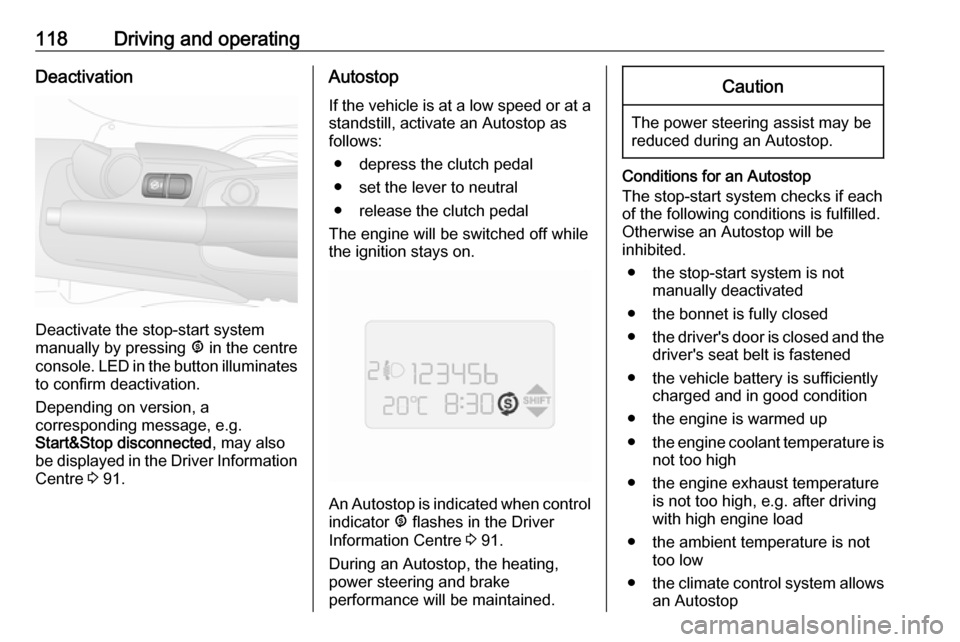
An Autostop is indicated when control
indicator ^ flashes in the Driver
Information Centre 3 91.
During an Autostop, the heating,
power steering and brake
performance will be maintained.
Caution
The power steering assist may be
reduced during an Autostop.
Conditions for an Autostop
The stop-start system checks if each
of the following conditions is fulfilled.
Otherwise an Autostop will be
inhibited.
● the stop-start system is not manually deactivated
● the bonnet is fully closed
● the driver's door is closed and the
driver's seat belt is fastened
● the vehicle battery is sufficiently charged and in good condition
● the engine is warmed up
● the engine coolant temperature is
not too high
● the engine exhaust temperature is not too high, e.g. after driving
with high engine load
● the ambient temperature is not too low
● the climate control system allows
an Autostop
Page 126 of 203

124Driving and operatingmalfunction and a warning message
may be displayed in the Driver
Information Centre.
Return the selector lever to the
centre position. After a short while,
N will be displayed in the Driver
Information Centre and the system
will operate normally again.
Driver Information Centre 3 91.
After selecting A/M, + or - and
releasing the selector lever, the lever automatically returns to the centre
position.N:neutralo:drive positionA/M:switch between automatic and manual mode
The transmission display
shows AUTO when in
automatic mode.R:reverse gear
Engage only when vehicle is
stationary. The transmission
display shows "R" when
reverse gear is engaged.+:shift to a higher gear-:shift to a lower gearCaution
It is not advisable to drive with the hand resting on the selector lever.
Starting-off
When the engine is started, depress
the brake pedal and move the
selector lever towards + to engage
first gear. Shift to a higher or lower
gear by moving selector lever to + or -.
Gears can be skipped by moving the selector lever repeatedly at short
intervals.
The driver will be alerted to an
incorrect gear selection by an audible warning chime in conjunction with a
message in the Driver Information
Centre 3 91. The system will
downshift, selecting the most
appropriate gear automatically.
If R is selected, reverse gear is
engaged. The vehicle starts to move
when the brake pedal is released. To
start off quickly, release the brake
pedal and accelerate immediately
after engaging a gear.
Move the selector lever towards A/M
to engage automatic mode; the
transmission shifts to other gears
automatically, dependent on driving conditions.
To engage manual mode, move the selector lever towards A/M. The
current gear will appear in the
transmission display.
Stopping the vehicle
In automatic or manual mode,
first gear is engaged and the clutch is
released when the vehicle is stopped. In R, reverse gear remains engaged.
When the vehicle is at a standstill, if
the engine is running and a forward or
reverse gear is engaged, a warning
chime will sound and the
transmission automatically shifts to
N in certain situations.
When stopping on gradients, engage
parking brake or depress the brake pedal. To prevent overheating of theclutch, an intermittent audible
warning chime may sound as a signal
to depress the brake pedal or apply
the parking brake.
Page 137 of 203

Driving and operating135Fuel
Fuel for petrol engines Only use unleaded fuel that complies
with European standard EN 228 or
equivalent.
The engine is capable of running with fuel that contains up to 10% ethanol(e.g. named E10).
Use fuel with the recommended
octane rating. A lower octane rating
can reduce engine power and torque
and slightly increases fuel
consumption.Caution
Do not use fuel or fuel additives
that contain metallic compounds
such as manganese-based
additives. This may cause engine
damage.
Caution
Use of fuel that does not comply to EN 228 or equivalent can lead todeposits or engine damage.
Caution
Use of fuel with a lower octane
rating than the lowest possible
rating could lead to uncontrolled combustion and engine damage.
The engine-specific requirements
regarding octane rating are given in
the engine data overview 3 183. A
country-specific label at the fuel filler
flap can supersede the requirement.
Fuel for diesel engines Only use diesel fuel that complies
with EN 590 and which has a sulphur
concentration of max. 10 ppm.
Fuels with a biodiesel (compliant with
EN 14214) content of max. 7% by
volume may be used (e.g. named
B7).
If travelling in countries outside the
European Union occasional use of Euro-Diesel fuel with a sulphur
concentration below 50 ppm is
possible.Caution
Frequent usage of diesel fuel containing more than 15 ppm
sulphur will cause severe engine
damage.
Caution
Use of fuel that does not comply to EN 590 or similar can lead to
engine powerloss, increased wear
or engine damage and may affect
your warranty.
Do not use marine diesel oils, heating
oils, Aquazole and similar diesel-
water emulsions. Diesel fuels must
not be diluted with fuels for petrol
engines.
Page 159 of 203
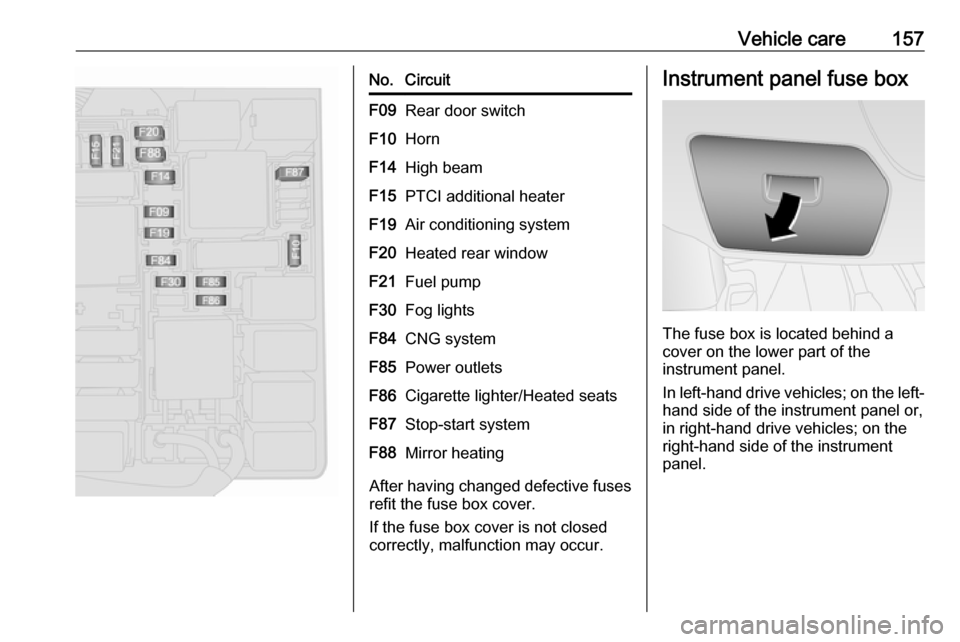
Vehicle care157No.CircuitF09Rear door switchF10HornF14High beamF15PTCI additional heaterF19Air conditioning systemF20Heated rear windowF21Fuel pumpF30Fog lightsF84CNG systemF85Power outletsF86Cigarette lighter/Heated seatsF87Stop-start systemF88Mirror heating
After having changed defective fuses
refit the fuse box cover.
If the fuse box cover is not closed
correctly, malfunction may occur.
Instrument panel fuse box
The fuse box is located behind a
cover on the lower part of the
instrument panel.
In left-hand drive vehicles; on the left-
hand side of the instrument panel or,
in right-hand drive vehicles; on the
right-hand side of the instrument
panel.