transmission OPEL COMBO D 2018 Manual user
[x] Cancel search | Manufacturer: OPEL, Model Year: 2018, Model line: COMBO D, Model: OPEL COMBO D 2018Pages: 203, PDF Size: 4.97 MB
Page 116 of 203

114Driving and operatingDriving and
operatingDriving hints ............................... 114
Control of the vehicle ...............114
Steering ................................... 115
Starting and operating ...............115
New vehicle running-in ............115
Ignition switch positions ...........115
Starting the engine ..................116
Vehicle shutdown ....................116
Overrun cut-off ........................ 117
Stop-start system ....................117
Parking .................................... 120
Engine exhaust .......................... 121
Diesel particle filter ..................121
Catalytic converter ...................121
Manual transmission ..................122
Manual transmission automa‐ ted .............................................. 123
Transmission display ...............123
Starting the engine ..................123
Selector lever .......................... 123
Manual mode ........................... 125
Electronic driving programmes 125
Fault ........................................ 126Brakes........................................ 127
Antilock brake system .............127
Parking brake .......................... 128
Brake assist ............................. 128
Hill start assist ......................... 128
Ride control systems .................129
Traction Control system ..........129
Electronic Stability Control ......130
Driver assistance systems .........131
Cruise control .......................... 131
Parking assist .......................... 132
Fuel ............................................ 135
Fuel for petrol engines .............135
Fuel for diesel engines ............135
Fuel for natural gas operation . 136
Refuelling ................................ 136
Fuel consumption - CO 2-
Emissions ............................... 138
Trailer hitch ................................ 139
General information .................139
Driving characteristics and towing tips .............................. 139
Trailer towing ........................... 139Driving hints
Control of the vehicle
Never coast with engine not
running (except during Autostop)
Many systems will not function in this
situation (e.g. brake servo unit, power
steering). Driving in this manner is a
danger to yourself and others. All
systems function during an Autostop,
but there may be a controlled
reduction in power steering assist and
vehicle speed is reduced.
Stop-start system 3 117.
Pedals
To ensure the pedal travel is
uninhibited, there must be no mats in the area of the pedals.
Use only floor mats which fit properly
and are fixed by the retainers on the
driver's side.
Driving downhill
Engage a gear when driving downhill to ensure that sufficient brake
pressure is available.
Page 118 of 203
116Driving and operatingSteering wheel lock
Remove key from ignition switch and
turn steering wheel until it engages.
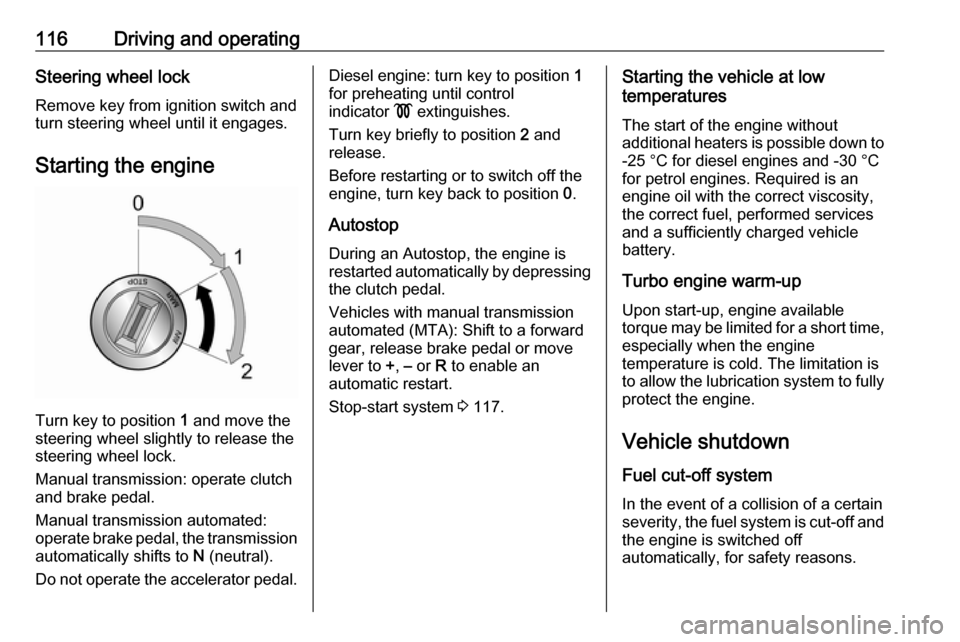
Starting the engine
Turn key to position 1 and move the
steering wheel slightly to release the
steering wheel lock.
Manual transmission: operate clutch
and brake pedal.
Manual transmission automated:
operate brake pedal, the transmission
automatically shifts to N (neutral).
Do not operate the accelerator pedal.
Diesel engine: turn key to position 1
for preheating until control
indicator ! extinguishes.
Turn key briefly to position 2 and
release.
Before restarting or to switch off the
engine, turn key back to position 0.
Autostop During an Autostop, the engine is
restarted automatically by depressing
the clutch pedal.
Vehicles with manual transmission
automated (MTA): Shift to a forward
gear, release brake pedal or move
lever to +, – or R to enable an
automatic restart.
Stop-start system 3 117.Starting the vehicle at low
temperatures
The start of the engine without
additional heaters is possible down to -25 °С for diesel engines and -30 °C
for petrol engines. Required is an engine oil with the correct viscosity,
the correct fuel, performed services
and a sufficiently charged vehicle
battery.
Turbo engine warm-up Upon start-up, engine available
torque may be limited for a short time, especially when the engine
temperature is cold. The limitation is
to allow the lubrication system to fully
protect the engine.
Vehicle shutdown
Fuel cut-off system In the event of a collision of a certain
severity, the fuel system is cut-off and
the engine is switched off
automatically, for safety reasons.
Page 121 of 203

Driving and operating119● the self-cleaning function of thediesel particle filter is not active
● the vehicle has moved since the last Autostop
● the brake vacuum is sufficient ● the windscreen wipers are not operating at fast speed
● reverse gear is not selected
● heated rear window is not operating
Ambient temperature near to the
freezing point can inhibit an Autostop.
For manual transmission automated
vehicles, an Autostop may be
inhibited until a speed of approx.
10 km/h is reached.
Immediately after motorway driving
an Autostop may be inhibited.
New vehicle running-in 3 115.
Vehicle battery discharge protection
To ensure reliable engine restarts,
several vehicle battery discharge
protection features are implemented
as part of the stop-start system.Restarting the engine
Manual transmission
The selector lever must be in neutral to enable an automatic restart.
Depress the clutch pedal to restart the
engine.
Manual transmission automated
If the lever is in position N, select
another gear, otherwise release the brake pedal or move the lever to +, –
or R to enable an automatic restart.
If an electrical accessory, e.g. a
portable CD player, is connected to
the power outlet, a brief power drop
during the restart may be noticeable.
Restarting the engine with the key When one of the following conditions
occurs during an Autostop, the
engine will need to be restarted
manually using the key.
● the driver's seat belt is unfastened and the driver's door
is opened.
● three minutes have elapsed since the engine was switched offIn this event, control indicator ^
flashes in the Driver Information
Centre in conjunction with a warning
chime. Depending on version, a
corresponding message may also be
displayed in the Driver Information
Centre 3 91.
Fault
If control indicator Æ illuminates in the
instrument cluster, there is a fault in
the stop-start system 3 90.
Depending on version, 9 will
illuminate as an alternative if control
indicator Æ is not present. A
corresponding warning message,
e.g. Start&Stop unavailable , may also
be displayed in the Driver Information
Centre 3 91.
Generic warning 9 3 82.
Seek the assistance of a workshop.
Page 124 of 203
122Driving and operatingCaution
Fuel grades other than those listedon pages 3 135, 3 183 could
damage the catalytic converter or
electronic components.
Unburnt petrol will overheat and
damage the catalytic converter.
Therefore avoid excessive use of the starter, running the fuel tank
dry and starting the engine by
pushing or towing.
In the event of misfiring, uneven
engine running, a reduction in engine performance or other unusual
problems, have the cause of the fault
rectified by a workshop as soon as
possible. In an emergency, driving
can be continued for a short period,
keeping vehicle speed and engine
speed low.
Manual transmission
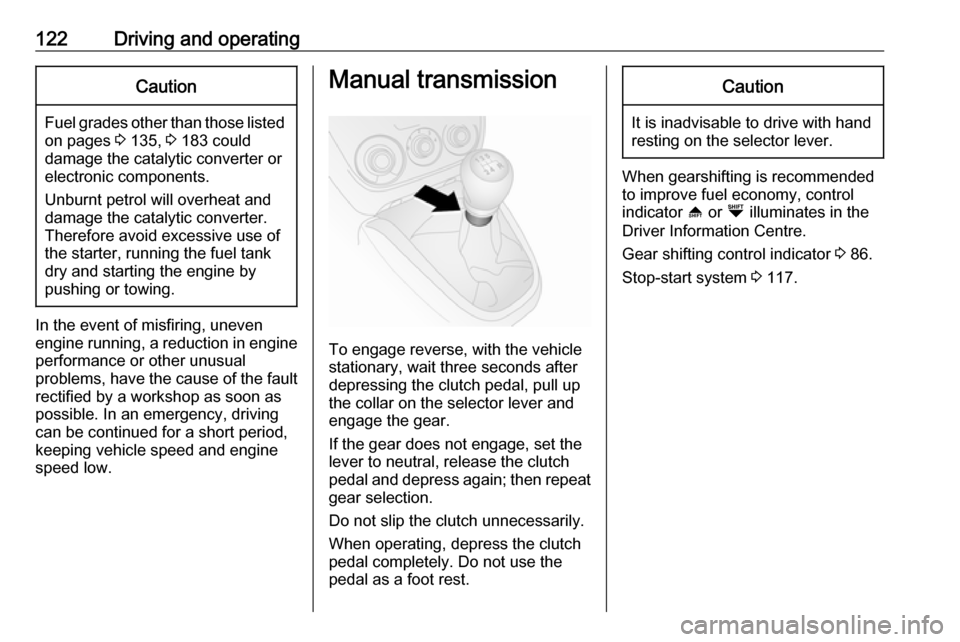
To engage reverse, with the vehicle
stationary, wait three seconds after
depressing the clutch pedal, pull up
the collar on the selector lever and
engage the gear.
If the gear does not engage, set the
lever to neutral, release the clutch
pedal and depress again; then repeat
gear selection.
Do not slip the clutch unnecessarily.
When operating, depress the clutch
pedal completely. Do not use the
pedal as a foot rest.
Caution
It is inadvisable to drive with hand
resting on the selector lever.
When gearshifting is recommended
to improve fuel economy, control
indicator [ or Ò illuminates in the
Driver Information Centre.
Gear shifting control indicator 3 86.
Stop-start system 3 117.
Page 125 of 203
Driving and operating123Manual transmission
automated
The manual transmission automated
(MTA) permits manual (manual
mode) or automatic gear shifting
(automatic mode), both with
automatic clutch control.
Transmission display
Shows the mode and current gear.
Starting the engine
Depress the brake pedal when
starting the engine.
If the brake pedal is not depressed, a
warning chime will sound 3 96 and
the engine cannot be started.
Depending on version, a
corresponding warning message,
e.g. Depress brake pedal , may also
be displayed in the Driver Information Centre 3 91.
Note
The volume of the warning chime
can also be adjusted via the Driver
Information Centre 3 91.
When the brake pedal is depressed,
the transmission automatically shifts
to N (neutral) and the engine can be
started. There may be a slight delay.
Autostop
During an Autostop, if the gearshift
lever is in position N, select another
gear, otherwise release the brake
pedal or move the lever to +, – or R to
enable an automatic restart of the
engine.
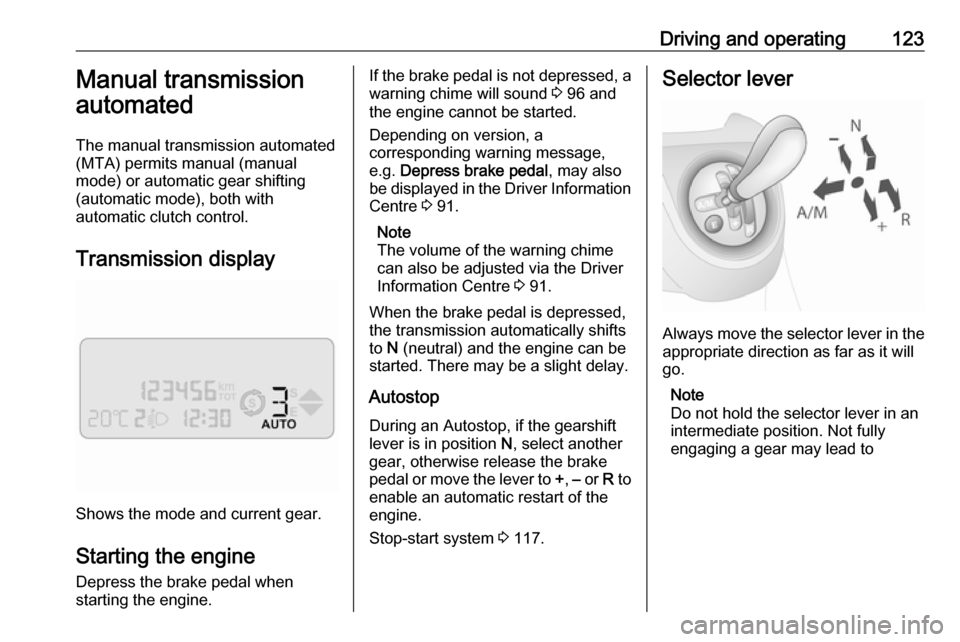
Stop-start system 3 117.Selector lever
Always move the selector lever in the
appropriate direction as far as it will
go.
Note
Do not hold the selector lever in an
intermediate position. Not fully
engaging a gear may lead to
Page 126 of 203

124Driving and operatingmalfunction and a warning message
may be displayed in the Driver
Information Centre.
Return the selector lever to the
centre position. After a short while,
N will be displayed in the Driver
Information Centre and the system
will operate normally again.
Driver Information Centre 3 91.
After selecting A/M, + or - and
releasing the selector lever, the lever automatically returns to the centre
position.N:neutralo:drive positionA/M:switch between automatic and manual mode
The transmission display
shows AUTO when in
automatic mode.R:reverse gear
Engage only when vehicle is
stationary. The transmission
display shows "R" when
reverse gear is engaged.+:shift to a higher gear-:shift to a lower gearCaution
It is not advisable to drive with the hand resting on the selector lever.
Starting-off
When the engine is started, depress
the brake pedal and move the
selector lever towards + to engage
first gear. Shift to a higher or lower
gear by moving selector lever to + or -.
Gears can be skipped by moving the selector lever repeatedly at short
intervals.
The driver will be alerted to an
incorrect gear selection by an audible warning chime in conjunction with a
message in the Driver Information
Centre 3 91. The system will
downshift, selecting the most
appropriate gear automatically.
If R is selected, reverse gear is
engaged. The vehicle starts to move
when the brake pedal is released. To
start off quickly, release the brake
pedal and accelerate immediately
after engaging a gear.
Move the selector lever towards A/M
to engage automatic mode; the
transmission shifts to other gears
automatically, dependent on driving conditions.
To engage manual mode, move the selector lever towards A/M. The
current gear will appear in the
transmission display.
Stopping the vehicle
In automatic or manual mode,
first gear is engaged and the clutch is
released when the vehicle is stopped. In R, reverse gear remains engaged.
When the vehicle is at a standstill, if
the engine is running and a forward or
reverse gear is engaged, a warning
chime will sound and the
transmission automatically shifts to
N in certain situations.
When stopping on gradients, engage
parking brake or depress the brake pedal. To prevent overheating of theclutch, an intermittent audible
warning chime may sound as a signal
to depress the brake pedal or apply
the parking brake.
Page 127 of 203

Driving and operating125Switch off engine if stopping for alengthy period, e.g. in traffic jams.
Engine braking
Automatic mode
When driving downhill, the manual
transmission automated does not shift into higher gears until a fairly
high engine speed has been reached.
It shifts down in good time when
braking.
Manual mode
To utilise the engine braking effect, select a lower gear in good time when driving downhill.
Rocking the vehicle Rocking the vehicle is only
permissible if the vehicle is stuck in
sand, mud, snow or a hole. Move the
selector lever between R and A/M (or
between + and -) in a repeat pattern,
while applying light pressure to the
accelerator pedal. Do not race the
engine and avoid sudden
acceleration.Parking
Apply the parking brake. The mostrecently engaged gear (see
transmission display) remains
engaged.Caution
Do not leave the vehicle with the
transmission in position N.
When the ignition is switched on, a
warning chime will sound when the
vehicle is parked if the transmission is still in N.
When the ignition is switched off, the transmission no longer responds to
movement of the selector lever.
Manual mode If engine speed is too low, the
transmission automatically shifts to a
lower gear.
In manual mode, no automatic
shifting to a higher gear takes place
at high engine revolutions. If engine
speed is too high, the transmission
only switches to a higher gear via
kickdown 3 125.
When gearshifting is recommended
to improve fuel economy, control
indicator [ or Ò illuminates in the
Driver Information Centre 3 86.
Electronic driving programmes
Eco mode E
When automatic mode is engaged,
the Eco mode can be selected to
reduce fuel consumption.
Page 128 of 203

126Driving and operatingEco mode selects the most suitable
gear depending on the speed of the
vehicle, the engine speed and the
intensity with which the accelerator is pressed.
Activation
Press E on the selector lever housing.
Control indicator E is shown in the
transmission display to indicate
activation.
Deactivation
Eco mode is switched off by:
● pressing E again
● switching to manual mode
In order to protect the transmission at extremely high clutch temperatures,
an intermittent audible warning chime
may sound. In such cases, depress
the brake pedal, select N and apply
the parking brake to allow the clutch
to cool down.
Kickdown If the accelerator pedal is pressed
past the pressure point, the
transmission shifts to a lower geardepending on engine speed. Full
engine power is available for
acceleration.
If engine speed is too high the
transmission switches to a higher
gear, even in manual mode. Without
kickdown this automatic shift is not
effected in manual mode.
Fault
In the event of a fault, control indicator s is shown in the transmission
display.
Continued driving is possible,
provided the vehicle is driven with
care and anticipation. A warning
message may appear in the Driver
Information Centre in conjunction with
a warning chime 3 96.
Note
The volume of the warning chime
can also be adjusted via the Driver
Information Centre 3 91.
Have the cause of the fault remedied by a workshop.
Page 173 of 203

Vehicle care171● A discharged vehicle battery canalready freeze at a temperature
of 0 °C. Defrost the frozen battery before connecting jump leads.
● Wear eye protection and protective clothing when
handling a vehicle battery.
● Use a booster battery with the same voltage (12 V). Its capacity
(Ah) must not be much less than
that of the discharged vehicle
battery.
● Use jump leads with insulated terminals and a cross section of
at least 16 mm 2
(25 mm 2
for
diesel engines).
● Do not disconnect the discharged
battery from the vehicle.
● Switch off all unnecessary electrical consumers.
● Do not lean over the vehicle battery during jump starting.
● Do not allow the terminals of one
lead to touch those of the otherlead.● The vehicles must not come into contact with each other during
the jump starting process.
● Apply the parking brake, transmission in neutral.
Lead connection order:
1. Connect the red lead to the positive terminal of the booster
battery.
2. Connect the other end of the red lead to the positive terminal of the
discharged vehicle battery.
3. Connect the black lead to the negative terminal of the booster
battery.
4. Connect the other end of the black
lead to a vehicle grounding point,
such as the engine block or an
engine mounting bolt. Connect as far away from the discharged
vehicle battery as possible,
however at least 60 cm.
Route the leads so that they cannot
catch on rotating parts in the engine
compartment.
To start the engine: 1. Start the engine of the vehicle providing the jump.
2. After five minutes, start the other engine. Start attempts should be
made for no longer than
15 seconds at an interval of
one minute.
3. Allow both engines to idle for approx. three minutes with the
leads connected.
Page 174 of 203

172Vehicle care4. Switch on electrical consumers(e.g. headlights, heated rear
window) of the vehicle receiving
the jump start.
5. Reverse above sequence exactly when removing leads.Towing
Towing the vehicle
Release the cap by carefully lifting
with a screwdriver. To prevent
damage, it is recommended to place
a cloth between the screwdriver and
the frame.
The towing eye is stowed with the vehicle tools 3 159.
Screw in the towing eye as far as it will
go until it stops in a horizontal
position.
Attach a tow rope – or better still a tow
rod – to the towing eye.
Caution
The towing eye must only be used for towing and not for recovering
the vehicle.
Switch on ignition to release steering
wheel lock and to permit operation of
brake lights, horn and windscreen
wiper.
Switch the selector lever to neutral.
Release the parking brake.
Note
If neutral cannot be selected on
vehicles with manual transmission
automated (MTA), the vehicle must
only be towed with the drive wheels
raised off the ground.
Caution
Drive slowly. Do not drive jerkily.
Excessive tractive force can
damage the vehicle.
When the engine is not running,
considerably more force is needed to
brake and steer.