fuel pressure OPEL COMBO D 2018 Manual user
[x] Cancel search | Manufacturer: OPEL, Model Year: 2018, Model line: COMBO D, Model: OPEL COMBO D 2018Pages: 203, PDF Size: 4.97 MB
Page 50 of 203
48Seats, restraintsUnfastening
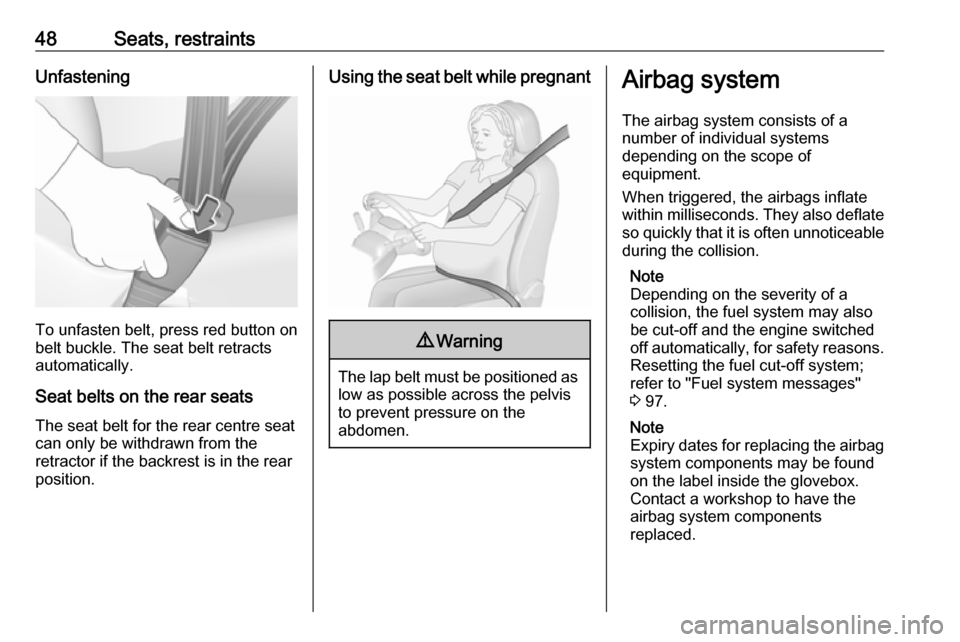
To unfasten belt, press red button on
belt buckle. The seat belt retracts automatically.
Seat belts on the rear seats The seat belt for the rear centre seat
can only be withdrawn from the
retractor if the backrest is in the rear
position.
Using the seat belt while pregnant9 Warning
The lap belt must be positioned as
low as possible across the pelvis
to prevent pressure on the
abdomen.
Airbag system
The airbag system consists of a
number of individual systems
depending on the scope of
equipment.
When triggered, the airbags inflate
within milliseconds. They also deflate
so quickly that it is often unnoticeable
during the collision.
Note
Depending on the severity of a
collision, the fuel system may also be cut-off and the engine switched
off automatically, for safety reasons. Resetting the fuel cut-off system;
refer to "Fuel system messages"
3 97.
Note
Expiry dates for replacing the airbag system components may be found
on the label inside the glovebox.
Contact a workshop to have the
airbag system components
replaced.
Page 71 of 203

Storage69● The load must not obstruct theoperation of the pedals, parking
brake and gear selector lever, or
hinder the freedom of movement of the driver. Do not place any
unsecured objects in the interior.
● Do not drive with an open load compartment.9Warning
Always make sure that the load in
the vehicle is securely stowed.
Otherwise objects can be thrown
around inside the vehicle and
cause personal injury or damage
to the load or vehicle.
● The payload is the difference between the permitted gross
vehicle weight (see identification
plate 3 181) and the EC kerb
weight.
To calculate the payload, enter
the data for your vehicle in the
weights table at the front of this
manual.
The EC kerb weight includes
weights for the driver (68 kg),
luggage (7 kg) and all fluids (fuel
tank 90% full).
Optional equipment and
accessories increase the kerb
weight.
● Driving with a roof load increases
the sensitivity of the vehicle to
cross-winds and has a
detrimental effect on vehicle
handling due to the vehicle's
higher centre of gravity.
Distribute the load evenly and secure it properly with retaining
straps. Adjust the tyre pressure
and vehicle speed according to
the load conditions. Check and
retighten the straps frequently.
Do not drive faster than
120 km/h.
The permissible roof load (which
includes the weight of the roof
rack) is 100 kg. The roof load is
the combined weight of the roof
rack and the load.
Page 72 of 203

70Instruments and controlsInstruments and
controlsControls ....................................... 71
Steering wheel adjustment ........71
Steering wheel controls .............71
Horn ........................................... 71
Windscreen wiper/washer .........72
Rear window wiper/washer .......72
Headlamp washer .....................73
Outside temperature ..................73
Clock ......................................... 73
Power outlets ............................. 75
Cigarette lighter ......................... 76
Ashtrays .................................... 76
Warning lights, gauges and indi‐ cators ........................................... 77
Instrument cluster ......................77
Speedometer ............................. 77
Odometer .................................. 77
Trip odometer ............................ 77
Tachometer ............................... 77
Fuel gauge ................................ 78
Fuel selector .............................. 78
Engine coolant temperature gauge ....................................... 79
Service display .......................... 79Transmission display .................80
Control indicators ......................80
Generic warning ........................82
Turn signal ................................. 83
Seat belt reminder .....................83
Airbag and belt tensioners .........83
Airbag deactivation ....................84
Charging system .......................84
Malfunction indicator light ..........84
Brake system ............................. 85
Brake pad wear ......................... 85
Antilock brake system (ABS) .....85
Transmission ............................. 85
Gear shifting .............................. 86
Hill start assist ........................... 86
Ultrasonic parking assist ...........86
Electronic Stability Control ........86
Engine coolant temperature ......87
Preheating ................................. 87
Diesel particle filter ....................87
Tyre pressure monitoring system ...................................... 88
Engine oil pressure ....................88
Change engine oil .....................89
Low engine oil level ...................89
Low fuel ..................................... 89
Drain fuel filter ........................... 90
Immobiliser ................................ 90
Stop-start system ......................90
Exterior light .............................. 90High beam................................. 90
Fog light ..................................... 91
Rear fog light ............................. 91
Cruise control ............................ 91
Door open .................................. 91
Information displays .....................91
Driver Information Centre ..........91
Vehicle messages ........................96
Warning chimes .........................96
Fuel system messages ..............97
Trip computer ............................... 97
Page 84 of 203

82Instruments and controlsControl indicator in the roof
console
Airbag deactivation 3 53, 3 84.
Overview
9Generic warning 3 82OTurn signal 3 83XSeat belt reminder 3 83vAirbag and belt tensioners
3 83*Airbag deactivation 3 84pCharging system 3 84ZMalfunction indicator light
3 84RBrake system 3 85FBrake pad wear 3 85uAntilock brake system (ABS)
3 85sTransmission 3 85[ ÒGear shifting 3 86ZHill start assist 3 86rUltrasonic parking assist
3 86RElectronic Stability Control
3 86$Engine coolant temperature
3 87!Preheating 3 87%Diesel particle filter 3 87wTyre pressure monitoring
system 3 88IEngine oil pressure 3 88,
Change engine oil 3 89SLow engine oil level 3 89$Low fuel 3 89UDrain fuel filter 3 90dImmobiliser 3 90ÆStop-start system 3 908Exterior light 3 90µExterior light failure 3 90CHigh beam 3 90>Fog light 3 91øRear fog light 3 91mCruise control 3 91(Door open 3 91
Generic warning
9 illuminates yellow.
Depending on model variant, control
indicator 9 may illuminate
independently or in conjunction with
Æ 3 90, t 3 90, Z 3 86 or r
3 86.
Page 99 of 203

Instruments and controls97● Vehicles with manualtransmission automated; brake
pedal has not been depressed
when starting the engine.
● Vehicles with manual transmission automated; an
incorrect gear has been selected when starting-off or during
driving.
● Vehicles with manual transmission automated; whenthe vehicle is at a standstill, if
engine is running and a gear is engaged; transmission
automatically shifts to N in certain
situations.
● If the clutch temperature is too high in vehicles with manual
transmission automated.
● If a transmission fault is detected
in vehicles with manual
transmission automated.
● If a warning message, e.g. low tyre pressure, appears in the
Driver Information Centre.When the vehicle is parked
and/or the driver's door is opened
● When the key is in the ignition switch.
Fuel system messages
Fuel cut-off system
In the event of a collision of a certain
severity, the fuel system is cut-off and
the engine is switched off
automatically, for safety reasons.
Control indicator 9 3 82 illuminates if
the fuel cut-off switch is triggered and, depending on version, a
corresponding warning message may also appear in the Driver Information
Centre 3 91.
To reset the fuel cut-off system and
enable the vehicle to be driven, refer
to " Vehicle shutdown " 3 116.Trip computer
The trip computer provides
information on driving data, which is
continually recorded and evaluated electronically.
Depending on version, the following
functions may be selected by
pressing TRIP repeatedly on the end
of the wiper lever:
Standard version ● outside temperature (if available)
● range
● distance travelled
Page 116 of 203

114Driving and operatingDriving and
operatingDriving hints ............................... 114
Control of the vehicle ...............114
Steering ................................... 115
Starting and operating ...............115
New vehicle running-in ............115
Ignition switch positions ...........115
Starting the engine ..................116
Vehicle shutdown ....................116
Overrun cut-off ........................ 117
Stop-start system ....................117
Parking .................................... 120
Engine exhaust .......................... 121
Diesel particle filter ..................121
Catalytic converter ...................121
Manual transmission ..................122
Manual transmission automa‐ ted .............................................. 123
Transmission display ...............123
Starting the engine ..................123
Selector lever .......................... 123
Manual mode ........................... 125
Electronic driving programmes 125
Fault ........................................ 126Brakes........................................ 127
Antilock brake system .............127
Parking brake .......................... 128
Brake assist ............................. 128
Hill start assist ......................... 128
Ride control systems .................129
Traction Control system ..........129
Electronic Stability Control ......130
Driver assistance systems .........131
Cruise control .......................... 131
Parking assist .......................... 132
Fuel ............................................ 135
Fuel for petrol engines .............135
Fuel for diesel engines ............135
Fuel for natural gas operation . 136
Refuelling ................................ 136
Fuel consumption - CO 2-
Emissions ............................... 138
Trailer hitch ................................ 139
General information .................139
Driving characteristics and towing tips .............................. 139
Trailer towing ........................... 139Driving hints
Control of the vehicle
Never coast with engine not
running (except during Autostop)
Many systems will not function in this
situation (e.g. brake servo unit, power
steering). Driving in this manner is a
danger to yourself and others. All
systems function during an Autostop,
but there may be a controlled
reduction in power steering assist and
vehicle speed is reduced.
Stop-start system 3 117.
Pedals
To ensure the pedal travel is
uninhibited, there must be no mats in the area of the pedals.
Use only floor mats which fit properly
and are fixed by the retainers on the
driver's side.
Driving downhill
Engage a gear when driving downhill to ensure that sufficient brake
pressure is available.
Page 127 of 203

Driving and operating125Switch off engine if stopping for alengthy period, e.g. in traffic jams.
Engine braking
Automatic mode
When driving downhill, the manual
transmission automated does not shift into higher gears until a fairly
high engine speed has been reached.
It shifts down in good time when
braking.
Manual mode
To utilise the engine braking effect, select a lower gear in good time when driving downhill.
Rocking the vehicle Rocking the vehicle is only
permissible if the vehicle is stuck in
sand, mud, snow or a hole. Move the
selector lever between R and A/M (or
between + and -) in a repeat pattern,
while applying light pressure to the
accelerator pedal. Do not race the
engine and avoid sudden
acceleration.Parking
Apply the parking brake. The mostrecently engaged gear (see
transmission display) remains
engaged.Caution
Do not leave the vehicle with the
transmission in position N.
When the ignition is switched on, a
warning chime will sound when the
vehicle is parked if the transmission is still in N.
When the ignition is switched off, the transmission no longer responds to
movement of the selector lever.
Manual mode If engine speed is too low, the
transmission automatically shifts to a
lower gear.
In manual mode, no automatic
shifting to a higher gear takes place
at high engine revolutions. If engine
speed is too high, the transmission
only switches to a higher gear via
kickdown 3 125.
When gearshifting is recommended
to improve fuel economy, control
indicator [ or Ò illuminates in the
Driver Information Centre 3 86.
Electronic driving programmes
Eco mode E
When automatic mode is engaged,
the Eco mode can be selected to
reduce fuel consumption.
Page 139 of 203
Driving and operating137
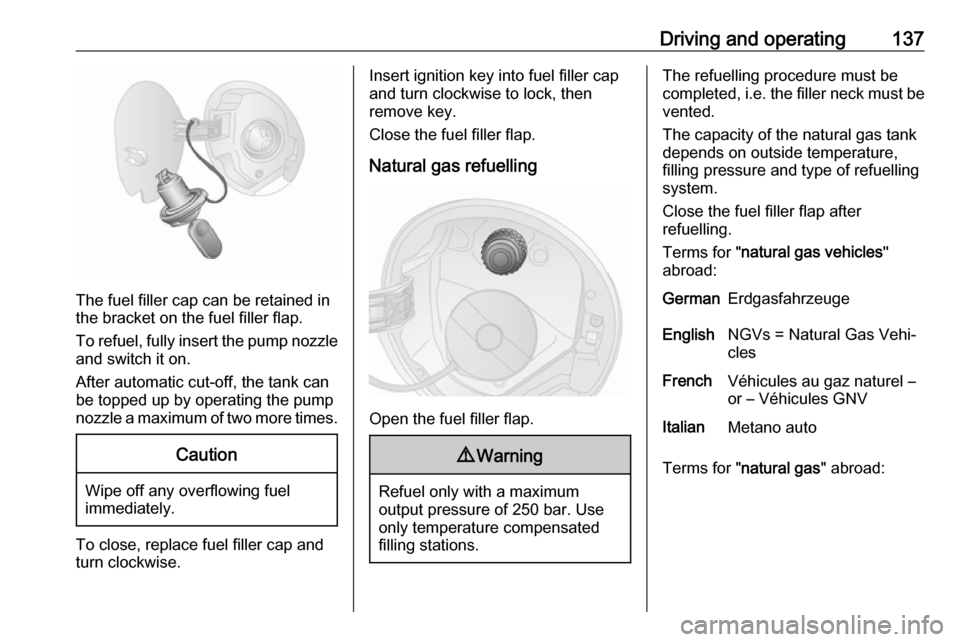
The fuel filler cap can be retained in
the bracket on the fuel filler flap.
To refuel, fully insert the pump nozzle
and switch it on.
After automatic cut-off, the tank can be topped up by operating the pump
nozzle a maximum of two more times.
Caution
Wipe off any overflowing fuel
immediately.
To close, replace fuel filler cap and
turn clockwise.
Insert ignition key into fuel filler cap
and turn clockwise to lock, then
remove key.
Close the fuel filler flap.
Natural gas refuelling
Open the fuel filler flap.
9 Warning
Refuel only with a maximum
output pressure of 250 bar. Use
only temperature compensated
filling stations.
The refuelling procedure must be
completed, i.e. the filler neck must be vented.
The capacity of the natural gas tank
depends on outside temperature,
filling pressure and type of refuelling
system.
Close the fuel filler flap after
refuelling.
Terms for " natural gas vehicles "
abroad:GermanErdgasfahrzeugeEnglishNGVs = Natural Gas Vehi‐
clesFrenchVéhicules au gaz naturel –
or – Véhicules GNVItalianMetano auto
Terms for " natural gas " abroad:
Page 143 of 203

Vehicle care141Vehicle careGeneral Information...................141
Accessories and vehicle modifications .......................... 141
Vehicle storage ........................142
End-of-life vehicle recovery .....142
Vehicle checks ........................... 143
Performing work ......................143
Bonnet ..................................... 143
Engine oil ................................. 144
Engine coolant ......................... 145
Power steering fluid .................145
Washer fluid ............................ 146
Brakes ..................................... 146
Brake fluid ............................... 146
Vehicle battery ......................... 147
Wiper blade replacement ........148
Bulb replacement .......................149
Halogen headlights ..................149
Fog lights ................................. 151
Tail lights ................................. 151
Side turn signal lights ..............152
Centre high-mounted brake light ......................................... 152
Number plate light ...................153Interior lights ............................ 154
Instrument panel illumination ...155
Electrical system ........................155
Fuses ....................................... 155
Engine compartment fuse box . 156
Instrument panel fuse box .......157
Vehicle tools .............................. 159
Tools ........................................ 159
Wheels and tyres .......................160
Winter tyres ............................. 160
Tyre designations ....................160
Tyre pressure .......................... 160
Tyre pressure monitoring
system .................................... 161
Tread depth ............................. 163
Changing tyre and wheel size . 163 Wheel covers ........................... 163
Tyre chains .............................. 164
Tyre repair kit .......................... 164
Wheel changing .......................166
Spare wheel ............................ 168
Jump starting ............................. 170
Towing ....................................... 172
Towing the vehicle ...................172
Towing another vehicle ...........173
Appearance care .......................173
Exterior care ............................ 173
Interior care ............................. 176General Information
Accessories and vehiclemodifications
We recommend the use of genuine
parts and accessories and factory
approved parts specific for your
vehicle type. We cannot assess or guarantee reliability of other products
- even if they have a regulatory or
otherwise granted approval.
Any modification, conversion or other
changes made to standard vehicle
specifications (including, without
limitation, software modifications,
modifications of the electronic control units) may invalidate the warrantyoffered by Opel. Furthermore, such
changes may affect driver assistance
systems, may impact fuel
consumption, CO 2 emissions and
other emissions of the vehicle and
cause the vehicle to no longer
conform to the operating permit,
impacting the validity of your vehicle
registration.
Page 144 of 203

142Vehicle careCaution
When transporting the vehicle on
a train or on a recovery vehicle, the
mud flaps might be damaged.
Vehicle storage
Storage for a long period of time
If the vehicle is to be stored for several months:
● Wash and wax the vehicle.
● Have the wax in the engine compartment and underbody
checked.
● Clean and preserve the rubber seals.
● Fill up fuel tank completely.
● Change the engine oil.
● Drain the washer fluid reservoir.
● Check the coolant antifreeze and
corrosion protection.
● Adjust tyre pressure to the value specified for full load.
● Park the vehicle in a dry, wellventilated place. Engage first or
reverse gear to prevent the
vehicle from rolling.
● Do not apply the parking brake.
● Open the bonnet, close all doors and lock the vehicle.
● Disconnect the clamp from the negative terminal of the vehicle
battery. Beware that all systems
are not functional, e.g. anti-theft
locking system.
Putting back into operation
When the vehicle is to be put back into operation:
● Connect the clamp to the negative terminal of the vehicle
battery. Activate the electronics
of the power windows.
● Check tyre pressure.
● Fill up the washer fluid reservoir.
● Check the engine oil level.
● Check the coolant level.
● Fit the number plates if necessary.End-of-life vehicle recovery
Information on end-of-life vehicle
recovery centres and the recycling of
end-of-life vehicles is available on our website. Only entrust this work to an
authorised recycling centre.
Natural gas vehicles must be recycled by a service centre authorised for
natural gas vehicles.