door lock OPEL COMBO E 2019.1 Manual user
[x] Cancel search | Manufacturer: OPEL, Model Year: 2019.1, Model line: COMBO E, Model: OPEL COMBO E 2019.1Pages: 283, PDF Size: 10.57 MB
Page 149 of 283
Driving and operating1479Warning
If the vehicle battery is discharged,
the vehicle must not be towed,
tow-started or jump-started as the
steering wheel lock cannot be
disengaged.
Operation on vehicles with
electronic key system in case of
failure
If either the electronic key fails or the
battery of the electronic key is weak,
a message may be displayed in the
Driver Information Centre.
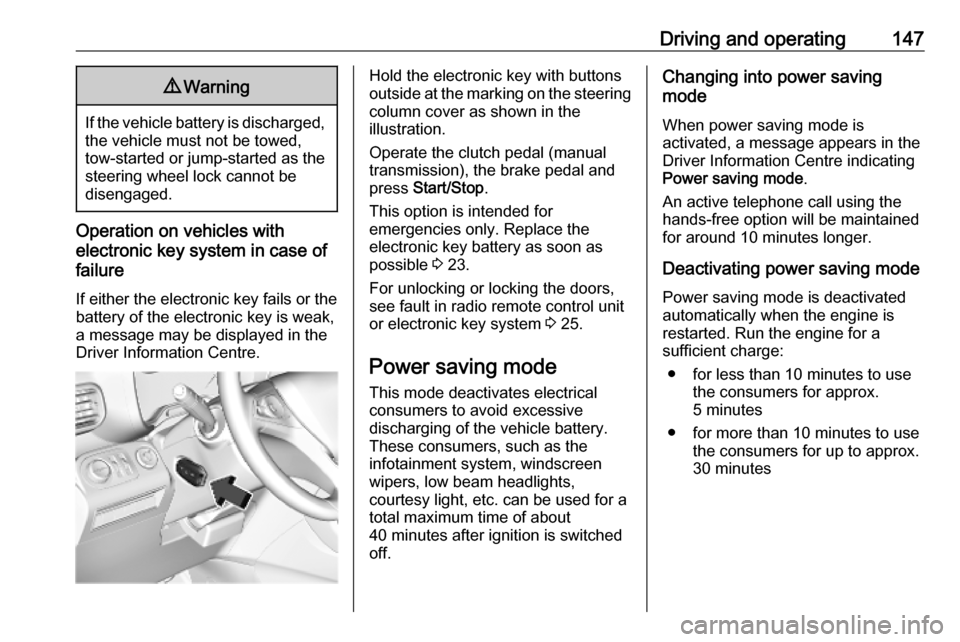
Hold the electronic key with buttons
outside at the marking on the steering column cover as shown in the
illustration.
Operate the clutch pedal (manual
transmission), the brake pedal and
press Start/Stop .
This option is intended for
emergencies only. Replace the
electronic key battery as soon as
possible 3 23.
For unlocking or locking the doors,
see fault in radio remote control unit
or electronic key system 3 25.
Power saving mode
This mode deactivates electrical
consumers to avoid excessive
discharging of the vehicle battery.
These consumers, such as the
infotainment system, windscreen
wipers, low beam headlights,
courtesy light, etc. can be used for a
total maximum time of about
40 minutes after ignition is switched
off.Changing into power saving
mode
When power saving mode is
activated, a message appears in the
Driver Information Centre indicating
Power saving mode .
An active telephone call using the
hands-free option will be maintained
for around 10 minutes longer.
Deactivating power saving mode
Power saving mode is deactivated
automatically when the engine is
restarted. Run the engine for a
sufficient charge:
● for less than 10 minutes to use the consumers for approx.
5 minutes
● for more than 10 minutes to use the consumers for up to approx.
30 minutes
Page 159 of 283

Driving and operating157The vehicle must be parked on a level
surface.
The filler neck for AdBlue is located
behind the fuel filler flap, which is located at right rear side of the
vehicle.
If the vehicle is equipped with an
electronic key system, the fuel filler
flap can only be opened if the vehicle is unlocked.
1. Remove key from ignition switch.
2. Close all doors to avoid ammonia fumes entering the interior of the
vehicle.
3. Release the fuel filler flap by pushing the flap 3 206.4. Unscrew protective cap from the
filler neck.
5. Open AdBlue canister.
6. Mount one end of the hose on the
canister and screw the other end
on the filler neck.
7. Lift the canister until it is empty, or
until the flow from the canister has stopped. This can take up to five
minutes.
8. Place the canister on the ground to empty the hose, wait 15 s.
9. Unscrew the hose from the filler neck.
10. Mount the protective cap and turn
clockwise until it engages.
Note
Dispose of AdBlue canister
according to environmental
requirements. Hose can be reused
after flushing with clear water before
AdBlue dries out.Automatic transmission
The automatic transmission permits
automatic gearshifting (automatic
mode) or manual gearshifting
(manual mode).
Manual shifting is possible in manual
mode by pressing M next to the
selector wheel and shifting with the paddles + and - on the steering wheel
3 158.
Transmission display
The mode or selected gear is shown
in the Driver Information Centre.
Page 201 of 283

Driving and operating199The panoramic view system may not
operate properly when:
● The surrounding is dark.
● The sun or the beam of headlights is shining directly into
the camera lenses.
● During nighttime driving.
● Weather limits visibility, such as fog, rain, or snow.
● The camera lenses are blocked by snow, ice, slush, mud, dirt.
● The vehicle is towing a trailer.
● The vehicle had an accident.
● There are extreme temperature changes.
Rear view camera Depending on version, camera is
mounted above the license plate in
the tailgate / left rear door or at the top
of the left rear door.9 Warning
The rear view camera does not
replace driver vision. Note that
objects that are outside the
camera's field of view and the
parking assist sensors, e.g. below
the bumper or underneath the
vehicle, are not displayed.
Do not reverse or park the vehicle
using only the rear view camera.
Always check the surrounding of
the vehicle before driving.
Camera above the license plate
on the tailgate / left rear door
The view of the camera is displayed
in the Info Display 3 113.
The area displayed by the camera is
limited. The distance of the image that
appears on the display differs from
the actual distance.
Switching on
Rear view camera is automatically
activated when reverse gear is
engaged.
Guidelines
Dynamic guidelines are horizontal
lines at one metre intervals projected
onto the picture to define the distance
to displayed objects.
Page 215 of 283

Vehicle care213Caution
When transporting the vehicle on
a train or on a recovery vehicle, the
mud flaps might be damaged.
Cold protection covers
In order to prevent the accumulation
of snow at the radiator cooling fan, it is recommended to install removable
protection covers.
The protection covers must be
professionally installed, consult a
workshop.
Caution
The protection covers must be removed when one of the
following conditions occur:
● The ambient temperature is above 10 °C.
● When the vehicle is towed.
● The vehicle is driven at speeds
above 120 km/h.
Vehicle storage
Storage for a long period of time If the vehicle is to be stored for several months:
● Wash and wax the vehicle.
● Have the wax in the engine compartment and underbody
checked.
● Clean and preserve the rubber seals.
● Fill up fuel tank completely.
● Change the engine oil.
● Drain the washer fluid reservoir.
● Check the coolant antifreeze and
corrosion protection.
● Adjust tyre pressure to the value specified for full load.
● Park the vehicle in a dry, well ventilated place. Engage first or
reverse gear or set selector lever
to P. Prevent the vehicle from
rolling.
● Do not apply the parking brake.● Open the bonnet, close all doors and lock the vehicle.
● Disconnect the clamp from the negative terminal of the vehicle
battery. Beware that all systems
are not functional, e.g. anti-theft
alarm system.
Putting back into operation When the vehicle is to be put back into
operation:
● Connect the clamp to the negative terminal of the vehicle
battery. Activate the electronics
of the power windows.
● Check tyre pressure.
● Fill up the washer fluid reservoir.
● Check the engine oil level.
● Check the coolant level.
● Fit the number plate if necessary.
Page 231 of 283

Vehicle care229No.Circuit16Front fog lights18Right headlight19Left headlight29Windscreen wiper
After having changed defective fuses,
close the fuse box cover and lock it.
If the fuse box cover is not closed
correctly, malfunction may occur.
Instrument panel fuse box
The fuse box is located behind a
cover in the instrument panel at the
left side.Remove the cover by pulling at the
top left, then at the right side.No.Circuit1Inductive charging, clutch
switch, selective ride control,
power steering, diesel exhaust
system, interior mirror4Horn6Windscreen washer7Power outlet rear10Door lock
Page 242 of 283

240Vehicle care
The rear arm position of the lifting
platform is centrically under the
relevant vehicle jacking point.
The front arm position of the lifting
platform is centrically under the
relevant vehicle jacking point.
Spare wheel The spare wheel can be classified as
a temporary spare wheel depending
on the size compared to the other
mounted wheels and country
regulations. In this case a permissible maximum speed applies, even
though no label at the spare wheel
indicates this.
Only mount one temporary spare
wheel. Do not drive faster than
80 km/h. Take curves slowly. Do not use for a long period of time.Caution
The use of a spare wheel that issmaller than the other wheels or in combination with winter tyres
could affect driveability. Have the defective tyre replaced as soon as
possible.
The spare wheel is located in a holder
beneath the vehicle floor.
1. Depending on the version, open the tailgate or the rear doors 3 31,
3 32.
2. Fit the wheel wrench on one
hexagon bolt. Turn it
anticlockwise until the spare wheel holder is low enough allow
the catch to be unhooked.
Page 243 of 283
Vehicle care241
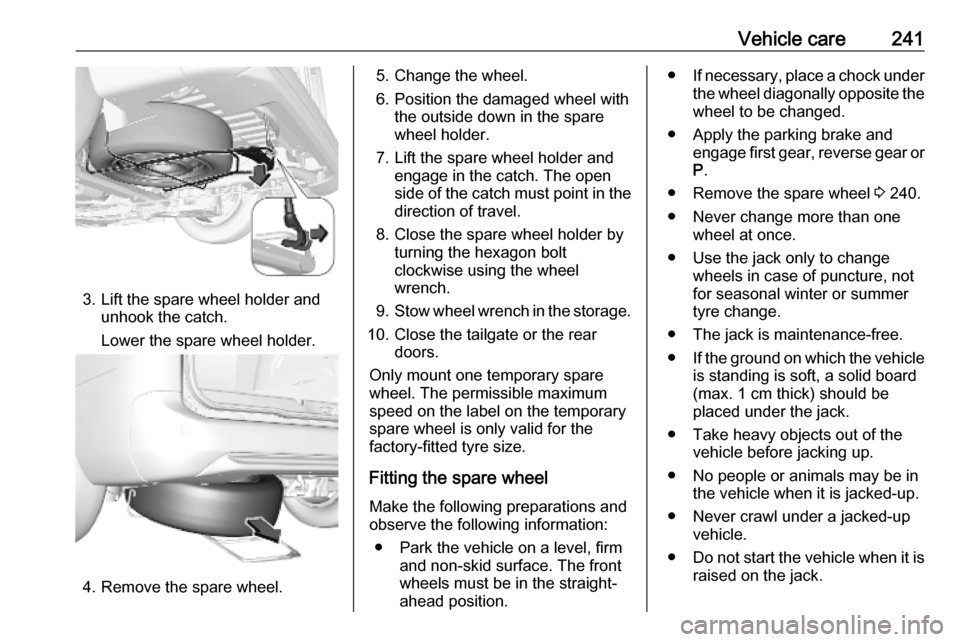
3. Lift the spare wheel holder andunhook the catch.
Lower the spare wheel holder.
4. Remove the spare wheel.
5. Change the wheel.
6. Position the damaged wheel with the outside down in the spare
wheel holder.
7. Lift the spare wheel holder and engage in the catch. The open
side of the catch must point in the
direction of travel.
8. Close the spare wheel holder by turning the hexagon bolt
clockwise using the wheel
wrench.
9. Stow wheel wrench in the storage.
10. Close the tailgate or the rear doors.
Only mount one temporary spare
wheel. The permissible maximum
speed on the label on the temporary
spare wheel is only valid for the
factory-fitted tyre size.
Fitting the spare wheel
Make the following preparations and
observe the following information:
● Park the vehicle on a level, firm and non-skid surface. The front
wheels must be in the straight- ahead position.● If necessary, place a chock under
the wheel diagonally opposite the
wheel to be changed.
● Apply the parking brake and engage first gear, reverse gear or
P .
● Remove the spare wheel 3 240.
● Never change more than one wheel at once.
● Use the jack only to change wheels in case of puncture, not
for seasonal winter or summer
tyre change.
● The jack is maintenance-free.
● If the ground on which the vehicle
is standing is soft, a solid board
(max. 1 cm thick) should be
placed under the jack.
● Take heavy objects out of the vehicle before jacking up.
● No people or animals may be in the vehicle when it is jacked-up.
● Never crawl under a jacked-up vehicle.
● Do not start the vehicle when it is
raised on the jack.
Page 277 of 283

Customer information275processing and use of personal data
for the purposes of preparation of services take place solely on the
basis of legal permission, e.g. in the
case of a legally prescribed
emergency communication system or
a contractual agreement, or by virtue
of consent.
You can activate or deactivate the services and functions (which are
subject to charges to some extent)
and, in some cases, the vehicle's
entire radio network connection. This
does not include statutory functions
and services such as an emergency
communication system.
Third party services
If you make use of online services
from other providers (third parties),
these services are subject to the
liability and data protection and usage conditions of the provider in question.
The manufacturer frequently has no
influence over the content exchanged
in this regard.Therefore, please note the nature,
scope and purpose of the collection
and use of personal data within the
scope of third party services provided by the service provider in question.
Radio Frequency
Identification (RFID)
RFID technology is used in some
vehicles for functions such as tyre
pressure monitoring and immobiliser.
It is also used in connection with
conveniences such as radio remote
controls for door locking / unlocking
and starting. RFID technology in Opel vehicles does not use or record
personal information or link with any other Opel system containing
personal information.
Page 279 of 283

277Climate control systems.............132
Clock............................................. 94
Colour Info Display .....................118
Control indicators........................ 102
Control of the vehicle .................145
Controls ........................................ 90
Convex shape .............................. 38
Coolant and antifreeze ...............255
Cornering lights .......................... 126
Cruise control ....................109, 170
Cupholders .................................. 71
Curtain airbag system .................. 63
D Danger, Warnings and Cautions ...4
Daytime running lights ...............126
Declaration of conformity ............268
DEF ............................................ 154
Deflation detection system .........108
Descent control system .....106, 166
Diesel exhaust fluid ....................154
Diesel fuel system bleeding .......219
Door open .................................. 110
Doors ................................ 30, 31, 32
Driver alert .................................. 203
Driver assistance systems ..........170
Driver Information Centre ...........110
Driving characteristics and towing tips .............................. 208
Driving hints ................................ 145E
Eco mode ................................... 160
Electric adjustment ......................38
Electrical system......................... 227
Electric parking brake. 105, 161, 162
Electric parking brake fault .........106
Electronic climate control system 136
Electronic driving programmes ..159
Electronic key system ...................23
Electronic Stability Control and Traction Control system ..107, 165
End-of-life vehicle recovery .......214
Engine compartment fuse box ...228
Engine coolant ........................... 216
Engine coolant temperature ......107
Engine coolant temperature gauge ..................................... 101
Engine data ............................... 262
Engine exhaust .......................... 153
Engine identification ...................258
Engine oil ................... 215, 255, 259
Engine oil level monitor ..............101
Engine oil pressure ....................108
Entry lighting .............................. 130
Event data recorders ..................272
Exhaust filter ....................... 107, 153
Exit lighting ................................ 130
Exterior care .............................. 247
Exterior light ............................... 109Exterior lighting ....................13, 123
Exterior mirrors ............................. 38
F
Fault ........................................... 160
First aid ......................................... 86
First aid kit ................................... 86
Fixed air vents ........................... 142
Folding front passenger seat ........49
Folding mirrors ............................. 38
Folding seats .......................... 52, 53
Footwell storage ........................... 75
Forward collision alert................. 181
Front airbag system .....................62
Front fog lights ...........109, 127, 222
Front passenger seat Table position ............................ 49
Front pedestrian protection ........185
Front seats.................................... 47 Front storage ................................ 72
Front turn lights .......................... 223
Fuel............................................. 205
Fuel for diesel engines ..............205
Fuel for petrol engines ...............205
Fuel gauge ................................. 101
Fuses ......................................... 227
G Gauges ......................................... 99
Gear shifting ............................... 106
General information ...................208