fuel OPEL COMBO E 2019 Manual user
[x] Cancel search | Manufacturer: OPEL, Model Year: 2019, Model line: COMBO E, Model: OPEL COMBO E 2019Pages: 279, PDF Size: 10.43 MB
Page 207 of 279

Driving and operating205Caution
Wipe off any overflowing fuel
immediately.
To close, turn the fuel filler cap
clockwise until it clicks.
Close the flap and allow it to engage.
Fuel filler cap
Only use genuine fuel filler caps.
Diesel-engined vehicles have special fuel filler caps.
Trailer hitch
General information
Only use towing equipment that has
been approved for your vehicle.
Entrust retrofitting of towing
equipment to a workshop. It may be
necessary to make changes that
affect the cooling system, heat
shields or other equipment.
The bulb outage detection function for
trailer brake light cannot detect a
partial bulb outage e.g. in case of four
bulbs with a power of 5 W each, the
function only detects lamp outage
when only a single 5 W lamp remains
or none remain.
Fitting of towing equipment could
cover the opening of the towing eye.
If this is the case use the coupling ball bar for towing. Always keep the
coupling ball bar in the vehicle to have
it on hand if needed.Driving characteristics and
towing tips
Before attaching a trailer, lubricate
the coupling ball. However, do not do
so if a stabiliser, which acts on the
coupling ball, is being used to reduce snaking movements.
During trailer towing do not exceed a
speed of 80 km/h. A maximum speed
of 100 km/h is only appropriate if an
oscillation damper is used and the
permissible gross trailer weight does
not exceed the vehicle’s curb weight.
For trailers with low driving stability
and caravan trailers, the use of an
oscillation damper is strongly
recommended.
If the trailer starts snaking, drive more
slowly, do not attempt to correct the
steering and brake sharply if
necessary.
When driving downhill, drive in the
same gear as if driving uphill and
drive at a similar speed.
Adjust tyre pressure to the value
specified for full load 3 263.
Page 212 of 279

210Vehicle careVehicle careGeneral Information...................210
Accessories and vehicle modifications .......................... 210
Vehicle storage ........................211
End-of-life vehicle recovery .....212
Vehicle checks ........................... 212
Performing work ......................212
Bonnet ..................................... 212
Engine oil ................................. 213
Engine coolant ......................... 214
Washer fluid ............................ 215
Brakes ..................................... 215
Brake fluid ............................... 215
Vehicle battery ......................... 215
Diesel fuel system bleeding .....217
Wiper blade replacement ........217
Bulb replacement .......................218
Halogen headlights ..................218
LED headlights ........................ 220
Front fog lights ......................... 220
Front turn lights .......................221
Tail lights ................................. 222
Side turn lights ......................... 224
Number plate light ...................225
Interior lights ............................ 225Electrical system........................225
Fuses ....................................... 225
Engine compartment fuse box . 226
Instrument panel fuse box .......227
Vehicle tools .............................. 228
Tools ........................................ 228
Wheels and tyres .......................229
Winter tyres ............................. 229
Tyre designations ....................230
Tyre pressure .......................... 230
Tyre deflation detection system .................................... 231
Tread depth ............................. 232
Changing tyre and wheel size . 233
Wheel covers ........................... 233
Tyre chains .............................. 233
Tyre repair kit .......................... 234
Wheel changing .......................237
Spare wheel ............................ 238
Jump starting ............................. 242
Towing ....................................... 243
Towing the vehicle ...................243
Towing another vehicle ...........244
Appearance care .......................245
Exterior care ............................ 245
Interior care ............................. 247General Information
Accessories and vehiclemodifications
We recommend the use of genuine
parts and accessories and factory approved parts specific for your
vehicle type. We cannot assess or guarantee reliability of other products
- even if they have a regulatory or
otherwise granted approval.
Any modification, conversion or other changes made to standard vehicle
specifications (including, without
limitation, software modifications,
modifications of the electronic control
units) may invalidate the warranty
offered by Opel. Furthermore, such
changes may affect driver assistance
systems, may impact fuel
consumption, CO 2 emissions and
other emissions of the vehicle and
cause the vehicle to no longer
conform to the operating permit,
impacting the validity of your vehicle
registration.
Page 213 of 279

Vehicle care211Caution
When transporting the vehicle on
a train or on a recovery vehicle, the
mud flaps might be damaged.
Cold protection covers
In order to prevent the accumulation
of snow at the radiator cooling fan, it is recommended to install removable
protection covers.
The protection covers must be
professionally installed, consult a
workshop.
Caution
The protection covers must be removed when one of the
following conditions occur:
● The ambient temperature is above 10 °C.
● When the vehicle is towed.
● The vehicle is driven at speeds
above 120 km/h.
Vehicle storage
Storage for a long period of time If the vehicle is to be stored for several months:
● Wash and wax the vehicle.
● Have the wax in the engine compartment and underbody
checked.
● Clean and preserve the rubber seals.
● Fill up fuel tank completely.
● Change the engine oil.
● Drain the washer fluid reservoir.
● Check the coolant antifreeze and
corrosion protection.
● Adjust tyre pressure to the value specified for full load.
● Park the vehicle in a dry, well ventilated place. Engage first or
reverse gear or set selector lever
to P. Prevent the vehicle from
rolling.
● Do not apply the parking brake.● Open the bonnet, close all doors and lock the vehicle.
● Disconnect the clamp from the negative terminal of the vehicle
battery. Beware that all systems
are not functional, e.g. anti-theft
alarm system.
Putting back into operation When the vehicle is to be put back into
operation:
● Connect the clamp to the negative terminal of the vehicle
battery. Activate the electronics
of the power windows.
● Check tyre pressure.
● Fill up the washer fluid reservoir.
● Check the engine oil level.
● Check the coolant level.
● Fit the number plate if necessary.
Page 219 of 279

Vehicle care217● See the Owner's Manual forfurther information.
● Explosive gas may be present in the vicinity of the vehicle battery.
Diesel fuel system bleeding If the tank has been run dry, the diesel
fuel system must be bled. Switch on the ignition three times for
15 seconds at a time. Then crank the
engine for a maximum of
40 seconds. Repeat this process after
no less than five seconds. If the
engine fails to start, seek the
assistance of a workshop.Wiper blade replacement
Windscreen
Switch off the ignition.
Within one minute after switching off
the ignition, operate the wiper lever to positon the wiper blades vertically on
the windscreen.
Lift the wiper arm until it stays in the
raised position, press button to
disengage the wiper blade and
remove.
Attach the wiper blade to the wiper
arm and push until it engages.
Lower the wiper arm carefully.
Rear window
Lift the wiper arm. Disengage the
wiper blade as shown in the
illustration and remove.
Attach the wiper blade slightly angled
to the wiper arm and push until it
engages.
Lower the wiper arm carefully.
Page 232 of 279
230Vehicle careTyre designationsE.g. 225/55 R 18 98 V225:tyre width, mm55:cross-section ratio (tyre height
to tyre width), %R:belt type: RadialRF:type: RunFlat18:wheel diameter, inches98:load index e.g. 98 is equivalent
to 750 kgV:speed code letter
Speed code letter:
Q:up to 160 km/hS:up to 180 km/hT:up to 190 km/hH:up to 210 km/hV:up to 240 km/hW:up to 270 km/h
Choose a tyre appropriate for the
maximum speed of your vehicle.
The maximum speed is achievable at kerb weight with driver (75 kg) plus
125 kg payload. Optional equipment
could reduce the maximum speed of
the vehicle.
Directional tyres
Directional tyres should be mounted
so that they rotate in the correct
direction. The proper rotation
direction is indicated by a symbol
(e.g. an arrow) on the sidewall.
Tyre pressure
Check the pressure of cold tyres at
least every 14 days and before any
long journey. Do not forget the spare
wheel. This also applies to vehicles
with tyre pressure monitoring system.
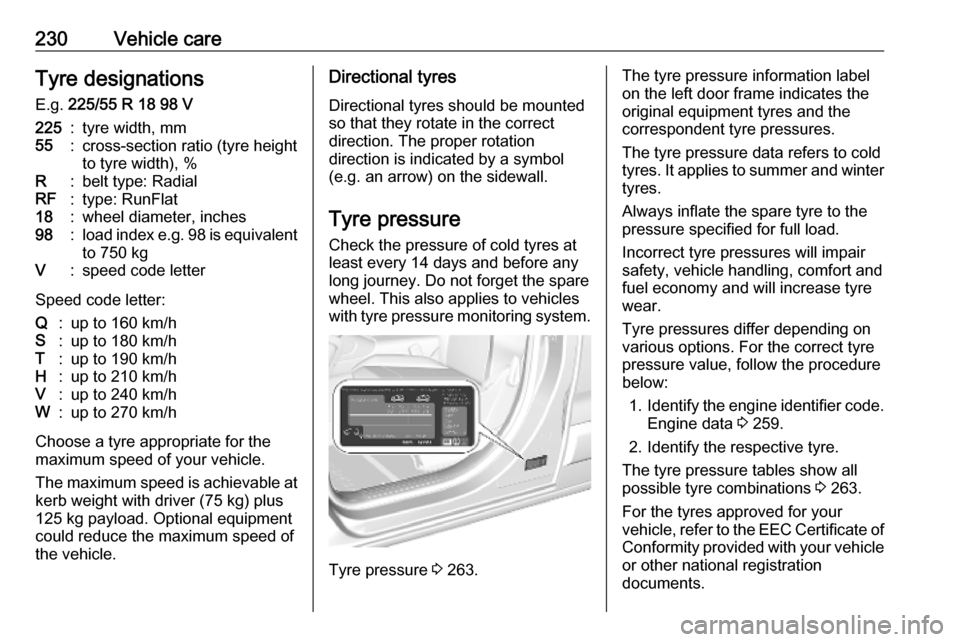
Tyre pressure 3 263.
The tyre pressure information label
on the left door frame indicates the
original equipment tyres and the
correspondent tyre pressures.
The tyre pressure data refers to cold
tyres. It applies to summer and winter tyres.
Always inflate the spare tyre to the
pressure specified for full load.
Incorrect tyre pressures will impair
safety, vehicle handling, comfort and
fuel economy and will increase tyre
wear.
Tyre pressures differ depending on
various options. For the correct tyre
pressure value, follow the procedure
below:
1. Identify the engine identifier code.
Engine data 3 259.
2. Identify the respective tyre.
The tyre pressure tables show all
possible tyre combinations 3 263.
For the tyres approved for your
vehicle, refer to the EEC Certificate of Conformity provided with your vehicle
or other national registration
documents.
Page 249 of 279

Vehicle care247Ice residues, pollution and continuous
wiping on dry windows will damage or
even destroy the wiper blades.
Glass panel Never clean with solvents or abrasive
agents, fuels, aggressive media e.g.
paint cleaner, acetone-containing
solutions, acidic or highly alkaline
media or abrasive pads.
Wheels and tyres Do not use high-pressure jet
cleaners.
Clean rims with a pH-neutral wheel
cleaner.
Rims are painted and can be treated
with the same agents as the body.
Paintwork damage Rectify minor paintwork damage with
a touch-up pen before rust forms.
Have more extensive damage or rust areas repaired by a workshop.Underbody
Some areas of the vehicle underbody
have a PVC undercoating while other
critical areas have a durable
protective wax coating.
After the underbody is washed, check the underbody and have it waxed if
necessary.
Bitumen / rubber materials could
damage the PVC coating. Have
underbody work carried out by a
workshop.
Before and after winter, wash the
underbody and have the protective
wax coating checked.
Liquid gas system9 Danger
Liquid gas is heavier than air and
can collect in sink points.
Take care when performing work
at the underbody in a pit.
For painting work and when using a
drying booth at a temperature above
60 °C, the liquid gas tank must be
removed.
Do not make any modifications to the
liquid gas system.
Towing equipment
Do not clean the coupling ball bar with a steam-jet or high-pressure jet
cleaner.
Interior care
Interior and upholstery
Only clean the vehicle interior,
including the instrument panel fascia
and panelling, with a dry cloth or
interior cleaner.
Clean the leather upholstery with
clear water and a soft cloth. In case of heavy soiling, use leather care.
The instrument cluster and the
displays should only be cleaned using
a soft damp cloth. If necessary use a
weak soap solution.
Page 254 of 279

252Service and maintenanceRecommended fluids,lubricants and parts
Recommended fluids and lubricants
Only use products that meet the
recommended specifications.9 Warning
Operating materials are
hazardous and could be
poisonous. Handle with care. Pay
attention to information given on
the containers.
Engine oil
Engine oil is identified by its quality
and its viscosity. Quality is more
important than viscosity when
selecting which engine oil to use. The oil quality ensures e.g. engine
cleanliness, wear protection and oil
aging control, whereas viscosity
grade gives information on the oil's
thickness over a temperature range.
Dexos is the newest engine oil quality
that provides optimum protection for
petrol and diesel engines. If it is
unavailable, engine oils of other listed qualities must be used.
Recommendations for petrol engines
are also valid for Compressed Natural
Gas (CNG), Liquified Petroleum Gas
(LPG) and Ethanol (E85) fuelled
engines.
Select the appropriate engine oil
based on its quality and on the
minimum ambient temperature
3 256.
Topping up engine oilCaution
In case of any spilled oil, wipe it up and dispose it properly.
Engine oils of different manufacturersand brands can be mixed as long as
they comply with the required engine
oil quality and viscosity.
Use of engine oils for all petrol
engines with only ACEA quality is
prohibited, since it can cause engine
damage under certain operating
conditions.
Select the appropriate engine oil
based on its quality and on the
minimum ambient temperature
3 256.
Additional engine oil additives
The use of additional engine oil
additives could cause damage and
invalidate the warranty.
Engine oil viscosity grades
The SAE viscosity grade gives
information of the thickness of the oil.
Multigrade oil is indicated by two
figures, e.g. SAE 5W-30. The first
figure, followed by a W, indicates the
low temperature viscosity and the
second figure the high temperature viscosity.
Select the appropriate viscosity grade depending on the minimum ambient
temperature 3 256.
Page 261 of 279
![OPEL COMBO E 2019 Manual user Technical data259Engine dataEngine identifier codeD12XHLD15DTD15DTD15DTHSales designation1.2 Turbo1.5 Turbo1.5 Turbo1.5 TurboEngineering codeEB2ADTDV5REDV5RDDV5RCPiston displacement [cm3
]119914991499](/img/37/18811/w960_18811-260.png "OPEL COMBO E 2019 Manual user Technical data259Engine dataEngine identifier codeD12XHLD15DTD15DTD15DTHSales designation1.2 Turbo1.5 Turbo1.5 Turbo1.5 TurboEngineering codeEB2ADTDV5REDV5RDDV5RCPiston displacement [cm3
]119914991499")
Technical data259Engine dataEngine identifier codeD12XHLD15DTD15DTD15DTHSales designation1.2 Turbo1.5 Turbo1.5 Turbo1.5 TurboEngineering codeEB2ADTDV5REDV5RDDV5RCPiston displacement [cm3
]1199149914991499Engine power [kW]81567596at rpm5500350035003750Torque [Nm]205230250300at rpm1750175017501750Fuel typePetrolDieselDieselDieselOctane rating RON 2)3)recommended95---possible98---2)
A country specific label at the fuel filler flap can supersede the engine specific requirement.
3) In certain countries, the use of a particular fuel, e.g. a specific octane rating, may be required to ensure proper engine operation.
Page 264 of 279
![OPEL COMBO E 2019 Manual user 262Technical dataVehicle dimensionsSizeL1L2Length [mm]44034753Width without exterior mirrors [mm]18471847Width with exterior mirrors [mm]21072107Height without roof railing [mm]18041837Height with roo](/img/37/18811/w960_18811-263.png "OPEL COMBO E 2019 Manual user 262Technical dataVehicle dimensionsSizeL1L2Length [mm]44034753Width without exterior mirrors [mm]18471847Width with exterior mirrors [mm]21072107Height without roof railing [mm]18041837Height with roo")
262Technical dataVehicle dimensionsSizeL1L2Length [mm]44034753Width without exterior mirrors [mm]18471847Width with exterior mirrors [mm]21072107Height without roof railing [mm]18041837Height with roof railing [mm]18411880Wheelbase [mm]27852975Turning circle diameter [m]10.8 / 1111.5 / 11.8Capacities
Engine oilEngineDV5REDV5RDDV5RCEB2ADTincluding filter [l]3.953.953.953.5between MIN and MAX [l]1111
Fuel tank
Petrol / diesel, refilling quantity [l]60 / 51
Page 275 of 279

273Cigarette lighter ........................... 97
Climate control ............................. 16
Climate control systems .............131
Clock............................................. 94
Control indicators........................ 104
Control of the vehicle .................144
Controls ........................................ 90
Convex shape .............................. 38
Coolant and antifreeze ...............252
Cornering lights .......................... 125
Cruise control ....................110, 169
Cupholders .................................. 71
Curtain airbag system .................. 63
D
Danger, Warnings and Cautions ...4
Daytime running lights ...............125
Declaration of conformity ............264
DEF ............................................ 153
Deflation detection system .........109
Descent control system .....107, 165
Diesel exhaust fluid ....................153
Diesel fuel system bleeding .......217
Door open .................................. 111
Doors ................................ 30, 31, 33
Driver alert .................................. 201
Driver assistance systems ..........169
Driver Information Centre ...........112Driving characteristics and
towing tips .............................. 205
Driving hints ................................ 144
E Eco mode ................................... 159
Electric adjustment ......................38
Electrical system......................... 225
Electric parking brake. 107, 160, 161
Electric parking brake fault .........107
Electronic climate control system 135
Electronic driving programmes ..158
Electronic key system ...................23
Electronic Stability Control and Traction Control system ..108, 164
End-of-life vehicle recovery .......212
Engine compartment fuse box ...226
Engine coolant ........................... 214
Engine coolant temperature ......108
Engine coolant temperature gauge ..................................... 102
Engine data ............................... 259
Engine exhaust .......................... 152
Engine identification ...................255
Engine oil ................... 213, 252, 256
Engine oil level monitor ..............102
Engine oil pressure ....................109
Entry lighting .............................. 129
Event data recorders ..................268
Exhaust filter ....................... 108, 152Exit lighting ................................ 129
Exterior care .............................. 245
Exterior light ............................... 110
Exterior lighting ....................13, 122
Exterior mirrors ............................. 38
F
Fault ........................................... 159
First aid ......................................... 86
First aid kit ................................... 86
Fixed air vents ........................... 141
Folding front passenger seat ........49
Folding mirrors ............................. 39
Folding seats .......................... 52, 53
Footwell storage ........................... 74
Forward collision alert................. 180
Front airbag system .....................62
Front fog lights ...........110, 126, 220
Front passenger seat Table position ............................ 49
Front pedestrian protection ........184
Front seats.................................... 47
Front storage ................................ 72
Front turn lights .......................... 221
Fuel............................................. 202
Fuel for diesel engines ..............202
Fuel for petrol engines ...............202
Fuel gauge ................................. 102
Fuses ......................................... 225