airbag OPEL CORSA 2009 User Guide
[x] Cancel search | Manufacturer: OPEL, Model Year: 2009, Model line: CORSA, Model: OPEL CORSA 2009Pages: 284, PDF Size: 4.96 MB
Page 64 of 284
58 Seats, InteriorThree-stage safety system Comprising:
zThree-point seat belts.
z Belt tensioners at the front seats.
z Airbag systems for driver seat, front
passenger seat 3 and outboard rear
seats 3.
The three stages are activated in sequence
depending on the severity of the accident:
z The automatic seat belt locking devices
prevent the belt strap from being pulled
out and thus ensure that the vehicle
occupants are retained in their seats.
z The front seat belts are pulled down at
the belt locks and at the lower, outer
attachment points 3. This tensions the
seat belt so the occupants are slowed
down with the vehicle early as the vehicle
stops, thus reducing stresses on the
body.
z The airbag systems are also triggered in
the event of severe accidents and form a
safety cushion for the occupants. Read the instructions supplied with the
child restraint system.
Picture no: 18533t.tif
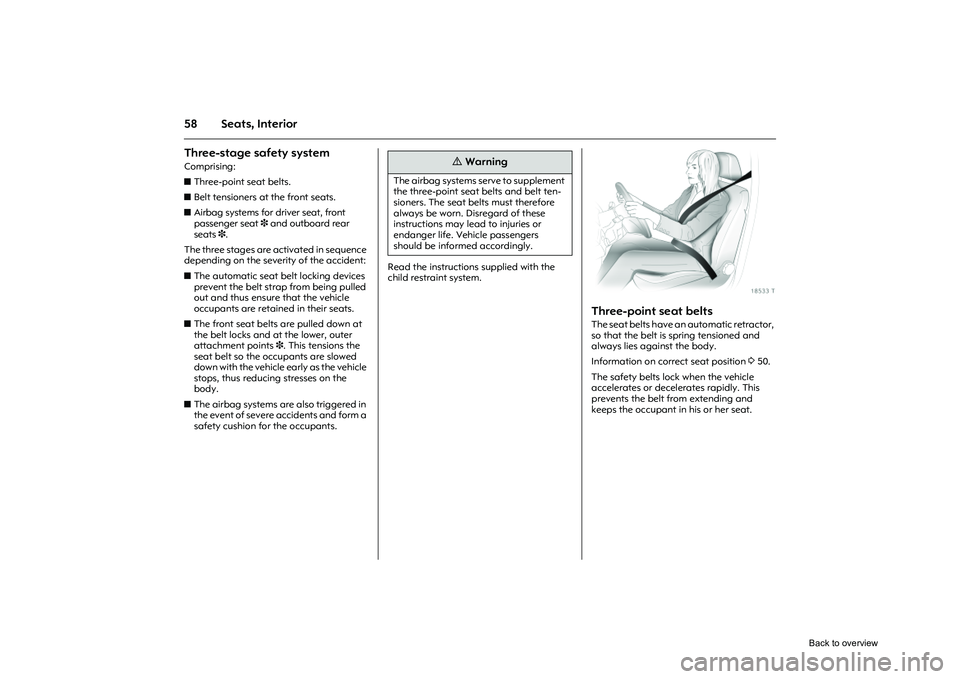
Three-point seat belts The seat belts have an automatic retractor,
so that the belt is spring tensioned and
always lies against the body.
Information on correct seat position
350.
The safety belts lock when the vehicle
accelerates or decelerates rapidly. This
prevents the belt from extending and
keeps the occupant in his or her seat.
9
Warning
The airbag systems serve to supplement
the three-point seat belts and belt ten-
sioners. The seat belts must therefore
always be worn. Disregard of these
instructions may lead to injuries or
endanger life. Vehicle passengers
should be informed accordingly.
Back to overview
Page 67 of 284
61
Seats, Interior
Picture no: 18247s.tif
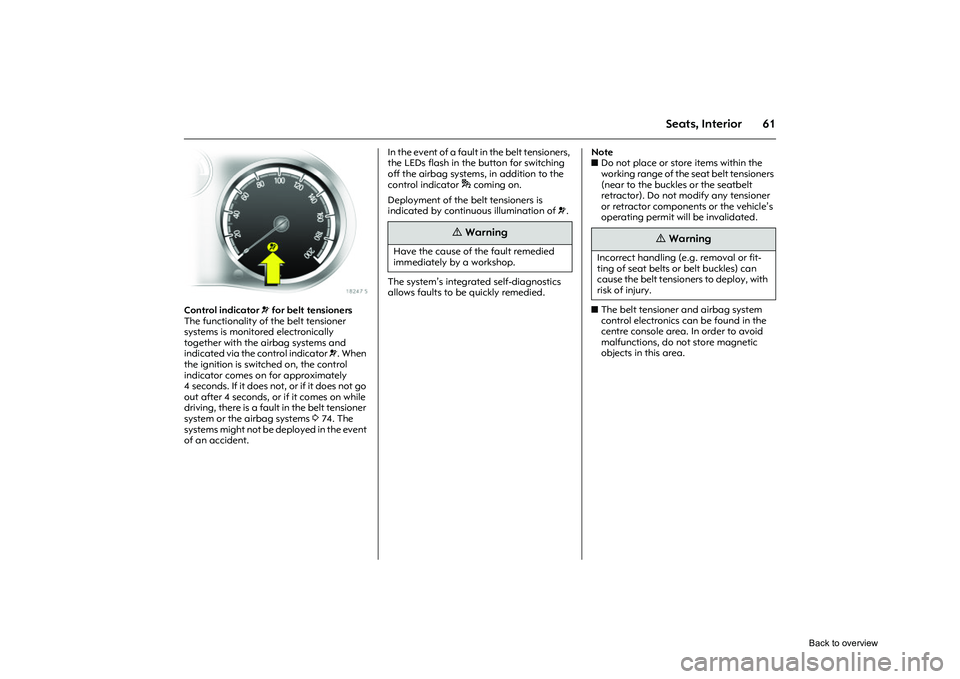
Control indicator v for belt tensioners
The functionality of the belt tensioner
systems is monitored electronically
together with the airbag systems and
indicated via the control indicator v. When
the ignition is switched on, the control
indicator comes on for approximately
4 seconds. If it does not, or if it does not go
out after 4 seconds, or if it comes on while
driving, there is a faul t in the belt tensioner
system or the airbag systems 374. The
systems might not be deployed in the event
of an accident. In the event of a fault in the belt tensioners,
the LEDs flash in the button for switching
off the airbag systems, in addition to the
control indicator
* coming on.
Deployment of the belt tensioners is
indicated by continuous illumination of v.
The system’s integrated self-diagnostics
allows faults to be quickly remedied. Note
z
Do not place or store items within the
working range of the seat belt tensioners
(near to the buckles or the seatbelt
retractor). Do not modify any tensioner
or retractor components or the vehicle’s
operating permit will be invalidated.
z The belt tensioner and airbag system
control electronics can be found in the
centre console area. In order to avoid
malfunctions, do not store magnetic
objects in this area.
9
Warning
Have the cause of the fault remedied
immediately by a workshop.
9
Warning
Incorrect handling (e.g. removal or fit-
ting of seat belts or belt buckles) can
cause the belt tensioners to deploy, with
risk of injury.
Back to overview
Page 70 of 284
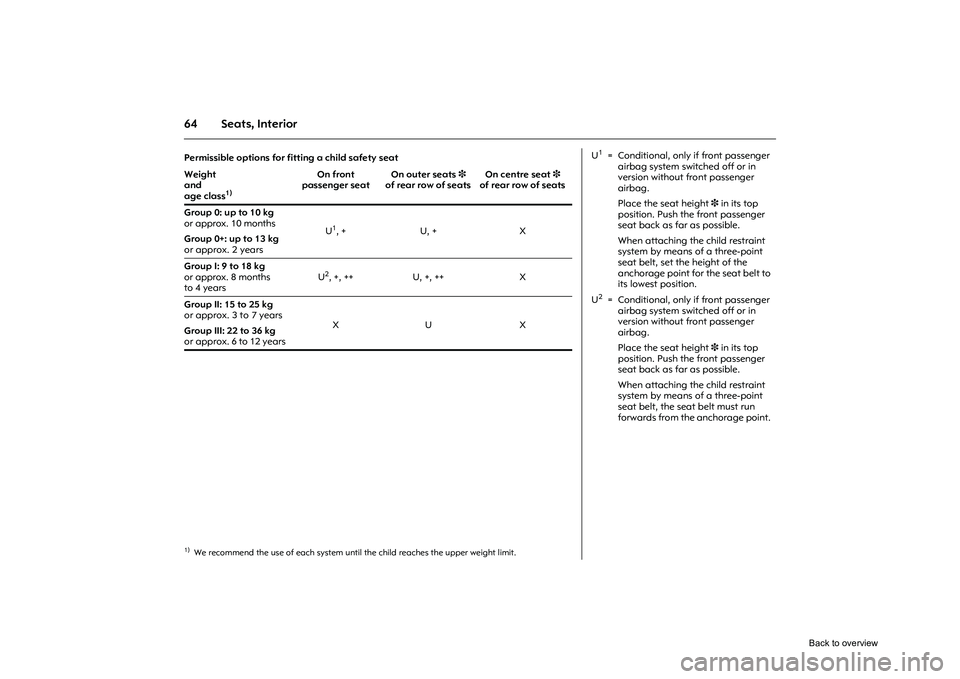
64 Seats, InteriorPermissible options for fitting a child safety seat
Weight
and
age class
1)
1)We recommend the use of each system until the child reaches the upper weight limit.
On front
passenger seat On outer seats
3
of rear row of seats On centre seat
3
of rear row of seats
Group 0: up to 10 kg
or approx. 10 months
Group 0+: up to 13 kg
or approx. 2 years U
1, +
U, + X
Group I: 9 to 18 kg
or approx. 8 months
to 4 years U2, +, ++
U, +, ++ X
Group II: 15 to 25 kg
or approx. 3 to 7 years
Group III: 22 to 36 kg
or approx. 6 to 12 years X U X
U1= Conditional, only if front passenger
airbag system switched off or in
version without front passenger
airbag.
Place the seat height 3 in its top
position. Push the front passenger
seat back as far as possible.
When attaching the child restraint
system by means of a three-point
seat belt, set the height of the
anchorage point for the seat belt to
its lowest position.
U2= Conditional, only if front passenger airbag system switched off or in
version without front passenger
airbag.
Place the seat height 3 in its top
position. Push the front passenger
seat back as far as possible.
When attaching the child restraint
system by means of a three-point
seat belt, the seat belt must run
forwards from the anchorage point.
Back to overview
Page 75 of 284
69
Seats, Interior
Picture no: 18195s.tif
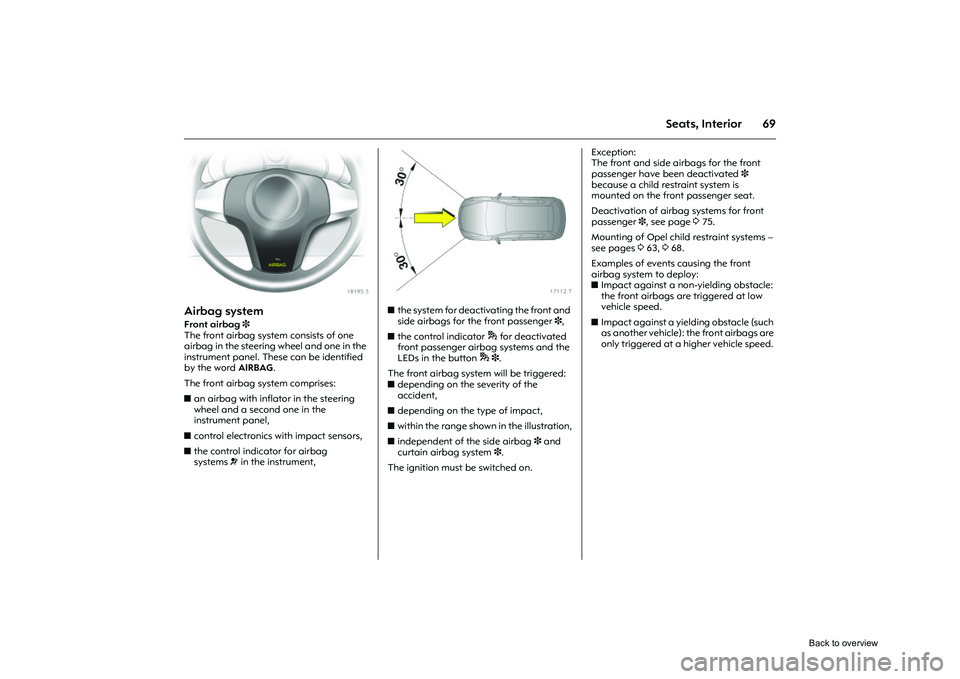
Airbag system Front airbag 3
The front airbag system consists of one
airbag in the steering wheel and one in the
instrument panel. These can be identified
by the word AIRBAG.
The front airbag system comprises:
z an airbag with inflator in the steering
wheel and a second one in the
instrument panel,
z control electronics with impact sensors,
z the control indicator for airbag
systems v in the instrument,
Picture no: 17112t.tif
z the system for deactivating the front and
side airbags for the front passenger 3,
z the control indicator * for deactivated
front passenger airbag systems and the
LEDs in the button * 3.
The front airbag system will be triggered:
z depending on the severity of the
accident,
z depending on the type of impact,
z within the range show n in the illustration,
z independent of the side airbag 3 and
curtain airbag system 3.
The ignition must be switched on. Exception:
The front and side airbags for the front
passenger have been deactivated
3
because a child restraint system is
mounted on the front passenger seat.
Deactivation of airbag systems for front
passenger 3, see page 375.
Mounting of Opel child restraint systems –
see pages 363, 368.
Examples of events causing the front
airbag system to deploy:
z Impact against a non-yielding obstacle:
the front airbags are triggered at low
vehicle speed.
z Impact against a yielding obstacle (such
as another vehicle): the front airbags are
only triggered at a higher vehicle speed.
Back to overview
Page 76 of 284
70 Seats, Interior
Picture no: 18184s.tif
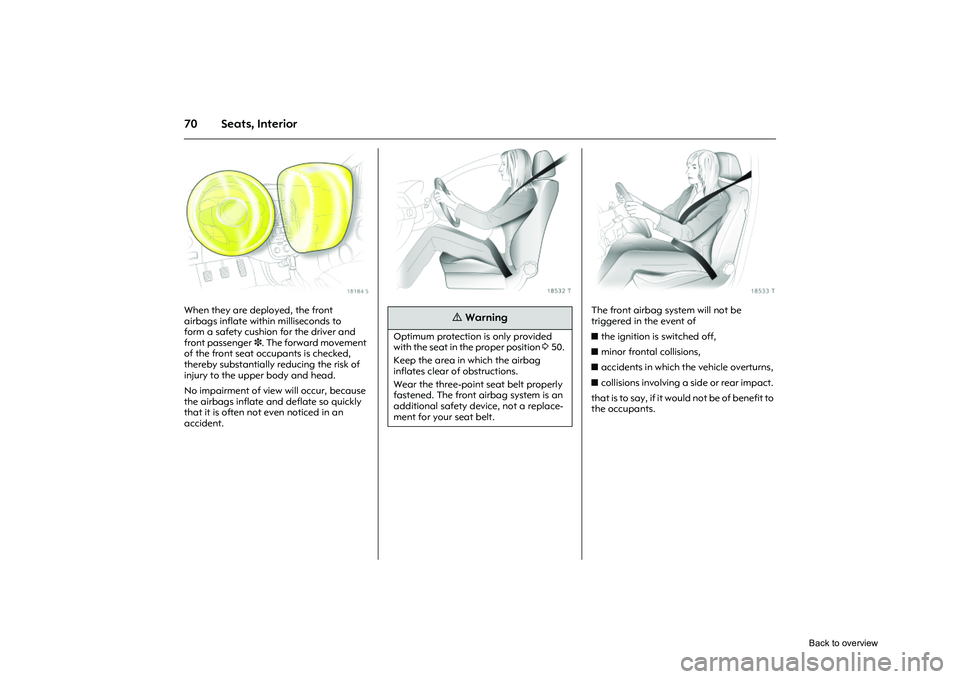
When they are deployed, the front
airbags inflate within milliseconds to
form a safety cushion for the driver and
front passenger3. The forward movement
of the front seat occupants is checked,
thereby substantially reducing the risk of
injury to the upper body and head.
No impairment of view will occur, because
the airbags inflate and deflate so quickly
that it is often not even noticed in an
accident.
Picture no: 18532t.tif.tif Picture no: 18533t.tif
The front airbag system will not be
triggered in the event of
zthe ignition is switched off,
z minor frontal collisions,
z accidents in which the vehicle overturns,
z collisions involving a side or rear impact.
that is to say, if it would not be of benefit to
the occupants.
9
Warning
Optimum protection is only provided
with the seat in the proper position 3 50.
Keep the area in which the airbag
inflates clear of obstructions.
Wear the three-point seat belt properly
fastened. The front airbag system is an
additional safety device, not a replace-
ment for your seat belt.
Back to overview
Page 77 of 284
71
Seats, Interior
Also, the front airbag system is not
deployed for the front passenger when the
airbag systems for the front passenger are
deactivated 3.
Deactivated airbag systems for the front
passenger 3 are indicated by constant
illumination of the LEDs in the button *
and the control indicator *.
Deactivating front passenger airbag
systems 3 375.
Mounting Opel child restraint
systems 3363, 368.
Picture no: 18320s.tif
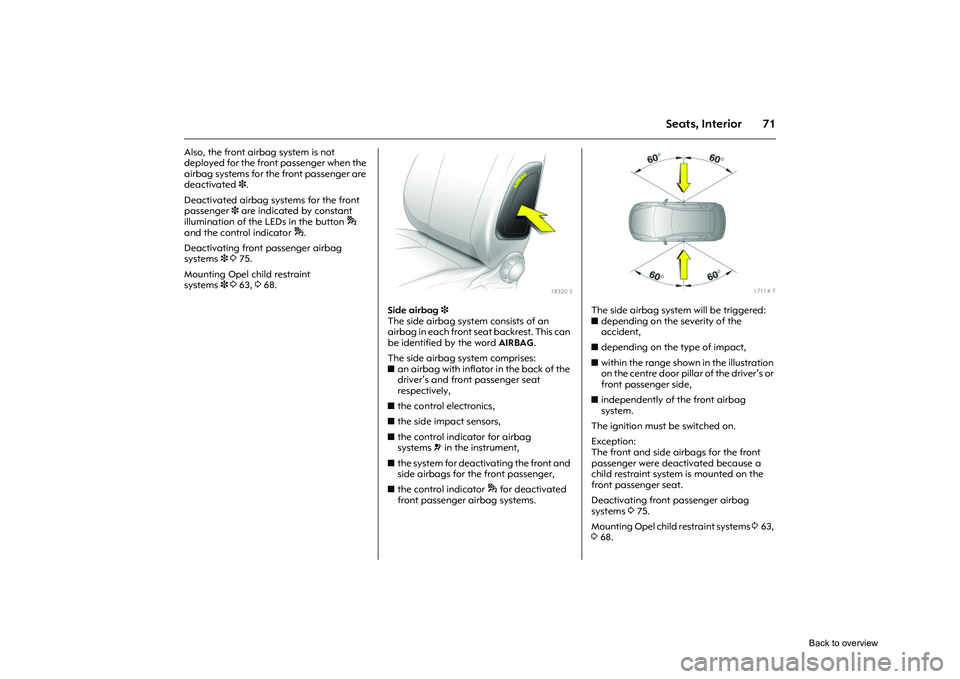
Side airbag 3
The side airbag system consists of an
airbag in each front seat backrest. This can
be identified by the word AIRBAG.
The side airbag system comprises:
z an airbag with inflator in the back of the
driver’s and front passenger seat
respectively,
z the control electronics,
z the side impact sensors,
z the control indicator for airbag
systems v in the instrument,
z the system for deactivating the front and
side airbags for the front passenger,
z the control indicator * for deactivated
front passenger airbag systems.
Picture no: 17114t.tif
The side airbag system will be triggered:
z depending on the severity of the
accident,
z depending on the type of impact,
z within the range shown in the illustration
on the centre door pillar of the driver’s or
front passenger side,
z independently of the front airbag
system.
The ignition must be switched on.
Exception:
The front and side airbags for the front
passenger were deactivated because a
child restraint system is mounted on the
front passenger seat.
Deactivating front passenger airbag
systems 3 75.
Mounting Opel child restraint systems 363,
3 68.
Back to overview
Page 78 of 284
72 Seats, Interior
Picture no: 17110t.tif
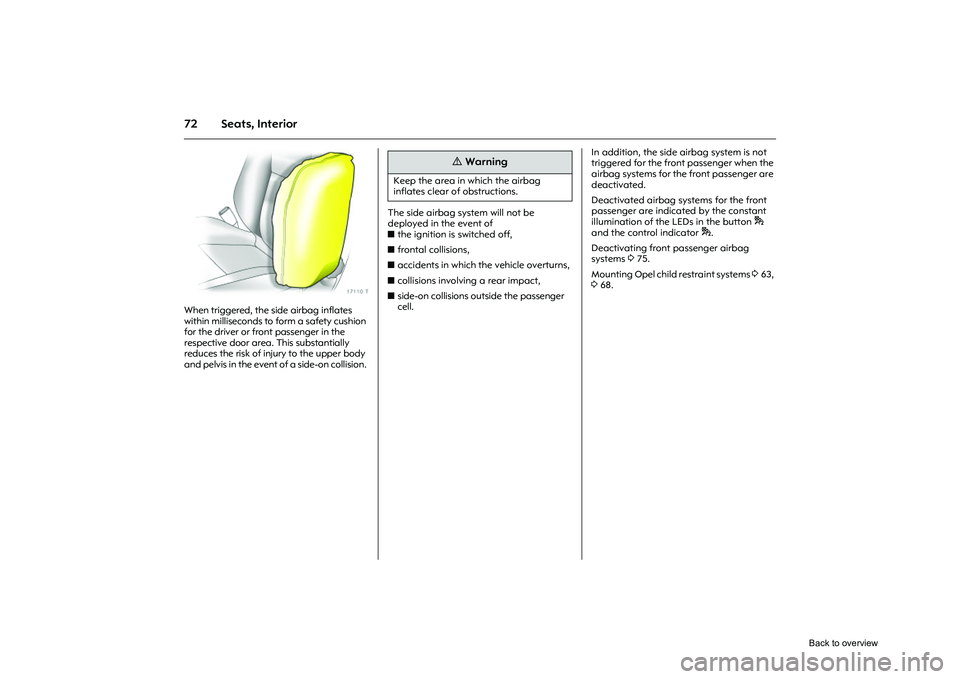
When triggered, the side airbag inflates
within milliseconds to form a safety cushion
for the driver or front passenger in the
respective door area. This substantially
reduces the risk of injury to the upper body
and pelvis in the event of a side-on collision. The side airbag system will not be
deployed in the event of
z
the ignition is switched off,
z frontal collisions,
z accidents in which the vehicle overturns,
z collisions involving a rear impact,
z side-on collisions outside the passenger
cell. In addition, the side airbag system is not
triggered for the front passenger when the
airbag systems for the front passenger are
deactivated.
Deactivated airbag systems for the front
passenger are indicated by the constant
illumination of the LEDs in the button
*
and the control indicator *.
Deactivating front passenger airbag
systems 3 75.
Mounting Opel child restraint systems 363,
3 68.
9
Warning
Keep the area in which the airbag
inflates clear of obstructions.
Back to overview
Page 79 of 284
73
Seats, Interior
Picture no: 18293s.tif
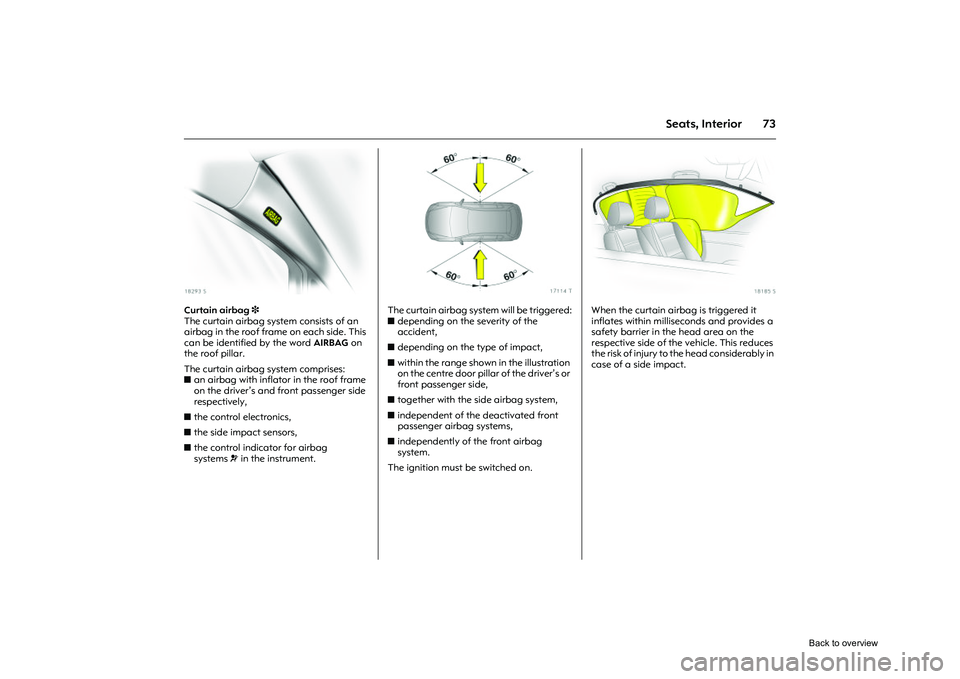
Curtain airbag 3
The curtain airbag system consists of an
airbag in the roof fram e on each side. This
can be identified by the word AIRBAG on
the roof pillar.
The curtain airbag system comprises:
z an airbag with inflator in the roof frame
on the driver’s and front passenger side
respectively,
z the control electronics,
z the side impact sensors,
z the control indicator for airbag
systems v in the instrument.
Picture no: 17114t.tif
The curtain airbag system will be triggered:
z depending on the severity of the
accident,
z depending on the type of impact,
z within the range shown in the illustration
on the centre door pillar of the driver’s or
front passenger side,
z together with the side airbag system,
z independent of the deactivated front
passenger airbag systems,
z independently of the front airbag
system.
The ignition must be switched on.
Picture no: 18185s.tif
When the curtain airb ag is triggered it
inflates within milliseconds and provides a
safety barrier in the head area on the
respective side of the vehicle. This reduces
the risk of injury to th e head considerably in
case of a side impact.
Back to overview
Page 80 of 284
74 Seats, InteriorThe curtain airbag system will not be
deployed in the event of
zthe ignition is switched off,
z frontal collisions,
z accidents in which the vehicle overturns,
z collisions involving a rear impact,
z side-on collisions outside the passenger
cell.
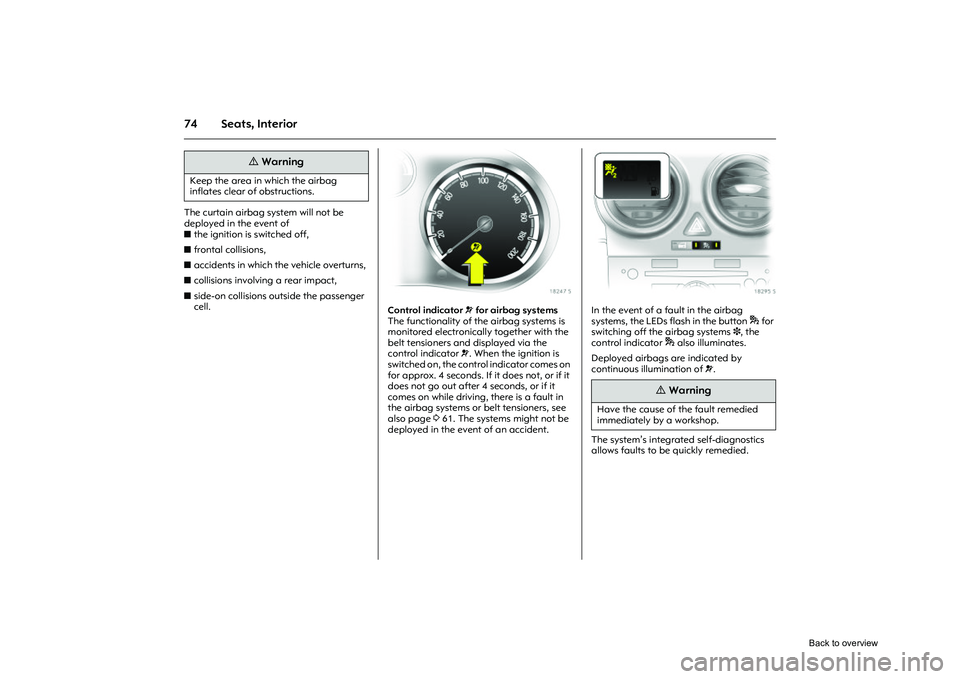
Picture no: 18247s.tif
Control indicator v for airbag systems
The functionality of the airbag systems is
monitored electronically together with the
belt tensioners and displayed via the
control indicator v. When the ignition is
switched on, the control indicator comes on
for approx. 4 seconds. If it does not, or if it
does not go out after 4 seconds, or if it
comes on while driving, there is a fault in
the airbag systems or belt tensioners, see
also page 361. The systems might not be
deployed in the event of an accident.
Picture no: 18295s.tif
In the event of a fault in the airbag
systems, the LEDs flash in the button * for
switching off the airbag systems 3 , the
control indicator * also illuminates.
Deployed airbags are indicated by
continuous illumination of v.
The system’s integrated self-diagnostics
allows faults to be quickly remedied.
9
Warning
Keep the area in which the airbag
inflates clear of obstructions.
9
Warning
Have the cause of the fault remedied
immediately by a workshop.
Back to overview
Page 81 of 284
75
Seats, Interior
Airbag systems which can be deactivated
for the front passenger * 3
The front and side airbag front passenger
airbag systems must be deactivated if a
child restraint system is to be fitted on the
front passenger seat. The curtain airbag
system 3, the belt tensioners and all driver
airbag systems remain active when the
front passenger airbag systems are
deactivated. The front passenger airbag
systems are active in the as-delivered
condition.
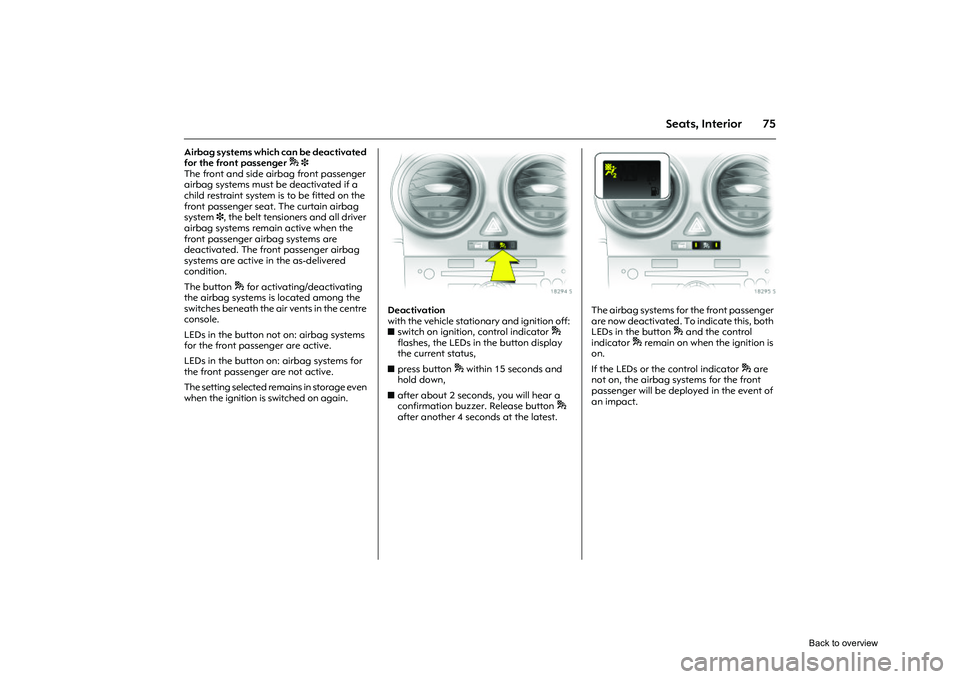
The button * for activating/deactivating
the airbag systems is located among the
switches beneath the air vents in the centre
console.
LEDs in the button not on: airbag systems
for the front passenger are active.
LEDs in the button on : airbag systems for
the front passenger are not active.
The setting selected remains in storage even
when the ignition is switched on again.
Picture no: 18294s.tif
Deactivation
with the vehicle stationary and ignition off:
z switch on ignition , control indicator *
flashes, the LEDs in the button display
the current status,
z press button * within 15 seconds and
hold down,
z after about 2 seconds, you will hear a
confirmation buzzer. Release button *
after another 4 seconds at the latest.
Picture no: 18295s.tif
The airbag systems fo r the front passenger
are now deactivated. To indicate this, both
LEDs in the button * and the control
indicator * remain on when the ignition is
on.
If the LEDs or the control indicator * are
not on, the airbag systems for the front
passenger will be deployed in the event of
an impact.
Back to overview