brake light OPEL CORSA 2009 User Guide
[x] Cancel search | Manufacturer: OPEL, Model Year: 2009, Model line: CORSA, Model: OPEL CORSA 2009Pages: 284, PDF Size: 4.96 MB
Page 111 of 284

105
Instruments, controls
Acknowledge warning messages as
described on page 96, confirm.
Unacknowledged warning messages can
be re-displayed later.
Warning messages:Remote Control
Battery
check
Remote control battery voltage too low
3 32.
Brakelight switch
check
Brake light does not come on during
braking. Have the cause of the fault
eliminated immediately by a workshop.
Picture no: 18435s.tif
If there is a fault in the lighting system, the
respective location of the fault is displayed
as text, e.g.:
Brakelight
check right
Interruption of power supply
Stored warning messages appear on the
display one after the other.
Warning buzzersWhen starting the engine or whilst
driving:
z If seat belt is not fastened 3.
z If a door or the luggage compartment
has not been closed correctly when you
set off.
z Once you have reached a certain speed
if the hand brake is applied.
z If the speed programmed at the factory 3
is exceeded.
z If the car has automated manual
transmission 3 and the driver’s door is
opened when the engine is running, a
gear is engaged and the foot brake is
not depressed.
z Warning signal sounded three times if
the Flex-Fix system is extended 3 and
reverse gear is selected.
When the vehicle is parked and the
driver’s door is opened:
z When the key is in the ignition switch 3.
z With parking lamps or dipped beam on.
z For automated manual transmission 3, if
the hand brake is not applied and no
gear is engaged when the engine is
switched off.
Brakelightcheck right
OK
Back to overview
Page 143 of 284
137
Driving and operation
Picture no: 18227s.tif
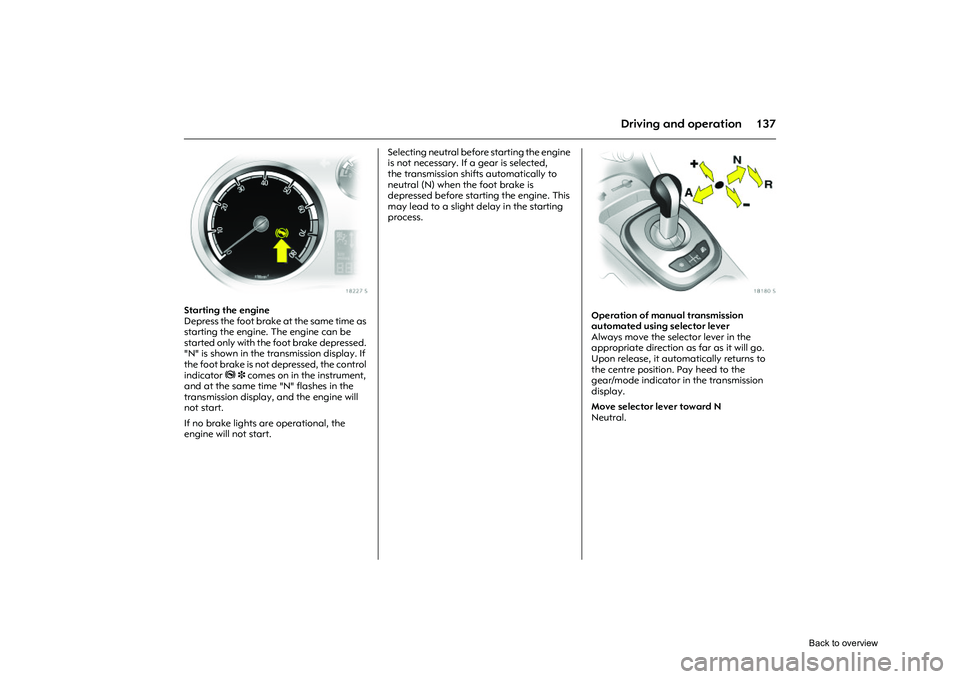
Starting the engine
Depress the foot brake at the same time as
starting the engine. The engine can be
started only with the foot brake depressed.
"N" is shown in the transmission display. If
the foot brake is not depressed, the control
indicator j 3 comes on in the instrument,
and at the same time "N" flashes in the
transmission display, and the engine will
not start.
If no brake lights are operational, the
engine will not start. Selecting neutral before
starting the engine
is not necessary. If a gear is selected,
the transmission shifts automatically to
neutral (N) when the foot brake is
depressed before starting the engine. This
may lead to a slight delay in the starting
process.
Picture no: 18180s.tif
Operation of manual transmission
automated using selector lever
Always move the selector lever in the
appropriate direction as far as it will go.
Upon release, it automatically returns to
the centre position. Pay heed to the
gear/mode indicator in the transmission
display.
Move selector lever toward N
Neutral.
Back to overview
Page 148 of 284
142 Driving and operation
Picture no: 18230s.tif
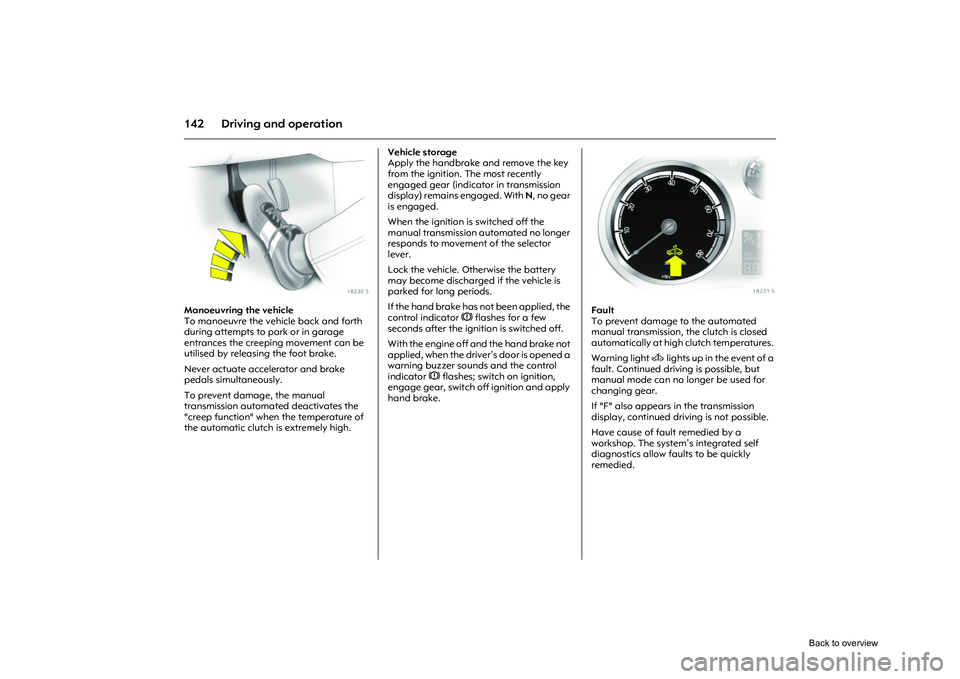
Manoeuvring the vehicle
To manoeuvre the vehicle back and forth
during attempts to park or in garage
entrances the creeping movement can be
utilised by releasing the foot brake.
Never actuate accelerator and brake
pedals simultaneously.
To prevent damage, the manual
transmission automated deactivates the
"creep function" when the temperature of
the automatic clutch is extremely high. Vehicle storage
Apply the handbrake and remove the key
from the ignition. The most recently
engaged gear (indicator in transmission
display) remains engaged. With
N, no gear
is engaged.
When the ignition is switched off the
manual transmission automated no longer
responds to movement of the selector
lever.
Lock the vehicle. Otherwise the battery
may become discharged if the vehicle is
parked for long periods.
If the hand brake has not been applied, the
control indicator R flashes for a few
seconds after the ignition is switched off.
With the engine off and the hand brake not
applied, when the driver ’s door is opened a
warning buzzer sounds and the control
indicator R flashes; switch on ignition,
engage gear, switch off ignition and apply
hand brake.
Picture no: 18231s.tif
Fault
To prevent damage to the automated
manual transmission, the clutch is closed
automatically at high clutch temperatures.
Warning light A lights up in the event of a
fault. Continued driving is possible, but
manual mode can no longer be used for
changing gear.
If "F" also appears in the transmission
display, continued driving is not possible.
Have cause of fault remedied by a
workshop. The system’s integrated self
diagnostics allow faults to be quickly
remedied.
Back to overview
Page 154 of 284
148 Driving and operation
Picture no: 18231s.tif
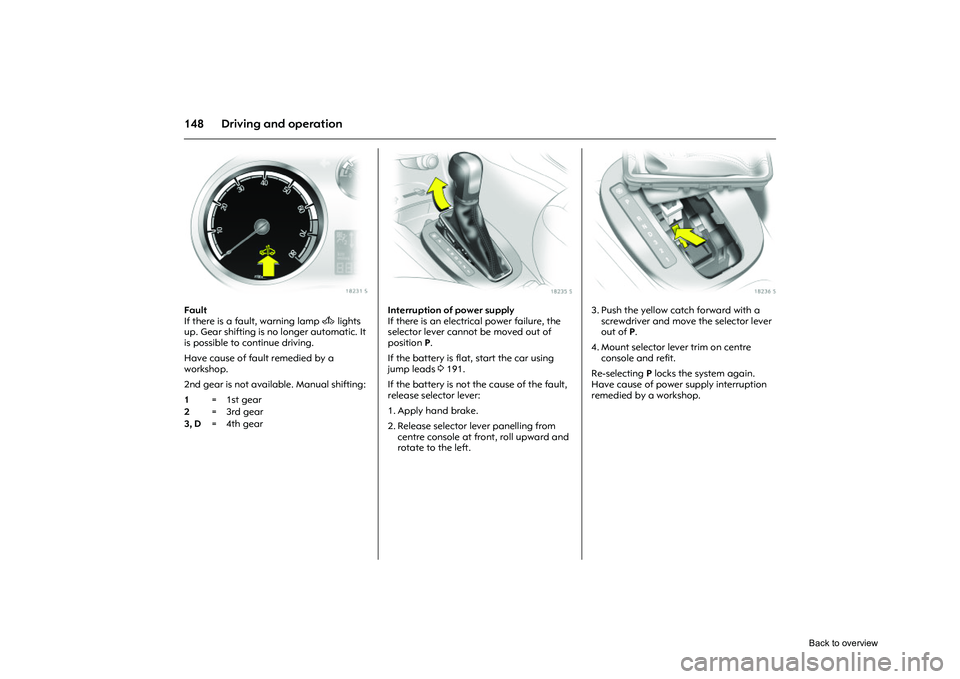
Fault
If there is a fault, warning lamp A lights
up. Gear shifting is no longer automatic. It
is possible to continue driving.
Have cause of fault remedied by a
workshop.
2nd gear is not available. Manual shifting:
Picture no: 18235s.tif
Interruption of power supply
If there is an electrical power failure, the
selector lever cannot be moved out of
position P.
If the battery is flat, start the car using
jump leads 3191.
If the battery is not the cause of the fault,
release selector lever:
1. Apply hand brake.
2. Release selector lever panelling from centre console at front, roll upward and
rotate to the left.
Picture no: 18236s.tif
3. Push the yellow catch forward with a
screwdriver and move the selector lever
out of P.
4. Mount selector lever trim on centre console and refit.
Re-selecting P locks the system again.
Have cause of power supply interruption
remedied by a workshop.
1 =1st gear
2 =3rd gear
3, D =4th gear
Back to overview
Page 157 of 284
151
Driving and operation
Saving fuel, protecting
the environment Trend-setting technology
Environmentally friendly and mainly
recyclable materials were used when your
vehicle was being developed and
manufactured. The production methods
used to make your vehicle are also
environmentally-compatible.
Recycling of production wastes keeps the
circulation of material closed. Reduction of
energy and water requirements also helps
to conserve natural resources.
A highly advanced design means that your
vehicle can be easily disassembled at the
end of its working life, and the individual
materials separated for subsequent re-use.
Materials such as asbestos and cadmium
are not used. The refrigerant in the air
conditioning system 3 is CFC-free.
New painting techniques employ water as
a solvent. End-of-life vehicle recovery
Information on end-of-life vehicle recovery
centres and the recycling of end-of-life
vehicles is availabl
e at www.opel.com.
Energy and environment-conscious
driving
z High noise levels and exhaust emissions
are often a result of driving without due
attention to saving energy and
protecting the environment.
z You should therefore drive with energy in
mind: "more miles – less fuel".
Reduce the noise level and exhaust
emissions by adopting an environment-
conscious driving style. This is extremely
worthwhile and improves the quality of
life.
Fuel consumption depends to a great
extent on your own personal driving
style. The following hints are intended to
help you consume fuel at a rate that is as
close as possible to the specified levels
3256.
Check your vehicle’s fuel consumption
every time you refuel. This facilitates
early detection of any irregularities
causing increased fuel consumption. Warming up
z
Full throttle and warming up at idle
speed increase wear, fuel consumption,
exhaust emission, the amount of
pollutant in the exhaust and the amount
of noise.
z Drive off as soon as possible after
starting.
Uniform speed
z Hectic driving significantly increases fuel
consumption, the exhaust emissions, the
proportion of pollutant in the exhaust
gas and the noise level.
z Do not accelerate and brake
unnecessarily. Drive at uniform speed,
watching the road.
Avoid frequent starting off and stopping
e.g. at traffic lights, in short distance
traffic and in queues of traffic by means
of clever planning. Select roads with
good traffic flow.
Idling
z The engine also consumes fuel when
idling.
z If you have to wait for more than one
minute, it is worthwhile switching off the
engine. Five minutes of idling
corresponds to approximately one
kilometre of driving.
Back to overview
Page 165 of 284
159
Driving and operation
Drive Control Systems Electronic Stability Program
(ESP
®Plus
) 3
ESP®
Plus
improves driving stability when
necessary in any driving situation
regardless of the type of road surface or
tyre grip. It also prevents the drive wheels
from spinning.
As soon as the vehicle starts to swerve
(understeer/oversteer), engine output is
reduced and the wheels are braked
individually. This considerably improves
the driving stability of the vehicle on
slippery road surfaces.
ESP®
Plus
is ready for operation as soon as
the ignition is switched on and control
indicator v goes out.
When the ESP®
Plus
comes into action,
v flashes. The vehicle is now in
a critical situation;
ESP®
Plus
allows you to keep control of the
vehicle and reminds you to match your
speed to the road conditions.
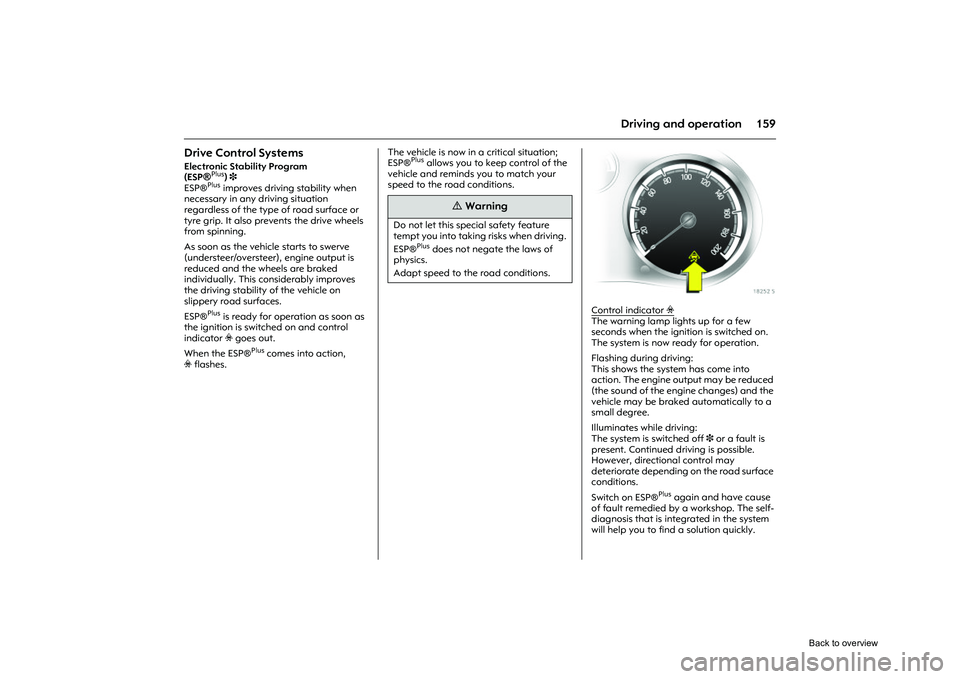
Picture no: 18252s.tif
Control indicator
v
The warning lamp lights up for a few
seconds when the ignition is switched on.
The system is now ready for operation.
Flashing during driving:
This shows the system has come into
action. The engine output may be reduced
(the sound of the engine changes) and the
vehicle may be braked automatically to a
small degree.
Illuminates while driving:
The system is switched off 3 or a fault is
present. Continued driving is possible.
However, directional control may
deteriorate depending on the road surface
conditions.
Switch on ESP®
Plus
again and have cause
of fault remedied by a workshop. The self-
diagnosis that is integrated in the system
will help you to find a solution quickly.
9
Warning
Do not let this special safety feature
tempt you into taking risks when driving.
ESP®
Plus
does not negate the laws of
physics.
Adapt speed to the road conditions.
Back to overview
Page 166 of 284

160 Driving and operation
Picture no: 18470s.tif
Switching off
3
ESP®
Plus
can be deactivated by pressing
button v 3 .
Switching off is indicated by the control
indicator v lighting up in the
instrument. Also appears on the service
display ESPoff391.
Pressing the v button again or turning on
the ignition switches the ESP®
Plus
on again. Cruise control
3
Cruise control can store and maintain
speeds between 30 and 200 km/h.
Deviation from the stored speed may occur
when driving up or downhill.
For safety reasons the cruise control
system cannot be activated until the foot
brake has been operated, otherwise the
control indicator flashes m.
Cruise control is operated with switch m, g,
and button 0 on the turn signal stalk.
Do not use the cruise control if it is not
advisable to maintain a constant speed
(e.g. in situations presenting a danger to
yourself and other road users, in heavy
traffic or on winding, slippery or greasy
roads). With automatic transmission
3, engage
cruise control only in D, or with manual
transmission automated 3 in automatic
mode only.
9
Warning
If the vehicle has run-flat tyres 3 the
ESP®
Plus
must not be deactivated with
depressurised tyres.
9
Warning
When the cruise control is active, reac-
tion times may be increased due to the
different position of the feet.
Back to overview
Page 171 of 284
165
Driving and operation
Picture no: 17206t.tif
Hydraulic brake system The foot brake comprises two independent
brake circuits.
If a brake circuit fails, the vehicle can still be
braked using the other brake circuit.
However, the brake pedal must be
depressed a considerable way before any
braking effect occurs, and much more
force is required. The braking distance is
longer. Contact a workshop for assistance
before continuing to drive. To ensure that full
pedal travel can be
utilised, especially in case of a fault in one
of the brake circuits, there must be no mats
in the vicinity of the pedals 3150.
When the engine is not running, the
support of the brake servo unit disappears
once the brake pedal has been depressed
once or twice. Braking effect is not
reduced, but braking requires significantly
greater force. This is especially important
to bear in mind when towing.
The brake fluid level should be checked
regularly. If the brake fluid level is too low
and the hand brake is not applied, control
indicator R on the instrument panel
illuminates 389.
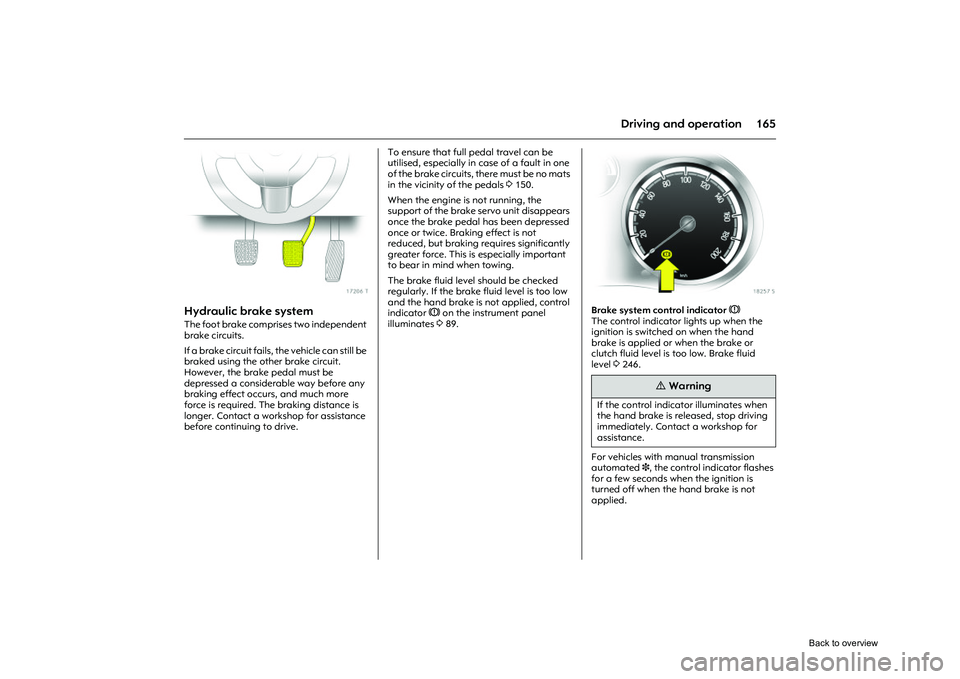
Picture no: 18257s.tif
Brake system control indicator R
The control indicator lights up when the
ignition is switched on when the hand
brake is applied or when the brake or
clutch fluid level is too low. Brake fluid
level 3246.
For vehicles with manual transmission
automated 3, the control indicator flashes
for a few seconds when the ignition is
turned off when the hand brake is not
applied.
9
Warning
If the control indicator illuminates when
the hand brake is released, stop driving
immediately. Contact a workshop for
assistance.
Back to overview
Page 173 of 284
167
Driving and operation
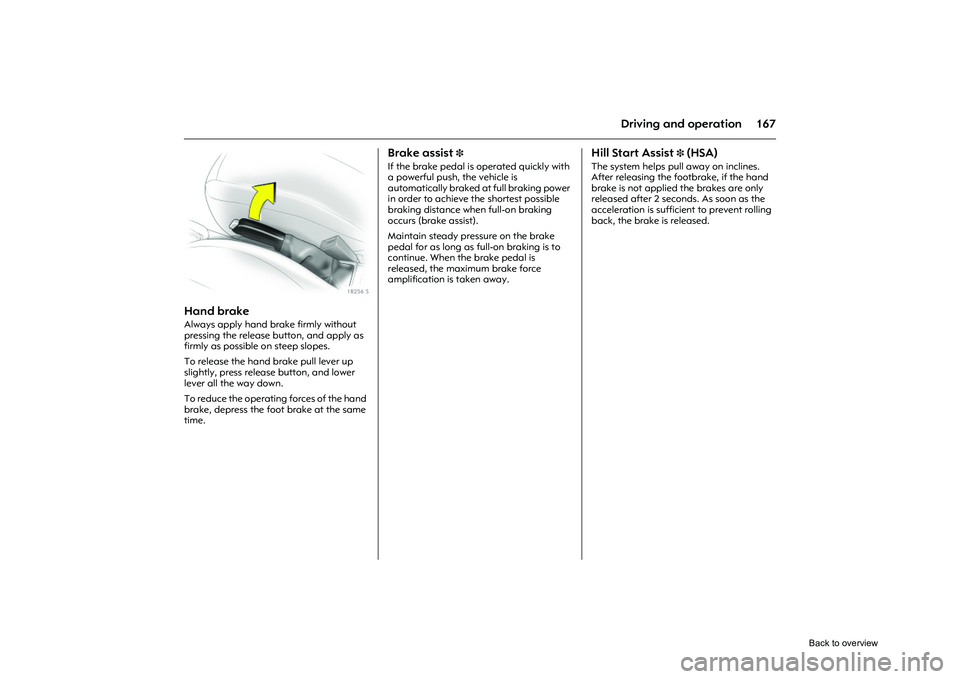
Picture no: 18256s.tif
Hand brake Always apply hand brake firmly without
pressing the release button, and apply as
firmly as possible on steep slopes.
To release the hand brake pull lever up
slightly, press release button, and lower
lever all the way down.
To reduce the operating forces of the hand
brake, depress the foot brake at the same
time.
Brake assist
3
If the brake pedal is operated quickly with
a powerful push, the vehicle is
automatically braked at full braking power
in order to achieve the shortest possible
braking distance when full-on braking
occurs (brake assist).
Maintain steady pressure on the brake
pedal for as long as full-on braking is to
continue. When the brake pedal is
released, the maximum brake force
amplification is taken away.
Hill Start Assist
3 (HSA)
The system helps pull away on inclines.
After releasing the footbrake, if the hand
brake is not applied the brakes are only
released after 2 seconds. As soon as the
acceleration is sufficient to prevent rolling
back, the brake is released.
Back to overview
Page 195 of 284
189
Driving and operation
Driving characteristics, towing tips
Before attaching the trailer/caravan,
lubricate the ball of the trailer/caravan
towing device. However, do not lubricate
the ball if a stabiliser, which acts on the
coupling ball, is being used to damp
hunting.
Check caravan/traile r lighting before
starting to drive. The fog tail lamps on the
vehicle are deactivated when towing a
caravan or trailer.
Trailers with LED turn signals must have a
provision enables lamp monitoring for
commercial bulbs.
Ultrasonic parking sensors 3 are
deactivated in towing mode.
Handling is greatly influenced by the
loading of the trailer/caravan. Loads
should therefore be secured so that they
cannot slip and be placed in the centre of
the trailer/caravan if possible, i.e. above
the axle.
For trailers with low directional control and
for caravans with a permissible gross
vehicle weight of more than 1000 kg, a
speed of 80 km/h must not be exceeded;
use of a roll damper in accordance with the
friction principle is urgently recommended. If the trailer/caravan starts to sway, drive
more slowly, do not attempt to correct the
steering and brake sharply if necessary.
If it is necessary to apply the brakes fully,
depress the brake pedal as hard as
possible.
Remember that the braking distance for
vehicles towing caravans/trailers with and
without brake is always greater than that
for vehicles not towing a caravan/trailer.
When driving downhill, drive in the same
gear as if driving uphill and drive at a
similar speed.
Adjust tyre pressure to the value specified
for full load
3264. Starting on inclines
For vehicles with manual transmission, the
most favourable engine speed when
starting off on an incline is between
2500 and 3000 rpm for petrol engines and
between 2000 and 2200 rpm for diesel
engines. Hold engine speed constant,
engage clutch gradually (let slip), release
hand brake and open throttle. If possible,
the engine speed should not drop during
this procedure.
In vehicles with automatic transmission
3
and manual transmission automated 3 it is
sufficient to give full throttle in D or
(in automatic mode) 3.
Before starting off under extreme
operating conditions, switch off
unnecessary consumers.
Back to overview