clutch OPEL CORSA 2009 User Guide
[x] Cancel search | Manufacturer: OPEL, Model Year: 2009, Model line: CORSA, Model: OPEL CORSA 2009Pages: 284, PDF Size: 4.96 MB
Page 148 of 284
142 Driving and operation
Picture no: 18230s.tif
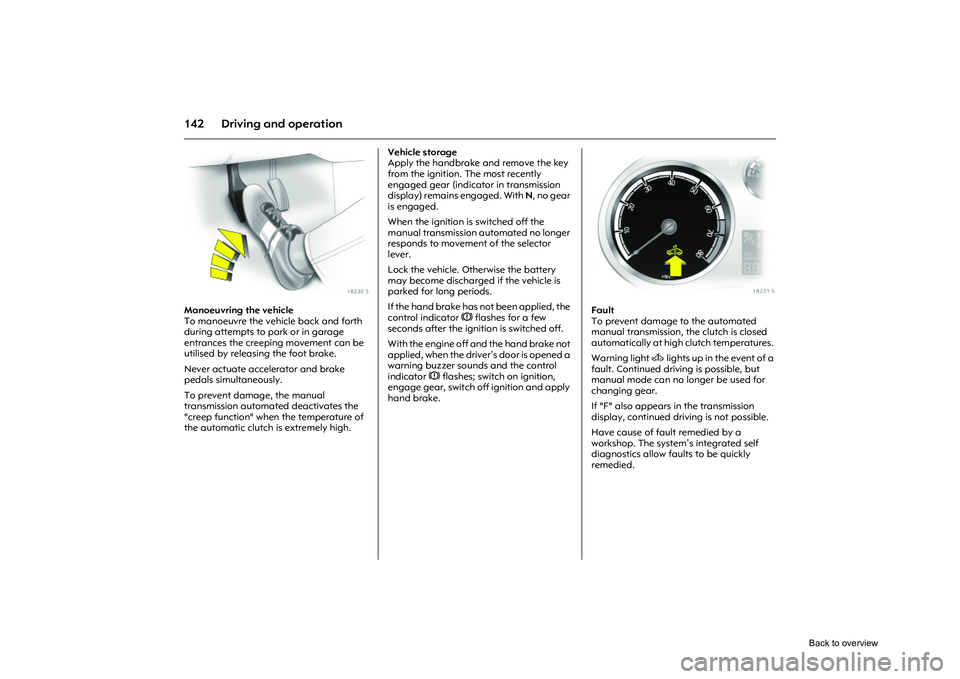
Manoeuvring the vehicle
To manoeuvre the vehicle back and forth
during attempts to park or in garage
entrances the creeping movement can be
utilised by releasing the foot brake.
Never actuate accelerator and brake
pedals simultaneously.
To prevent damage, the manual
transmission automated deactivates the
"creep function" when the temperature of
the automatic clutch is extremely high. Vehicle storage
Apply the handbrake and remove the key
from the ignition. The most recently
engaged gear (indicator in transmission
display) remains engaged. With
N, no gear
is engaged.
When the ignition is switched off the
manual transmission automated no longer
responds to movement of the selector
lever.
Lock the vehicle. Otherwise the battery
may become discharged if the vehicle is
parked for long periods.
If the hand brake has not been applied, the
control indicator R flashes for a few
seconds after the ignition is switched off.
With the engine off and the hand brake not
applied, when the driver ’s door is opened a
warning buzzer sounds and the control
indicator R flashes; switch on ignition,
engage gear, switch off ignition and apply
hand brake.
Picture no: 18231s.tif
Fault
To prevent damage to the automated
manual transmission, the clutch is closed
automatically at high clutch temperatures.
Warning light A lights up in the event of a
fault. Continued driving is possible, but
manual mode can no longer be used for
changing gear.
If "F" also appears in the transmission
display, continued driving is not possible.
Have cause of fault remedied by a
workshop. The system’s integrated self
diagnostics allow faults to be quickly
remedied.
Back to overview
Page 149 of 284
143
Driving and operation
Picture no: 18308s.tif
Interruption of power supply
The clutch is not disengaged if there is an
interruption of the power supply when a
gear is engaged. The vehicle cannot move.
If the battery is flat, start the car using
jump leads 3191. If the cause of the power supply
interruption is not a flat battery, contact a
workshop for assistance. If the vehicle has
to be moved out of flowing traffic,
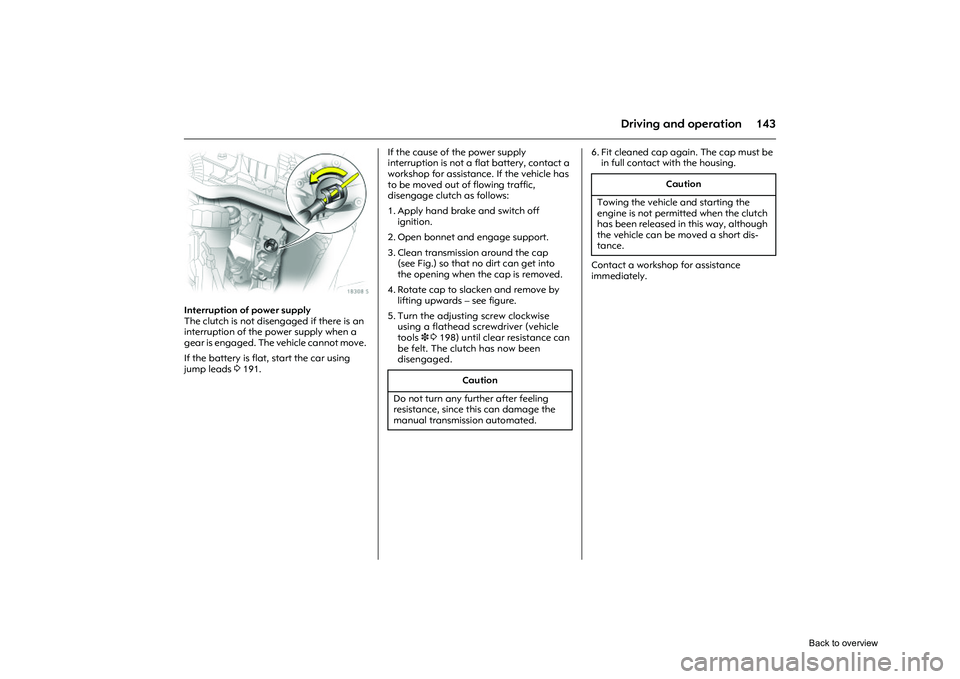
disengage clutch as follows:
1. Apply hand brake and switch off
ignition.
2. Open bonnet and engage support.
3. Clean transmission around the cap (see Fig.) so that no dirt can get into
the opening when the cap is removed.
4. Rotate cap to slacken and remove by lifting upwards – see figure.
5. Turn the adjusting screw clockwise using a flathead screwdriver (vehicle
tools 3 3198) until clear resistance can
be felt. The clutch has now been
disengaged. 6. Fit cleaned cap again. The cap must be
in full contact with the housing.
Contact a workshop for assistance
immediately.
Caution
Do not turn any further after feeling
resistance, since this can damage the
manual transmission automated.
Caution
Towing the vehicle and starting the
engine is not permitted when the clutch
has been released in this way, although
the vehicle can be moved a short dis-
tance.
Back to overview
Page 150 of 284
144 Driving and operation
Picture no: 18179s.tif
Manual transmissionTo engage reverse, with the vehicle
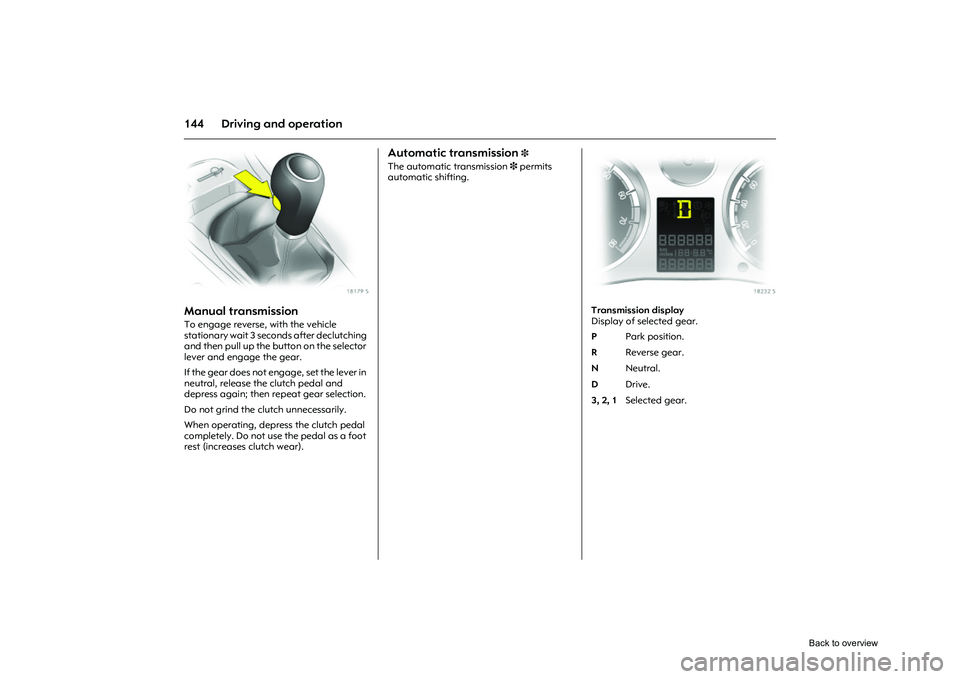
stationary wait 3 seconds after declutching
and then pull up the button on the selector
lever and engage the gear.
If the gear does not engage, set the lever in
neutral, release the clutch pedal and
depress again; then repeat gear selection.
Do not grind the clutch unnecessarily.
When operating, depress the clutch pedal
completely. Do not use the pedal as a foot
rest (increases clutch wear).
Automatic transmission
3
The automatic transmission 3 permits
automatic shifting.
Picture no: 18232s.tif
Transmission display
Display of selected gear. P Park position.
R Reverse gear.
N Neutral.
D Drive.
3, 2, 1 Selected gear.
Back to overview
Page 156 of 284
150 Driving and operationSave energy – more kilometres
Please observe the running-in hints on the
previous page and the tips for saving
energy on the following pages.
Good, technically correct and economical
driving ensures maximum durability and
performance for your vehicle.
Overrun cut-off
The fuel supply is automatically cut off
during overrun, e.g. when the vehicle is
driven with a gear engaged but no throttle
application. Overrun cut-off is deactivated
if catalytic converter temperature is high.
Vehicles with turbocharged engine Flow-generated noises may be audible if
the accelerator is released quickly on
account of air flow in the turbocharger.
Engine speed
Drive in a low engine speed range for each
gear as much as possible. Warming up
After a cold start, the automatic
transmission
3 or manual transmission
automated 3 in automatic mode shifts into
higher gears at higher rpm. This allows the
catalytic converter to quickly reach the
temperature required for optimum pollutant
reduction.
Correct gear selection
Do not race your engine whilst in neutral or
with a low gear selected. Driving too fast in
individual gears as well as stop-and-go
traffic increases engine wear and fuel
consumption.
Change down
When decreasing speed, shift down into
the next lowest gear. Do not slip the clutch
with a high-revving engine. This is
especially important when hill climbing. Cooling fan
The cooling fan is controlled via a
thermoswitch and therefore only runs if
necessary.
The cooling fan automatically switches on
when the diesel particle filter is being
cleaned
3 depending on the engine.
Pedals
Do not place any objects in the foot well
which could slip under the pedals and
inhibit the pedal travel.
To ensure the pedal travel is uninhibited,
there must be no mats in the area of the
pedals.
Battery care
When driving slowly or when the vehicle is
stationary, e.g. in slow urban traffic, stop-
and-go traffic or traffic jams, turn off all
unnecessary electrical loads where
possible (e.g. heated rear window, heated
front seats, etc.).
Declutch when starting in order to relieve
the strain on the starter and the battery.
Back to overview
Page 158 of 284

152 Driving and operationOverrun
zThe fuel supply is shut off automatically
on overrun, e.g. when descending steep
hills or when braking 3150.
z To enable the overrun cut-off to come
into action and save fuel, do not
accelerate or declutch during overrun.
Correct gear selection
z High revs increase engine wear and fuel
consumption.
z Do not race your engine. Avoid driving at
high engine speeds.
Making use of the tachometer helps to
save fuel. Drive in a low engine speed
range for each gear as much as possible
with uniform engine speeds. Drive as
often as possible in top gear, select the
next higher gear as soon as possible,
and only change down when the engine
is no longer running perfectly smoothly.
High speed
z The higher the speed, the higher the
consumption and the noise level. At top
speed, you consume a great deal of fuel
and produce excessive noise and
exhaust emissions. z
Slightly releasing th e accelerator pedal
results in distinct fu el savings with no
major loss of speed.
Drive at no more than around three
quarters of maximum speed and you will
use up to 50 % less fuel, without losing a
great deal of time.
Tyre pressure
z Inadequate tyre pressure, leading to
higher road resistance, costs money in
two ways: for more fuel and increased
tyre wear.
z Regular checks (every 14 days) pay off.
Electrical loads
z The power consumption of electrical
equipment increases fuel consumption.
z Switch off all additional consumers (e.g.
air conditioning 3, heated rear window)
when not needed.
Roof racks, ski-holders
z Roof loads can increase fuel consumption
by approximately 1l/100 km due to air
resistance.
z Remove them if they are not being used. Repair and maintenance
z
Improper repairs or adjustment and
maintenance work can increase fuel
consumption. Do not carry out work on
the engine yourself.
You may out of ignorance infringe
environmental laws by not disposing of
materials properly.
Appropriate parts might not be recycled.
Contact with some of the materials
involved may pose a health hazard.
z We recommend that repair and
maintenance be entrusted to your Opel
Partner.
Extreme driving conditions
z Driving up steep slopes, cornering,
driving on poor roads and driving in ice
and snow all increase fuel consumption.
Fuel consumption increases dramatically
in urban traffic and at low temperatures,
especially on short trips when the engine
operating temperature is not reached.
z Following the instructions given above
will minimise consumption under these
conditions.
Back to overview
Page 167 of 284
161
Driving and operation
Picture no: 18253s.tif
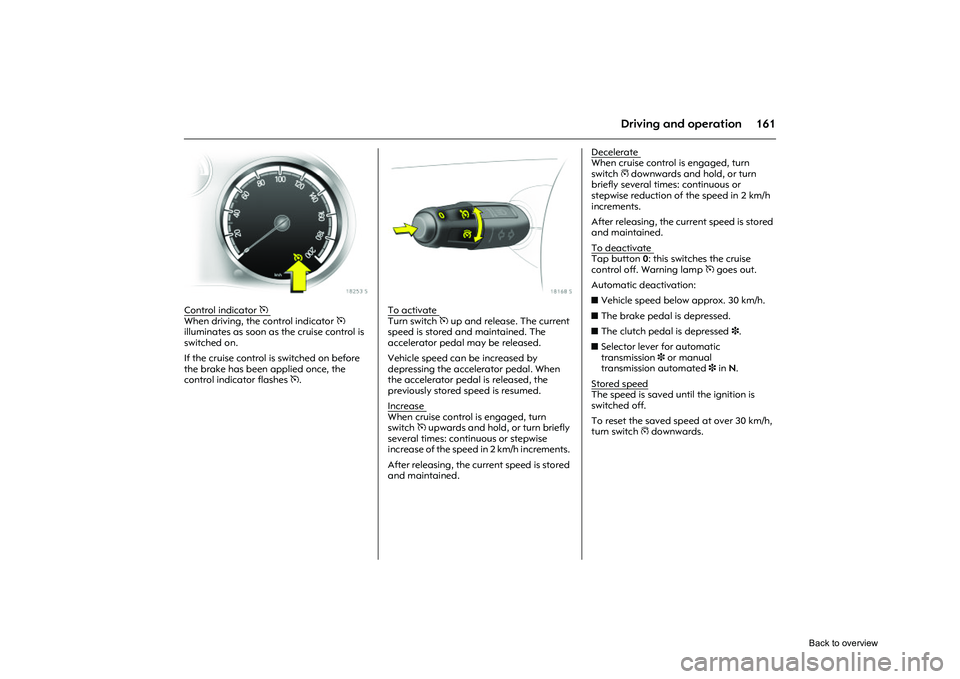
Control indicator
m
When driving, the control indicator m
illuminates as soon as the cruise control is
switched on.
If the cruise control is switched on before
the brake has been applied once, the
control indicator flashes m.
Picture no: 18168s.tif
To activate Turn switch m up and release. The current
speed is stored and maintained. The
accelerator pedal may be released.
Vehicle speed can be increased by
depressing the accelerator pedal. When
the accelerator pedal is released, the
previously stored speed is resumed.
Increase When cruise control is engaged, turn
switch m upwards and hold, or turn briefly
several times: continuous or stepwise
increase of the speed in 2 km/h increments.
After releasing, the current speed is stored
and maintained. Decelerate
When cruise control is engaged, turn
switch
g downwards and hold, or turn
briefly several times: continuous or
stepwise reduction of the speed in 2 km/h
increments.
After releasing, the current speed is stored
and maintained.
To deactivate Tap button 0: this switches the cruise
control off. Warning lamp m goes out.
Automatic deactivation:
z Vehicle speed below approx. 30 km/h.
z The brake pedal is depressed.
z The clutch pedal is depressed 3.
z Selector lever for automatic
transmission 3 or manual
transmission automated 3 in N.
Stored speedThe speed is saved until the ignition is
switched off.
To reset the saved speed at over 30 km/h,
turn switch g downwards.
Back to overview
Page 171 of 284
165
Driving and operation
Picture no: 17206t.tif
Hydraulic brake system The foot brake comprises two independent
brake circuits.
If a brake circuit fails, the vehicle can still be
braked using the other brake circuit.
However, the brake pedal must be
depressed a considerable way before any
braking effect occurs, and much more
force is required. The braking distance is
longer. Contact a workshop for assistance
before continuing to drive. To ensure that full
pedal travel can be
utilised, especially in case of a fault in one
of the brake circuits, there must be no mats
in the vicinity of the pedals 3150.
When the engine is not running, the
support of the brake servo unit disappears
once the brake pedal has been depressed
once or twice. Braking effect is not
reduced, but braking requires significantly
greater force. This is especially important
to bear in mind when towing.
The brake fluid level should be checked
regularly. If the brake fluid level is too low
and the hand brake is not applied, control
indicator R on the instrument panel
illuminates 389.
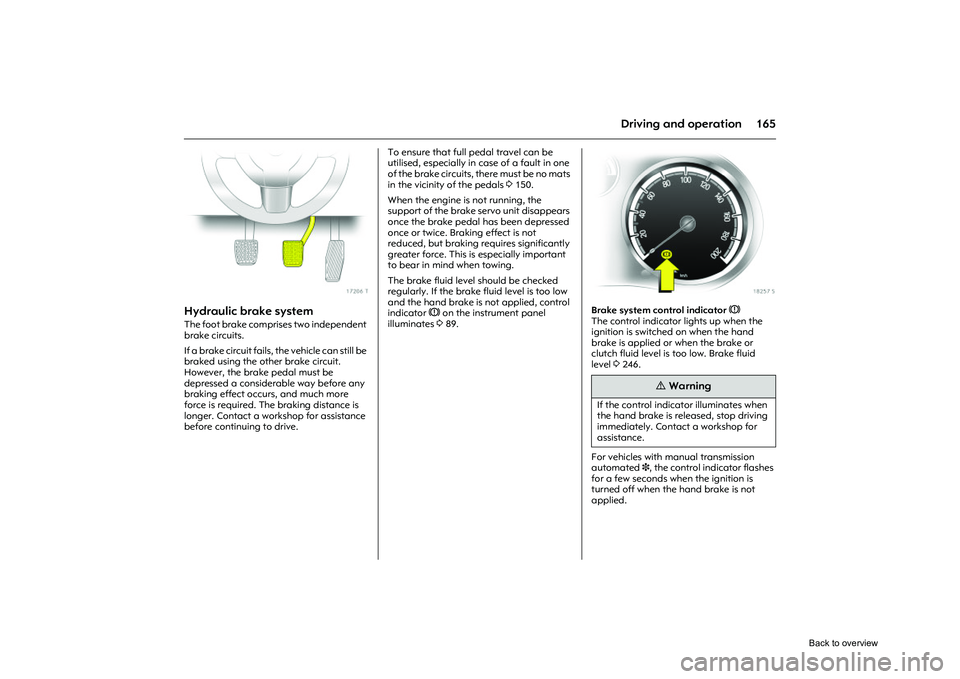
Picture no: 18257s.tif
Brake system control indicator R
The control indicator lights up when the
ignition is switched on when the hand
brake is applied or when the brake or
clutch fluid level is too low. Brake fluid
level 3246.
For vehicles with manual transmission
automated 3, the control indicator flashes
for a few seconds when the ignition is
turned off when the hand brake is not
applied.
9
Warning
If the control indicator illuminates when
the hand brake is released, stop driving
immediately. Contact a workshop for
assistance.
Back to overview
Page 195 of 284
189
Driving and operation
Driving characteristics, towing tips
Before attaching the trailer/caravan,
lubricate the ball of the trailer/caravan
towing device. However, do not lubricate
the ball if a stabiliser, which acts on the
coupling ball, is being used to damp
hunting.
Check caravan/traile r lighting before
starting to drive. The fog tail lamps on the
vehicle are deactivated when towing a
caravan or trailer.
Trailers with LED turn signals must have a
provision enables lamp monitoring for
commercial bulbs.
Ultrasonic parking sensors 3 are
deactivated in towing mode.
Handling is greatly influenced by the
loading of the trailer/caravan. Loads
should therefore be secured so that they
cannot slip and be placed in the centre of
the trailer/caravan if possible, i.e. above
the axle.
For trailers with low directional control and
for caravans with a permissible gross
vehicle weight of more than 1000 kg, a
speed of 80 km/h must not be exceeded;
use of a roll damper in accordance with the
friction principle is urgently recommended. If the trailer/caravan starts to sway, drive
more slowly, do not attempt to correct the
steering and brake sharply if necessary.
If it is necessary to apply the brakes fully,
depress the brake pedal as hard as
possible.
Remember that the braking distance for
vehicles towing caravans/trailers with and
without brake is always greater than that
for vehicles not towing a caravan/trailer.
When driving downhill, drive in the same
gear as if driving uphill and drive at a
similar speed.
Adjust tyre pressure to the value specified
for full load
3264. Starting on inclines
For vehicles with manual transmission, the
most favourable engine speed when
starting off on an incline is between
2500 and 3000 rpm for petrol engines and
between 2000 and 2200 rpm for diesel
engines. Hold engine speed constant,
engage clutch gradually (let slip), release
hand brake and open throttle. If possible,
the engine speed should not drop during
this procedure.
In vehicles with automatic transmission
3
and manual transmission automated 3 it is
sufficient to give full throttle in D or
(in automatic mode) 3.
Before starting off under extreme
operating conditions, switch off
unnecessary consumers.
Back to overview
Page 201 of 284
195
Self-help, vehicle care
Vehicles with automatic transmission 3
should be towed facing forward only and
must not be towed faster than 80 km/h or
further than 100 km. If the transmission is
defective, or if the above speed or distance
is to be exceeded, the front axle must be
raised off the ground.
Contact a workshop for assistance.
If the automatic clutch has been manually
disengaged in vehicles with manual
automated transmission 3 towing is not
permitted 3143. In this case, contact a
workshop for assistance immediately.
After towing, unscrew towing eye by
rotating clockwise and insert and close the
cap.
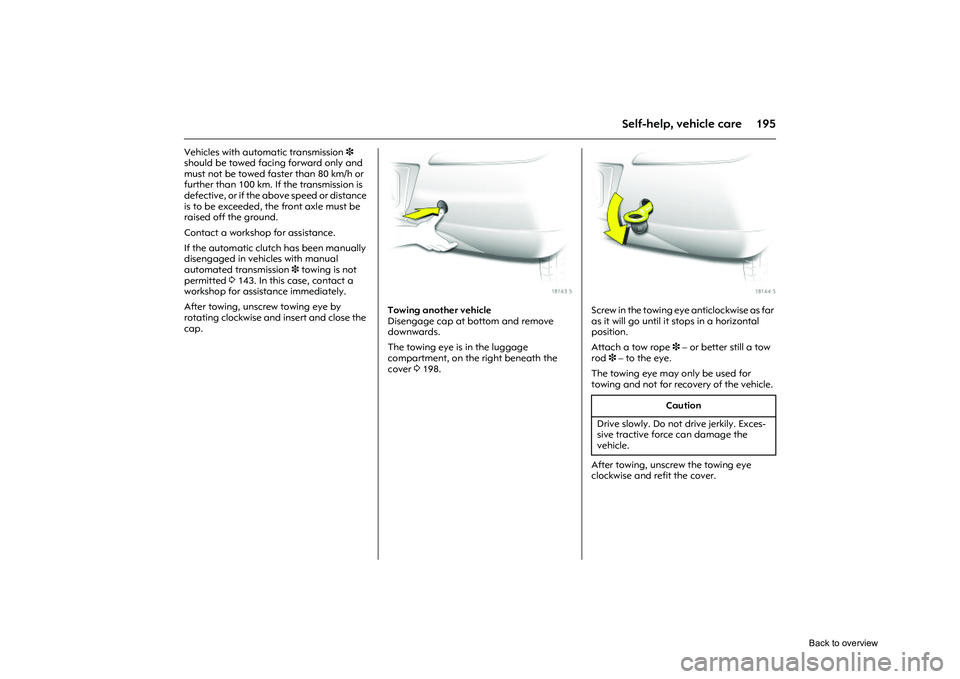
Picture no: 18143s.tif
Towing another vehicle
Disengage cap at bottom and remove
downwards.
The towing eye is in the luggage
compartment, on the right beneath the
cover 3198.
Picture no: 18144s.tif
Screw in the towing eye anticlockwise as far
as it will go until it stops in a horizontal
position.
Attach a tow rope 3 – or better still a tow
rod 3 – to the eye.
The towing eye may only be used for
towing and not for recovery of the vehicle.
After towing, unscrew the towing eye
clockwise and refit the cover.
Caution
Drive slowly. Do not drive jerkily. Exces-
sive tractive force can damage the
vehicle.
Back to overview
Page 240 of 284
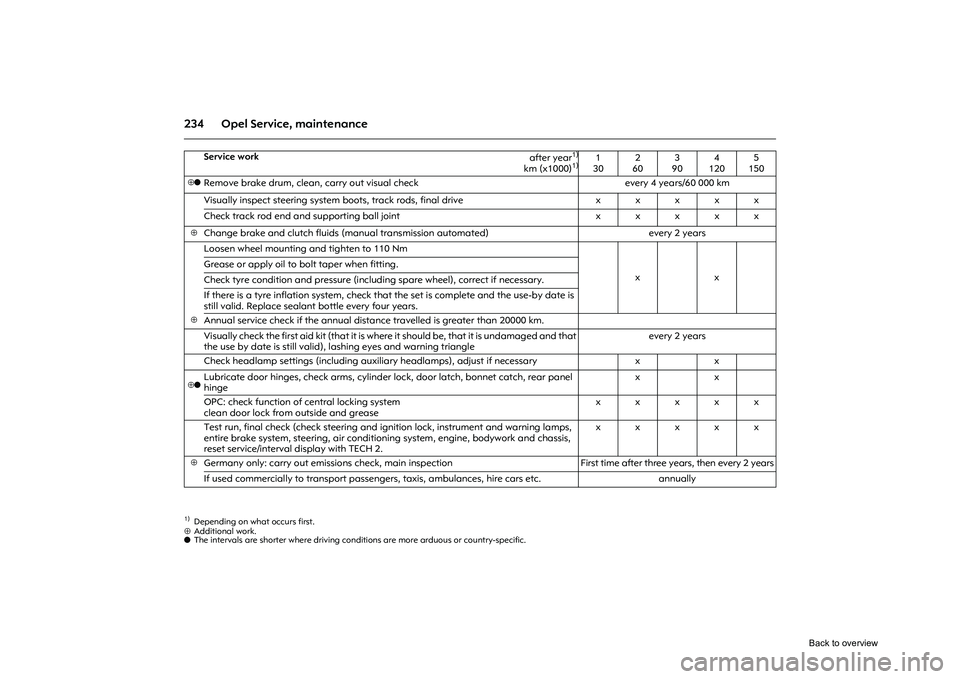
234 Opel Service, maintenance⊕Additional work.
o The intervals are shorter where driving conditions are more arduous or country-specific.
Service work
after year
1)
km (x1000)
1)
1)Depending on what occurs first.
1
30 2
60 3
90 4
120 5
150
⊕o
Remove brake drum, clean, carry out visual check every 4 years/60 000 km
Visually inspect steering system boots, track rods, final drive xxxxx
Check track rod end and supporting ball joint xxxxx
⊕
Change brake and clutch fluids (manual transmission automated) every 2 years
Loosen wheel mounting and tighten to 110 Nm
xx
Grease or apply oil to
bolt taper when fitting.
Check tyre condition and pressure (inclu ding spare wheel), correct if necessary.
If there is a tyre inflation system, check that the set is complete and the use-by date is
still valid. Replace sealant bottle every four years.
⊕
Annual service check if the annual distance travelled is greater than 20000 km.
Visually check the first aid kit (that it is wher e it should be, that it is undamaged and that
the use by date is still valid), lashing eyes and warning triangle every 2 years
Check headlamp settings (including auxi liary headlamps), adjust if necessary x x
⊕o
Lubricate door hinges, check arms, cylinder lo ck, door latch, bonnet catch, rear panel
hinge xx
OPC: check function of central locking system
clean door lock from outside and grease xxxxx
Test run, final check (check steering and ig nition lock, instrument and warning lamps,
entire brake system, steering, air conditioni ng system, engine, bodywork and chassis,
reset service/interval display with TECH 2. xxxxx
⊕
Germany only: carry out emissions check, main inspection
First time after three years, then every 2 years
If used commercially to transport passengers, taxis, ambulances, hire cars etc. annually
Back to overview