fuel consumption OPEL CORSA 2009 User Guide
[x] Cancel search | Manufacturer: OPEL, Model Year: 2009, Model line: CORSA, Model: OPEL CORSA 2009Pages: 284, PDF Size: 4.96 MB
Page 162 of 284

156 Driving and operation
Picture no: 18251s.tif
Control indicator
Z for exhaust
Illuminates when the ignition is switched on
and during the start attempt. Goes off
shortly after the engine starts running.
Illumination whilst the engine is running
indicates a fault in the emission control
system. The permissible emission limits
may be exceeded. Contact a workshop for
assistance immediately.
Illumination with the engine running
indicates a fault that can cause damage to
the catalytic converter. It is possible to
continue driving without causing damage
by slowing down until the flashing stops
and the control indicator illuminates.
Contact a workshop for assistance
immediately.
Picture no: 18231s.tif
Control indicator
A
for engine electronics
Illuminates for a few seconds after the
ignition is switched on.
If it illuminates when the engine is running,
there is a fault in engine or transmission
electronics. The electr onic system switches
to an emergency runni ng programme. Fuel
consumption may be increased and the
driveability of the vehicle may be impaired.
In some cases the fault can be remedied by
switching the engine off and starting it
again. If the control indicator continues to
illuminate whilst the en gine is running,
contact a workshop for assistance in
remedying the cause of the fault. If it illuminates briefly, but does not recur, it
is of no significance.
If
A lights up, this could mean that there
is water in the diesel fuel filter 3. A
message appears at the same time on the
service display 391. Have the fuel filter
checked for possible water contamination
by a workshop.
If it flashes after the ignition is switched on,
there is a fault in the immobiliser system.
The engine cannot be started 327.
Back to overview
Page 163 of 284
157
Driving and operation
Engine exhaust Diesel particle filter 3
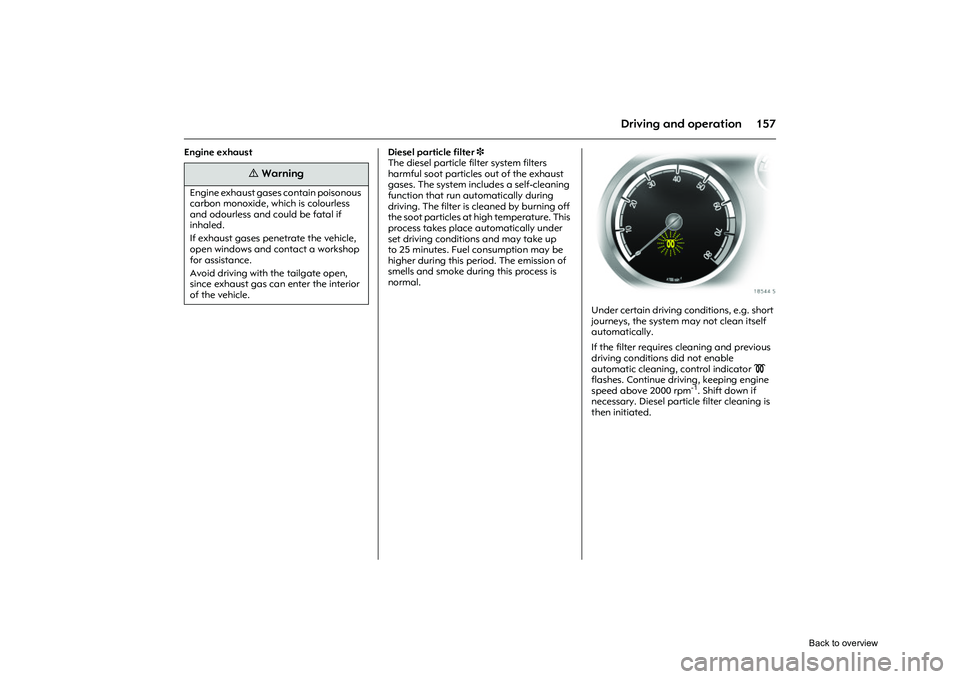
The diesel particle filter system filters
harmful soot particles out of the exhaust
gases. The system includes a self-cleaning
function that run automatically during
driving. The filter is cleaned by burning off
the soot particles at hi gh temperature. This
process takes place automatically under
set driving conditions and may take up
to 25 minutes. Fuel consumption may be
higher during this period. The emission of
smells and smoke during this process is
normal.
Picture no: 18544s.tif
Under certain driving conditions, e.g. short
journeys, the system may not clean itself
automatically.
If the filter requires cleaning and previous
driving conditions did not enable
automatic cleaning, control indicator !
flashes. Continue driving, keeping engine
speed above 2000 rpm
-1. Shift down if
necessary. Diesel partic le filter cleaning is
then initiated.
9
Warning
Engine exhaust gases contain poisonous
carbon monoxide, which is colourless
and odourless and could be fatal if
inhaled.
If exhaust gases penetrate the vehicle,
open windows and contact a workshop
for assistance.
Avoid driving with the tailgate open,
since exhaust gas can enter the interior
of the vehicle.
Back to overview
Page 256 of 284

250 Technical DataTechnical Data
Picture no: 18330s.tif
Vehicle data The technical data is determined in
accordance with European Community
standards. We reserve the right to make
modifications. Specifications in the vehicle
documents always have priority over those
given in this manual.
The identification plate is affixed to the
front right door frame.
Picture no: 17322t.tif
Information on identification plate:
Vehicle data ......................................... 250
Engine data.......................................... 252
Performance 5-door ............................ 254
Performance 3-door ............................ 255
Performance, delivery vehicle............. 255
Fuel consumption, CO
2-emissions ......
256
Weights, payload and roof load ........ 259
Tyres ..................................................... 264
Capacities ............................................ 267
Dimensions ........................................... 268
Trailer hitch installation dimensions .. 269
1 Manufacturer
2 Type approval number
3 Vehicle identification number
4 Gross vehicle weight rating
5 Permissible gross train weight
6 Maximum permissible front axle load
7 Maximum permissible rear axle load
8 Vehicle-specific or country-specific
data
Back to overview
Page 258 of 284

252 Technical DataEngine data Sales designation
Engine identifier code1.0
Z 10 XEP1.2
Z 12 XEP 1.4
Z 14 XEP 1.6
Z 16 LEL 1.6 OPC
Z 16 LER
Number of cylinders 3 4 4 4 4
Piston displacement [cm
3] 9981229 13641598 1598
Brake horse power [kW/bhp] at rpm 44
560059
5600 66
5600 110
5000 141
5850
Torque [Nm] at rpm 88
3800110
4000 125
4000210
1850 to 5000 230
1980 to 5850
Fuel type PetrolPetrol PetrolPetrol Petrol
Octane rating RON
1)
recommended
possible
possible1)Standard high-quality fuels, e.g. unleaded DIN EN 228; N = Normal (Regular), S = Super (Premium), SP = Super Plus (Premium Plus ); value printed in
bold: recommended fuel.
95 (S)
2)
98 (SP)
2)
91 (N)
2)3)
2)Knock control system automatically adjusts ignition timing according to type of fuel used (octane number).
95 (S)
2)
98 (SP)
2)
91 (N)
2)3)
95 (S)
2)
98 (SP)
2)
91 (N)
2)3)
3)Use of 91 RON fuel reduces power and torque. Slight increase in fuel consumption.
95 (S)
2)4)
98 (SP)2)
–
5)
4)Use of 95 RON fuel reduces power and torque. Slight increase in fuel consumption.
95 (S)
2)4)
98 (SP)
2)
–
5)
5)91 RON fuel must not be used. Max. permissible engine speed,
continuous operation (rpm) approx. 6200 6200 6200 6500 6500
Oil consumption [l/1000 km] 0.6 0.6 0.6 0.6 0.6
Back to overview
Page 259 of 284
![OPEL CORSA 2009 User Guide 253
Technical Data
Engine data Sales designation
Engine identifier code 1.3 CDTI
Z 13 DTJ1.3 CDTI
Z 13 DTH1.7 CDTI
Z 17 DTR
Number of cylinders 4 4 4
Piston displacement [cm
3 ] 1248 12481686
Brake h](/img/37/58224/w960_58224-258.png "OPEL CORSA 2009 User Guide 253
Technical Data
Engine data Sales designation
Engine identifier code 1.3 CDTI
Z 13 DTJ1.3 CDTI
Z 13 DTH1.7 CDTI
Z 17 DTR
Number of cylinders 4 4 4
Piston displacement [cm
3 ] 1248 12481686
Brake h")
253
Technical Data
Engine data Sales designation
Engine identifier code 1.3 CDTI
Z 13 DTJ1.3 CDTI
Z 13 DTH1.7 CDTI
Z 17 DTR
Number of cylinders 4 4 4
Piston displacement [cm
3 ] 1248 12481686
Brake horse power [kW/bhp] at rpm 55
400066
400092
4000
Torque [Nm] at rpm 170
1750 to 2500200
1750 to 2500280
2300
Fuel type DieselDieselDiesel
Cetane requirement [CZ]1)
1)standard high-quality fuels; Di esel DIN EN 590; D = Diesel.
49 (D)
2)
2)A lower value is possible with winter diesel fuels.
49 (D)
2)
49 (D)
2)
Max. permissible engine speed,
continuous operation (rpm) approx. 5100 5100 4730
Oil consumption [l/1000 km] 0.6 0.6 0.6
Back to overview
Page 262 of 284

256 Technical DataFuel consumption, CO
2-emissions
Directive 80/1268/EEC (last changed
by 2004/3/EC) has applied for the
measurement of fuel consumption
since 1996.The directive is oriented to actual driving
practices: Urban driving is rated at
approx.
1/3 and off-road driving with
approx.2/3 (urban and extra-urban
consumption). Cold starts and acceleration
phases are also taken into consideration.
The specification of CO
2-emission is also
a constituent of the directive. The figures given must not be taken as a
guarantee for the actual fuel consumption
of a particular vehicle.
All values are based on the EU base model
with standard equipment.
The calculation of fuel consumption as
specified by directive 2004/3/EC takes
account of the vehicle’s kerb weight,
ascertained in accordance with the said
regulation. Optional ex
tras may result in
slightly higher fuel consumption and
CO
2-emission levels than those quoted.
Fuel economy, Protec ting the environment
3 151.
Back to overview
Page 263 of 284

257
Technical Data
Fuel consumption, CO
2-emissions, passenger car 5-door
Engine Z 10 XEP Z 12 XEP Z 14 XEP Z 16 LEL
Conventional/sport/manual transmission
automated/automatic transmission urban [l/100 km]
extra-urban cycle [l/100 km]
combined [l/100 km]
CO
2 [g/km] –/ 7.3/–/–
–/ 4.6/–/–
–/ 5.6/–/–
–/134/–/– 7.7/ 8.0/ 7.6/–
4.7/ 5.0/ 4.6/–
5.8/ 6.1/ 5.7/–
139/146/137/– 7.7/ 8.0/–/ 8.6
4.7/ 5.0/–/ 5.4
5.8/ 6.1/–/ 6.6
139/146/–/15810.5/–/–/–
6.4/–/–/–
7.9/–/–/–
189/–/–/–
Engine Z 13 DTJ Z 13 DTH Z 17 DTR
Conventional/sport/manual transmission
automated/automatic transmission urban [l/100 km]
extra-urban cycle [l/100 km]
combined [l/100 km]
CO2 [g/km] 5.7
1)/–/–/–
3.81)/–/–/–
4.51)/–/–/–
1191)/–/–/–
1)Value is different for low-pollution version. Value not available at time of printing.
6.3/–/ 6.1/–
4.1/–/ 4.1/–
4.9/–/ 4.8/–
129/–/128/– 6.3/–/–/–
4.1/–/–/–
4.9/–/–/–
132/–/–/–
Back to overview
Page 264 of 284

258 Technical DataFuel consumption, CO
2-emissions, passenger car 3-door
EngineZ 10 XEP Z 12 XEP Z 14 XEP Z 16 LER Z 16 LEL
Conventional/sport/manual transmission
automated/automatic transmission urban [l/100 km]
extra-urban cycle [l/100 km]
combined [l/100 km]
CO
2 [g/km] –/ 7.3/–/–
–/ 4.6/–/–
–/ 5.6/–/–
–/134/–/–
7.7/ 8.0/ 7.6/–
4.7/ 5.0/ 4.6/–
5.8/ 6.1/ 5.7/–
139/146/137/–
7.7/ 8.0/–/ 8.5
4.7/ 5.0/–/ 5.3
5.8/ 6.1/–/ 6.5
139/146/–/154
10.5/–/–/–
6.4/–/–/–
7.9/–/–/–
190/–/–/–10.5/–/–/–
6.4/–/–/–
7.9/–/–/–
189/–/–/–
Engine Z 13 DTJ Z 13 DTH Z 17 DTR
Conventional/sport/manual transmission
automated/automatic transmission urban [l/100 km]
extra-urban cycle [l/100 km]
combined [l/100 km]
CO2 [g/km]
5.7
1)/–/–/–
3.81)/–/–/–
4.51)/–/–/–
1191)/–/–/–
1)Value is different for low-pollution version. Value not available at time of printing.
6.3/–/ 6.1/–
4.1/–/ 4.1/–
4.9/–/ 4.8/–
129/–/128/– 6.2/–/–/–
4.0/–/–/–
4.8/–/–/–
130/–/–/–
Fuel consumption, CO
2-emissions, delivery vehicle
Engine
Z 10 XEP Z 12 XEP Z 13 DTJ Z 13 DTH
Conventional/sport/manual transmission
automated/automatic transmission urban [l/100 km]
extra-urban cycle [l/100 km]
combined [l/100 km]
CO
2 [g/km]
7.3/–/–/–
4.6/–/–/–
5.6/–/–/–
134/–/–/–
7.7/ 8.0/ 7.6/–
4.7/ 5.0/ 4.6/–
5.8/ 6.1/ 5.7/–
139/146/137/– 5.7/–/–/–
3.8/–/–/–
4.5/–/–/–
119/–/–/–
6.3/–/ 6.1/–
4.1/–/ 4.1/–
4.9/–/ 4.8/–
129/–/128/–
Back to overview
Page 271 of 284
![OPEL CORSA 2009 User Guide 265
Technical Data
Tyre pressure (overpressure) Passenger vehicle, van Suspension behaviour when
loaded with up to 3 people
[kPa/bar] ECO
1) when loaded with up
to 3 people [kPa/bar]
1)To achieve t](/img/37/58224/w960_58224-270.png "OPEL CORSA 2009 User Guide 265
Technical Data
Tyre pressure (overpressure) Passenger vehicle, van Suspension behaviour when
loaded with up to 3 people
[kPa/bar] ECO
1) when loaded with up
to 3 people [kPa/bar]
1)To achieve t")
265
Technical Data
Tyre pressure (overpressure) Passenger vehicle, van Suspension behaviour when
loaded with up to 3 people
[kPa/bar] ECO
1) when loaded with up
to 3 people [kPa/bar]
1)To achieve the smallest amount of fuel consumption possible. Not for use with run-flat tyres.
Tyre pressure when fully laden
[kPa/bar]
Engine Tyres Front Rear Front Rear Front Rear
Z 10 XEP 185/70 R14, 185/60 R 15
2),
185/65 R 15,
195/55 R16,
195/55 RF 163),
195/60 R 15
2)Only approved as winter tyres. 3)Only for vehicles with a specific rear axle application. We recommend your Opel Partner.
200/2.0 180/1.8 270/2.7 250/2.5 260/2.6 320/3.2
Z 12 XEP,
Z 14 XEP 185/70 R14,
185/60 R15
2),
185/65 R 15,
195/55 R16,
195/55 RF 16,
195/60 R 15,
215/45 R 17 200/2.0 180/1.8 270/2.7 250/2.5 260/2.6
320/3.2
Z16LEL,
Z16LER
OPC 195/55 R164),
205/50 R 16,
215/45 R 17
4)Only permitted for use as a winter tyre. Wheel chains not permitted.
240/2.4 240/2.4 270/2.7 250/2.5 260/2.6 320/3.2
225/35 ZR 18
5)
5)Not vehicles with Z 16 LEL engine.
260/2.6 240/2.4 – –280/2.8 320/3.2
Back to overview
Page 272 of 284
![OPEL CORSA 2009 User Guide 266 Technical DataTyre pressure (overpressure) Passenger vehicle, vanSuspension behaviour when
loaded with up to 3 people
[kPa/bar] ECO
1) when loaded with up
to 3 people [kPa/bar]
1)To achieve the](/img/37/58224/w960_58224-271.png "OPEL CORSA 2009 User Guide 266 Technical DataTyre pressure (overpressure) Passenger vehicle, vanSuspension behaviour when
loaded with up to 3 people
[kPa/bar] ECO
1) when loaded with up
to 3 people [kPa/bar]
1)To achieve the")
266 Technical DataTyre pressure (overpressure) Passenger vehicle, vanSuspension behaviour when
loaded with up to 3 people
[kPa/bar] ECO
1) when loaded with up
to 3 people [kPa/bar]
1)To achieve the smallest amount of fuel consumption possible. Not for use with run-flat tyres.
Tyre pressure when fully laden
[kPa/bar]
Engine Tyres Front Rear Front Rear Front Rear
Z 13 DTJ 185/70 R14
2),
185/65 R 15,
195/55 R16,
195/55 RF 16,
195/60 R 15,
215/45 R 173)
2)Only with 14-inch brake.3)Not with low-pollution version.
200/2.0 180/1.8 270/2.7 250/2.5 260/2.6 320/3.2
185/60 R15
4)
4)Only approved as winter tyres.
220/2.2 180/1.8 – –260/2.6 320/3.2
Z 13 DTJ
ECO 175/70 R14 220/2.2 200/2.0 270/2.7 250/2.5 260/2.6
320/3.2
Z 13 DTH 185/65 R 15, 195/55 R16,
195/55 RF 16,
195/60 R 15,
215/45 R 17 220/2.2 200/2.0 270/2.7 250/2.5 260/2.6
320/3.2
185/60 R15
4)
240/2.4 200/2.0 – –260/2.6 320/3.2
Z 17 DTR 185/65 R 15, 195/55 R16,
195/55 RF 16,
195/60 R 15,
215/45 R 17 240/2.4 220/2.2 270/2.7 250/2.5 260/2.6
320/3.2
185/60 R15
4)
260/2.6 220/2.2 – –260/2.6 320/3.2
Back to overview