spare wheel OPEL CORSA 2009 User Guide
[x] Cancel search | Manufacturer: OPEL, Model Year: 2009, Model line: CORSA, Model: OPEL CORSA 2009Pages: 284, PDF Size: 4.96 MB
Page 196 of 284

190 Self-help, vehicle careSelf-help,
vehicle care
Diesel fuel system, bleeding If the tank is allowed to run dry, the diesel
fuel system must be bled. Turn over the
ignition three times for 15 seconds at a
time. Then start the engine for a maximum
of 40 seconds
1). Repeat this process after
no less than 5 seconds. If the engine fails to
start, seek the assistance of a workshop.
Picture no: 18190s.tif
Bonnet Pull the release lever located on the left
side below the instru ment panel and push
it back to its original position.
Diesel fuel system, bleeding ............... 190
Bonnet .................................................. 190
Starting the engine with jump leads
3. 191
Towing .................................................. 193
Warning triangle ¨ 3......................... 196
First-aid kit (cushion) + 3................... 196
Spare wheel 3...................................... 196
Jack £ 3 and vehicle tools 3........... 198
Changing wheels ................................. 200
Tyre repair kit 3................................... 204
Electrical system .................................. 208
Fuses and the most important circuits they protect ....................................... 209
Bulb replacement ................................ 212
Halogen headlamp system ................ 212
Adaptive Forward Lighting system 3. 216
Front indicator lamps .......................... 220
Fog lamps 3......................................... 220
Side turn signal lamp .......................... 220
Tail lamps ............................................. 221
Number plate lamp ............................. 225
Courtesy lamps .................................... 226
Vehicle care.......................................... 228
1)For technical reasons only 30 seconds are
possible on engines A 17 DTR/Z 17 DTR
Back to overview
Page 202 of 284
196 Self-help, vehicle care
Picture no: 18314s.tif
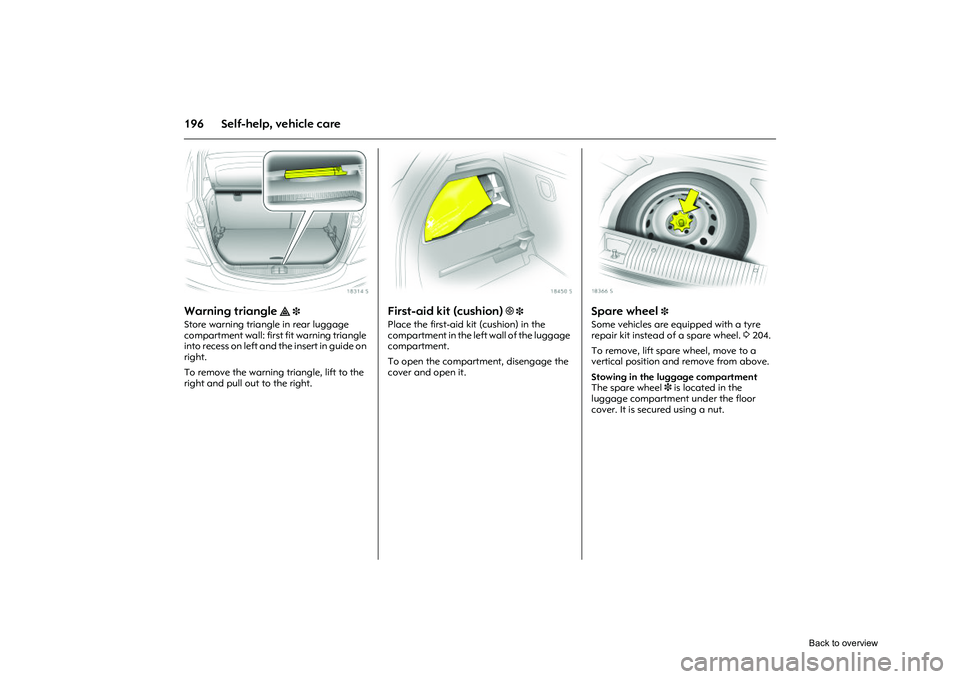
Warning triangle
¨ 3
Store warning triangle in rear luggage
compartment wall: first fit warning triangle
into recess on left and the insert in guide on
right.
To remove the warning triangle, lift to the
right and pull out to the right.
Picture no: 18450s.tif
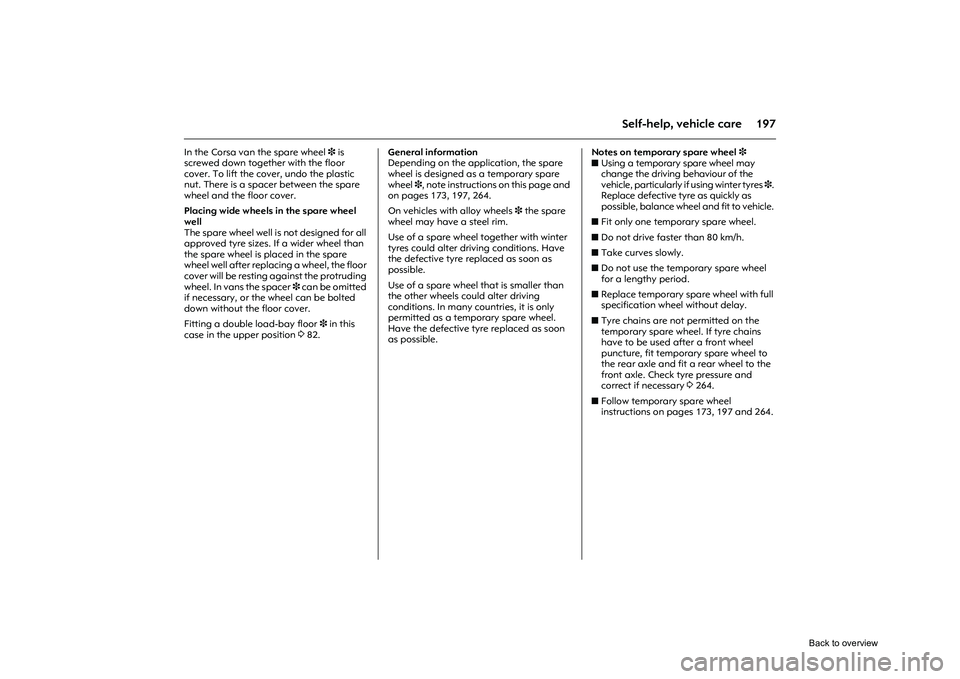
First-aid kit (cushion)
+ 3
Place the first-aid ki t (cushion) in the
compartment in the left wall of the luggage
compartment.
To open the compartment, disengage the
cover and open it.
Picture no: 18366s.tif
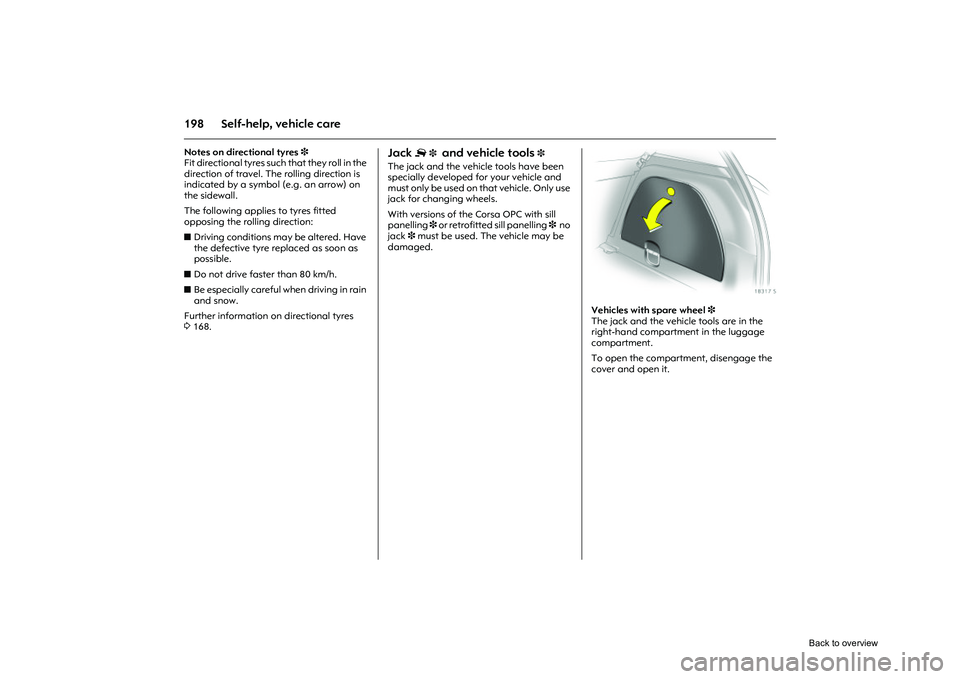
Spare wheel
3
Some vehicles are equipped with a tyre
repair kit instead of a spare wheel. 3204.
To remove, lift spare wheel, move to a
vertical position and remove from above.
Stowing in the luggage compartment
The spare wheel 3 is located in the
luggage compartment under the floor
cover. It is secured using a nut.
Back to overview
Page 203 of 284
197
Self-help, vehicle care
In the Corsa van the spare wheel 3 is
screwed down together with the floor
cover. To lift the cover, undo the plastic
nut. There is a spacer between the spare
wheel and the floor cover.
Placing wide wheels in the spare wheel
well
The spare wheel well is not designed for all
approved tyre sizes. If a wider wheel than
the spare wheel is placed in the spare
wheel well after replacing a wheel, the floor
cover will be resting against the protruding
wheel. In vans the spacer 3 can be omitted
if necessary, or the wheel can be bolted
down without the floor cover.
Fitting a double load-bay floor 3 in this
case in the upper position 382. General information
Depending on the application, the spare
wheel is designed as a temporary spare
wheel
3, note instructions on this page and
on pages 173, 197, 264.
On vehicles with alloy wheels 3 the spare
wheel may have a steel rim.
Use of a spare wheel together with winter
tyres could alter driving conditions. Have
the defective tyre replaced as soon as
possible.
Use of a spare wheel that is smaller than
the other wheels could alter driving
conditions. In many countries, it is only
permitted as a temporary spare wheel.
Have the defective tyre replaced as soon
as possible. Notes on temporary spare wheel
3
z Using a temporary spare wheel may
change the driving behaviour of the
vehicle, particularly if using winter tyres 3.
Replace defective tyre as quickly as
possible, balance wheel and fit to vehicle.
z Fit only one temporary spare wheel.
z Do not drive faster than 80 km/h.
z Take curves slowly.
z Do not use the temporary spare wheel
for a lengthy period.
z Replace temporary spare wheel with full
specification wheel without delay.
z Tyre chains are not permitted on the
temporary spare wheel. If tyre chains
have to be used after a front wheel
puncture, fit temporary spare wheel to
the rear axle and fit a rear wheel to the
front axle. Check tyre pressure and
correct if necessary 3264.
z Follow temporary spare wheel
instructions on pages 173, 197 and 264.
Back to overview
Page 204 of 284
198 Self-help, vehicle careNotes on directional tyres 3
Fit directional tyres such that they roll in the
direction of travel. The rolling direction is
indicated by a symbol (e.g. an arrow) on
the sidewall.
The following applies to tyres fitted
opposing the rolling direction:
z Driving conditions may be altered. Have
the defective tyre replaced as soon as
possible.
z Do not drive faster than 80 km/h.
z Be especially careful when driving in rain
and snow.
Further information on directional tyres
3 168.
Jack
£
3 and vehicle tools
3
The jack and the vehicle tools have been
specially developed for your vehicle and
must only be used on that vehicle. Only use
jack for changing wheels.
With versions of the Corsa OPC with sill
panelling 3 or retrofitted sill panelling 3 no
jack 3 must be used. The vehicle may be
damaged.
Picture no: 18317s.tif
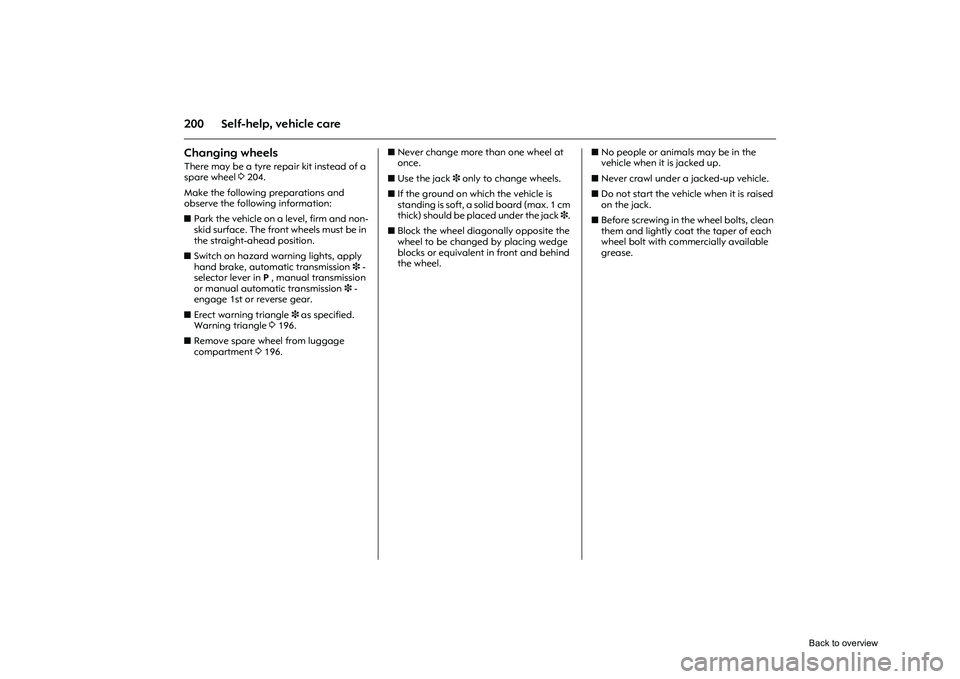
Vehicles with spare wheel 3
The jack and the vehicle tools are in the
right-hand compartm ent in the luggage
compartment.
To open the compartment, disengage the
cover and open it.
Back to overview
Page 206 of 284
200 Self-help, vehicle careChanging wheels There may be a tyre repair kit instead of a
spare wheel 3204.
Make the following preparations and
observe the following information:
z Park the vehicle on a level, firm and non-
skid surface. The front wheels must be in
the straight-ahead position.
z Switch on hazard warning lights, apply
hand brake, automa tic transmission 3 -
selector lever in P , manual transmission
or manual automatic transmission 3 -
engage 1st or reverse gear.
z Erect warning triangle 3 as specified.
Warning triangle 3196.
z Remove spare wheel from luggage
compartment 3196. z
Never change more than one wheel at
once.
z Use the jack 3 only to change wheels.
z If the ground on which the vehicle is
standing is soft, a solid board (max. 1 cm
thick) should be placed under the jack 3.
z Block the wheel diagonally opposite the
wheel to be changed by placing wedge
blocks or equivalent in front and behind
the wheel. z
No people or animals may be in the
vehicle when it is jacked up.
z Never crawl under a jacked-up vehicle.
z Do not start the vehicle when it is raised
on the jack.
z Before screwing in the wheel bolts, clean
them and lightly coat the taper of each
wheel bolt with comm ercially available
grease.
Back to overview
Page 209 of 284
203
Self-help, vehicle care
5. Unscrew the wheel bolts. If the wheel bolts have retaining
washers 3, they must not be removed.
6. Change wheel. Notes on spare wheel 3197. Notes on temporary spare wheel
3 197.
Picture no: 17249t.tif
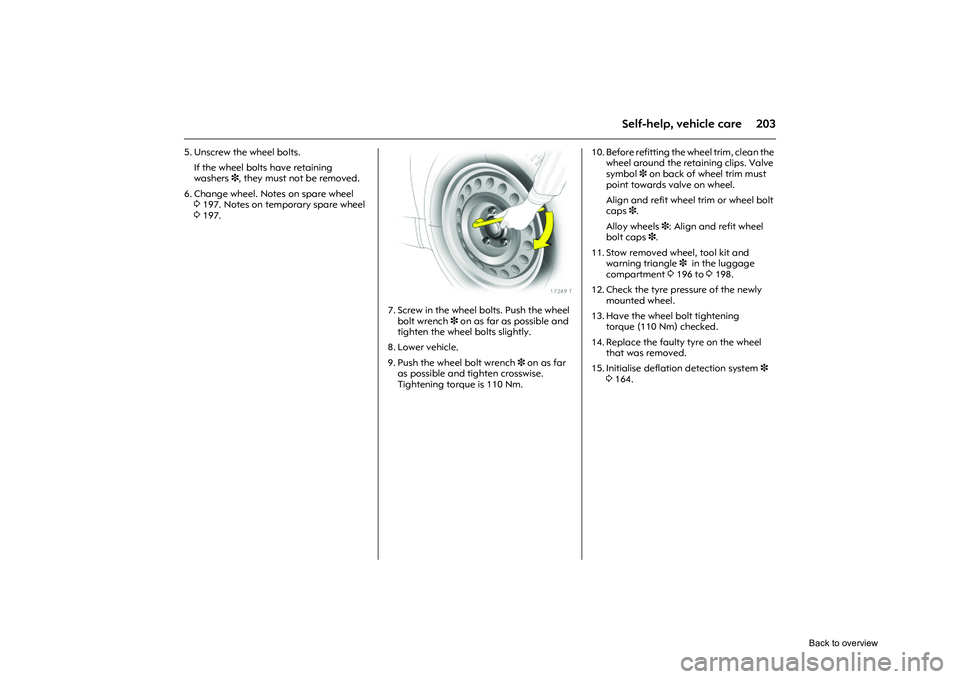
7. Screw in the wheel bolts. Push the wheel
bolt wrench 3 on as far as possible and
tighten the wheel bolts slightly.
8. Lower vehicle.
9. Push the wheel bolt wrench 3 on as far
as possible and tighten crosswise.
Tightening torque is 110 Nm. 10. Before refitting the wheel trim, clean the
wheel around the retaining clips. Valve
symbol 3 on back of wheel trim must
point towards valve on wheel.
Align and refit wheel trim or wheel bolt
caps 3.
Alloy wheels 3: Align and refit wheel
bolt caps 3.
11. Stow removed wheel, tool kit and warning triangle 3 in the luggage
compartment 3196 to 3198.
12. Check the tyre pressure of the newly mounted wheel.
13. Have the wheel bolt tightening torque (110 Nm) checked.
14. Replace the faulty tyre on the wheel that was removed.
15. Initialise deflation detection system 3
3 164.
Back to overview
Page 210 of 284
204 Self-help, vehicle careTyre repair kit
3
Minor damage to the tyre tread or side wall
can be repaired using the tyre repair kit
(does not apply to run-flat tyres).
Do not remove the foreign body from the
tyre.
T y r e d a m a g e e x c e e d i n g 4 m m o r t ha t i s o n
the rim cannot be repaired with the tyre
repair kit.
Important 3207.
In the event of a flat tyre:
z Switch on hazard warning lights, apply
handbrake, engage 1st or reverse gear,
in the case of automatic transmission 3
move selector lever to position P.
z Erect warning triangle 3 as specified.
Warning triangle 3196.
Picture no: 18317s.tif
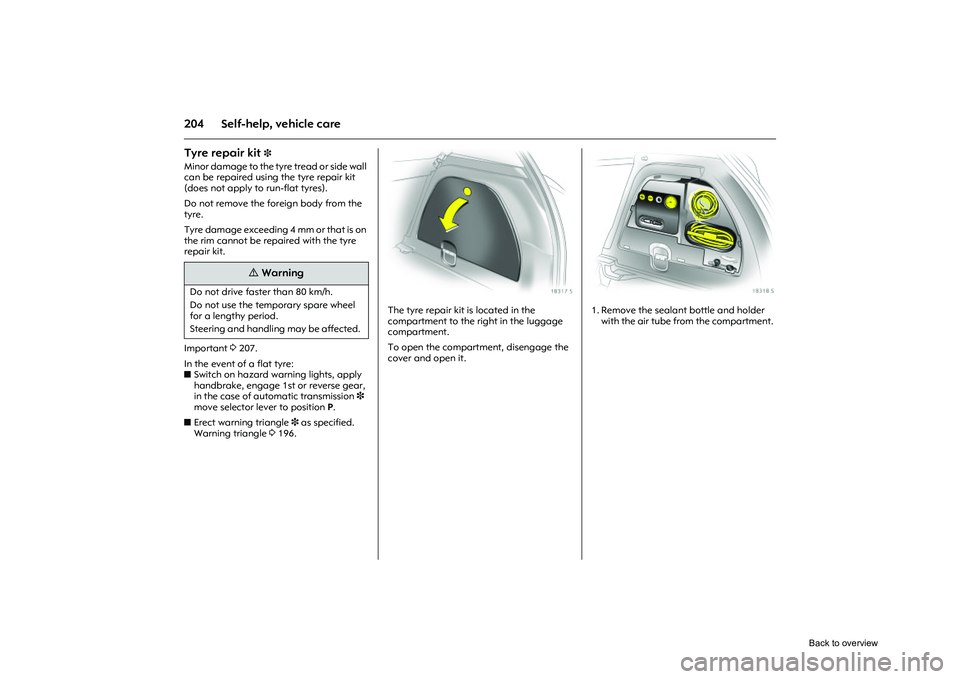
The tyre repair kit is located in the
compartment to the right in the luggage
compartment.
To open the compartment, disengage the
cover and open it.
Picture no: 18318s.tif
1. Remove the sealant bottle and holder
with the air tube from the compartment.
9
Warning
Do not drive faster than 80 km/h.
Do not use the temporary spare wheel
for a lengthy period.
Steering and handling may be affected.
Back to overview
Page 240 of 284
234 Opel Service, maintenance⊕Additional work.
o The intervals are shorter where driving conditions are more arduous or country-specific.
Service work
after year
1)
km (x1000)
1)
1)Depending on what occurs first.
1
30 2
60 3
90 4
120 5
150
⊕o
Remove brake drum, clean, carry out visual check every 4 years/60 000 km
Visually inspect steering system boots, track rods, final drive xxxxx
Check track rod end and supporting ball joint xxxxx
⊕
Change brake and clutch fluids (manual transmission automated) every 2 years
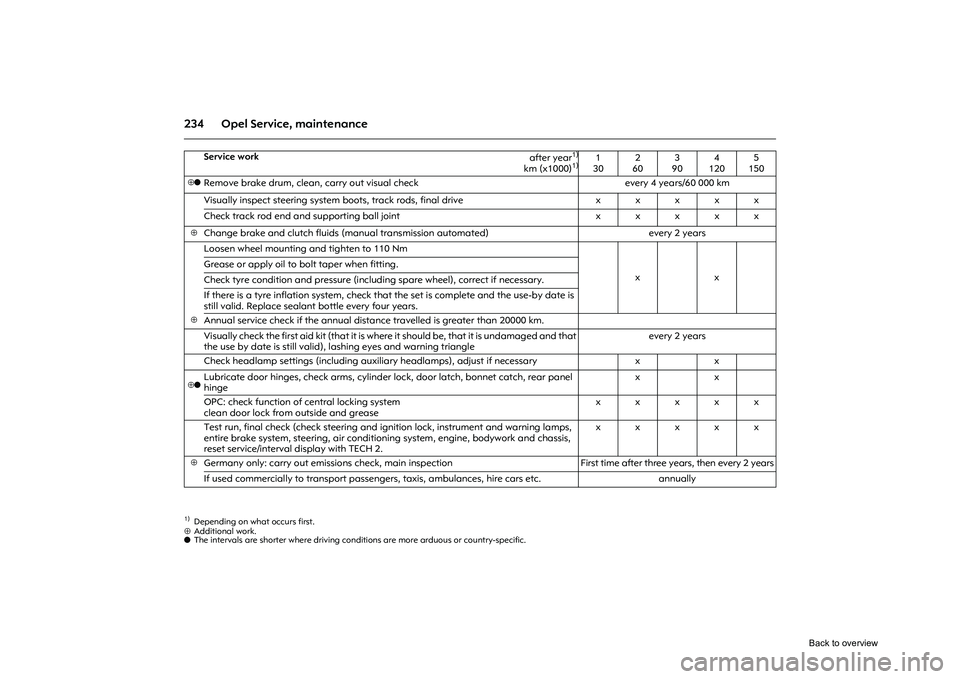
Loosen wheel mounting and tighten to 110 Nm
xx
Grease or apply oil to
bolt taper when fitting.
Check tyre condition and pressure (inclu ding spare wheel), correct if necessary.
If there is a tyre inflation system, check that the set is complete and the use-by date is
still valid. Replace sealant bottle every four years.
⊕
Annual service check if the annual distance travelled is greater than 20000 km.
Visually check the first aid kit (that it is wher e it should be, that it is undamaged and that
the use by date is still valid), lashing eyes and warning triangle every 2 years
Check headlamp settings (including auxi liary headlamps), adjust if necessary x x
⊕o
Lubricate door hinges, check arms, cylinder lo ck, door latch, bonnet catch, rear panel
hinge xx
OPC: check function of central locking system
clean door lock from outside and grease xxxxx
Test run, final check (check steering and ig nition lock, instrument and warning lamps,
entire brake system, steering, air conditioni ng system, engine, bodywork and chassis,
reset service/interval display with TECH 2. xxxxx
⊕
Germany only: carry out emissions check, main inspection
First time after three years, then every 2 years
If used commercially to transport passengers, taxis, ambulances, hire cars etc. annually
Back to overview
Page 243 of 284
237
Opel Service, maintenance
⊕ Additional work.
o The intervals are shorter where driving conditions are more arduous or country-specific.
Service work
after year
1)
km (x1000)
1)
1)Depending on what occurs first.
1
15 2
30 3
45 4
60 5
75
⊕o
Remove brake drum, clean, carry out visual check every 4 years/60000 km
Visually inspect steering system boots, track rods, final drive xxxxx
Check track rod end and supporting ball joint xxxxx
⊕
Change brake and clutch fluids (manual transmission automated) every 2 years
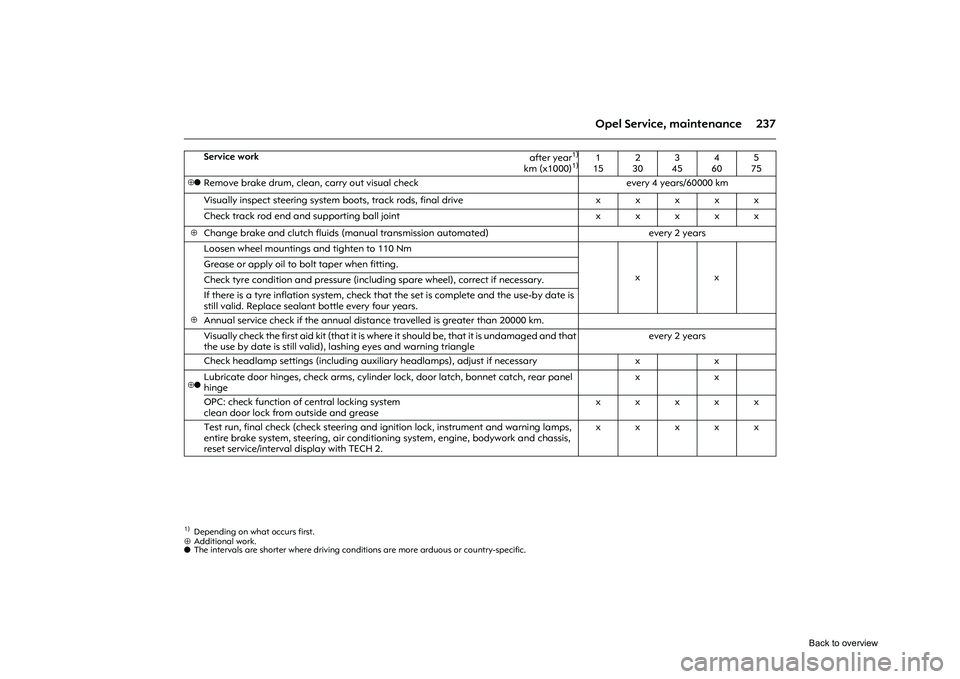
Loosen wheel mountings and tighten to 110 Nm
xx
Grease or apply oil to
bolt taper when fitting.
Check tyre condition and pressure (inclu ding spare wheel), correct if necessary.
If there is a tyre inflation system, check that the set is complete and the use-by date is
still valid. Replace sealant bottle every four years.
⊕
Annual service check if the annual distance travelled is greater than 20000 km.
Visually check the first aid kit (that it is wher e it should be, that it is undamaged and that
the use by date is still valid), lashing eyes and warning triangle every 2 years
Check headlamp settings (including auxi liary headlamps), adjust if necessary x x
⊕o
Lubricate door hinges, check arms, cylinder lo ck, door latch, bonnet catch, rear panel
hinge xx
OPC: check function of central locking system
clean door lock from outside and grease xxxxx
Test run, final check (check steering and ig nition lock, instrument and warning lamps,
entire brake system, steering, air conditioni ng system, engine, bodywork and chassis,
reset service/interval display with TECH 2. xxxxx
Back to overview
Page 270 of 284

264 Technical DataTyres Not all tyres available on the market
currently meet the structural requirements.
We recommend that you consult an Opel
Partner concerning suitable tyre makes.
These tyres have undergone special tests
to establish their reliability, safety and
specific suitability for Opel vehicles.
Despite continuous market monitoring, we
are unable to assess these attributes for
other tyres, even if they have been granted
approval by the relevant authorities or in
some other form.
Further information 3168. Wheels Wheel bolt tightening torque: 110 Nm. Winter tyres
3
Tyres of size 195/60 R 15, 215/45 R 17
and 225/35 R 18 must not be used as
winter tyres.
Tyres of size 185/60 R 15 are only approved
as winter tyres.
Tyres of size 185/65 R 15 are only
a p p r o v e d a s w i n te r t y r e s o n ve h i c l e s w i t h a
sports chassis. We recommend that you
contact your Opel partner in order to find
out whether your vehicle is equipped with a
sports chassis. If you use winter tyres, the spare wheel
3
m a y s t i l l b e f i t t e d w i t h a s u m m e r t y r e . I f y o u
use the spare wheel the vehicle’s handling
may be altered. Obtain a replacement for
the faulty tyre as soon as possible, and
have the wheel balanced and fitted to the
vehicle.
Further information 3 172.
Tyre chains
3
Tyre chains may be used on the front
wheels only.
We recommend the use of tyre chains with
a fine mesh that add no more than 10 mm
to the running surface and the insides of
the tyres (including chain lock).
Tyre chains are not permitted on tyre sizes
195/60 R 15, 215/45 R 17 and 225/35 R 18.
Tyre chains are only approved on tyres of
size 185/60 R 15 on vehicles with a sports
chassis. We recommend that you contact
your Opel partner in order to find out
whether your vehicle is equipped with a
sports chassis.
Further information 3172. Spare wheel
3
Depending on the version, the spare wheel
will be in the form of a temporary spare
wheel 3. The vehicle may handle
differently if a spare wheel has been fitted. Replace defective tyre as soon as possible,
balance wheel and fit to vehicle.
Please pay attention to the notes on this
page and on pages 173, 196.
On vehicles with alloy wheels
3 the spare
wheel may have a steel rim.
The spare wheel can be fitted with a
smaller tyre
1) and a smaller rim than the
wheels fitted on the vehicle.
Tyre pressure (overpressure) The specified tyre pressures are valid for
cold tyres. The increased tyre pressure
resulting from extensive driving must not
be reduced. The tyre pressures specified on
the following pages apply to both summer
and winter tyres.
Always inflate the spare wheel 3 to the tyre
pressure for full load – see tables on the
following pages.
Temporary spare wheel tyre pressure 3 –
see tables on the following pages.
Further information 3168 to 3172.1)Country-specific version: The spare wheel is
only to be used as a temporary spare wheel.
Back to overview