towing OPEL CORSA 2009 User Guide
[x] Cancel search | Manufacturer: OPEL, Model Year: 2009, Model line: CORSA, Model: OPEL CORSA 2009Pages: 284, PDF Size: 4.96 MB
Page 194 of 284
188 Driving and operationThe permitted caravan/trailer load applies
up to the specified incline and up to an
altitude of 1000 metres above sea level.
Since engine power decreases as altitude
increases because of the air becoming
thinner, therefore reducing climbing ability,
the permitted towing weight also
decreases by 10 % for every 1000 metres of
additional altitude. The towing weight
does not have to be reduced when driving
on roads with slight inclines (less than 8 %,
e. g. motorways).
The permissible gross train weight must not
be exceeded. This weight is specified on
the identification plate 3250. Coupling socket load
The coupling socket load is the load
exerted by the trailer/caravan on the
coupling ball. It can be varied by changing
the weight distributi
on when loading the
trailer/caravan.
The maximum permitted coupling socket
load (vehicles with engine Z 12 XEP: 45 kg,
other versions: 55 kg) of the towing vehicle
is noted on the identification plate of the
trailer towing device and specified in the
vehicle documents. This must always be
complied with, partic ularly when towing
heavy trailers. The coupling socket load
must never be less than 25 kg.
When measuring the coupling socket load,
make sure that the drawbar of the loaded
trailer/caravan is at the same height as it
will be when the trailer/caravan is coupled
with the towing vehicl e loaded. Particularly
important for trailers/caravans with
tandem axle. Rear axle load during towing
With the trailer attached and the towing
vehicle fully loaded, including all the
passengers, the permitted rear axle load
(specified on identifica
tion plate and vehicle
documents) for passenger vehicles may be
exceeded by 45 kg and the permitted total
load may be exceeded by 50 kg.
For vans the permitted rear axle load may
be exceeded by 25 kg. The permitted total
load may be exceeded by the following
amounts with the engines specified below:
Trailer operation is not permitted for vans
with tyre size 215/45 R 17.
If the permitted rear axle load is exceeded
a maximum speed of 100 km/h applies. If
lower national maximum speeds are
specified for trailer operation, they must be
complied with. Z 10 XEP 30 kg
Z 12 XEP 15 kg
Z 13 DTH 40 kg
Z 13 DTJ 35 kg
Back to overview
Page 195 of 284
189
Driving and operation
Driving characteristics, towing tips
Before attaching the trailer/caravan,
lubricate the ball of the trailer/caravan
towing device. However, do not lubricate
the ball if a stabiliser, which acts on the
coupling ball, is being used to damp
hunting.
Check caravan/traile r lighting before
starting to drive. The fog tail lamps on the
vehicle are deactivated when towing a
caravan or trailer.
Trailers with LED turn signals must have a
provision enables lamp monitoring for
commercial bulbs.
Ultrasonic parking sensors 3 are
deactivated in towing mode.
Handling is greatly influenced by the
loading of the trailer/caravan. Loads
should therefore be secured so that they
cannot slip and be placed in the centre of
the trailer/caravan if possible, i.e. above
the axle.
For trailers with low directional control and
for caravans with a permissible gross
vehicle weight of more than 1000 kg, a
speed of 80 km/h must not be exceeded;
use of a roll damper in accordance with the
friction principle is urgently recommended. If the trailer/caravan starts to sway, drive
more slowly, do not attempt to correct the
steering and brake sharply if necessary.
If it is necessary to apply the brakes fully,
depress the brake pedal as hard as
possible.
Remember that the braking distance for
vehicles towing caravans/trailers with and
without brake is always greater than that
for vehicles not towing a caravan/trailer.
When driving downhill, drive in the same
gear as if driving uphill and drive at a
similar speed.
Adjust tyre pressure to the value specified
for full load
3264. Starting on inclines
For vehicles with manual transmission, the
most favourable engine speed when
starting off on an incline is between
2500 and 3000 rpm for petrol engines and
between 2000 and 2200 rpm for diesel
engines. Hold engine speed constant,
engage clutch gradually (let slip), release
hand brake and open throttle. If possible,
the engine speed should not drop during
this procedure.
In vehicles with automatic transmission
3
and manual transmission automated 3 it is
sufficient to give full throttle in D or
(in automatic mode) 3.
Before starting off under extreme
operating conditions, switch off
unnecessary consumers.
Back to overview
Page 196 of 284

190 Self-help, vehicle careSelf-help,
vehicle care
Diesel fuel system, bleeding If the tank is allowed to run dry, the diesel
fuel system must be bled. Turn over the
ignition three times for 15 seconds at a
time. Then start the engine for a maximum
of 40 seconds
1). Repeat this process after
no less than 5 seconds. If the engine fails to
start, seek the assistance of a workshop.
Picture no: 18190s.tif
Bonnet Pull the release lever located on the left
side below the instru ment panel and push
it back to its original position.
Diesel fuel system, bleeding ............... 190
Bonnet .................................................. 190
Starting the engine with jump leads
3. 191
Towing .................................................. 193
Warning triangle ¨ 3......................... 196
First-aid kit (cushion) + 3................... 196
Spare wheel 3...................................... 196
Jack £ 3 and vehicle tools 3........... 198
Changing wheels ................................. 200
Tyre repair kit 3................................... 204
Electrical system .................................. 208
Fuses and the most important circuits they protect ....................................... 209
Bulb replacement ................................ 212
Halogen headlamp system ................ 212
Adaptive Forward Lighting system 3. 216
Front indicator lamps .......................... 220
Fog lamps 3......................................... 220
Side turn signal lamp .......................... 220
Tail lamps ............................................. 221
Number plate lamp ............................. 225
Courtesy lamps .................................... 226
Vehicle care.......................................... 228
1)For technical reasons only 30 seconds are
possible on engines A 17 DTR/Z 17 DTR
Back to overview
Page 199 of 284
193
Self-help, vehicle care
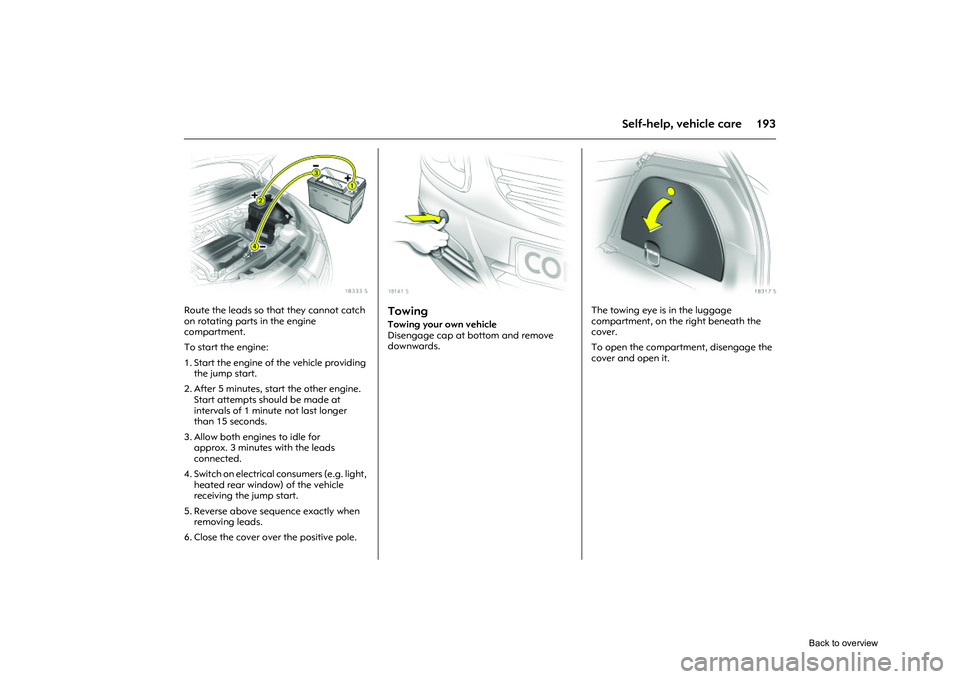
Picture no: 18333s.tif
Route the leads so that they cannot catch
on rotating parts in the engine
compartment.
To start the engine:
1. Start the engine of the vehicle providing the jump start.
2. After 5 minutes, start the other engine. Start attempts shou ld be made at
intervals of 1 minute not last longer
than 15 seconds.
3. Allow both engines to idle for approx. 3 minutes with the leads
connected.
4. Switch on electrical consumers (e.g. light, heated rear window) of the vehicle
receiving the jump start.
5. Reverse above sequence exactly when removing leads.
6. Close the cover over the positive pole.
Picture no: 18141s.tif
Towing Towing your own vehicle
Disengage cap at bottom and remove
downwards.
Picture no: 18317s.tif
The towing eye is in the luggage
compartment, on the right beneath the
cover.
To open the compartment, disengage the
cover and open it.
Back to overview
Page 200 of 284
194 Self-help, vehicle care
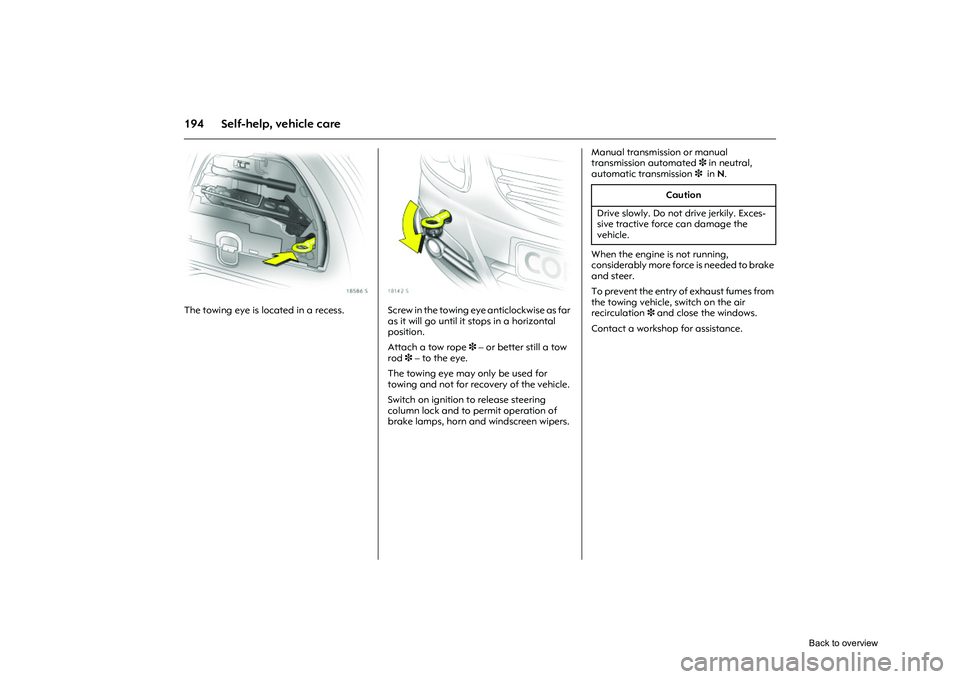
Picture no: 18586s.tif
The towing eye is located in a recess.
Picture no: 18142s.tif
Screw in the towing eye anticlockwise as far
as it will go until it stops in a horizontal
position.
Attach a tow rope 3 – or better still a tow
rod 3 – to the eye.
The towing eye may only be used for
towing and not for recovery of the vehicle.
Switch on ignition to release steering
column lock and to permit operation of
brake lamps, horn an d windscreen wipers. Manual transmission or manual
transmission automated
3 in neutral,
automatic transmission 3 in N.
When the engine is not running,
considerably more force is needed to brake
and steer.
To prevent the entry of exhaust fumes from
the towing vehicle, switch on the air
recirculation 3 and close the windows.
Contact a workshop for assistance.
Caution
Drive slowly. Do not drive jerkily. Exces-
sive tractive force can damage the
vehicle.
Back to overview
Page 201 of 284
195
Self-help, vehicle care
Vehicles with automatic transmission 3
should be towed facing forward only and
must not be towed faster than 80 km/h or
further than 100 km. If the transmission is
defective, or if the above speed or distance
is to be exceeded, the front axle must be
raised off the ground.
Contact a workshop for assistance.
If the automatic clutch has been manually
disengaged in vehicles with manual
automated transmission 3 towing is not
permitted 3143. In this case, contact a
workshop for assistance immediately.
After towing, unscrew towing eye by
rotating clockwise and insert and close the
cap.
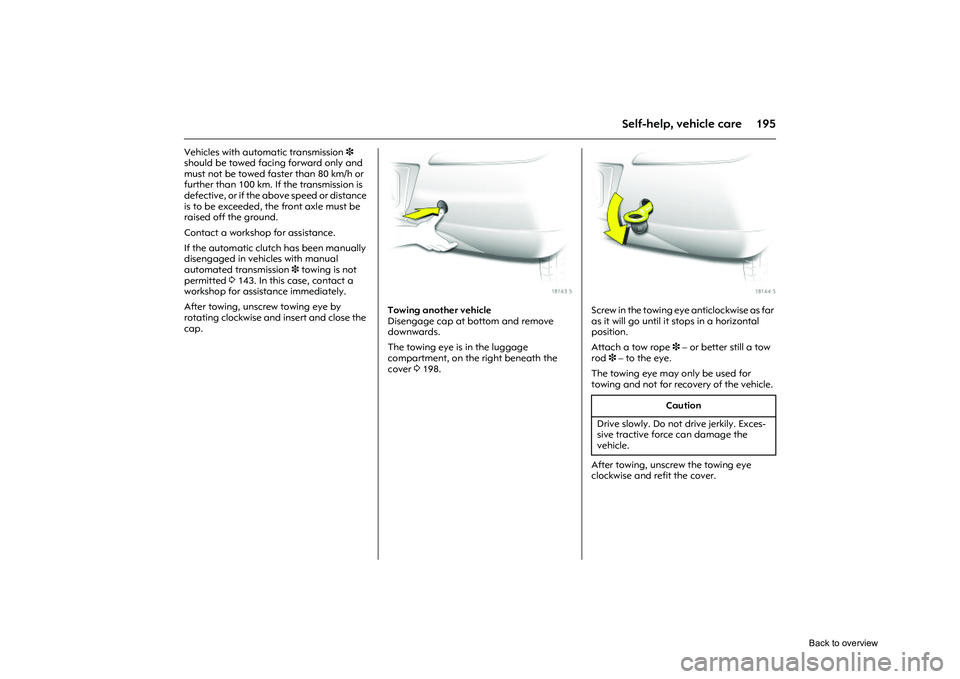
Picture no: 18143s.tif
Towing another vehicle
Disengage cap at bottom and remove
downwards.
The towing eye is in the luggage
compartment, on the right beneath the
cover 3198.
Picture no: 18144s.tif
Screw in the towing eye anticlockwise as far
as it will go until it stops in a horizontal
position.
Attach a tow rope 3 – or better still a tow
rod 3 – to the eye.
The towing eye may only be used for
towing and not for recovery of the vehicle.
After towing, unscrew the towing eye
clockwise and refit the cover.
Caution
Drive slowly. Do not drive jerkily. Exces-
sive tractive force can damage the
vehicle.
Back to overview
Page 202 of 284
196 Self-help, vehicle care
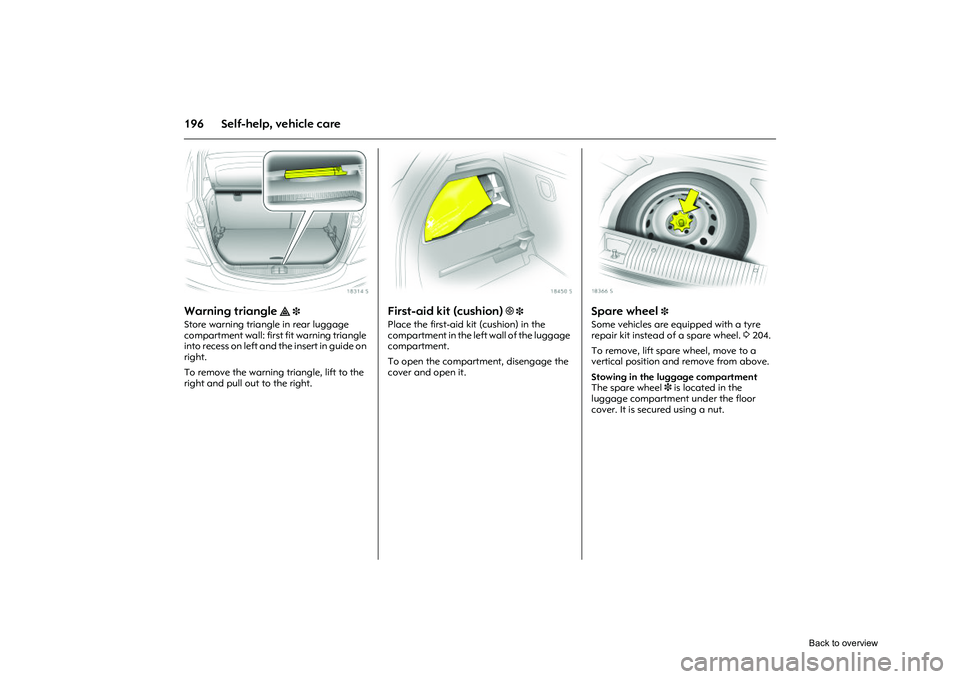
Picture no: 18314s.tif
Warning triangle
¨ 3
Store warning triangle in rear luggage
compartment wall: first fit warning triangle
into recess on left and the insert in guide on
right.
To remove the warning triangle, lift to the
right and pull out to the right.
Picture no: 18450s.tif
First-aid kit (cushion)
+ 3
Place the first-aid ki t (cushion) in the
compartment in the left wall of the luggage
compartment.
To open the compartment, disengage the
cover and open it.
Picture no: 18366s.tif
Spare wheel
3
Some vehicles are equipped with a tyre
repair kit instead of a spare wheel. 3204.
To remove, lift spare wheel, move to a
vertical position and remove from above.
Stowing in the luggage compartment
The spare wheel 3 is located in the
luggage compartment under the floor
cover. It is secured using a nut.
Back to overview
Page 217 of 284
211
Self-help, vehicle care
Picture no: 18590s.tifPicture no: 18261s.tif
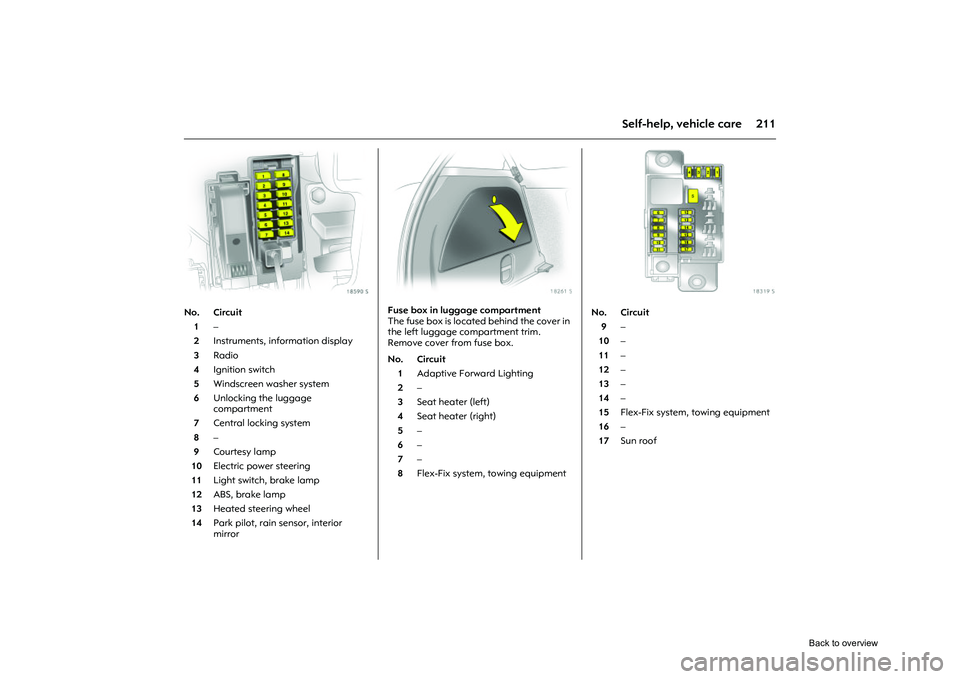
Fuse box in luggage compartment
The fuse box is located behind the cover in
the left luggage compartment trim.
Remove cover from fuse box.
Picture no: 18319s.tif
No. Circuit
1 –
2 Instruments, information display
3 Radio
4 Ignition switch
5 Windscreen washer system
6 Unlocking the luggage
compartment
7 Central locking system
8 –
9 Courtesy lamp
10 Electric power steering
11 Light switch, brake lamp
12 ABS, brake lamp
13 Heated steering wheel
14 Park pilot, rain sensor, interior
mirror
No. Circuit
1 Adaptive Forward Lighting
2 –
3 Seat heater (left)
4 Seat heater (right)
5 –
6 –
7 –
8 Flex-Fix system, towing equipment
No. Circuit
9 –
10 –
11 –
12 –
13 –
14 –
15 Flex-Fix system, towing equipment
16 –
17 Sun roof
Back to overview
Page 236 of 284
230 Self-help, vehicle careWindows
Use a soft lint-free cloth or chamois leather
together with window cleaner and insect
remover.
When cleaning the rear window, make sure
the heating element inside the window is
not damaged.
For mechanical removal of ice, use a sharp-
edged ice scraper. Press the scraper firmly
against the glass so that no dirt can get
under it and scratch the glass.
Clean smearing wiper blades with a soft
cloth and window cleaner.
Sun roof 3
Never clean with solvents or abrasives,
fuels, aggressive agents (e.g. paintwork
cleaner, solutions containing acetone,
etc.), acidic or strongly alkaline agents or
scourers.
No stickers may be applied to the sun roof. Locks
The locks are lubricated with a high-quality
locking cylinder grease
in the factory. Only
use de-icer in urgent cases, since it has a
de-greasing effect and affects the
operation of the locks. Have the locks re-
greased in a workshop after using de-icer.
Engine compartment
Clean painted surfaces in the engine
compartment like any other painted
surface.
It is advisable to wash the engine
compartment before and after winter and
preserve it with wax. Cover alternator and
brake fluid reservoir with plastic sheets
before washing the engine.
When washing the engine with a steam-jet
cleaner, do not direct the steam jet at
components of the anti-lock brake system,
the air conditioning system, the climate
control system, belt drive or the fuse box.
After an engine wash, have all engine room
components preserved thoroughly by a
workshop using protective wax.
Do not use high-pressure jet cleaners. Underbody
Some areas of the vehicle underbody have
a PVC undercoating while other critical
areas have a durable protective wax
coating.
After the underbody is washed, check the
underbody and have more protective wax
applied if necessary.
Bitumen/rubber materials could damage
the PVC coating. Have underbody work
carried out by a workshop.
Before and after winter, wash the
underbody and have the protective wax
coating checked.
Towing equipment
Do not clean the coupling ball bar with a
steam-jet or high-pressure jet cleaner.
Back to overview
Page 244 of 284
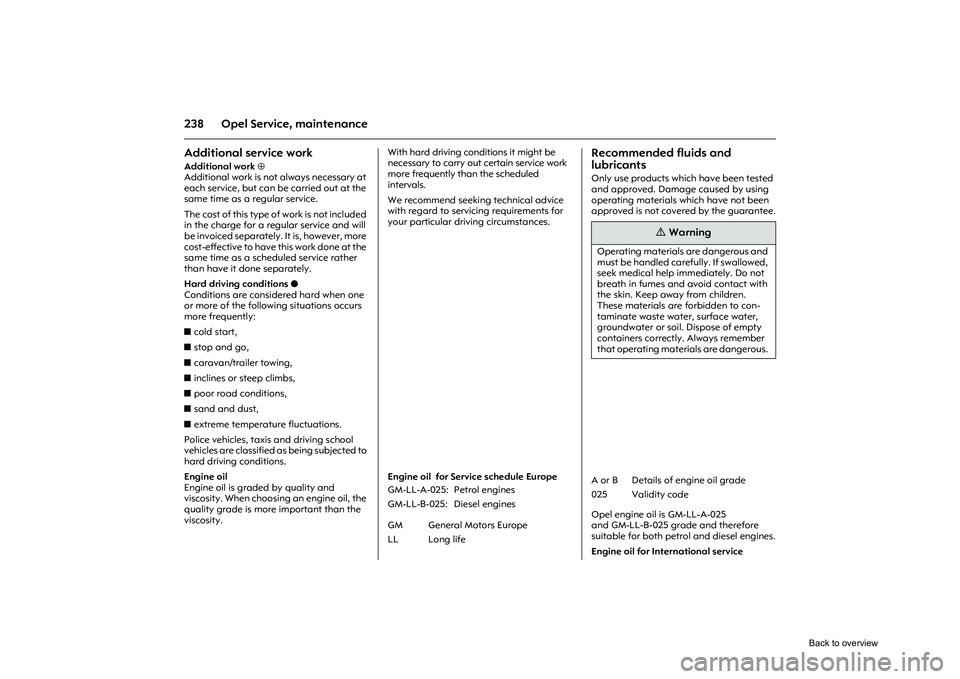
238 Opel Service, maintenanceAdditional service workAdditional work ⊕
Additional work is not always necessary at
each service, but can be carried out at the
same time as a regular service.
T h e c o s t o f th i s t y p e o f w o r k i s n o t i n c l ud e d
in the charge for a regular service and will
be invoiced separately. It is, however, more
c o s t - e f f e c t i v e t o h a v e t h i s w o r k d o n e a t t h e
same time as a scheduled service rather
than have it done separately.
Hard driving conditions o
Conditions are considered hard when one
or more of the following situations occurs
more frequently:
z cold start,
z stop and go,
z caravan/trailer towing,
z inclines or steep climbs,
z poor road conditions,
z sand and dust,
z extreme temperature fluctuations.
Police vehicles, taxis and driving school
vehicles are classified as being subjected to
hard driving conditions. With hard driving conditions it might be
necessary to carry out certain service work
more frequently than the scheduled
intervals.
We recommend seeking technical advice
with regard to servic
ing requirements for
your particular driving circumstances.
Recommended fluids and
lubricants Only use products which have been tested
and approved. Damage caused by using
operating materials which have not been
approved is not covere d by the guarantee.
Engine oil
Engine oil is graded by quality and
viscosity. When choosing an engine oil, the
quality grade is more important than the
viscosity. Engine oil for Service schedule Europe
Opel engine oil is GM-LL-A-025
and GM-LL-B-025 grade and therefore
suitable for both petrol and diesel engines.
Engine oil for International service
9
Warning
Operating materials are dangerous and
must be handled carefully. If swallowed,
seek medical help immediately. Do not
breath in fumes and avoid contact with
the skin. Keep away from children.
These materials are forbidden to con-
taminate waste water, surface water,
groundwater or soil. Dispose of empty
containers correctly. Always remember
that operating materials are dangerous.
GM-LL-A-025: Petrol engines
GM-LL-B-025: Diesel engines
GM General Motors Europe
LL Long life A or B Details of engine oil grade
025 Validity code
Back to overview