automatic transmission OPEL CORSA 2009 Owner's Manual
[x] Cancel search | Manufacturer: OPEL, Model Year: 2009, Model line: CORSA, Model: OPEL CORSA 2009Pages: 284, PDF Size: 4.96 MB
Page 156 of 284
150 Driving and operationSave energy – more kilometres
Please observe the running-in hints on the
previous page and the tips for saving
energy on the following pages.
Good, technically correct and economical
driving ensures maximum durability and
performance for your vehicle.
Overrun cut-off
The fuel supply is automatically cut off
during overrun, e.g. when the vehicle is
driven with a gear engaged but no throttle
application. Overrun cut-off is deactivated
if catalytic converter temperature is high.
Vehicles with turbocharged engine Flow-generated noises may be audible if
the accelerator is released quickly on
account of air flow in the turbocharger.
Engine speed
Drive in a low engine speed range for each
gear as much as possible. Warming up
After a cold start, the automatic
transmission
3 or manual transmission
automated 3 in automatic mode shifts into
higher gears at higher rpm. This allows the
catalytic converter to quickly reach the
temperature required for optimum pollutant
reduction.
Correct gear selection
Do not race your engine whilst in neutral or
with a low gear selected. Driving too fast in
individual gears as well as stop-and-go
traffic increases engine wear and fuel
consumption.
Change down
When decreasing speed, shift down into
the next lowest gear. Do not slip the clutch
with a high-revving engine. This is
especially important when hill climbing. Cooling fan
The cooling fan is controlled via a
thermoswitch and therefore only runs if
necessary.
The cooling fan automatically switches on
when the diesel particle filter is being
cleaned
3 depending on the engine.
Pedals
Do not place any objects in the foot well
which could slip under the pedals and
inhibit the pedal travel.
To ensure the pedal travel is uninhibited,
there must be no mats in the area of the
pedals.
Battery care
When driving slowly or when the vehicle is
stationary, e.g. in slow urban traffic, stop-
and-go traffic or traffic jams, turn off all
unnecessary electrical loads where
possible (e.g. heated rear window, heated
front seats, etc.).
Declutch when starting in order to relieve
the strain on the starter and the battery.
Back to overview
Page 166 of 284

160 Driving and operation
Picture no: 18470s.tif
Switching off
3
ESP®
Plus
can be deactivated by pressing
button v 3 .
Switching off is indicated by the control
indicator v lighting up in the
instrument. Also appears on the service
display ESPoff391.
Pressing the v button again or turning on
the ignition switches the ESP®
Plus
on again. Cruise control
3
Cruise control can store and maintain
speeds between 30 and 200 km/h.
Deviation from the stored speed may occur
when driving up or downhill.
For safety reasons the cruise control
system cannot be activated until the foot
brake has been operated, otherwise the
control indicator flashes m.
Cruise control is operated with switch m, g,
and button 0 on the turn signal stalk.
Do not use the cruise control if it is not
advisable to maintain a constant speed
(e.g. in situations presenting a danger to
yourself and other road users, in heavy
traffic or on winding, slippery or greasy
roads). With automatic transmission
3, engage
cruise control only in D, or with manual
transmission automated 3 in automatic
mode only.
9
Warning
If the vehicle has run-flat tyres 3 the
ESP®
Plus
must not be deactivated with
depressurised tyres.
9
Warning
When the cruise control is active, reac-
tion times may be increased due to the
different position of the feet.
Back to overview
Page 167 of 284
161
Driving and operation
Picture no: 18253s.tif
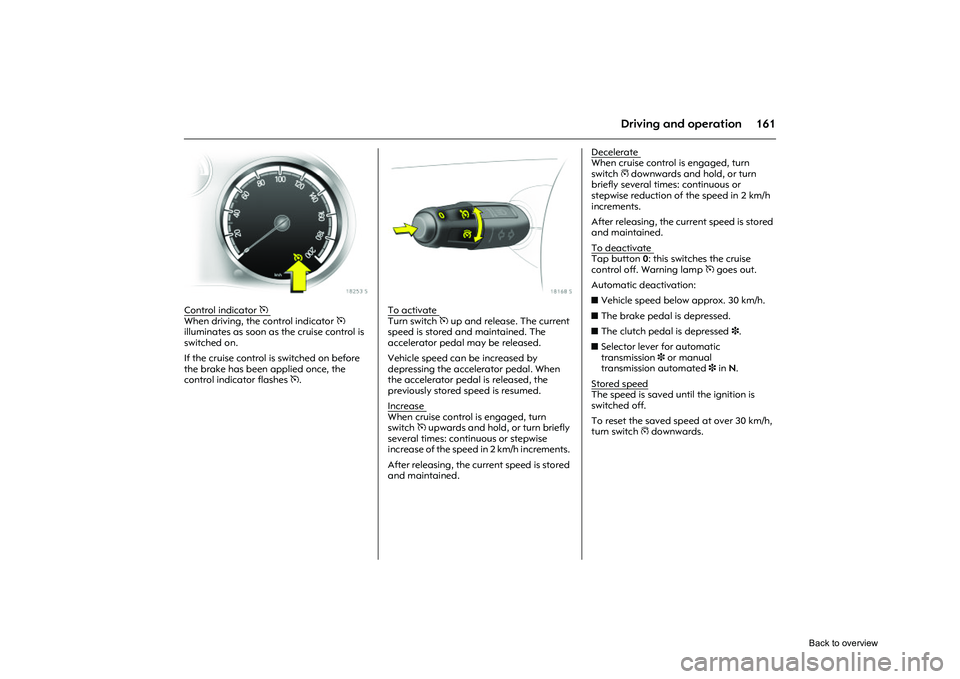
Control indicator
m
When driving, the control indicator m
illuminates as soon as the cruise control is
switched on.
If the cruise control is switched on before
the brake has been applied once, the
control indicator flashes m.
Picture no: 18168s.tif
To activate Turn switch m up and release. The current
speed is stored and maintained. The
accelerator pedal may be released.
Vehicle speed can be increased by
depressing the accelerator pedal. When
the accelerator pedal is released, the
previously stored speed is resumed.
Increase When cruise control is engaged, turn
switch m upwards and hold, or turn briefly
several times: continuous or stepwise
increase of the speed in 2 km/h increments.
After releasing, the current speed is stored
and maintained. Decelerate
When cruise control is engaged, turn
switch
g downwards and hold, or turn
briefly several times: continuous or
stepwise reduction of the speed in 2 km/h
increments.
After releasing, the current speed is stored
and maintained.
To deactivate Tap button 0: this switches the cruise
control off. Warning lamp m goes out.
Automatic deactivation:
z Vehicle speed below approx. 30 km/h.
z The brake pedal is depressed.
z The clutch pedal is depressed 3.
z Selector lever for automatic
transmission 3 or manual
transmission automated 3 in N.
Stored speedThe speed is saved until the ignition is
switched off.
To reset the saved speed at over 30 km/h,
turn switch g downwards.
Back to overview
Page 195 of 284
189
Driving and operation
Driving characteristics, towing tips
Before attaching the trailer/caravan,
lubricate the ball of the trailer/caravan
towing device. However, do not lubricate
the ball if a stabiliser, which acts on the
coupling ball, is being used to damp
hunting.
Check caravan/traile r lighting before
starting to drive. The fog tail lamps on the
vehicle are deactivated when towing a
caravan or trailer.
Trailers with LED turn signals must have a
provision enables lamp monitoring for
commercial bulbs.
Ultrasonic parking sensors 3 are
deactivated in towing mode.
Handling is greatly influenced by the
loading of the trailer/caravan. Loads
should therefore be secured so that they
cannot slip and be placed in the centre of
the trailer/caravan if possible, i.e. above
the axle.
For trailers with low directional control and
for caravans with a permissible gross
vehicle weight of more than 1000 kg, a
speed of 80 km/h must not be exceeded;
use of a roll damper in accordance with the
friction principle is urgently recommended. If the trailer/caravan starts to sway, drive
more slowly, do not attempt to correct the
steering and brake sharply if necessary.
If it is necessary to apply the brakes fully,
depress the brake pedal as hard as
possible.
Remember that the braking distance for
vehicles towing caravans/trailers with and
without brake is always greater than that
for vehicles not towing a caravan/trailer.
When driving downhill, drive in the same
gear as if driving uphill and drive at a
similar speed.
Adjust tyre pressure to the value specified
for full load
3264. Starting on inclines
For vehicles with manual transmission, the
most favourable engine speed when
starting off on an incline is between
2500 and 3000 rpm for petrol engines and
between 2000 and 2200 rpm for diesel
engines. Hold engine speed constant,
engage clutch gradually (let slip), release
hand brake and open throttle. If possible,
the engine speed should not drop during
this procedure.
In vehicles with automatic transmission
3
and manual transmission automated 3 it is
sufficient to give full throttle in D or
(in automatic mode) 3.
Before starting off under extreme
operating conditions, switch off
unnecessary consumers.
Back to overview
Page 200 of 284
194 Self-help, vehicle care
Picture no: 18586s.tif
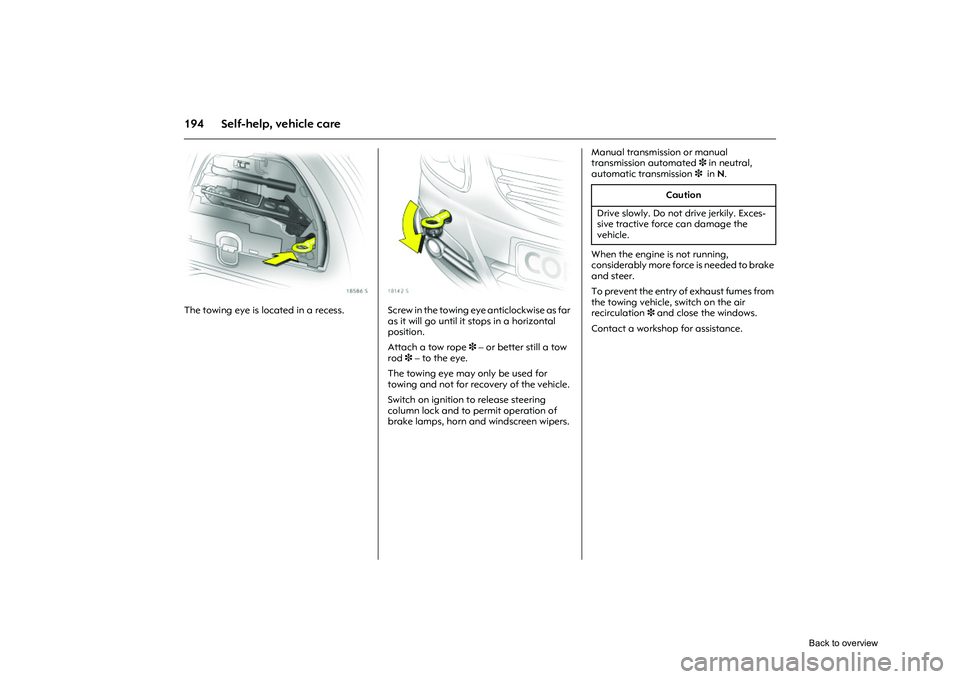
The towing eye is located in a recess.
Picture no: 18142s.tif
Screw in the towing eye anticlockwise as far
as it will go until it stops in a horizontal
position.
Attach a tow rope 3 – or better still a tow
rod 3 – to the eye.
The towing eye may only be used for
towing and not for recovery of the vehicle.
Switch on ignition to release steering
column lock and to permit operation of
brake lamps, horn an d windscreen wipers. Manual transmission or manual
transmission automated
3 in neutral,
automatic transmission 3 in N.
When the engine is not running,
considerably more force is needed to brake
and steer.
To prevent the entry of exhaust fumes from
the towing vehicle, switch on the air
recirculation 3 and close the windows.
Contact a workshop for assistance.
Caution
Drive slowly. Do not drive jerkily. Exces-
sive tractive force can damage the
vehicle.
Back to overview
Page 201 of 284
195
Self-help, vehicle care
Vehicles with automatic transmission 3
should be towed facing forward only and
must not be towed faster than 80 km/h or
further than 100 km. If the transmission is
defective, or if the above speed or distance
is to be exceeded, the front axle must be
raised off the ground.
Contact a workshop for assistance.
If the automatic clutch has been manually
disengaged in vehicles with manual
automated transmission 3 towing is not
permitted 3143. In this case, contact a
workshop for assistance immediately.
After towing, unscrew towing eye by
rotating clockwise and insert and close the
cap.
Picture no: 18143s.tif
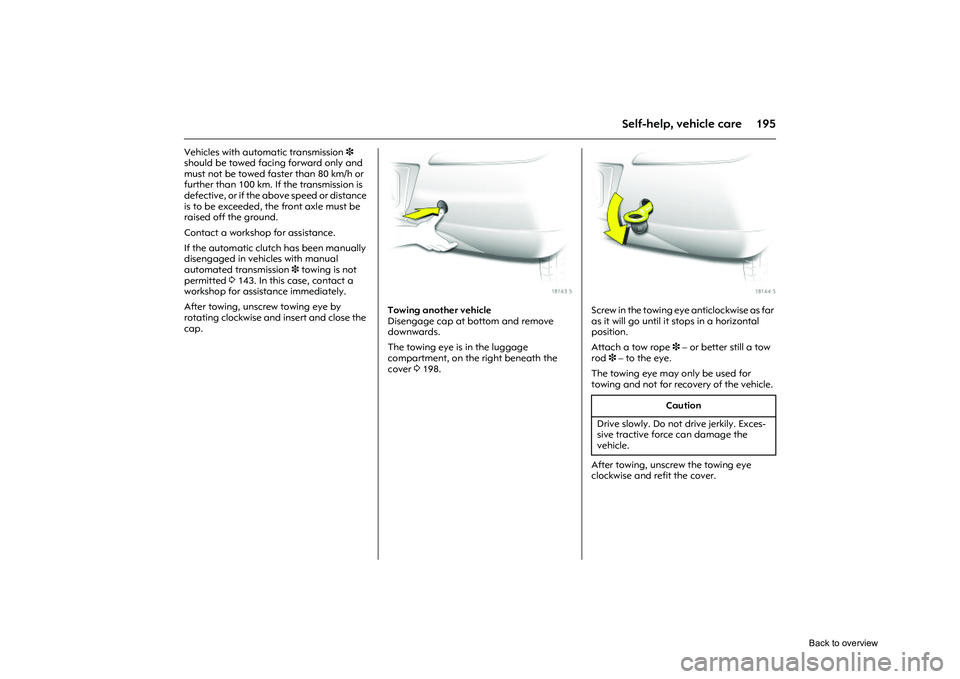
Towing another vehicle
Disengage cap at bottom and remove
downwards.
The towing eye is in the luggage
compartment, on the right beneath the
cover 3198.
Picture no: 18144s.tif
Screw in the towing eye anticlockwise as far
as it will go until it stops in a horizontal
position.
Attach a tow rope 3 – or better still a tow
rod 3 – to the eye.
The towing eye may only be used for
towing and not for recovery of the vehicle.
After towing, unscrew the towing eye
clockwise and refit the cover.
Caution
Drive slowly. Do not drive jerkily. Exces-
sive tractive force can damage the
vehicle.
Back to overview
Page 206 of 284
200 Self-help, vehicle careChanging wheels There may be a tyre repair kit instead of a
spare wheel 3204.
Make the following preparations and
observe the following information:
z Park the vehicle on a level, firm and non-
skid surface. The front wheels must be in
the straight-ahead position.
z Switch on hazard warning lights, apply
hand brake, automa tic transmission 3 -
selector lever in P , manual transmission
or manual automatic transmission 3 -
engage 1st or reverse gear.
z Erect warning triangle 3 as specified.
Warning triangle 3196.
z Remove spare wheel from luggage
compartment 3196. z
Never change more than one wheel at
once.
z Use the jack 3 only to change wheels.
z If the ground on which the vehicle is
standing is soft, a solid board (max. 1 cm
thick) should be placed under the jack 3.
z Block the wheel diagonally opposite the
wheel to be changed by placing wedge
blocks or equivalent in front and behind
the wheel. z
No people or animals may be in the
vehicle when it is jacked up.
z Never crawl under a jacked-up vehicle.
z Do not start the vehicle when it is raised
on the jack.
z Before screwing in the wheel bolts, clean
them and lightly coat the taper of each
wheel bolt with comm ercially available
grease.
Back to overview
Page 210 of 284
204 Self-help, vehicle careTyre repair kit
3
Minor damage to the tyre tread or side wall
can be repaired using the tyre repair kit
(does not apply to run-flat tyres).
Do not remove the foreign body from the
tyre.
T y r e d a m a g e e x c e e d i n g 4 m m o r t ha t i s o n
the rim cannot be repaired with the tyre
repair kit.
Important 3207.
In the event of a flat tyre:
z Switch on hazard warning lights, apply
handbrake, engage 1st or reverse gear,
in the case of automatic transmission 3
move selector lever to position P.
z Erect warning triangle 3 as specified.
Warning triangle 3196.
Picture no: 18317s.tif
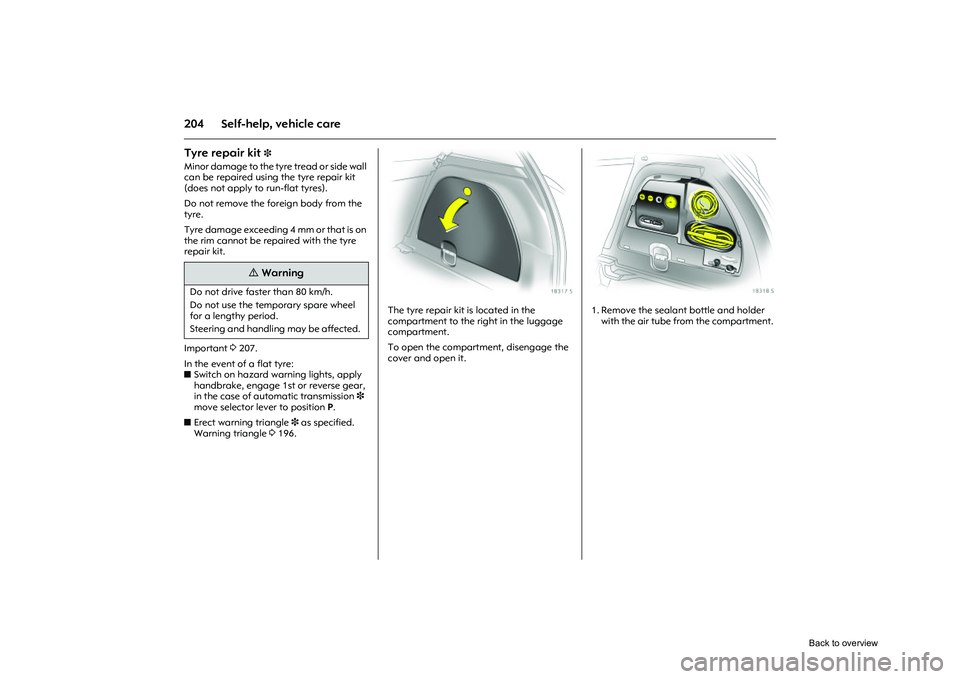
The tyre repair kit is located in the
compartment to the right in the luggage
compartment.
To open the compartment, disengage the
cover and open it.
Picture no: 18318s.tif
1. Remove the sealant bottle and holder
with the air tube from the compartment.
9
Warning
Do not drive faster than 80 km/h.
Do not use the temporary spare wheel
for a lengthy period.
Steering and handling may be affected.
Back to overview
Page 215 of 284
209
Self-help, vehicle care
Picture no: 18588s.tif
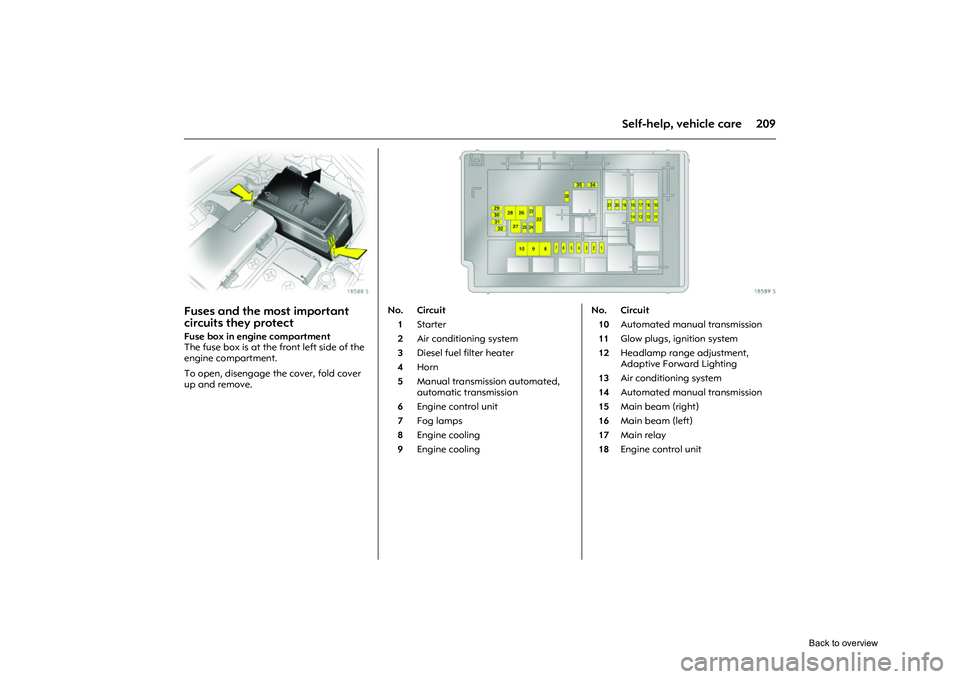
Fuses and the most important
circuits they protectFuse box in engine compartment
The fuse box is at the front left side of the
engine compartment.
To open, disengage the cover, fold cover
up and remove.
Picture no: 18589s.tif Picture no:
No. Circuit
1 Starter
2 Air conditioning system
3 Diesel fuel filter heater
4 Horn
5 Manual transmission automated,
automatic transmission
6 Engine control unit
7 Fog lamps
8 Engine cooling
9 Engine cooling
No. Circuit
10 Automated manual transmission
11 Glow plugs, ignition system
12 Headlamp range adjustment,
Adaptive Forward Lighting
13 Air conditioning system
14 Automated manual transmission
15 Main beam (right)
16 Main beam (left)
17 Main relay
18 Engine control unit
Back to overview
Page 255 of 284

249
Opel Service, maintenance
Protecting electronic components In order to prevent faults in electronic
components in the electrical system, never
connect or disconnect battery with engine
running or ignition switched on. Never start
engine with battery disconnected, e.g.
when starting using jump leads.
To avoid damaging th e vehicle, do not
make any modifications to the electrical
system, e. g. connecting additional
consumers or tampering with electronic
control units (chip tuning).
Laying the vehicle up for a long
period of time If the vehicle is to be laid up for several
months, the following work should be
undertaken to prevent damage:
z Wash and wax the vehicle 3228.
z Have the wax in the engine
compartment and underbody checked.
z Clean and preserve rubber seals.
z Change engine oil.
z Check antifreeze and corrosion
protection 3244.
z Check coolant level, add antifreeze if
necessary 3245.
z Drain the windscreen washer system.
z Increase tyre pressure to value given for
full load 3264. z
Park the vehicle in dry and well
ventilated place. Select first gear or
reverse gear, and with automatic
transmission 3 move selector lever to P.
Use chocks or something similar to
prevent vehicle from rolling.
z Do not apply hand brake.
z Disconnect the clamp from the negative
terminal of the vehicle battery.
Putting the vehicle back into
servicePerform the following work before
recommissioning the vehicle:
zConnect the clamp to the negative
terminal of the vehicle battery.
z Check tyre pressure 3264.
z Top up windscreen washer system 3248.
z Check engine oil level 3242.
z Check coolant level 3245.
z Fit the number plate if necessary.
9
Warning
Electronic ignition systems generate very
high voltages. Do not touch the ignition
system; high voltage can be fatal.
Back to overview