steering OPEL CORSA 2009 Owner's Guide
[x] Cancel search | Manufacturer: OPEL, Model Year: 2009, Model line: CORSA, Model: OPEL CORSA 2009Pages: 284, PDF Size: 4.96 MB
Page 123 of 284

117
Lighting
Headlamps when driving abroad The asymmetrical dipped beam increases
the field of vision on the passenger side of
the lane.
This causes glare for oncoming traffic if the
vehicle is driven in countries where traffic
drives on the opposite side of the road. Do as follows to prevent glare:
Vehicles with halogen headlamps
Have headlights conv
erted in a workshop. Vehicles with Adaptive Forward Lighting
3
(AFL)
1. Pull and hold stalk for main beam on steering wheel (headlamp flash).
2. Switch on ignition.
3. After approx. 3 seconds, an acoustic signal sounds and then AFL control
indicator
B flashes approx. 4 seconds.
After the switch, AFL control indicator
B
flashes for 4 seconds each time the ignition
is switched on.
To return to asymmetrical dipped beam,
pull and hold the main beam stalk again,
switch on the ignition and wait for the
acoustic signal. AFL control indicator
B
will then discontinue flashing.
Control indicator
B
3 85. 3112.
Back to overview
Page 124 of 284
118 Infotainment systemInfotainment system
Radio reception
3
Radio reception may be disrupted by
static, noise, distortion or loss of reception
due to
zchanges in dist ance from the
transmitter,
z multi-path reception due to reflection
and
z shadowing. Infotainment system
3
The infotainment system is operated as
described in the operating instructions.
Picture no: 18188s.tif
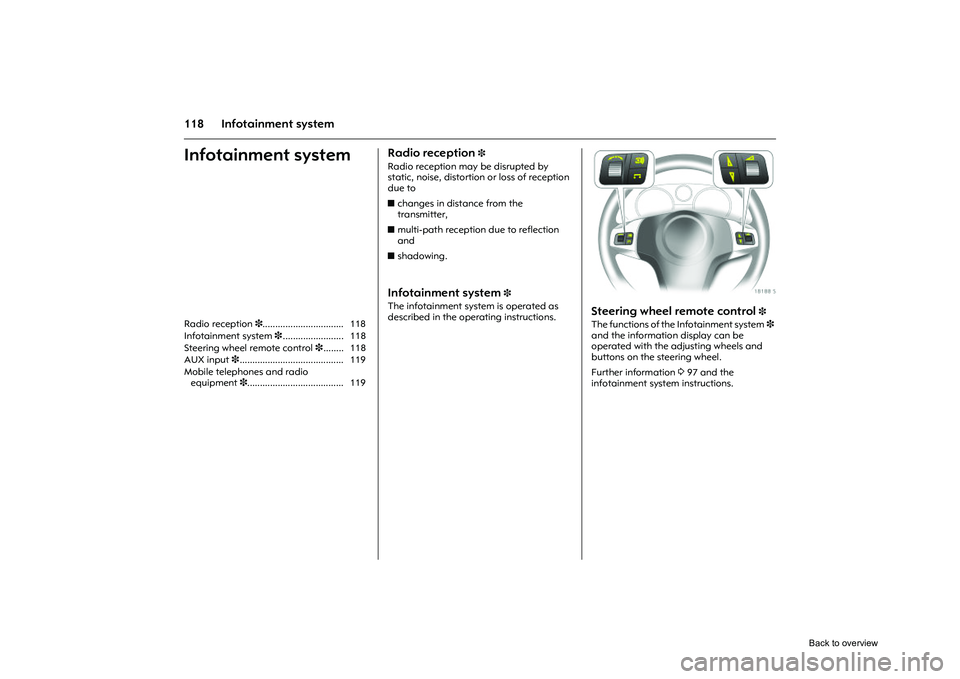
Steering wheel remote control
3
The functions of the Infotainment system 3
and the information display can be
operated with the adjusting wheels and
buttons on the steering wheel.
Further information 397 and the
infotainment system instructions.
Radio reception
3................................ 118
Infotainment system 3........................ 118
Steering wheel remote control 3........ 118
AUX input 3......................................... 119
Mobile telephones and radio equipment 3...................................... 119
Back to overview
Page 155 of 284

149
Driving and operation
Driving hints The first 1000 km
Drive your vehicle at various speeds. Do
not use full throttle. Never allow the engine
to labour at low revs.
Make good use of all gears. Depress the
accelerator pedal a maximum of about
3/4
of the available pedal travel in all gears.
Do not drive faster than three quarters of
maximum speed.
Do not brake unnecessarily hard for the
first 200 km.
During the first drive smoke may develop
because of wax and oil evaporating on the
exhaust system. Park the vehicle in the
open for a while after the first drive and
avoid inhaling the fumes.
Fuel and engine oil consumption is higher
than normal during the running-in period.
Never coast with engine not running
Many units will not function in this situation
(e.g. brake servo unit, electro-hydraulic
power steering). Driving in this manner is a
danger to yourself and others. Brake servo unit
When the engine is not running, the brake
servo unit is no longer effective once the
brake pedal has been depressed once or
twice. Braking effect is not reduced, but
significantly greater force is required for
braking.
Electro-hydraulic power assisted steering
If the power assisted steering fails when
being towed with the engine switched off,
the vehicle can still be steered, but
considerably more force is required.
Driving in mountainous terrain or with a
trailer/caravan
The cooling fan is elec
trically operated. Its
cooling power is therefore independent of
the engine speed.
Since a considerable amount of heat is
generated at high engine speeds and less
at slower speeds, do not shift down when
climbing hills whilst the vehicle is still coping
with the gradient in the higher gear. Driving with a roof load
Do not exceed the permissible roof load
3
173, 3259. For reasons of safety,
distribute the load evenly and secure it
properly with retaining straps. Adjust tyre
pressure to load conditions. Do not drive
faster than 120 km/h. Check and re-tighten
the straps frequently. Observe country-
specific regulations.
Switching off the engine
When you switch off, fans in the engine
compartment may continue running for a
time to cool the engine.
If the engine temperature is very high, e.g.
after driving in mountainous terrain: allow
the engine to idle for approximately two
minutes in order to prevent heat
accumulation.
Vehicles with turbocharged engine
After running at high engine speeds or
high engine loads, operate the engine
briefly at a low load or run in neutral for
approx. 30 seconds befo re switching off
in order to protect the turbocharger.
Back to overview
Page 195 of 284
189
Driving and operation
Driving characteristics, towing tips
Before attaching the trailer/caravan,
lubricate the ball of the trailer/caravan
towing device. However, do not lubricate
the ball if a stabiliser, which acts on the
coupling ball, is being used to damp
hunting.
Check caravan/traile r lighting before
starting to drive. The fog tail lamps on the
vehicle are deactivated when towing a
caravan or trailer.
Trailers with LED turn signals must have a
provision enables lamp monitoring for
commercial bulbs.
Ultrasonic parking sensors 3 are
deactivated in towing mode.
Handling is greatly influenced by the
loading of the trailer/caravan. Loads
should therefore be secured so that they
cannot slip and be placed in the centre of
the trailer/caravan if possible, i.e. above
the axle.
For trailers with low directional control and
for caravans with a permissible gross
vehicle weight of more than 1000 kg, a
speed of 80 km/h must not be exceeded;
use of a roll damper in accordance with the
friction principle is urgently recommended. If the trailer/caravan starts to sway, drive
more slowly, do not attempt to correct the
steering and brake sharply if necessary.
If it is necessary to apply the brakes fully,
depress the brake pedal as hard as
possible.
Remember that the braking distance for
vehicles towing caravans/trailers with and
without brake is always greater than that
for vehicles not towing a caravan/trailer.
When driving downhill, drive in the same
gear as if driving uphill and drive at a
similar speed.
Adjust tyre pressure to the value specified
for full load
3264. Starting on inclines
For vehicles with manual transmission, the
most favourable engine speed when
starting off on an incline is between
2500 and 3000 rpm for petrol engines and
between 2000 and 2200 rpm for diesel
engines. Hold engine speed constant,
engage clutch gradually (let slip), release
hand brake and open throttle. If possible,
the engine speed should not drop during
this procedure.
In vehicles with automatic transmission
3
and manual transmission automated 3 it is
sufficient to give full throttle in D or
(in automatic mode) 3.
Before starting off under extreme
operating conditions, switch off
unnecessary consumers.
Back to overview
Page 200 of 284
194 Self-help, vehicle care
Picture no: 18586s.tif
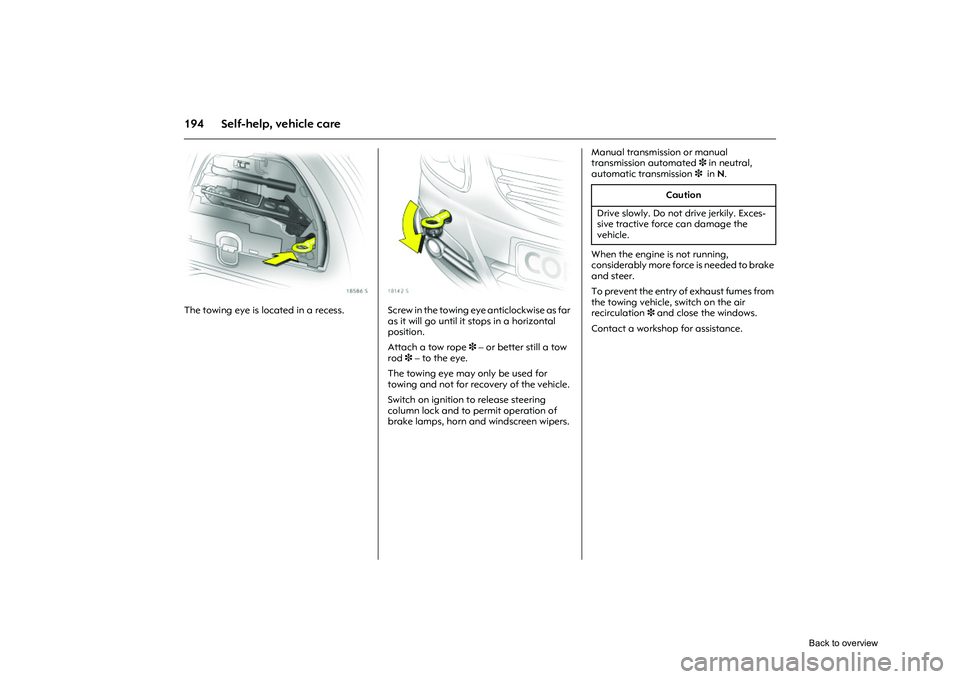
The towing eye is located in a recess.
Picture no: 18142s.tif
Screw in the towing eye anticlockwise as far
as it will go until it stops in a horizontal
position.
Attach a tow rope 3 – or better still a tow
rod 3 – to the eye.
The towing eye may only be used for
towing and not for recovery of the vehicle.
Switch on ignition to release steering
column lock and to permit operation of
brake lamps, horn an d windscreen wipers. Manual transmission or manual
transmission automated
3 in neutral,
automatic transmission 3 in N.
When the engine is not running,
considerably more force is needed to brake
and steer.
To prevent the entry of exhaust fumes from
the towing vehicle, switch on the air
recirculation 3 and close the windows.
Contact a workshop for assistance.
Caution
Drive slowly. Do not drive jerkily. Exces-
sive tractive force can damage the
vehicle.
Back to overview
Page 210 of 284
204 Self-help, vehicle careTyre repair kit
3
Minor damage to the tyre tread or side wall
can be repaired using the tyre repair kit
(does not apply to run-flat tyres).
Do not remove the foreign body from the
tyre.
T y r e d a m a g e e x c e e d i n g 4 m m o r t ha t i s o n
the rim cannot be repaired with the tyre
repair kit.
Important 3207.
In the event of a flat tyre:
z Switch on hazard warning lights, apply
handbrake, engage 1st or reverse gear,
in the case of automatic transmission 3
move selector lever to position P.
z Erect warning triangle 3 as specified.
Warning triangle 3196.
Picture no: 18317s.tif
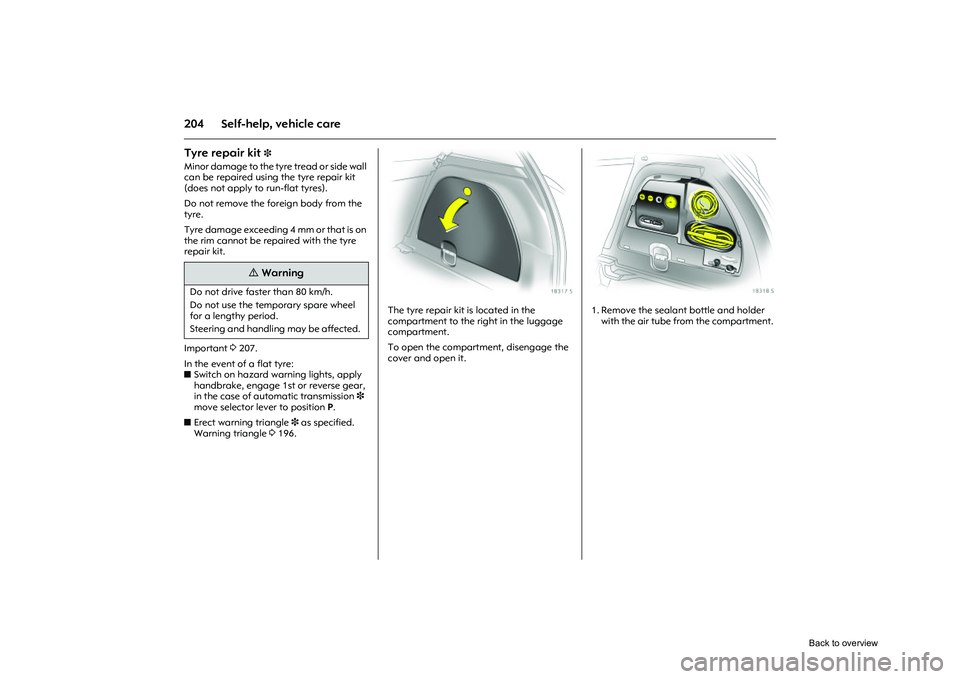
The tyre repair kit is located in the
compartment to the right in the luggage
compartment.
To open the compartment, disengage the
cover and open it.
Picture no: 18318s.tif
1. Remove the sealant bottle and holder
with the air tube from the compartment.
9
Warning
Do not drive faster than 80 km/h.
Do not use the temporary spare wheel
for a lengthy period.
Steering and handling may be affected.
Back to overview
Page 217 of 284
211
Self-help, vehicle care
Picture no: 18590s.tifPicture no: 18261s.tif
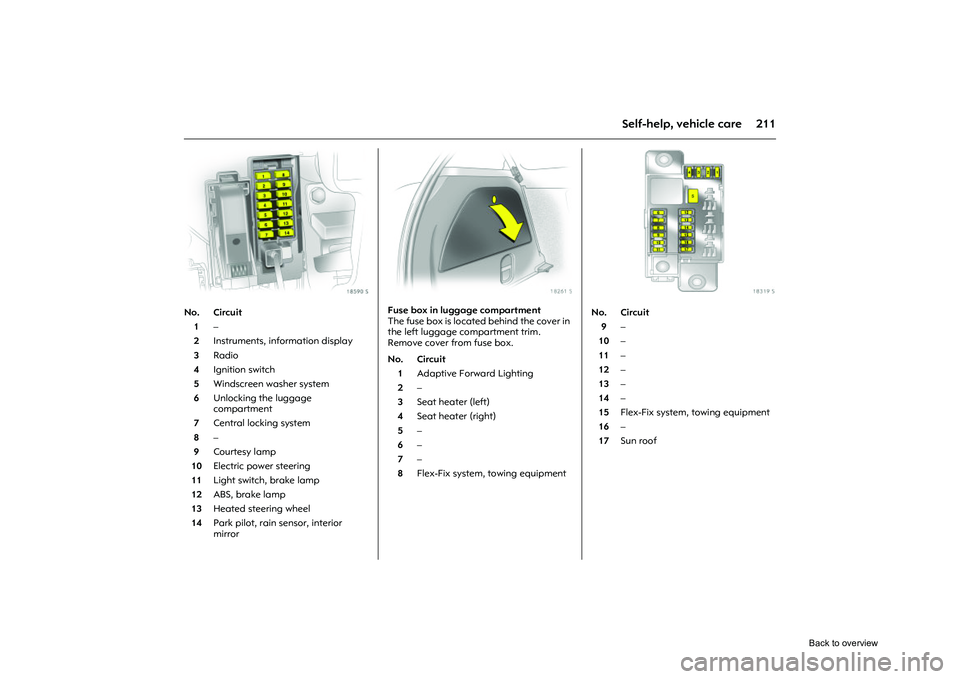
Fuse box in luggage compartment
The fuse box is located behind the cover in
the left luggage compartment trim.
Remove cover from fuse box.
Picture no: 18319s.tif
No. Circuit
1 –
2 Instruments, information display
3 Radio
4 Ignition switch
5 Windscreen washer system
6 Unlocking the luggage
compartment
7 Central locking system
8 –
9 Courtesy lamp
10 Electric power steering
11 Light switch, brake lamp
12 ABS, brake lamp
13 Heated steering wheel
14 Park pilot, rain sensor, interior
mirror
No. Circuit
1 Adaptive Forward Lighting
2 –
3 Seat heater (left)
4 Seat heater (right)
5 –
6 –
7 –
8 Flex-Fix system, towing equipment
No. Circuit
9 –
10 –
11 –
12 –
13 –
14 –
15 Flex-Fix system, towing equipment
16 –
17 Sun roof
Back to overview
Page 238 of 284
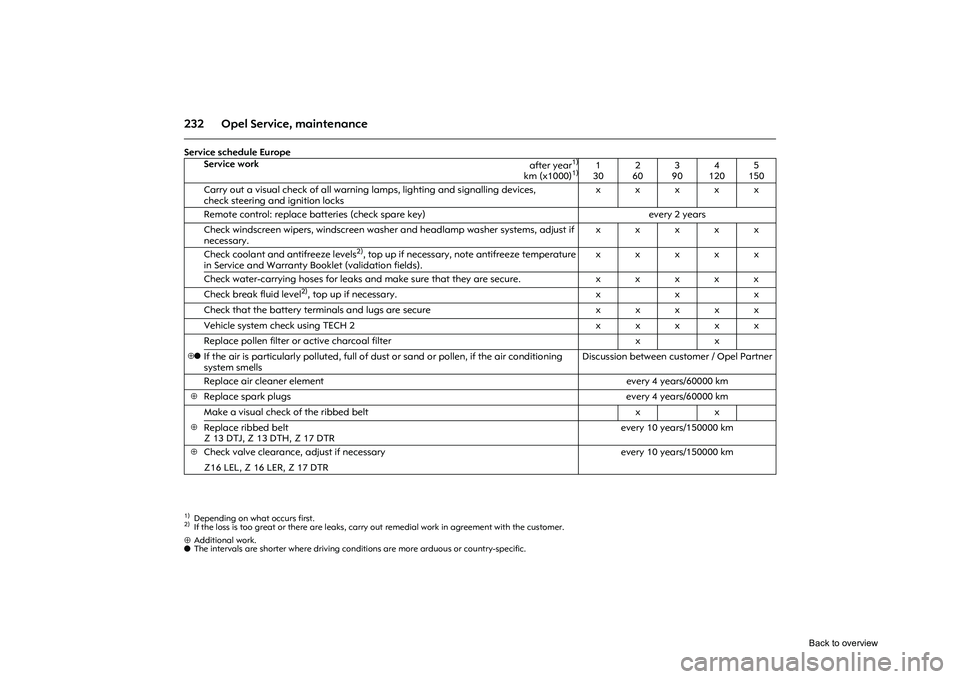
232 Opel Service, maintenanceService schedule Europe⊕Additional work.
o The intervals are shorter where driving conditions are more arduous or country-specific.
Service work
after year
1)
km (x1000)
1)
1)Depending on what occurs first.
1
30 2
60 3
90 4
120 5
150
Carry out a visual check of all warning lamps, lighting and signalling devices,
check steering and ignition locks xxxxx
Remote control: replace batterie s (check spare key) every 2 years
Check windscreen wipers, windscreen washer and headlamp washer systems, adjust if
necessary. xxxxx
Check coolant and antifreeze levels
2), top up if necessary, note antifreeze temperature
in Service and Warranty Booklet (validation fields).
2)If the loss is too great or there are leaks, carry out remedial work in agreement with the customer.
xxxxx
Check water-carrying hoses for leaks and make sure that they are secure. xxxxx
Check break fluid level
2), top up if necessary. xxx
Check that the battery terminals and lugs are secure xxxxx
Vehicle system check using TECH 2 xxxxx
Replace pollen filter or active charcoal filter xx
⊕o
If the air is particularly polluted, full of du st or sand or pollen, if the air conditioning
system smells Discussion between customer / Opel Partner
Replace air cleaner element every 4 years/60000 km
⊕
Replace spark plugs every 4 years/60000 km
Make a visual check of the ribbed belt x x
⊕
Replace ribbed belt
Z 13 DTJ, Z 13 DTH, Z 17 DTR every 10 years/150000 km
⊕
Check valve clearance,
adjust if necessary
Z16 LEL, Z 16 LER, Z 17 DTR every 10 years/150000 km
Back to overview
Page 240 of 284
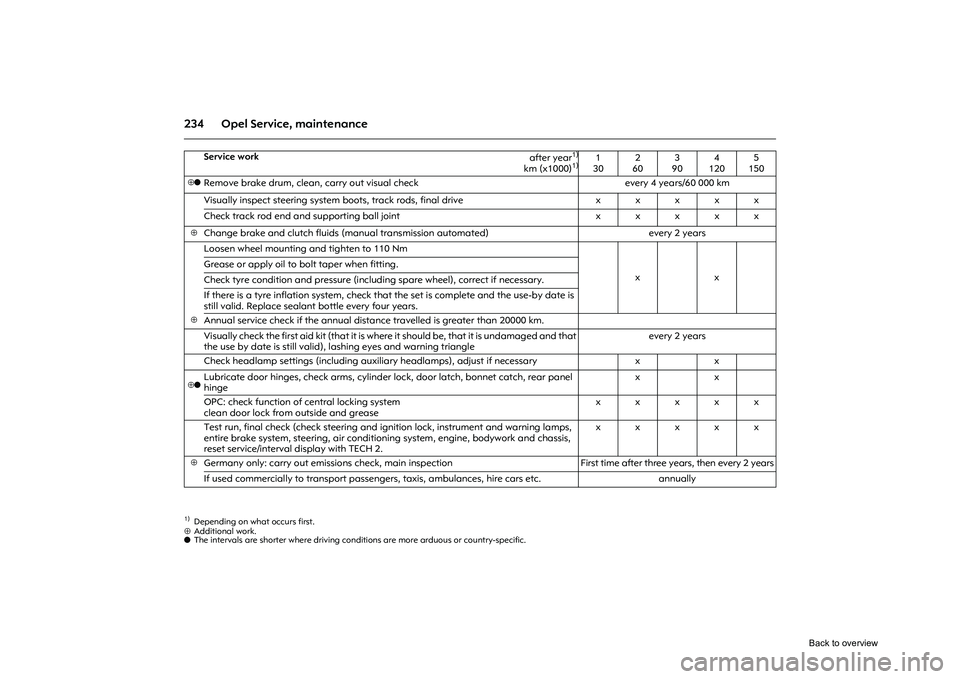
234 Opel Service, maintenance⊕Additional work.
o The intervals are shorter where driving conditions are more arduous or country-specific.
Service work
after year
1)
km (x1000)
1)
1)Depending on what occurs first.
1
30 2
60 3
90 4
120 5
150
⊕o
Remove brake drum, clean, carry out visual check every 4 years/60 000 km
Visually inspect steering system boots, track rods, final drive xxxxx
Check track rod end and supporting ball joint xxxxx
⊕
Change brake and clutch fluids (manual transmission automated) every 2 years
Loosen wheel mounting and tighten to 110 Nm
xx
Grease or apply oil to
bolt taper when fitting.
Check tyre condition and pressure (inclu ding spare wheel), correct if necessary.
If there is a tyre inflation system, check that the set is complete and the use-by date is
still valid. Replace sealant bottle every four years.
⊕
Annual service check if the annual distance travelled is greater than 20000 km.
Visually check the first aid kit (that it is wher e it should be, that it is undamaged and that
the use by date is still valid), lashing eyes and warning triangle every 2 years
Check headlamp settings (including auxi liary headlamps), adjust if necessary x x
⊕o
Lubricate door hinges, check arms, cylinder lo ck, door latch, bonnet catch, rear panel
hinge xx
OPC: check function of central locking system
clean door lock from outside and grease xxxxx
Test run, final check (check steering and ig nition lock, instrument and warning lamps,
entire brake system, steering, air conditioni ng system, engine, bodywork and chassis,
reset service/interval display with TECH 2. xxxxx
⊕
Germany only: carry out emissions check, main inspection
First time after three years, then every 2 years
If used commercially to transport passengers, taxis, ambulances, hire cars etc. annually
Back to overview
Page 241 of 284

235
Opel Service, maintenance
International service schedule⊕ Additional work.
o The intervals are shorter where driving conditions are more arduous or country-specific.
Service work
after year
1)
km (x1000)
1)
1)Depending on what occurs first.
1
15 2
30 3
45 4
60 5
75
Carry out a visual check of all warning lamps, lighting and signalling devices,
check steering and ignition locks xxxxx
Remote control: replace batterie s (check spare key) every 2 years
Check windscreen wipers, windscreen washer and headlamp washer systems, adjust if
necessary. xxxxx
Check coolant and antifreeze levels
2), top up if necessary, note antifreeze temperature
in Service and Warranty Booklet (validation fields).
2)If the loss is too great or there are leaks, carry out remedial work in agreement with the customer.
xxxxx
Check water-carrying hoses for leaks and make sure that they are secure. xxxxx
Check break fluid level
2), top up if necessary. xxx
Check that the battery terminals and lugs are secure xxxxx
Vehicle system check using TECH 2 xxxxx
Replace pollen filter or active charcoal filter xx
⊕o
If the air is particularly polluted, full of du st or sand or pollen, if the air conditioning
system smells Discussion between customer/Opel Partner
Replace air cleaner element every 4 years/60000 km
⊕
Replace spark plugs every 4 years/60000 km
Make a visual check of the ribbed belt x x
⊕
Replace ribbed belt
Z 13 DTJ, Z 13 DTH, Z 17 DTR every 10 years/150000 km
⊕
Check valve clearance,
adjust if necessary
Z16 LEL, Z 16 LER, Z 17 DTR every 10 years/150000 km
Back to overview