wheel OPEL CORSA 2009 Repair Manual
[x] Cancel search | Manufacturer: OPEL, Model Year: 2009, Model line: CORSA, Model: OPEL CORSA 2009Pages: 284, PDF Size: 4.96 MB
Page 209 of 284
203
Self-help, vehicle care
5. Unscrew the wheel bolts. If the wheel bolts have retaining
washers 3, they must not be removed.
6. Change wheel. Notes on spare wheel 3197. Notes on temporary spare wheel
3 197.
Picture no: 17249t.tif
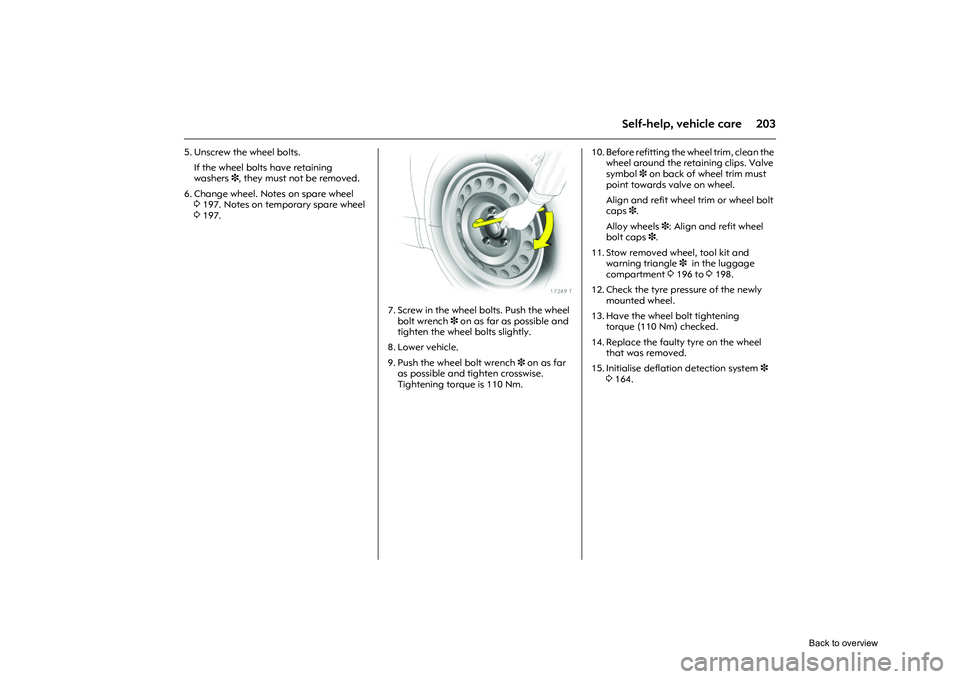
7. Screw in the wheel bolts. Push the wheel
bolt wrench 3 on as far as possible and
tighten the wheel bolts slightly.
8. Lower vehicle.
9. Push the wheel bolt wrench 3 on as far
as possible and tighten crosswise.
Tightening torque is 110 Nm. 10. Before refitting the wheel trim, clean the
wheel around the retaining clips. Valve
symbol 3 on back of wheel trim must
point towards valve on wheel.
Align and refit wheel trim or wheel bolt
caps 3.
Alloy wheels 3: Align and refit wheel
bolt caps 3.
11. Stow removed wheel, tool kit and warning triangle 3 in the luggage
compartment 3196 to 3198.
12. Check the tyre pressure of the newly mounted wheel.
13. Have the wheel bolt tightening torque (110 Nm) checked.
14. Replace the faulty tyre on the wheel that was removed.
15. Initialise deflation detection system 3
3 164.
Back to overview
Page 210 of 284
204 Self-help, vehicle careTyre repair kit
3
Minor damage to the tyre tread or side wall
can be repaired using the tyre repair kit
(does not apply to run-flat tyres).
Do not remove the foreign body from the
tyre.
T y r e d a m a g e e x c e e d i n g 4 m m o r t ha t i s o n
the rim cannot be repaired with the tyre
repair kit.
Important 3207.
In the event of a flat tyre:
z Switch on hazard warning lights, apply
handbrake, engage 1st or reverse gear,
in the case of automatic transmission 3
move selector lever to position P.
z Erect warning triangle 3 as specified.
Warning triangle 3196.
Picture no: 18317s.tif
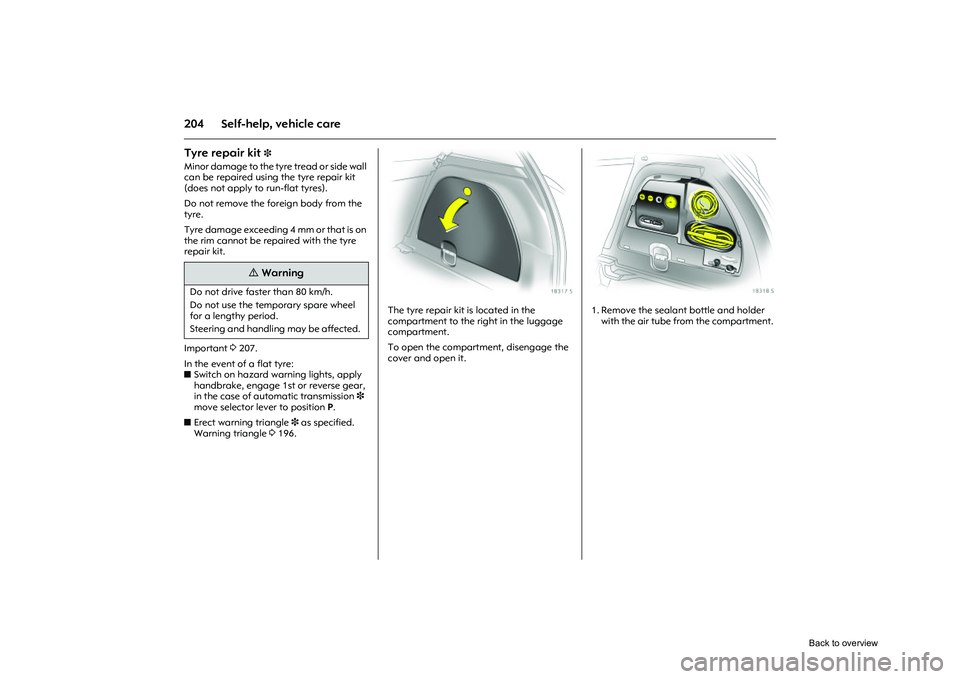
The tyre repair kit is located in the
compartment to the right in the luggage
compartment.
To open the compartment, disengage the
cover and open it.
Picture no: 18318s.tif
1. Remove the sealant bottle and holder
with the air tube from the compartment.
9
Warning
Do not drive faster than 80 km/h.
Do not use the temporary spare wheel
for a lengthy period.
Steering and handling may be affected.
Back to overview
Page 217 of 284
211
Self-help, vehicle care
Picture no: 18590s.tifPicture no: 18261s.tif
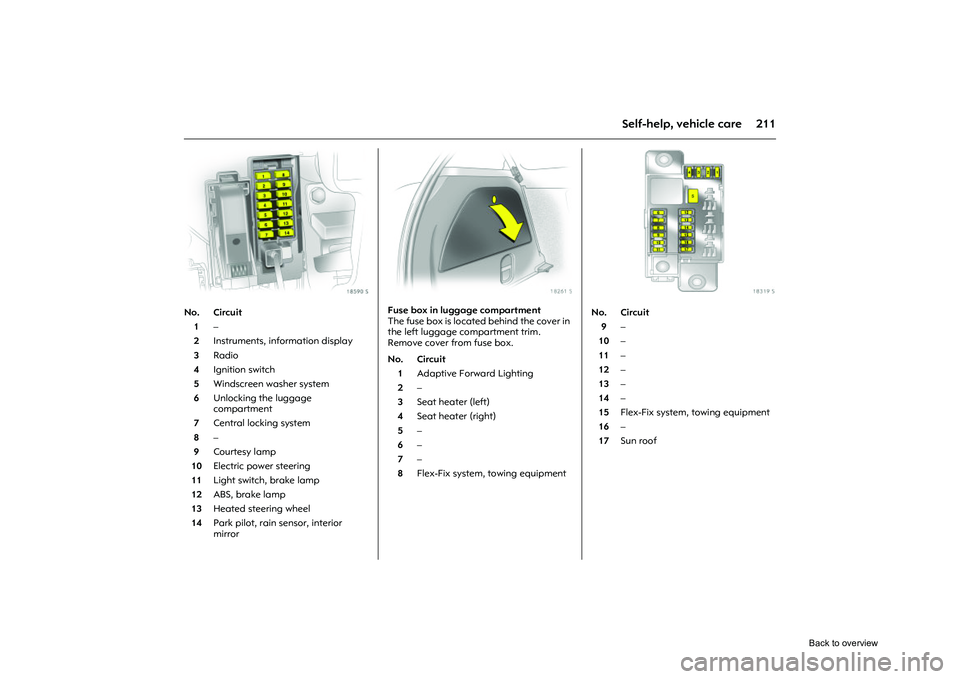
Fuse box in luggage compartment
The fuse box is located behind the cover in
the left luggage compartment trim.
Remove cover from fuse box.
Picture no: 18319s.tif
No. Circuit
1 –
2 Instruments, information display
3 Radio
4 Ignition switch
5 Windscreen washer system
6 Unlocking the luggage
compartment
7 Central locking system
8 –
9 Courtesy lamp
10 Electric power steering
11 Light switch, brake lamp
12 ABS, brake lamp
13 Heated steering wheel
14 Park pilot, rain sensor, interior
mirror
No. Circuit
1 Adaptive Forward Lighting
2 –
3 Seat heater (left)
4 Seat heater (right)
5 –
6 –
7 –
8 Flex-Fix system, towing equipment
No. Circuit
9 –
10 –
11 –
12 –
13 –
14 –
15 Flex-Fix system, towing equipment
16 –
17 Sun roof
Back to overview
Page 235 of 284

229
Self-help, vehicle care
Polishing and waxing
Wax the vehicle regularly (by the time the
water no longer beads at the latest).
Otherwise, the paintwork will dry out.
Polishing is necessary only if the paint has
become dull or if solid deposits have
become attached to it.
Paintwork polish with silicone forms a
protective film, making waxing
unnecessary.
Plastic body parts should not be treated
with wax and polish.
Wheels and tyres
Do not use high-pressure jet cleaners.
Clean wheels with a pH-neutral wheel
cleaner.
Wheels are painted and can be treated
with the same agents as the body.
Paintwork damage
Rectify minor paintwork damage with a
touch-up pen before rust forms. Have more
extensive damage or rust areas repaired
by a workshop. Exterior lights
Headlamp and other lamp covers are
made of plastic. Do not use any caustic
agents, do not use an ice scraper, and do
not clean them when dry.
Plastic and rubber parts
Plastic and rubber parts can be cleaned
with the same cleaner as used to clean the
body. Use interior cleaner if necessary. Do
not use any other agent. Avoid solvents
and petrol in particular. Do not use high-
pressure jet cleaners.
Interior and upholstery
Only clean the vehicle interior, including
the instrument panel fa
scia and panelling,
with a dry cloth or interior cleaner.
The instrument pane l should only be
cleaned using a soft damp cloth.
Clean fabric upholstery with a vacuum
cleaner and brush. Remove stains with an
upholstery cleaner.
Clean seat belts with lukewarm water or
interior cleaner.
Caution
Close Velcro fasteners as open Velcro
fasteners on clothing could damage
seat upholstery.
Back to overview
Page 239 of 284
233
Opel Service, maintenance
⊕ Additional work.
o The intervals are shorter where driving conditions are more arduous or country-specific.
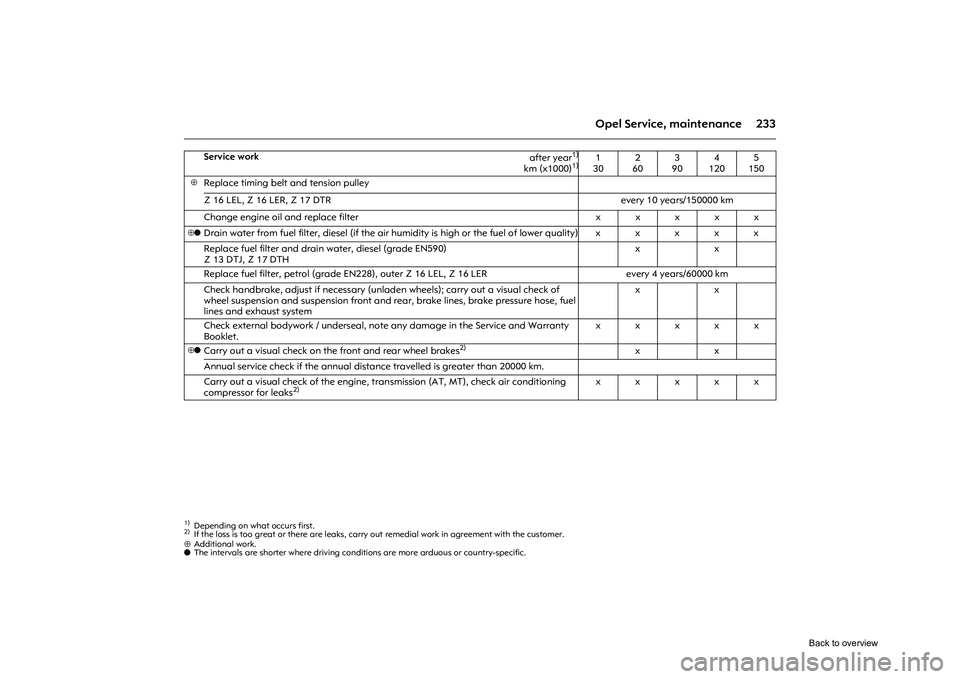
Service work
after year
1)
km (x1000)
1)
1)Depending on what occurs first.
1
30 2
60 3
90 4
120 5
150
⊕
Replace timing belt and tension pulley
Z 16 LEL, Z 16 LER, Z 17 DTR every 10 years/150000 km
Change engine oil and replace filter xxxxx
⊕o
Drain water from fuel filter, diesel (if the air humidity is high or the fuel of lower quality)xxxxx
Replace fuel filter and drain water, diesel (grade EN590)
Z 13 DTJ, Z 17 DTH xx
Replace fuel filter, petrol (g rade EN228), outer Z 16 LEL, Z 16 LER every 4 years/60000 km
Check handbrake, adjust if necessary (unl aden wheels); carry out a visual check of
wheel suspension and suspension front and re ar, brake lines, brake pressure hose, fuel
lines and exhaust system xx
Check external bodywork / underseal, note any damage in the Service and Warranty
Booklet. xxxxx
⊕o
Carry out a visual check on the front and rear wheel brakes
2)
2)If the loss is too great or there are leaks, carry
out remedial work in agreement with the customer.
xx
Annual service check if the annual distance travelled is greater than 20000 km.
Carry out a visual check of the engine, tran smission (AT, MT), check air conditioning
compressor for leaks
2)
xxxxx
Back to overview
Page 240 of 284
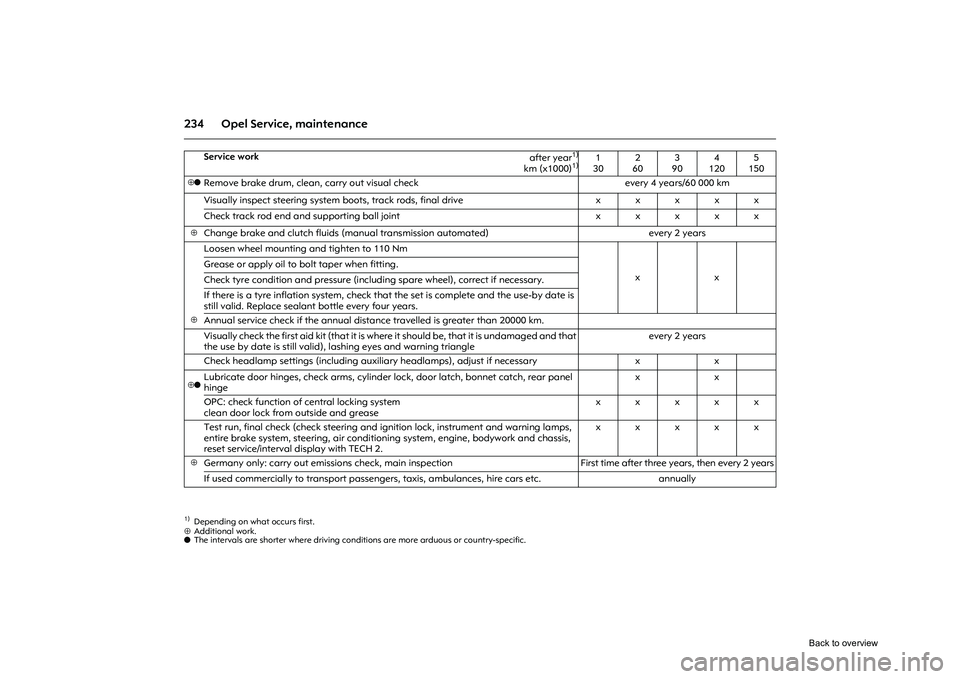
234 Opel Service, maintenance⊕Additional work.
o The intervals are shorter where driving conditions are more arduous or country-specific.
Service work
after year
1)
km (x1000)
1)
1)Depending on what occurs first.
1
30 2
60 3
90 4
120 5
150
⊕o
Remove brake drum, clean, carry out visual check every 4 years/60 000 km
Visually inspect steering system boots, track rods, final drive xxxxx
Check track rod end and supporting ball joint xxxxx
⊕
Change brake and clutch fluids (manual transmission automated) every 2 years
Loosen wheel mounting and tighten to 110 Nm
xx
Grease or apply oil to
bolt taper when fitting.
Check tyre condition and pressure (inclu ding spare wheel), correct if necessary.
If there is a tyre inflation system, check that the set is complete and the use-by date is
still valid. Replace sealant bottle every four years.
⊕
Annual service check if the annual distance travelled is greater than 20000 km.
Visually check the first aid kit (that it is wher e it should be, that it is undamaged and that
the use by date is still valid), lashing eyes and warning triangle every 2 years
Check headlamp settings (including auxi liary headlamps), adjust if necessary x x
⊕o
Lubricate door hinges, check arms, cylinder lo ck, door latch, bonnet catch, rear panel
hinge xx
OPC: check function of central locking system
clean door lock from outside and grease xxxxx
Test run, final check (check steering and ig nition lock, instrument and warning lamps,
entire brake system, steering, air conditioni ng system, engine, bodywork and chassis,
reset service/interval display with TECH 2. xxxxx
⊕
Germany only: carry out emissions check, main inspection
First time after three years, then every 2 years
If used commercially to transport passengers, taxis, ambulances, hire cars etc. annually
Back to overview
Page 242 of 284
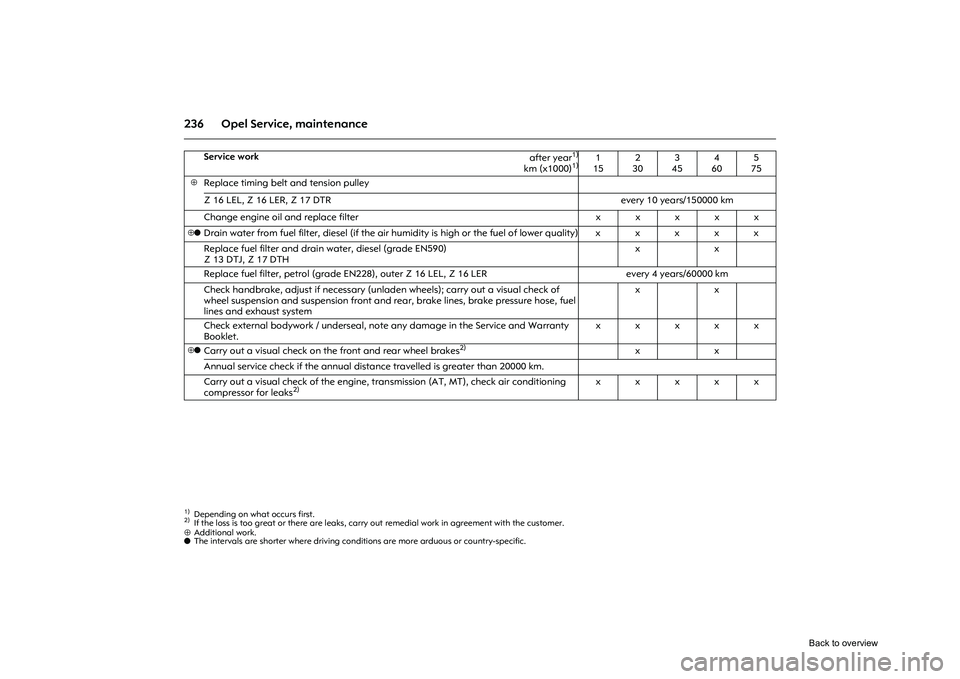
236 Opel Service, maintenance⊕Additional work.
o The intervals are shorter where driving conditions are more arduous or country-specific.
Service work
after year
1)
km (x1000)
1)
1)Depending on what occurs first.
1
15 2
30 3
45 4
60 5
75
⊕
Replace timing belt and tension pulley
Z 16 LEL, Z 16 LER, Z 17 DTR every 10 years/150000 km
Change engine oil and replace filter xxxxx
⊕o
Drain water from fuel filter, diesel (if the air humidity is high or the fuel of lower quality)xxxxx
Replace fuel filter and drain water, diesel (grade EN590)
Z 13 DTJ, Z 17 DTH xx
Replace fuel filter, petrol (g rade EN228), outer Z 16 LEL, Z 16 LER every 4 years/60000 km
Check handbrake, adjust if necessary (unl aden wheels); carry out a visual check of
wheel suspension and suspension front and re ar, brake lines, brake pressure hose, fuel
lines and exhaust system xx
Check external bodywork / underseal, note any damage in the Service and Warranty
Booklet. xxxxx
⊕o
Carry out a visual check on the front and rear wheel brakes
2)
2)If the loss is too great or there are leaks, carry
out remedial work in agreement with the customer.
xx
Annual service check if the annual distance travelled is greater than 20000 km.
Carry out a visual check of the engine, tran smission (AT, MT), check air conditioning
compressor for leaks
2)
xxxxx
Back to overview
Page 243 of 284
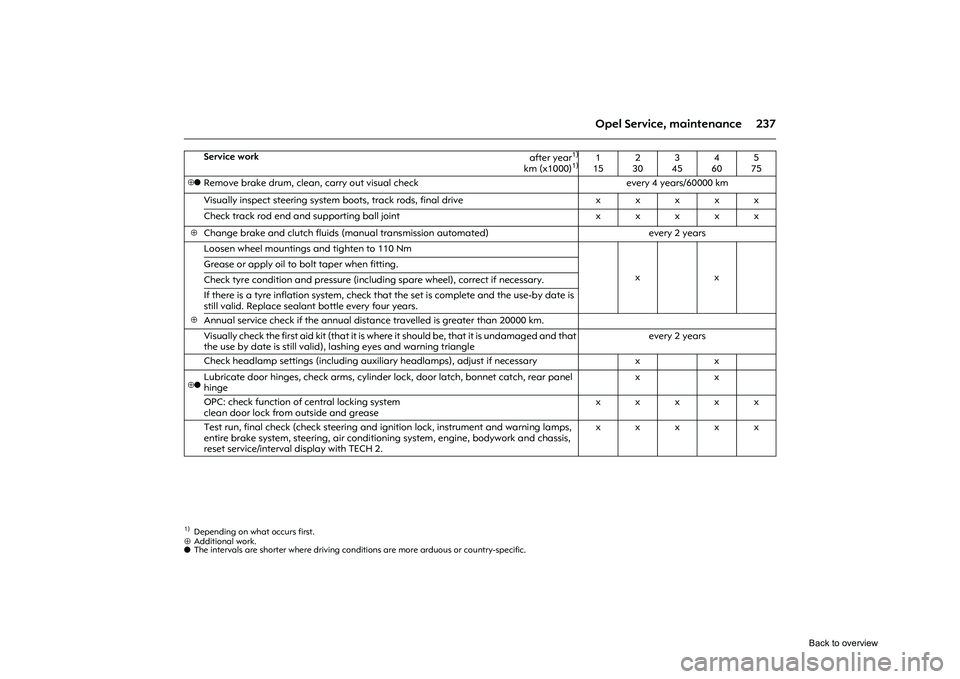
237
Opel Service, maintenance
⊕ Additional work.
o The intervals are shorter where driving conditions are more arduous or country-specific.
Service work
after year
1)
km (x1000)
1)
1)Depending on what occurs first.
1
15 2
30 3
45 4
60 5
75
⊕o
Remove brake drum, clean, carry out visual check every 4 years/60000 km
Visually inspect steering system boots, track rods, final drive xxxxx
Check track rod end and supporting ball joint xxxxx
⊕
Change brake and clutch fluids (manual transmission automated) every 2 years
Loosen wheel mountings and tighten to 110 Nm
xx
Grease or apply oil to
bolt taper when fitting.
Check tyre condition and pressure (inclu ding spare wheel), correct if necessary.
If there is a tyre inflation system, check that the set is complete and the use-by date is
still valid. Replace sealant bottle every four years.
⊕
Annual service check if the annual distance travelled is greater than 20000 km.
Visually check the first aid kit (that it is wher e it should be, that it is undamaged and that
the use by date is still valid), lashing eyes and warning triangle every 2 years
Check headlamp settings (including auxi liary headlamps), adjust if necessary x x
⊕o
Lubricate door hinges, check arms, cylinder lo ck, door latch, bonnet catch, rear panel
hinge xx
OPC: check function of central locking system
clean door lock from outside and grease xxxxx
Test run, final check (check steering and ig nition lock, instrument and warning lamps,
entire brake system, steering, air conditioni ng system, engine, bodywork and chassis,
reset service/interval display with TECH 2. xxxxx
Back to overview
Page 269 of 284
![OPEL CORSA 2009 Repair Manual 263
Technical Data
Table 2, added weight for different specifications 5-door passenger vehicle
Engine Z 10 XEP Z 12 XEP Z 14 XEP Z 16 LEL Z 13 DTJ Z 13 DTH Z 17 DTR
Enjoy [kg] 7 7 7 7 7 7 7
Sport [kg](/img/37/58224/w960_58224-268.png "OPEL CORSA 2009 Repair Manual 263
Technical Data
Table 2, added weight for different specifications 5-door passenger vehicle
Engine Z 10 XEP Z 12 XEP Z 14 XEP Z 16 LEL Z 13 DTJ Z 13 DTH Z 17 DTR
Enjoy [kg] 7 7 7 7 7 7 7
Sport [kg")
263
Technical Data
Table 2, added weight for different specifications 5-door passenger vehicle
Engine Z 10 XEP Z 12 XEP Z 14 XEP Z 16 LEL Z 13 DTJ Z 13 DTH Z 17 DTR
Enjoy [kg] 7 7 7 7 7 7 7
Sport [kg] 12 12 12 12 12 12 12
Cosmo [kg] 14 14 14 14 14 14 14
3-door passenger vehicle
Engine Z 10 XEP Z 12 XEP Z 14 XEP Z 16 LEL Z 13 DTJ Z 13 DTH Z 17 DTR
Enjoy [kg] 15 15 15 15 15 15 15
Sport [kg] 21 21 21 21 21 21 21
Cosmo [kg] 14 14 14 14 14 14 14Weights, table 3, heavy accessoriesAccessories Sun roof Towing equipment Flex-Fix system17-inch wheels
on van
Weight [kg] 20 15 23.520
Back to overview
Page 270 of 284

264 Technical DataTyres Not all tyres available on the market
currently meet the structural requirements.
We recommend that you consult an Opel
Partner concerning suitable tyre makes.
These tyres have undergone special tests
to establish their reliability, safety and
specific suitability for Opel vehicles.
Despite continuous market monitoring, we
are unable to assess these attributes for
other tyres, even if they have been granted
approval by the relevant authorities or in
some other form.
Further information 3168. Wheels Wheel bolt tightening torque: 110 Nm. Winter tyres
3
Tyres of size 195/60 R 15, 215/45 R 17
and 225/35 R 18 must not be used as
winter tyres.
Tyres of size 185/60 R 15 are only approved
as winter tyres.
Tyres of size 185/65 R 15 are only
a p p r o v e d a s w i n te r t y r e s o n ve h i c l e s w i t h a
sports chassis. We recommend that you
contact your Opel partner in order to find
out whether your vehicle is equipped with a
sports chassis. If you use winter tyres, the spare wheel
3
m a y s t i l l b e f i t t e d w i t h a s u m m e r t y r e . I f y o u
use the spare wheel the vehicle’s handling
may be altered. Obtain a replacement for
the faulty tyre as soon as possible, and
have the wheel balanced and fitted to the
vehicle.
Further information 3 172.
Tyre chains
3
Tyre chains may be used on the front
wheels only.
We recommend the use of tyre chains with
a fine mesh that add no more than 10 mm
to the running surface and the insides of
the tyres (including chain lock).
Tyre chains are not permitted on tyre sizes
195/60 R 15, 215/45 R 17 and 225/35 R 18.
Tyre chains are only approved on tyres of
size 185/60 R 15 on vehicles with a sports
chassis. We recommend that you contact
your Opel partner in order to find out
whether your vehicle is equipped with a
sports chassis.
Further information 3172. Spare wheel
3
Depending on the version, the spare wheel
will be in the form of a temporary spare
wheel 3. The vehicle may handle
differently if a spare wheel has been fitted. Replace defective tyre as soon as possible,
balance wheel and fit to vehicle.
Please pay attention to the notes on this
page and on pages 173, 196.
On vehicles with alloy wheels
3 the spare
wheel may have a steel rim.
The spare wheel can be fitted with a
smaller tyre
1) and a smaller rim than the
wheels fitted on the vehicle.
Tyre pressure (overpressure) The specified tyre pressures are valid for
cold tyres. The increased tyre pressure
resulting from extensive driving must not
be reduced. The tyre pressures specified on
the following pages apply to both summer
and winter tyres.
Always inflate the spare wheel 3 to the tyre
pressure for full load – see tables on the
following pages.
Temporary spare wheel tyre pressure 3 –
see tables on the following pages.
Further information 3168 to 3172.1)Country-specific version: The spare wheel is
only to be used as a temporary spare wheel.
Back to overview