ECU OPEL CORSA 2009 Owners Manual
[x] Cancel search | Manufacturer: OPEL, Model Year: 2009, Model line: CORSA, Model: OPEL CORSA 2009Pages: 284, PDF Size: 4.96 MB
Page 39 of 284
33
Keys, doors, windows, sun roof
Picture no: 16968t.tif
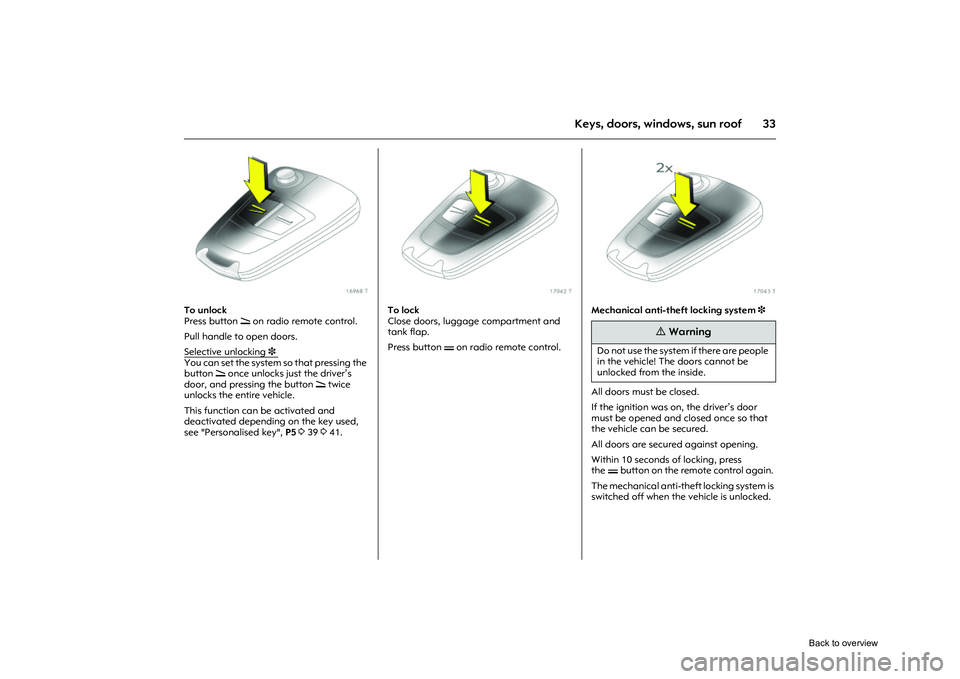
To unlock
Press button q on radio remote control.
Pull handle to open doors.
Selective unlocking
3
You can set the system so that pressing the
button q once unlocks just the driver’s
door, and pressing the button q twice
unlocks the entire vehicle.
This function can be activated and
deactivated depending on the key used,
see "Personalised key", P5 339 341.
Picture no: 17042t.tif
To lock
Close doors, luggage compartment and
tank flap.
Press button p on radio remote control.
Picture no: 17043t.tif
Mechanical anti-theft locking system 3
All doors must be closed.
If the ignition was on, the driver’s door
must be opened and closed once so that
the vehicle can be secured.
All doors are secured against opening.
Within 10 seconds of locking, press
the pbutton on the remote control again.
The mechanical anti-theft locking system is
switched off when the vehicle is unlocked.
9
Warning
Do not use the system if there are people
in the vehicle! The doors cannot be
unlocked from the inside.
Back to overview
Page 41 of 284
35
Keys, doors, windows, sun roof
Picture no: 17047t.tif
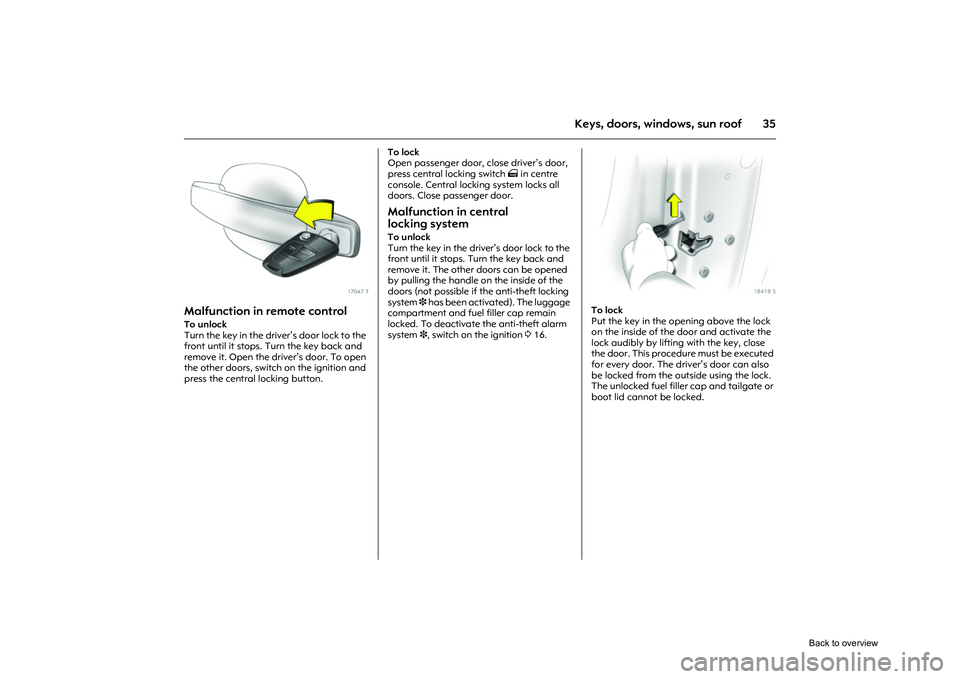
Malfunction in remote control To unlock
Turn the key in the driver’s door lock to the
front until it stops. Turn the key back and
remove it. Open the driver’s door. To open
the other doors, switch on the ignition and
press the central locking button. To lock
Open passenger door, close driver’s door,
press central locking switch
m in centre
console. Central locking system locks all
doors. Close passenger door.
Malfunction in central
locking system To unlock
Turn the key in the driv er’s door lock to the
front until it stops. Turn the key back and
remove it. The other doors can be opened
by pulling the handle on the inside of the
doors (not possible if the anti-theft locking
system 3 has been activated). The luggage
compartment and fuel filler cap remain
locked. To deactivate the anti-theft alarm
system 3, switch on the ignition 3 16.
Picture no: 18410s.tif
To lock
Put the key in the opening above the lock
on the inside of the door and activate the
lock audibly by lifting with the key, close
the door. This procedure must be executed
for every door. The driver’s door can also
be locked from the outside using the lock.
The unlocked fuel filler cap and tailgate or
boot lid cannot be locked.
Back to overview
Page 62 of 284
56 Seats, Interior
Picture no: 18476s.tif
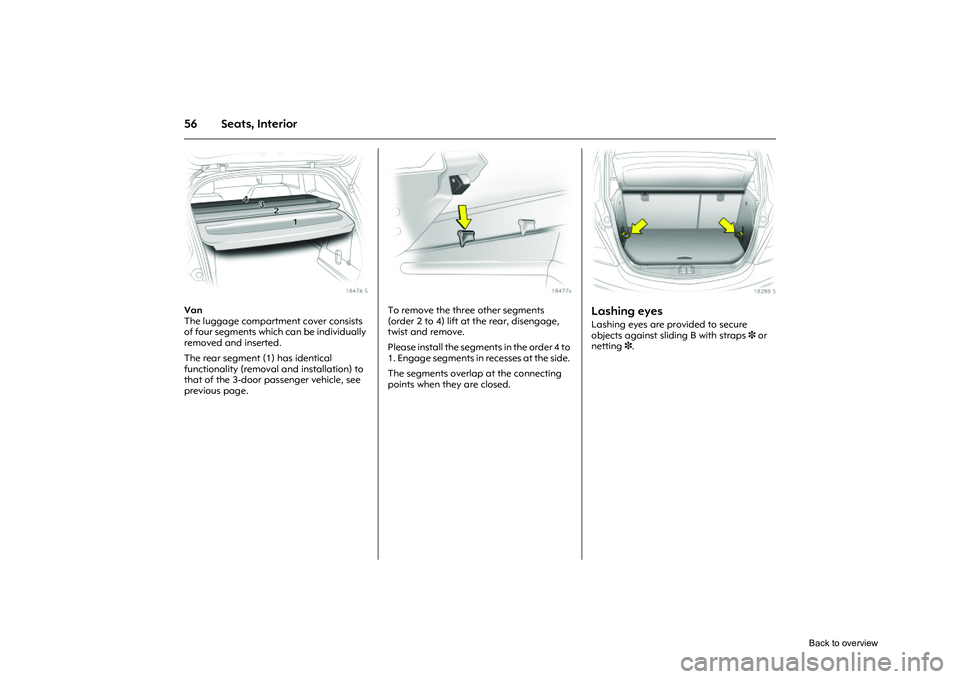
Van
The luggage compartment cover consists
of four segments which can be individually
removed and inserted.
The rear segment (1) has identical
functionality (removal and installation) to
that of the 3-door passenger vehicle, see
previous page.
Picture no: 18477s.tif
To remove the three other segments
(order 2 to 4) lift at the rear, disengage,
twist and remove.
Please install the segments in the order 4 to
1. Engage segments in recesses at the side.
The segments overlap at the connecting
points when they are closed.
Picture no: 18280s.tif
Lashing eyes Lashing eyes are provided to secure
objects against sliding B with straps 3 or
netting 3.
Back to overview
Page 63 of 284
57
Seats, Interior
Picture no: 18281s.tif
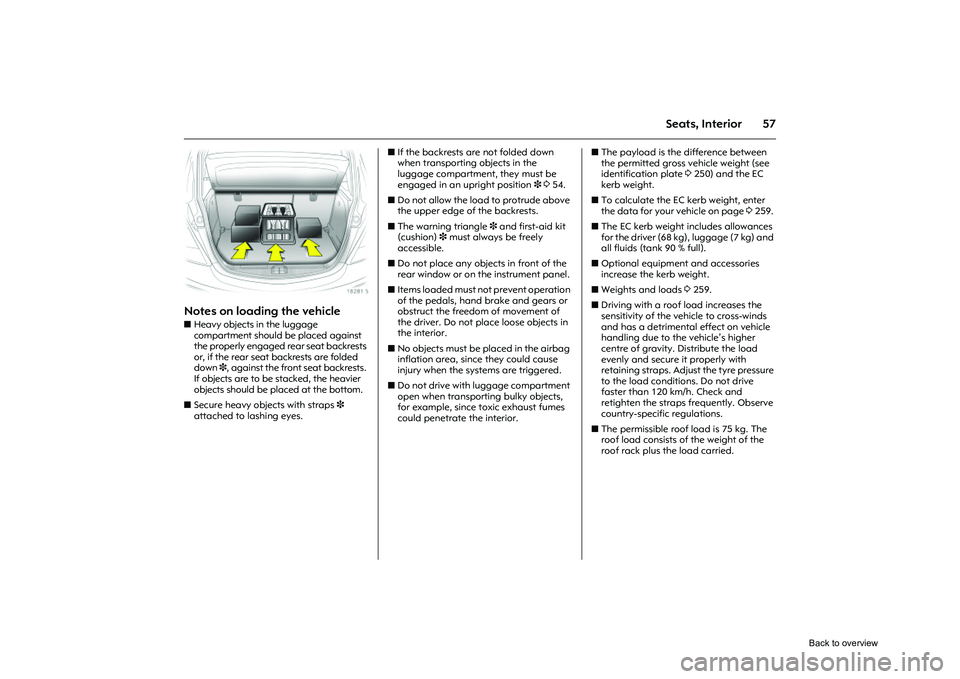
Notes on loading the vehicle zHeavy objects in the luggage
compartment should be placed against
the properly engaged rear seat backrests
or, if the rear seat backrests are folded
down 3, against the front seat backrests.
If objects are to be stacked, the heavier
objects should be placed at the bottom.
z Secure heavy objects with straps 3
attached to lashing eyes. z
If the backrests are not folded down
when transporting objects in the
luggage compartment, they must be
engaged in an upright position 3354.
z Do not allow the load to protrude above
the upper edge of the backrests.
z The warning triangle 3 and first-aid kit
(cushion) 3 must always be freely
accessible.
z Do not place any objects in front of the
rear window or on the instrument panel.
z Items loaded must not prevent operation
of the pedals, hand brake and gears or
obstruct the freedom of movement of
the driver. Do not place loose objects in
the interior.
z No objects must be placed in the airbag
inflation area, since they could cause
injury when the systems are triggered.
z Do not drive with luggage compartment
open when transporting bulky objects,
for example, since toxic exhaust fumes
could penetrate the interior. z
The payload is the difference between
the permitted gross vehicle weight (see
identification plate 3250) and the EC
kerb weight.
z To calculate the EC kerb weight, enter
the data for your vehicle on page 3259.
z The EC kerb weight includes allowances
for the driver (68 kg), luggage (7 kg) and
all fluids (tank 90 % full).
z Optional equipment and accessories
increase the kerb weight.
z Weights and loads 3259.
z Driving with a roof load increases the
sensitivity of the vehicle to cross-winds
and has a detrimental effect on vehicle
handling due to the vehicle’s higher
centre of gravity. Distribute the load
evenly and secure it properly with
retaining straps. Adjust the tyre pressure
to the load conditions. Do not drive
faster than 120 km/h. Check and
retighten the straps frequently. Observe
country-specific regulations.
z The permissible roof load is 75 kg. The
roof load consists of the weight of the
roof rack plus the load carried.
Back to overview
Page 71 of 284
65
Seats, Interior
Note
zChildren under 12 years or under 150 cm
tall should only travel in an appropriate
child restraint system.
z When transporting ch ildren, use the child
restraint systems suitable for the child’s
weight.
z Ensure correct inst allation of child
restraint system, see the instructions
enclosed with the system.
z The covers of the Opel child restraint
system can be wiped clean. z
Do not stick anything on the child
restraint systems and do not cover them
with any other materials.
z Only allow the child to enter and exit on
the side of the vehicle facing away from
the road.
z A child restraint system which has been
subjected to stress in an accident must
be replaced.
z Secure or remove child restraint systems
that are in the vehicle but not in use.
U = Universal suitability in conjunction
with three-point seat belt.
+ = Vehicle seat with ISOFIX mounting available
1). Only the ISOFIX child
restraint systems that are approved
for the vehicle must be used when
mounting with ISOFIX.
1)Not available on the front passenger
seat in the Corsa OPC.++ = Vehicle seat with ISOFIX mounting
available
1). Universally approved
ISOFIX child restraint systems may
be used when mounting with ISOFIX
and Top-Tether.
X = No child restraint system permitted in this weight class.
Back to overview
Page 74 of 284
68 Seats, Interior
Picture no: 18299s.tif
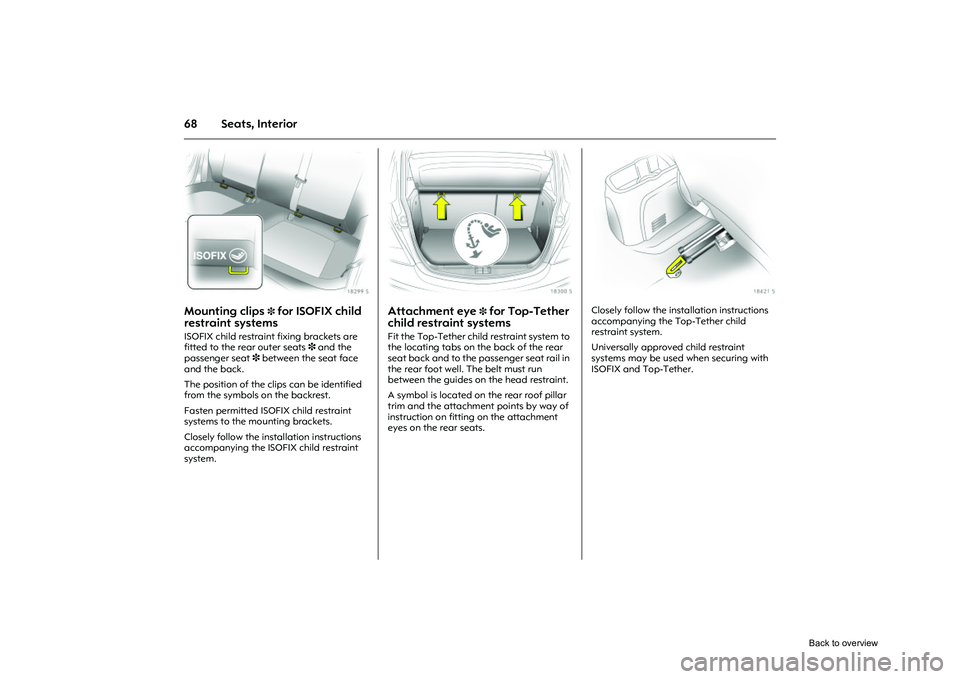
Mounting clips
3 for ISOFIX child
restraint systems
ISOFIX child restraint fixing brackets are
fitted to the rear outer seats 3 and the
passenger seat 3 between the seat face
and the back.
The position of the clips can be identified
from the symbols on the backrest.
Fasten permitted ISOF IX child restraint
systems to the mounting brackets.
Closely follow the installation instructions
accompanying the ISOFIX child restraint
system.
Picture no: 18300s.tif
Attachment eye
3 for Top-Tether
child restraint systems
Fit the Top-Tether child restraint system to
the locating tabs on the back of the rear
seat back and to the passenger seat rail in
the rear foot well. The belt must run
between the guides on the head restraint.
A symbol is located on the rear roof pillar
trim and the attachment points by way of
instruction on fitting on the attachment
eyes on the rear seats.
Picture no: 18421s.tif
Closely follow the installation instructions
accompanying the Top-Tether child
restraint system.
Universally approved child restraint
systems may be used when securing with
ISOFIX and Top-Tether.
Back to overview
Page 103 of 284
97
Instruments, controls
Picture no: 18612t.tif
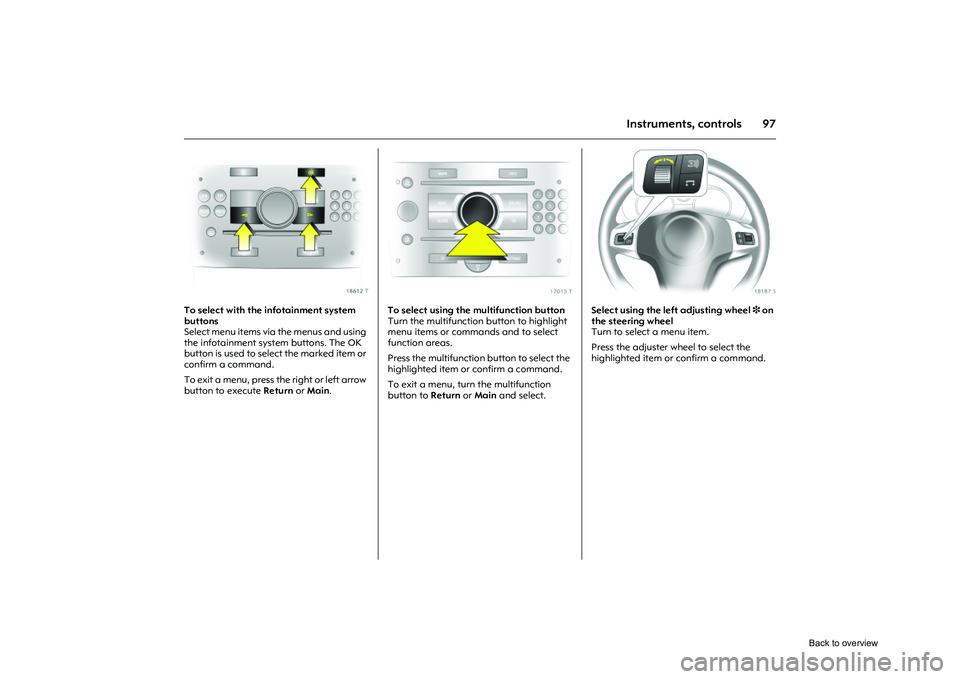
To select with the infotainment system
buttons
Select menu items via the menus and using
the infotainment system buttons. The OK
button is used to select the marked item or
confirm a command.
To exit a menu, press the right or left arrow
button to execute Return or Main .
Picture no: 17013t.tif
To select using the multifunction button
Turn the multifunction button to highlight
menu items or commands and to select
function areas.
Press the multifunction button to select the
highlighted item or confirm a command.
To exit a menu, turn the multifunction
button to Return or Main and select.
Picture no: 18187s.tif
Select using the left adjusting wheel 3 on
the steering wheel
Turn to select a menu item.
Press the adjuster wheel to select the
highlighted item or confirm a command.
Back to overview
Page 155 of 284

149
Driving and operation
Driving hints The first 1000 km
Drive your vehicle at various speeds. Do
not use full throttle. Never allow the engine
to labour at low revs.
Make good use of all gears. Depress the
accelerator pedal a maximum of about
3/4
of the available pedal travel in all gears.
Do not drive faster than three quarters of
maximum speed.
Do not brake unnecessarily hard for the
first 200 km.
During the first drive smoke may develop
because of wax and oil evaporating on the
exhaust system. Park the vehicle in the
open for a while after the first drive and
avoid inhaling the fumes.
Fuel and engine oil consumption is higher
than normal during the running-in period.
Never coast with engine not running
Many units will not function in this situation
(e.g. brake servo unit, electro-hydraulic
power steering). Driving in this manner is a
danger to yourself and others. Brake servo unit
When the engine is not running, the brake
servo unit is no longer effective once the
brake pedal has been depressed once or
twice. Braking effect is not reduced, but
significantly greater force is required for
braking.
Electro-hydraulic power assisted steering
If the power assisted steering fails when
being towed with the engine switched off,
the vehicle can still be steered, but
considerably more force is required.
Driving in mountainous terrain or with a
trailer/caravan
The cooling fan is elec
trically operated. Its
cooling power is therefore independent of
the engine speed.
Since a considerable amount of heat is
generated at high engine speeds and less
at slower speeds, do not shift down when
climbing hills whilst the vehicle is still coping
with the gradient in the higher gear. Driving with a roof load
Do not exceed the permissible roof load
3
173, 3259. For reasons of safety,
distribute the load evenly and secure it
properly with retaining straps. Adjust tyre
pressure to load conditions. Do not drive
faster than 120 km/h. Check and re-tighten
the straps frequently. Observe country-
specific regulations.
Switching off the engine
When you switch off, fans in the engine
compartment may continue running for a
time to cool the engine.
If the engine temperature is very high, e.g.
after driving in mountainous terrain: allow
the engine to idle for approximately two
minutes in order to prevent heat
accumulation.
Vehicles with turbocharged engine
After running at high engine speeds or
high engine loads, operate the engine
briefly at a low load or run in neutral for
approx. 30 seconds befo re switching off
in order to protect the turbocharger.
Back to overview
Page 162 of 284

156 Driving and operation
Picture no: 18251s.tif
Control indicator
Z for exhaust
Illuminates when the ignition is switched on
and during the start attempt. Goes off
shortly after the engine starts running.
Illumination whilst the engine is running
indicates a fault in the emission control
system. The permissible emission limits
may be exceeded. Contact a workshop for
assistance immediately.
Illumination with the engine running
indicates a fault that can cause damage to
the catalytic converter. It is possible to
continue driving without causing damage
by slowing down until the flashing stops
and the control indicator illuminates.
Contact a workshop for assistance
immediately.
Picture no: 18231s.tif
Control indicator
A
for engine electronics
Illuminates for a few seconds after the
ignition is switched on.
If it illuminates when the engine is running,
there is a fault in engine or transmission
electronics. The electr onic system switches
to an emergency runni ng programme. Fuel
consumption may be increased and the
driveability of the vehicle may be impaired.
In some cases the fault can be remedied by
switching the engine off and starting it
again. If the control indicator continues to
illuminate whilst the en gine is running,
contact a workshop for assistance in
remedying the cause of the fault. If it illuminates briefly, but does not recur, it
is of no significance.
If
A lights up, this could mean that there
is water in the diesel fuel filter 3. A
message appears at the same time on the
service display 391. Have the fuel filter
checked for possible water contamination
by a workshop.
If it flashes after the ignition is switched on,
there is a fault in the immobiliser system.
The engine cannot be started 327.
Back to overview
Page 186 of 284
180 Driving and operation
Picture no: 18353s.tif
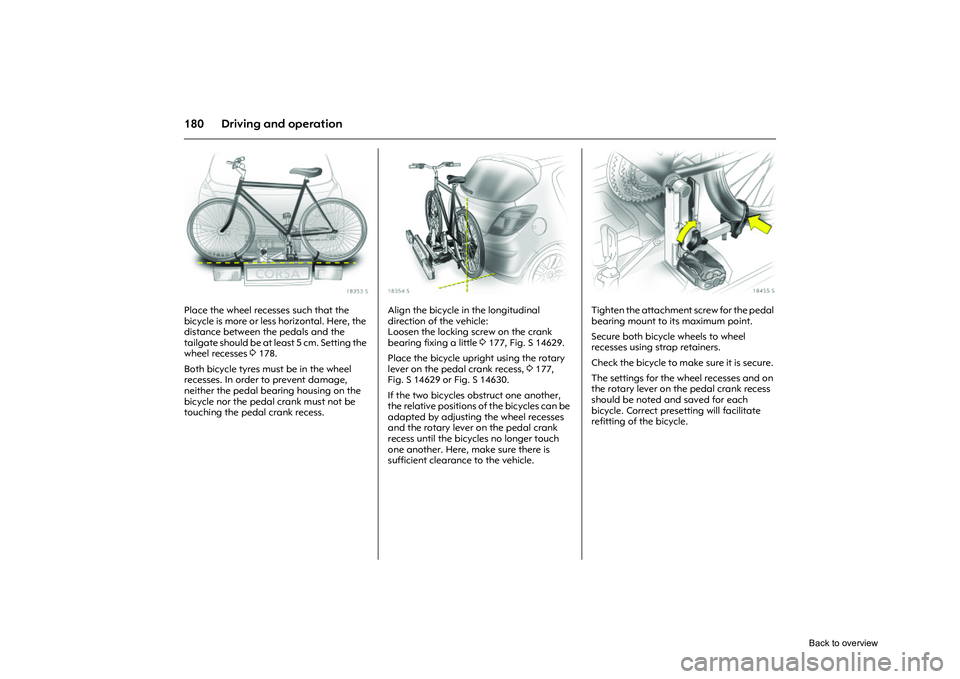
Place the wheel recesses such that the
bicycle is more or less horizontal. Here, the
distance between the pedals and the
tailgate should be at least 5 cm. Setting the
wheel recesses 3178.
Both bicycle tyres must be in the wheel
recesses. In order to prevent damage,
neither the pedal bearing housing on the
bicycle nor the pedal crank must not be
touching the pedal crank recess.
Picture no: 18354s.tif
Align the bicycle in the longitudinal
direction of the vehicle:
Loosen the locking screw on the crank
bearing fixing a little 3177, Fig. S 14629.
Place the bicycle upright using the rotary
lever on the pedal crank recess, 3177,
Fig. S 14629 or Fig. S 14630.
If the two bicycles obstruct one another,
the relative positions of the bicycles can be
adapted by adjusting the wheel recesses
and the rotary lever on the pedal crank
recess until the bicycles no longer touch
one another. Here, make sure there is
sufficient clearance to the vehicle.
Picture no: 18455s.tif
Tighten the attachment screw for the pedal
bearing mount to its maximum point.
Secure both bicycle wheels to wheel
recesses using strap retainers.
Check the bicycle to make sure it is secure.
The settings for the wheel recesses and on
the rotary lever on the pedal crank recess
should be noted and saved for each
bicycle. Correct presetting will facilitate
refitting of the bicycle.
Back to overview