catalytic converter OPEL CORSA 2009 Owners Manual
[x] Cancel search | Manufacturer: OPEL, Model Year: 2009, Model line: CORSA, Model: OPEL CORSA 2009Pages: 284, PDF Size: 4.96 MB
Page 91 of 284
85
Instruments, controls
r
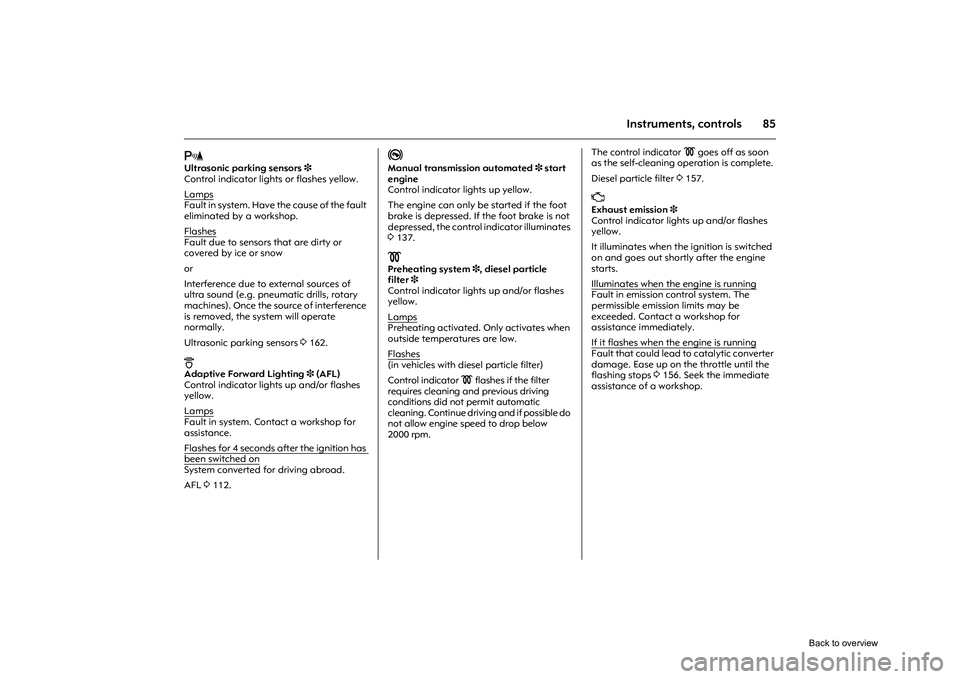
Ultrasonic parking sensors 3
Control indicator lights or flashes yellow.
Lamps
Fault in system. Have the cause of the fault
eliminated by a workshop.
Flashes
Fault due to sensors that are dirty or
covered by ice or snow
or
Interference due to external sources of
ultra sound (e.g. pneumatic drills, rotary
machines). Once the source of interference
is removed, the system will operate
normally.
Ultrasonic parking sensors 3 162.
B
Adaptive Forward Lighting 3 (AFL)
Control indicator lights up and/or flashes
yellow.
Lamps
Fault in system. Contact a workshop for
assistance.
Flashes for 4 seconds after the ignition has
been switched on
System converted for driving abroad.
AFL 3112.
j
Manual transmission automated 3 start
engine
Control indicator lights up yellow.
The engine can only be started if the foot
brake is depressed. If the foot brake is not
depressed, the control indicator illuminates
3 137.
!
Preheating system 3, diesel particle
filter 3
Control indicator lights up and/or flashes
yellow.
Lamps
Preheating activated. Only activates when
outside temperatures are low.
Flashes
(in vehicles with diesel particle filter)
Control indicator ! flashes if the filter
requires cleaning and previous driving
conditions did not permit automatic
cleaning. Continue driving and if possible do
not allow engine speed to drop below
2000 rpm. The control indicator
! goes off as soon
as the self-cleaning op eration is complete.
Diesel particle filter 3157.
Z
Exhaust emission 3
Control indicator lights up and/or flashes
yellow.
It illuminates when the ignition is switched
on and goes out shortly after the engine
starts.
Illuminates when the engine is running
Fault in emission control system. The
permissible emission limits may be
exceeded. Contact a workshop for
assistance immediately.
If it flashes when the engine is runningFault that could lead to catalytic converter
damage. Ease up on the throttle until the
flashing stops 3156. Seek the immediate
assistance of a workshop.
Back to overview
Page 93 of 284

87
Instruments, controls
p
Alternator
Control indicator lights up and/or flashes
red.
It illuminates when the ignition is switched
on and goes out shortly after the engine
starts.
Flashes during or after engine start
Battery voltage too lo w. Have electrical
system tested by a workshop.
Illuminates when the engine is runningStop and switch engine off. Battery will not
be charged. Engine cooling may be
interrupted. Effect of brake servo unit may
stop in vehicles with diesel engines.
Contact a workshop for assistance. p
Electro-hydraulic power assisted steering
Control indicator lights up yellow.
Fault in electro-hydr aulic power assisted
steering system. The power assisted
steering may have failed. The vehicle can
be steered but considerably more force is
required. Contact a workshop for
assistance.
O
Turn signal lamps
Control indicator flashes green.
The control indicator flashes if a turn signal
or the hazard warning flashers are
activated.
Rapid flashes: A turn signal lamp or the
related fuse has failed, failure of turn signal
lamp on the trailer 3.
Change bulbs 3212. Fuses 3 209.
Y
Fuel level
Control indicator lights up and/or flashes
yellow
Lamps
Level in fuel tank too low.
Flashes
Fuel level is used up, fuel immediately.
Never let the tank run dry!
Erratic fuel supply can cause catalytic
converter to overheat 3155.
Diesel engines: Bleed the fuel system after
running empty 3190.
C
Main beam
Control indicator lights up blue.
It is illuminated when main beam is on and
during headlamp flash 311, 3109.
W
Coolant temperature
Stop, switch off engine.
Check coolant level immediately 3244.
If there is sufficient coolant, consult a
workshop. Caution
Coolant temperature too high.
Back to overview
Page 142 of 284
136 Driving and operationDriving and operation
Manual transmission automated
3
The Easytronic transmission permits
manual (manual mode ) or automatic gear
shifting ( automatic mode ), both with
automatic clutch control.
Picture no: 18432s.tif
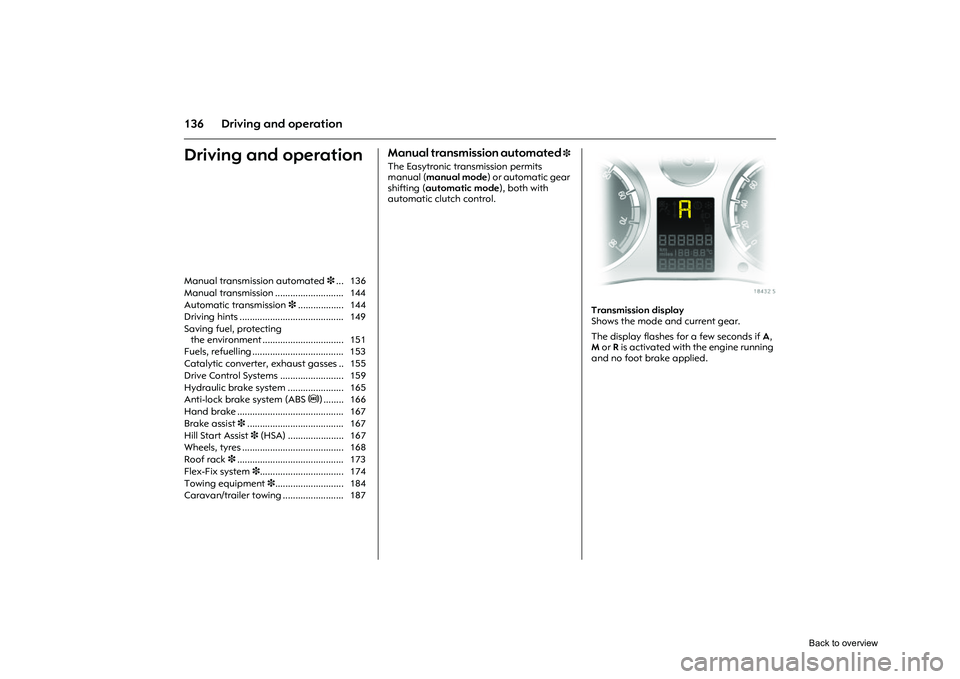
Transmission display
Shows the mode and current gear.
The display flashes for a few seconds if A,
M or R is activated with the engine running
and no foot brake applied.
Manual transmission automated
3... 136
Manual transmission ........................... 144
Automatic transmission 3.................. 144
Driving hints ......................................... 149
Saving fuel, protecting the environment ................................ 151
Fuels, refuelling .................................... 153
Catalytic converter, exhaust gasses .. 155
Drive Control Systems ......................... 159
Hydraulic brake system ...................... 165
Anti-lock brake system (ABS u ) ........ 166
Hand brake .......................................... 167
Brake assist 3...................................... 167
Hill Start Assist 3 (HSA) ...................... 167
Wheels, tyres ........................................ 168
Roof rack 3.......................................... 173
Flex-Fix system 3................................. 174
Towing equipment 3........................... 184
Caravan/trailer towing ........................ 187
Back to overview
Page 145 of 284
139
Driving and operation
If the vehicle is in automatic mode, on
movement of the selector lever to
+ or
- the
manual transmission automated shifts to
manual mode and changes up or down.
The gear currently engaged appears on
the transmission display.
Move selector lever toward R
Reverse gear. Engage only when vehicle is
stationary.
Depress the foot brake, release the hand
brake and move the selector lever to R.
Reverse gear is engaged. "R" appears in
the transmission display.
The vehicle begins to "creep" when the foot
brake is released.
It is also possible to start off in reverse
without depressing the foot brake if the
accelerator pedal is operated directly after
moving the selector lever. If there is no
acceleration or the foot brake is not
depressed, no gear is engaged and "R"
flashes. After a few seconds, the display
resumes showing "N". Start off by
repeating the previously described
procedure. Stopping the vehicle
In Automatic or Manual mode, when the
vehicle has stopped first gear (with Winter
mode engaged, second gear) is engaged
automatically and the clutch released. In
R
reverse remains engaged.
A warning buzzer sounds when the driver’s
door is opened if the engine is running, a
gear is engaged and the foot brake is not
depressed. The vehicle creeps if the hand
brake is not engaged. Move the selector
lever to N and apply the hand brake.
When stopping on gradients, engage the
hand brake or depress the brake pedal. To
prevent overheating of the clutch, do not
increase engine speed to ensure smooth
idling when in gear.
To prevent damage to the automated
manual transmission, the clutch is closed
automatically at high clutch temperatures.
Switch off engine if stopping for a lengthy
period, e.g. in traffic jams or at level
crossings. Electronically controlled driving
programmes
z
Following a cold start, the operating
temperature program automatically
increases the engine revolutions to bring
the catalytic converter to the required
temperature.
z The adaptive program automatically
selects the gear according to the driving
conditions, e.g. increased load and
gradients.
Back to overview
Page 152 of 284

146 Driving and operationElectronically controlled driving
programmes
zThe automatic neutral shift function
automatically shifts to idling when the
vehicle is stopped with a forward gear
engaged (depending on transmission
fluid temperature).
z Following a cold start, the operating
temperature programme increases
engine speed to quickly bring the
catalytic converter to the required
temperature.
z The adaptive program automatically
adjusts the gear change to the driving
conditions, e.g. greater load or gradients.
Picture no: 18234s.tif
Winter programme T
Activate the Winter pr ogramme if you have
problems starting off on a slippery road
surface.
To activate Press the T button with P , R , N , D or 3
engaged. The vehicle starts off in 3rd gear.
To deactivate The Winter programme is switched off by:
z pressing the T button again,
z manually selecting 2 or 1 ,
z turning off the ignition,
z or if the transmission oil temperature is
too high.
Picture no: 18451s.tif
Kickdown
If the accelerator pedal is pressed past the
pressure point, the transmission shifts to a
lower gear depending on engine speed.
Back to overview
Page 156 of 284
150 Driving and operationSave energy – more kilometres
Please observe the running-in hints on the
previous page and the tips for saving
energy on the following pages.
Good, technically correct and economical
driving ensures maximum durability and
performance for your vehicle.
Overrun cut-off
The fuel supply is automatically cut off
during overrun, e.g. when the vehicle is
driven with a gear engaged but no throttle
application. Overrun cut-off is deactivated
if catalytic converter temperature is high.
Vehicles with turbocharged engine Flow-generated noises may be audible if
the accelerator is released quickly on
account of air flow in the turbocharger.
Engine speed
Drive in a low engine speed range for each
gear as much as possible. Warming up
After a cold start, the automatic
transmission
3 or manual transmission
automated 3 in automatic mode shifts into
higher gears at higher rpm. This allows the
catalytic converter to quickly reach the
temperature required for optimum pollutant
reduction.
Correct gear selection
Do not race your engine whilst in neutral or
with a low gear selected. Driving too fast in
individual gears as well as stop-and-go
traffic increases engine wear and fuel
consumption.
Change down
When decreasing speed, shift down into
the next lowest gear. Do not slip the clutch
with a high-revving engine. This is
especially important when hill climbing. Cooling fan
The cooling fan is controlled via a
thermoswitch and therefore only runs if
necessary.
The cooling fan automatically switches on
when the diesel particle filter is being
cleaned
3 depending on the engine.
Pedals
Do not place any objects in the foot well
which could slip under the pedals and
inhibit the pedal travel.
To ensure the pedal travel is uninhibited,
there must be no mats in the area of the
pedals.
Battery care
When driving slowly or when the vehicle is
stationary, e.g. in slow urban traffic, stop-
and-go traffic or traffic jams, turn off all
unnecessary electrical loads where
possible (e.g. heated rear window, heated
front seats, etc.).
Declutch when starting in order to relieve
the strain on the starter and the battery.
Back to overview
Page 161 of 284
155
Driving and operation
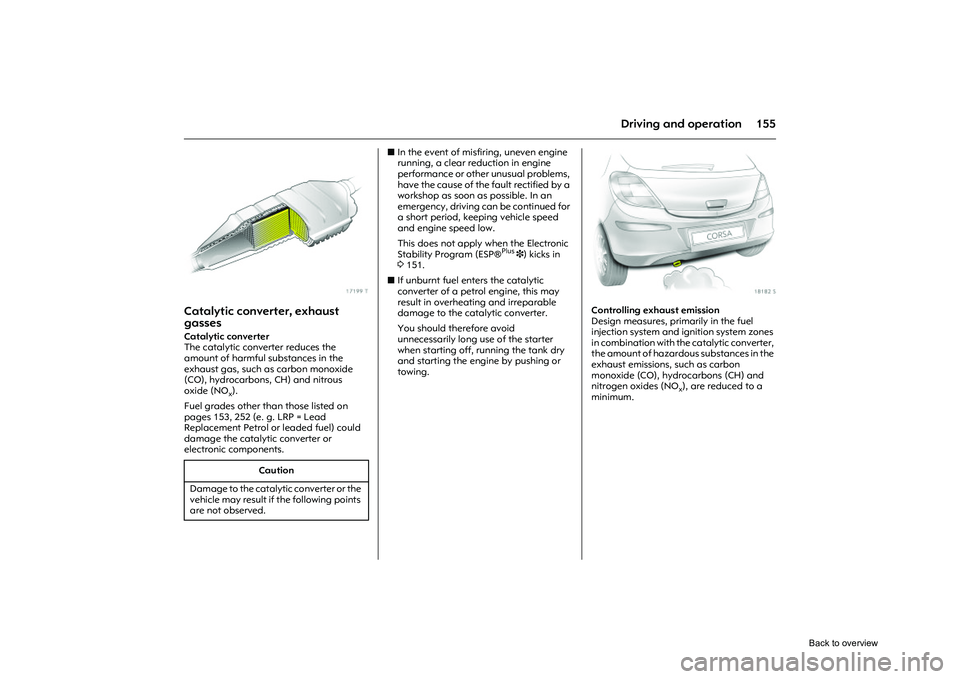
Picture no: 17199t.tif
Catalytic converter, exhaust
gassesCatalytic converter
The catalytic converter reduces the
amount of harmful substances in the
exhaust gas, such as carbon monoxide
(CO), hydrocarbons, CH) and nitrous
oxide (NO
x).
Fuel grades other than those listed on
pages 153, 252 (e. g. LRP = Lead
Replacement Petrol or leaded fuel) could
damage the catalytic converter or
electronic components. z
In the event of misfiring, uneven engine
running, a clear reduction in engine
performance or other unusual problems,
have the cause of the fault rectified by a
workshop as soon as possible. In an
emergency, driving can be continued for
a short period, keeping vehicle speed
and engine speed low.
This does not apply when the Electronic
Stability Program (ESP®
Plus
3) kicks in
3 151.
z If unburnt fuel enters the catalytic
converter of a petrol engine, this may
result in overheating and irreparable
damage to the catalytic converter.
You should therefore avoid
unnecessarily long use of the starter
when starting off, running the tank dry
and starting the engine by pushing or
towing.
Picture no: 18182s.tif
Controlling exhaust emission
Design measures, primarily in the fuel
injection system and ignition system zones
in combination with the catalytic converter,
the amount of hazardous substances in the
exhaust emissions, such as carbon
monoxide (CO), hydrocarbons (CH) and
nitrogen oxides (NO
x), are reduced to a
minimum.
Caution
Damage to the catalytic converter or the
vehicle may result if the following points
are not observed.
Back to overview
Page 162 of 284

156 Driving and operation
Picture no: 18251s.tif
Control indicator
Z for exhaust
Illuminates when the ignition is switched on
and during the start attempt. Goes off
shortly after the engine starts running.
Illumination whilst the engine is running
indicates a fault in the emission control
system. The permissible emission limits
may be exceeded. Contact a workshop for
assistance immediately.
Illumination with the engine running
indicates a fault that can cause damage to
the catalytic converter. It is possible to
continue driving without causing damage
by slowing down until the flashing stops
and the control indicator illuminates.
Contact a workshop for assistance
immediately.
Picture no: 18231s.tif
Control indicator
A
for engine electronics
Illuminates for a few seconds after the
ignition is switched on.
If it illuminates when the engine is running,
there is a fault in engine or transmission
electronics. The electr onic system switches
to an emergency runni ng programme. Fuel
consumption may be increased and the
driveability of the vehicle may be impaired.
In some cases the fault can be remedied by
switching the engine off and starting it
again. If the control indicator continues to
illuminate whilst the en gine is running,
contact a workshop for assistance in
remedying the cause of the fault. If it illuminates briefly, but does not recur, it
is of no significance.
If
A lights up, this could mean that there
is water in the diesel fuel filter 3. A
message appears at the same time on the
service display 391. Have the fuel filter
checked for possible water contamination
by a workshop.
If it flashes after the ignition is switched on,
there is a fault in the immobiliser system.
The engine cannot be started 327.
Back to overview
Page 164 of 284

158 Driving and operation
Picture no: 18540t.tif
We recommend not stopping driving
during cleaning, and not switching off the
ignition. Cleaning is fa stest at high engine
revs and high loads.
Picture no: 18545s.tif
The control indicator
! goes off as soon as
the self-cleaning operation is complete. Maintenance
Have all maintenance work carried out at
the specified intervals. We recommend
that you entrust this work to your Opel
Partner, who has proper equipment and
trained personnel available. Electronic
testing systems permit rapid diagnosis and
remedy of faults. This way you can be
certain that all components of the vehicle’s
electrical, injection and ignition systems
operate correctly, that your vehicle has a
low level of pollutant emission and that the
catalytic converter system will have a long
service life.
You are thereby making an important
contribution towards keeping the air clean
and compliance with emissions legislation.
Checking and adjustment of the fuel-
injection and ignition systems is included in
the inspection. For this reason, you should
have all maintenance work carried out at
the intervals specified in your Service and
Warranty Booklet.
Back to overview
Page 277 of 284

271
Index
BBattery ............................................ 150, 248Interruption of
power supply ........................46, 143, 148
Battery discharge protection ................ 116
Before starting off ................................... 15
Belt force limiters ..................................... 59
Belt tensioners .......................................... 60
Bleeding, diesel fuel system .................. 190
Bonnet .................................................... 190
Boot, see Luggage co mpartment .... 36, 53
Brake assist ............................................ 167
Brake lamp ............................................. 166
Brake system ............................................ 89
Brakes ABS ...................................................... 166
Brake assist ........................................ 167
Brake fluid .......................................... 246
Brake lamps ....................................... 221
Brake servo unit ................................. 149
Foot brake .......................................... 167
Hand brake ........................................ 167
Bulb replacement .................................. 212
Bulbs ....................................................... 212
CCapacities .............................................. 267
Car dimensions ...................................... 268
Car Pass ................................................... 26
Caravan/trailer towing .......................... 149
Care ........................................................ 228
Catalytic converter ................................ 158
Central locking system ...................... 28, 32
Changing the battery Remote control .............................. 32, 33
Changing tyre/wheel type .................... 168
Changing wheels ................................... 200
Chassis number, see vehicle identification number .......................... 251
Check control ................................... 21, 104
Child restraint system .............................. 63
Child safety locks ..................................... 39
Cigarette lighter ...................................... 80
Climate control ...................................... 120
Climate control system ................. 121, 128
Clutch operation .................................... 144
CO
2-emissions ........................................ 256
Cold start ............................................... 150
Colour information display ..................... 94
Contrast .................................................. 100
Control indicator ABS (Anti-lock Brake System) ........... 166
Airbag ................................................... 74
Engine electronics .............................. 156
Exhaust ............................................... 156
Immobiliser ........................................... 27
Park pilot ............................................ 163 Control indicators .............................. 10, 86
Adaptive Forward
Lighting (AFL) .............................. 85, 112
Belt tensioners ..................................... 61
Brake system ...................................... 165
Cruise control ..................................... 161
DDS ..................................................... 164
Deflation detection system ............... 164
ESP (Electronic Stability Program) .... 151
Seat belts ............................................. 59
Coolant .................................................. 244
Coolant level .......................................... 245
Coolant temperature .............................. 87
Cooling ................................................... 127
Cornering light ....................................... 112 Bulb replacement .............................. 218
Correcting time ........................................ 99
Coupling socket load ............................ 188
Courtesy lamp ............................... 114, 115
Courtesy lamps Bulb replacement .............................. 226
Cruise control ......................................... 160
Curtain airbags ....................................... 73
Curve lighting .................................. 23, 112
Back to overview