roof rack OPEL CORSA 2009 Owners Manual
[x] Cancel search | Manufacturer: OPEL, Model Year: 2009, Model line: CORSA, Model: OPEL CORSA 2009Pages: 284, PDF Size: 4.96 MB
Page 53 of 284

47
Keys, doors, windows, sun roof
To raise
With the sun roof closed, press button ü.
The sun roof is raised at the rear.
To open
Press button ü again with the sun roof in
the raised position. The sun roof opens
automatically until it reaches its limit
position.
To close
Hold down button d until the sun roof is
completely closed.
Picture no: 18372s.tif
Sunblind
The sun blind can be opened and closed
manually whether the sun roof is open or
closed.
Note
z If the top of the roof is wet, tilt sun roof,
allow water to run off and then open sun
roof.
z When using a roof rack 3, check the free
movement of the sun roof in order to
avoid damage. It is only permitted to
raise the sun roof. Overload
If the system is overloaded, the power
supply is automatically cut off for a short
time.
The system is protected by fuses in the fuse
box – see page
3208.
Fault
If perfect function of the sun roof is not
guaranteed. Activate the electronics as
follows:
1. Switch on ignition.
2. Close the sun roof and hold button d
depressed at least 10 seconds.
Please contact a workshop to have the
cause of the fault remedied.
Back to overview
Page 63 of 284
57
Seats, Interior
Picture no: 18281s.tif
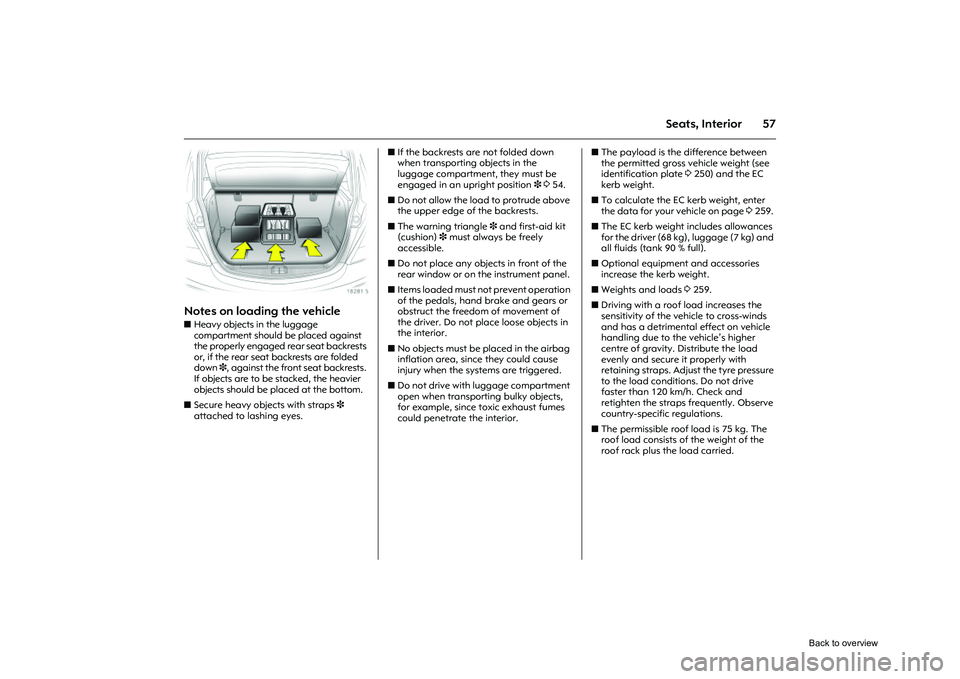
Notes on loading the vehicle zHeavy objects in the luggage
compartment should be placed against
the properly engaged rear seat backrests
or, if the rear seat backrests are folded
down 3, against the front seat backrests.
If objects are to be stacked, the heavier
objects should be placed at the bottom.
z Secure heavy objects with straps 3
attached to lashing eyes. z
If the backrests are not folded down
when transporting objects in the
luggage compartment, they must be
engaged in an upright position 3354.
z Do not allow the load to protrude above
the upper edge of the backrests.
z The warning triangle 3 and first-aid kit
(cushion) 3 must always be freely
accessible.
z Do not place any objects in front of the
rear window or on the instrument panel.
z Items loaded must not prevent operation
of the pedals, hand brake and gears or
obstruct the freedom of movement of
the driver. Do not place loose objects in
the interior.
z No objects must be placed in the airbag
inflation area, since they could cause
injury when the systems are triggered.
z Do not drive with luggage compartment
open when transporting bulky objects,
for example, since toxic exhaust fumes
could penetrate the interior. z
The payload is the difference between
the permitted gross vehicle weight (see
identification plate 3250) and the EC
kerb weight.
z To calculate the EC kerb weight, enter
the data for your vehicle on page 3259.
z The EC kerb weight includes allowances
for the driver (68 kg), luggage (7 kg) and
all fluids (tank 90 % full).
z Optional equipment and accessories
increase the kerb weight.
z Weights and loads 3259.
z Driving with a roof load increases the
sensitivity of the vehicle to cross-winds
and has a detrimental effect on vehicle
handling due to the vehicle’s higher
centre of gravity. Distribute the load
evenly and secure it properly with
retaining straps. Adjust the tyre pressure
to the load conditions. Do not drive
faster than 120 km/h. Check and
retighten the straps frequently. Observe
country-specific regulations.
z The permissible roof load is 75 kg. The
roof load consists of the weight of the
roof rack plus the load carried.
Back to overview
Page 74 of 284
68 Seats, Interior
Picture no: 18299s.tif
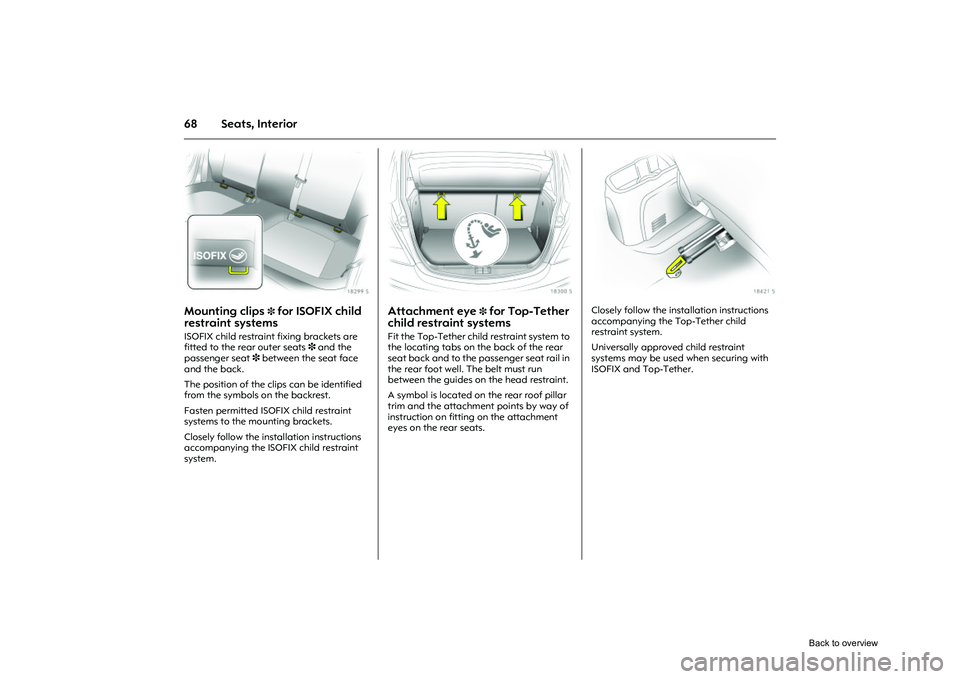
Mounting clips
3 for ISOFIX child
restraint systems
ISOFIX child restraint fixing brackets are
fitted to the rear outer seats 3 and the
passenger seat 3 between the seat face
and the back.
The position of the clips can be identified
from the symbols on the backrest.
Fasten permitted ISOF IX child restraint
systems to the mounting brackets.
Closely follow the installation instructions
accompanying the ISOFIX child restraint
system.
Picture no: 18300s.tif
Attachment eye
3 for Top-Tether
child restraint systems
Fit the Top-Tether child restraint system to
the locating tabs on the back of the rear
seat back and to the passenger seat rail in
the rear foot well. The belt must run
between the guides on the head restraint.
A symbol is located on the rear roof pillar
trim and the attachment points by way of
instruction on fitting on the attachment
eyes on the rear seats.
Picture no: 18421s.tif
Closely follow the installation instructions
accompanying the Top-Tether child
restraint system.
Universally approved child restraint
systems may be used when securing with
ISOFIX and Top-Tether.
Back to overview
Page 142 of 284
136 Driving and operationDriving and operation
Manual transmission automated
3
The Easytronic transmission permits
manual (manual mode ) or automatic gear
shifting ( automatic mode ), both with
automatic clutch control.
Picture no: 18432s.tif
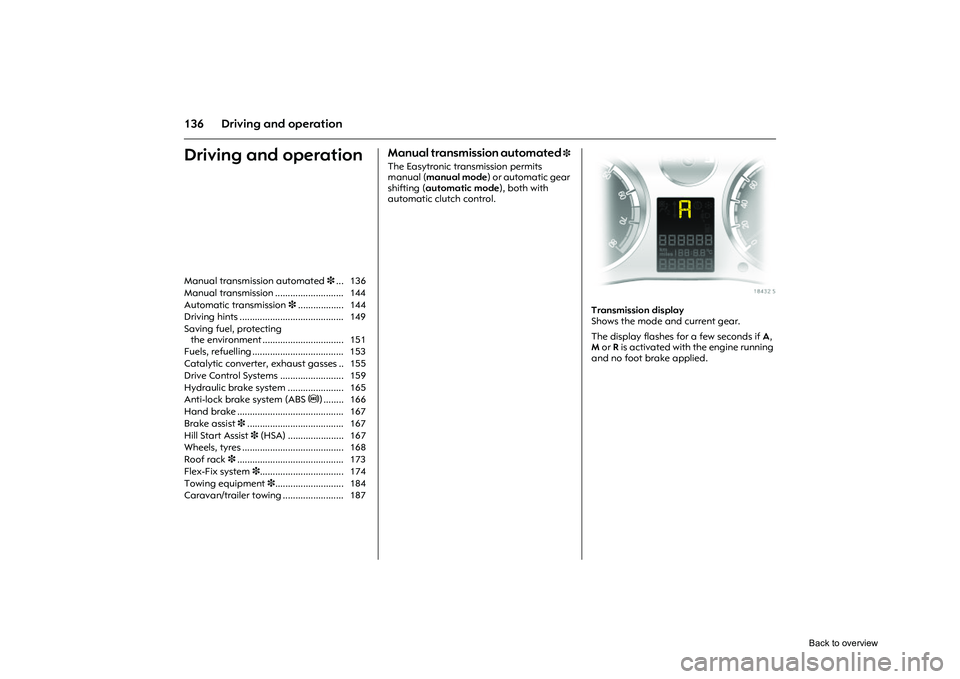
Transmission display
Shows the mode and current gear.
The display flashes for a few seconds if A,
M or R is activated with the engine running
and no foot brake applied.
Manual transmission automated
3... 136
Manual transmission ........................... 144
Automatic transmission 3.................. 144
Driving hints ......................................... 149
Saving fuel, protecting the environment ................................ 151
Fuels, refuelling .................................... 153
Catalytic converter, exhaust gasses .. 155
Drive Control Systems ......................... 159
Hydraulic brake system ...................... 165
Anti-lock brake system (ABS u ) ........ 166
Hand brake .......................................... 167
Brake assist 3...................................... 167
Hill Start Assist 3 (HSA) ...................... 167
Wheels, tyres ........................................ 168
Roof rack 3.......................................... 173
Flex-Fix system 3................................. 174
Towing equipment 3........................... 184
Caravan/trailer towing ........................ 187
Back to overview
Page 158 of 284

152 Driving and operationOverrun
zThe fuel supply is shut off automatically
on overrun, e.g. when descending steep
hills or when braking 3150.
z To enable the overrun cut-off to come
into action and save fuel, do not
accelerate or declutch during overrun.
Correct gear selection
z High revs increase engine wear and fuel
consumption.
z Do not race your engine. Avoid driving at
high engine speeds.
Making use of the tachometer helps to
save fuel. Drive in a low engine speed
range for each gear as much as possible
with uniform engine speeds. Drive as
often as possible in top gear, select the
next higher gear as soon as possible,
and only change down when the engine
is no longer running perfectly smoothly.
High speed
z The higher the speed, the higher the
consumption and the noise level. At top
speed, you consume a great deal of fuel
and produce excessive noise and
exhaust emissions. z
Slightly releasing th e accelerator pedal
results in distinct fu el savings with no
major loss of speed.
Drive at no more than around three
quarters of maximum speed and you will
use up to 50 % less fuel, without losing a
great deal of time.
Tyre pressure
z Inadequate tyre pressure, leading to
higher road resistance, costs money in
two ways: for more fuel and increased
tyre wear.
z Regular checks (every 14 days) pay off.
Electrical loads
z The power consumption of electrical
equipment increases fuel consumption.
z Switch off all additional consumers (e.g.
air conditioning 3, heated rear window)
when not needed.
Roof racks, ski-holders
z Roof loads can increase fuel consumption
by approximately 1l/100 km due to air
resistance.
z Remove them if they are not being used. Repair and maintenance
z
Improper repairs or adjustment and
maintenance work can increase fuel
consumption. Do not carry out work on
the engine yourself.
You may out of ignorance infringe
environmental laws by not disposing of
materials properly.
Appropriate parts might not be recycled.
Contact with some of the materials
involved may pose a health hazard.
z We recommend that repair and
maintenance be entrusted to your Opel
Partner.
Extreme driving conditions
z Driving up steep slopes, cornering,
driving on poor roads and driving in ice
and snow all increase fuel consumption.
Fuel consumption increases dramatically
in urban traffic and at low temperatures,
especially on short trips when the engine
operating temperature is not reached.
z Following the instructions given above
will minimise consumption under these
conditions.
Back to overview
Page 179 of 284
173
Driving and operation
Remove the wheel trims if using tyre chains
3201.
Tyre chains may only be used at speeds up
to 50 km/h. When travelling on roads that
are free of snow, they may only be used for
brief periods.
Tyre chains must not be used on the
temporary spare wheel. If you need to use
tyre chains after suffering a flat front tyre,
fit the temporary spare on the rear axle
and transfer one of the rear wheels to the
front axle.
Roof rack
3
For safety reasons and to avoid roof
damage we recommend using the Opel
roof rack system that is approved for your
vehicle.
Follow the usage instructions for the roof
rack.
Remove the roof rack when not in use.
Driving hints 3 149
Picture no: 18313s.tif
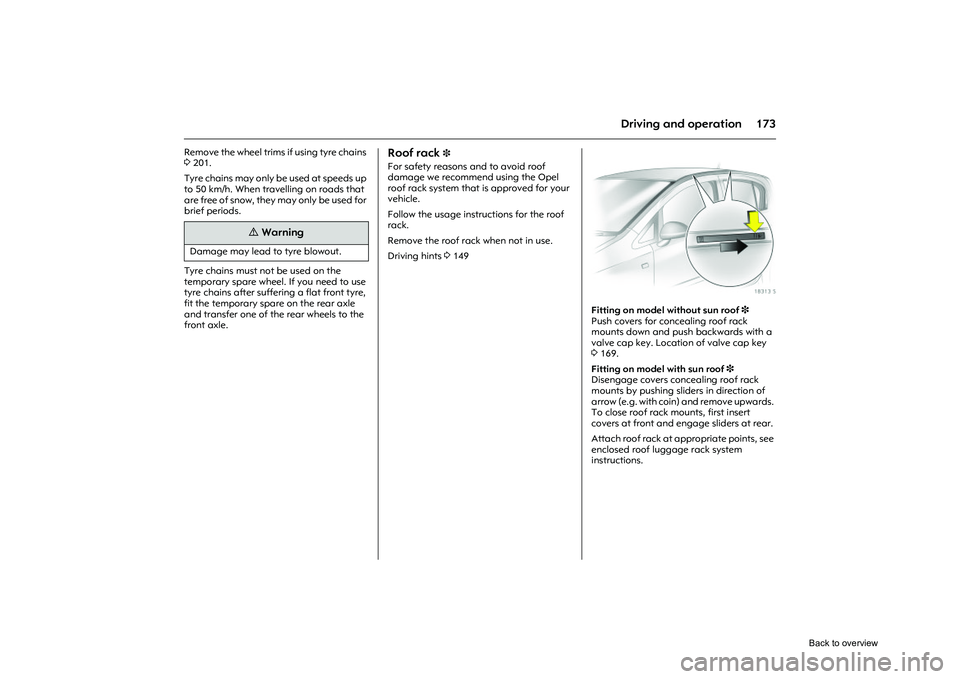
Fitting on model without sun roof 3
Push covers for concealing roof rack
mounts down and push backwards with a
valve cap key. Location of valve cap key
3 169.
Fitting on model with sun roof 3
Disengage covers concealing roof rack
mounts by pushing sliders in direction of
arrow (e.g. with coin) and remove upwards.
To close roof rack mounts, first insert
covers at front and engage sliders at rear.
Attach roof rack at appropriate points, see
enclosed roof luggage rack system
instructions.
9
Warning
Damage may lead to tyre blowout.
Back to overview
Page 234 of 284
228 Self-help, vehicle careVehicle careWhen caring for your vehicle, observe all
national environmental regulations,
particularly when washing it.
Regular, thorough care helps to improve
the appearance of your vehicle and
maintain its value over the years. It is also
prerequisite for warranty claims for any
paint or corrosion da mage. The following
pages contain tips for vehicle care which, if
used properly, will help combat the
unavoidable, damaging effects of the
environment. Washing
The paintwork of your vehicle is exposed to
environmental influences. Wash and wax
your vehicle regularly. When using
automatic car washes, select a program
that includes waxing.
Bird droppings, dead insects, resin, pollen
and the like should be cleaned off
immediately, as they contain aggressive
constituents which can cause paint
damage.
If using a car wash, comply with the car
wash manufacturer’s instructions. The
windscreen wipers and rear window wiper
must be switched off. Remove antenna
3
and roof rack 3. Stand on the door sill to
reach them more easily. If you wash your vehicle by hand, make
sure that the insides
of the wings are also
thoroughly rinsed out.
Clean edges and folds on opened doors
and flaps as well as the areas they cover.
Thoroughly rinse off and leather-off the
vehicle. Rinse leather frequently. Use
separate leathers for paint and window
surfaces: remnants of wax on the windows
will impair vision.
Do not use hard objects to remove spots of
tar. Use tar removal spray on painted
surfaces.
Back to overview
Page 265 of 284

259
Technical Data
Weights, payload and roof load The payload is the difference between the
permitted gross vehicle weight (see
identification plate, page 3250) and the
EC kerb weight.
To calculate the kerb weight, enter the
data for your vehicle below:
is the EC kerb weight.
Optional equipmen t and accessories
increase the kerb weight, which means that
the payload will also change slightly.
Note the weights given in the vehicle
documents. The combined total of front and rear axle
loads must not exceed the permissible
gross vehicle weight. For example, if the
front axle is bearing its maximum
permissible load, the rear axle can only
bear a load that is equal to the gross
vehicle weight minus
the front axle load.
With the trailer attached and the towing
vehicle fully loaded, including all the
passengers, the permitted rear axle load
(specified on identification plate and
vehicle documents) for passenger vehicles
may be exceeded by 45 kg and the
permitted total load may be exceeded
by 50 kg.
For vans the permitted rear axle load may
be exceeded by 25 kg. The permitted total
load may be exceeded by the following
amounts with the engines
1) specified
below:
Trailer operation is not permitted for vans
with tyre size 215/45 R 17. If the permitted rear axle load is exceeded
a maximum speed of 100 km/h applies. If
lower national maximum speeds are
specified for trailer operation, they must be
complied with.
See the identification
plate or vehicle
documents for permissible axle loads.
Roof load
The permissible roof load is 75 kg. The roof
load consists of the weight of the roof rack
plus the load carried.
Driving instructions 3149. Caravan/trailer
towing 3187, roof rack 3173.
z
Unladen weight from
table 1 3260 +.............. kg
z Added weight for
different specifications
are given in
table 2 3263 +.............. kg
z Weight of heavy
accessories from table 3
3263 +.............. kg
Total =.............. kg
1)Sales designation – see pages
3252,
3253.
Z 10 XEP 30 kg
Z 12 XEP 15 kg
Z 13 DTH 40 kg
Z 13 DTJ 35 kg
Back to overview
Page 280 of 284

274 IndexMMain beam ....................................... 11, 109Bulb replacement ....................... 214, 217
Control indicator .................................. 87
Maintenance .......................................... 231 Air conditioning system ..................... 135
Antifreeze protection ......................... 244
Brake fluid .......................................... 246
Brakes ......................................... 165, 245
Engine oil ............................................ 242
Fuel consumption .............................. 152
Tyre pressure ...................................... 169
Tyres ................................................... 170
Manual transmission – see Transmission ............................ 14, 144
Mirrors ............................................. 4, 43, 44
Misted windows ............................. 125, 131
Mobile telephone ................................... 119
Motorway lighting ................................. 112
Muffler, see Exhaust system ................. 157NNeutral, transmission .............................. 14
Number plate lamps Bulb replacement ............................... 225
Number plate lighting ........................... 225
Number plates ....................................... 249
OOctane numbers ............................ 252, 253
Oil ........................................................... 239 Additives ............................................ 239
Top up ................................................ 239
Viscosity .............................................. 239
Oil consumption .................................... 242
Oil level ................................................... 242
Oil pressure .............................................. 86
Oils .......................................................... 242
Opel Service ........................................... 231
Operating temperature ........................ 150
Outside temperature gauge ................... 95
Overrun .................................................. 152PPark pilot ................................................ 162
Parking ..................................................... 17
Parking lamps .................................. 11, 114 Bulb replacement ...................... 215, 219
Parking the vehicle .................................. 17
Pedals ..................................................... 150
Performance .................................. 254, 256
Peripheral lighting ................................. 113
Personalised key ................. 23, 33, 34, 39, 92, 107, 110
Petrol .............................................. 252, 253
Pollen filter ............................................. 135
Power assisted steering, see electro-hydraulic power
assisted steering .................................. 149 Power steering, see electro-hydraulic
power assisted steering ...................... 149
Preheating ............................................... 85
QQuickheat .............................................. 134RRadio ...................................................... 118
Radio equipment (CB) .......................... 119
Radio reception ..................................... 118
Rain sensor ............................................ 106
Reading lamps .............................. 115, 116
Rear lamp cluster .................................. 108 Bulb replacement .............................. 221
Rear window washer system ...............13, 107, 228, 248
Rear window wiper .......................... 13, 107
Refuelling Fuel filler cap ............................. 153, 154
Remote control Central locking system .................... 2, 31
Steering wheel ............................. 21, 118
Replacement keys ................................... 26
Reversing lamps Bulb replacement .............................. 221
Roof load ................................. 57, 149, 152
Roof rack ..........................57, 152, 173, 259
Roof racks ................................ 57, 152, 259
Run-flat tyres ......................................... 171
Running-in Brakes ......................................... 165, 245
Back to overview