Door OPEL CORSA E 2017.5 Service Manual
[x] Cancel search | Manufacturer: OPEL, Model Year: 2017.5, Model line: CORSA E, Model: OPEL CORSA E 2017.5Pages: 269, PDF Size: 7.97 MB
Page 188 of 269

186Driving and operatingThe permissible gross train weight
must not be exceeded. This weight is
specified on the identification plate
3 241.
Vertical coupling load The vertical coupling load is the load
exerted by the trailer on the coupling
ball. It can be varied by changing the
weight distribution when loading the
trailer.Petrol and diesel engines
The maximum permissible vertical
coupling load (55 kg) is specified on
the towing equipment identification
plate and in the vehicle documents.
Always aim for the maximum load,
especially in the case of heavy
trailers. The vertical coupling load
should never fall below 25 kg.Engine B14XEL LPG
The maximum permissible vertical
coupling load (45 kg) is specified on
the towing equipment identification
plate and in the vehicle documents.
Always aim for the maximum load,
especially in the case of heavy
trailers. The vertical coupling load
should never fall below 25 kg.Rear axle loadPetrol and diesel engines
When the trailer is coupled and the
towing vehicle fully loaded, the
permissible rear axle load (see
identification plate or vehicle
documents) for passenger vehicles
may be exceeded by 70 kg for the 5-
door vehicle and 60 kg for the 3-door
vehicle, the gross vehicle weight
rating by 55 kg.Engine B14XEL LPG
When the trailer is coupled and the
towing vehicle fully loaded, the
permissible rear axle load (see
identification plate or vehicle
documents) for passenger vehicles
may be exceeded by 70 kg for the 5-
door vehicle and 70 kg for the 3-door
vehicle and the gross vehicle weight
rating by 45 kg.Delivery van
When the trailer is coupled and the
towing vehicle fully loaded, the
permissible rear axle load (see
identification plate or vehicle
documents) for passenger vehicles
may be exceeded by 60 kg and the
gross vehicle weight rating by 55 kg.General
If the permitted rear axle load is
exceeded a maximum speed of
100 km/h applies. If lower national
maximum speeds are specified for
trailer operation, they must be
complied with.
Towing equipmentCaution
When operating without a trailer,
remove the coupling ball bar.
Stowage of coupling ball bar
The coupling ball bar is stowed in a
bag in the spare wheel well and
secured to the lashing eyes in the
load compartment.
Page 193 of 269
Vehicle care191General Information
Accessories and vehicle modifications
We recommend the use of genuine
parts and accessories and factory
approved parts specific for your
vehicle type. We cannot assess or guarantee reliability of other products
- even if they have a regulatory or
otherwise granted approval.
Any modification, conversion or other changes made to standard vehicle
specifications (including, without
limitation, software modifications,
modifications of the electronic control
units) may invalidate the warranty
offered by Opel. Furthermore, such
changes may affect driver assistance systems, may impact fuel
consumption, CO 2 emissions and
other emissions of the vehicle and
cause the vehicle to no longer
conform to the type approval,
impacting the validity of your vehicle
registration.Caution
When transporting the vehicle on
a train or on a recovery vehicle, the
mud flaps may be damaged.
Vehicle storage
Storage for a long period of time
If the vehicle is to be stored for several months:
● Wash and wax the vehicle.
● Have the wax in the engine compartment and underbody
checked.
● Clean and preserve the rubber seals.
● Fill up fuel tank completely.
● Change the engine oil.
● Drain the washer fluid reservoir.
● Check the coolant antifreeze and
corrosion protection.
● Adjust tyre pressure to the value specified for full load.
● Park the vehicle in a dry, wellventilated place. Engage first or
reverse gear or set selector lever
to P. Prevent the vehicle from
rolling.
● Do not apply the parking brake.
● Open the bonnet, close all doors and lock the vehicle.
● Disconnect the clamp from the negative terminal of the vehicle
battery. Beware that all systems
are not functional, e.g. anti-theft
alarm system.
Putting back into operation
When the vehicle is to be put back into
operation:
● Connect the clamp to the negative terminal of the vehicle
battery. Activate the electronics
of the power windows.
● Check tyre pressure.
● Fill up the washer fluid reservoir.
● Check the engine oil level.
● Check the coolant level.
● Fit the number plate if necessary.
Page 201 of 269
Vehicle care199Bulb replacement
Switch off the ignition and switch off
the relevant switch or close the doors.
Only hold a new bulb at the base! Do
not touch the bulb glass with bare
hands.
Use only the same bulb type for
replacement.
Replace headlight bulbs from within
the engine compartment.
Bulb check After a bulb replacement switch on
the ignition, operate and check the
lights.
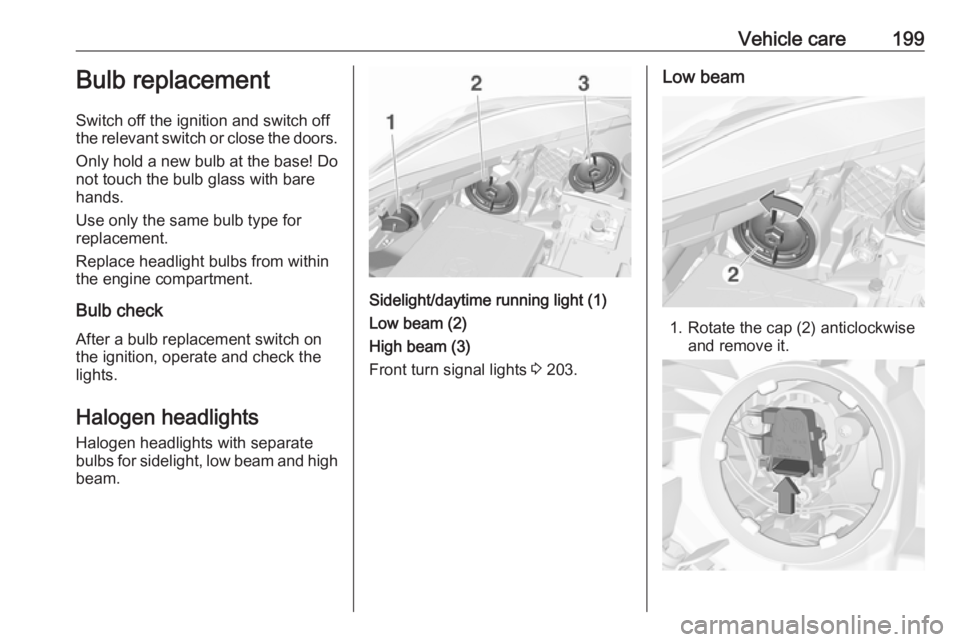
Halogen headlights Halogen headlights with separate
bulbs for sidelight, low beam and high
beam.
Sidelight/daytime running light (1)
Low beam (2)
High beam (3)
Front turn signal lights 3 203.
Low beam
1. Rotate the cap (2) anticlockwise
and remove it.
Page 216 of 269

214Vehicle careTyre pressure 3 253.
The tyre pressure information label on the right door frame indicates theoriginal equipment tyres and the
correspondent tyre pressures.
The tyre pressure data refers to cold
tyres. It applies to summer and winter tyres.
The ECO tyre pressure serves to
achieve the smallest amount of fuel
consumption possible.
Incorrect tyre pressures will impair
safety, vehicle handling, comfort and fuel economy and will increase tyre
wear.
Tyre pressures differ depending on
various options.
For the correct tyre pressure value,
follow the procedure below:
● Identify the engine identifier code. Engine data 3 245.
● Identify the respective tyre. ● The tyre pressure tables show all
possible tyre combinations
3 253.For the tyres approved for your
vehicle, refer to the EEC Certificate of Conformity provided with your vehicle
or other national registration
documents.
The driver is responsible for correct
adjustment of tyre pressure.9 Warning
If the pressure is too low, this can
result in considerable tyre warm-
up and internal damage, leading to tread separation and even to tyre
blow-out at high speeds.
9 Warning
For specific tyres the
recommended tyre pressure as
shown in the tyre pressure table may exceed the maximum tyre
pressure as indicated on the tyre.
Never exceed the maximum tyre
pressure as indicated on the tyre.
If the tyre pressure must be reduced
or increased, switch off ignition. After
adjusting tyre pressure switch on
ignition and select the relevant setting on the page Tyre load in the Driver
Information Centre 3 97.
Temperature dependency
The tyre pressure depends on the
temperature of the tyre. During
driving, tyre temperature and
pressure increase. Tyre pressure
values provided on the tyre
information label and tyre pressure
chart are valid for cold tyres, which
means at 20 °C.
The pressure increases by nearly
10 kPa for a 10 °C temperature
increase. This must be considered
when warm tyres are checked.
The tyre pressure value displayed in
the Driver Information Centre shows
the real tyre pressure. A cooled down tyre will show a decreased value,
which does not indicate an air leak.
Page 230 of 269
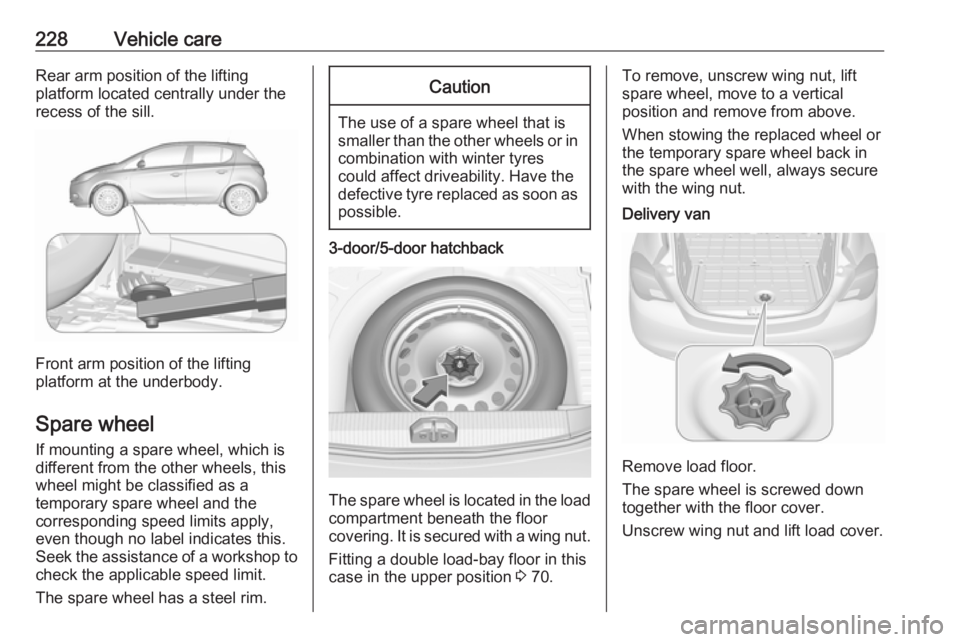
228Vehicle careRear arm position of the lifting
platform located centrally under the
recess of the sill.
Front arm position of the lifting
platform at the underbody.
Spare wheel If mounting a spare wheel, which is
different from the other wheels, this
wheel might be classified as a
temporary spare wheel and the
corresponding speed limits apply,
even though no label indicates this.
Seek the assistance of a workshop to
check the applicable speed limit.
The spare wheel has a steel rim.
Caution
The use of a spare wheel that is smaller than the other wheels or in combination with winter tyres
could affect driveability. Have the defective tyre replaced as soon as
possible.
3-door/5-door hatchback
The spare wheel is located in the load
compartment beneath the floor
covering. It is secured with a wing nut.
Fitting a double load-bay floor in this
case in the upper position 3 70.
To remove, unscrew wing nut, lift
spare wheel, move to a vertical
position and remove from above.
When stowing the replaced wheel or
the temporary spare wheel back in
the spare wheel well, always secure
with the wing nut.Delivery van
Remove load floor.
The spare wheel is screwed down
together with the floor cover.
Unscrew wing nut and lift load cover.
Page 236 of 269
234Vehicle careIf using a car wash, comply with the
car wash manufacturer's instructions. The windscreen wiper and rear
window wiper must be switched off.
Remove antenna and external
accessories such as roof racks etc.
If you wash your vehicle by hand,
make sure that the insides of the
wheel housings are also thoroughly
rinsed out.
Clean edges and folds on opened
doors and the bonnet as well as the
areas they cover.
Clean bright metal mouldings with a
cleaning solution approved for
aluminium to avoid damages.Caution
Always use a cleaning agent with
a pH value of four to nine.
Do not use cleaning agents on hot surfaces.
Have the door hinges of all doors
greased by a workshop.
Do not clean the engine compartment with a steam-jet or high-pressure jet
cleaner.
Thoroughly rinse and leather-off the vehicle. Rinse leather frequently. Use
separate leathers for painted and
glass surfaces: remnants of wax on
the windows will impair vision.
Do not use hard objects to remove
spots of tar. Use tar removal spray on
painted surfaces.
Exterior lights
Headlight and other light covers are
made of plastic. Do not use any
abrasive or caustic agents, do not use
an ice scraper, and do not clean them
dry.
Polishing and waxing
Wax painted parts of the vehicle
regularly (at the latest when water no longer beads). Otherwise, the
paintwork will dry out.
Polishing is necessary only if the paint
has become dull or if solid deposits
have become attached to it.
Paintwork polish with silicone forms a
protective film, making waxing
unnecessary.Unpainted plastic body parts must not
be treated with wax or polishing
agents.
Matt filmed body parts or decor tapes must not be polished, to avoid
gleaming. Do not use hot wax
programmes in automatic car washes if the vehicle is equipped with theseparts.
Matt painted decor parts, e.g. mirror
housing cover, must not be polished.
Otherwise these parts would become agleam or the colour would be
dissolved.
Windows and windscreen wiper
blades
Use a soft lint-free cloth or chamois
leather together with window cleaner
and insect remover.
When cleaning the rear window from
inside, always wipe in parallel to the
heating element to prevent damage.
For mechanical removal of ice, use a
sharp-edged ice scraper. Press the
scraper firmly against the glass so
that no dirt can get under it and
scratch the glass.
Page 243 of 269

Technical data241Identification plate
The identification plate is located on
the left or right door frame.
Information on identification label:1:manufacturer2:type approval number3:vehicle identification number4:permissible gross vehicle weight rating in kg5:permissible gross train weight
in kg6:maximum permissible front axle
load in kg7:maximum permissible rear axle
load in kg8:vehicle-specific or country-
specific data
The combined total of front and rear
axle loads must not exceed the
permissible gross vehicle weight. For
example, if the front axle is bearing its
maximum permissible load, the rear
axle can only bear a load that is equal
to the gross vehicle weight minus the front axle load.
The technical data is determined in
accordance with European
Community standards. We reserve
the right to make modifications.
Specifications in the vehicle
documents always have priority over
those given in this manual.
Engine identification
The technical data tables use the
engine identifier code. The engine
data table additionally shows the
engineering code. Engine data
3 245.
To identify the respective engine,
refer to the EEC Certificate of
Conformity provided with your vehicle
or other national registration
documents.
The Certificate of Conformity shows
the engine identifier code, other
national publications may show the
engineering code. Check piston
displacement and engine power to
identify the respective engine.
Page 251 of 269
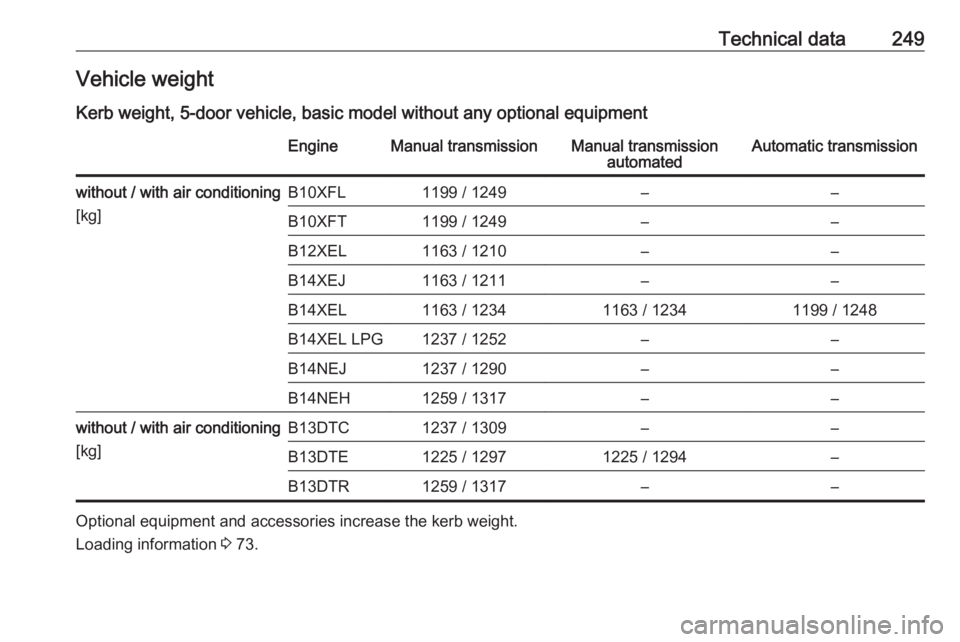
Technical data249Vehicle weightKerb weight, 5-door vehicle, basic model without any optional equipmentEngineManual transmissionManual transmission automatedAutomatic transmissionwithout / with air conditioning
[kg]B10XFL1199 / 1249––B10XFT1199 / 1249––B12XEL1163 / 1210––B14XEJ1163 / 1211––B14XEL1163 / 12341163 / 12341199 / 1248B14XEL LPG1237 / 1252––B14NEJ1237 / 1290––B14NEH1259 / 1317––without / with air conditioning
[kg]B13DTC1237 / 1309––B13DTE1225 / 12971225 / 1294–B13DTR1259 / 1317––
Optional equipment and accessories increase the kerb weight.
Loading information 3 73.
Page 252 of 269
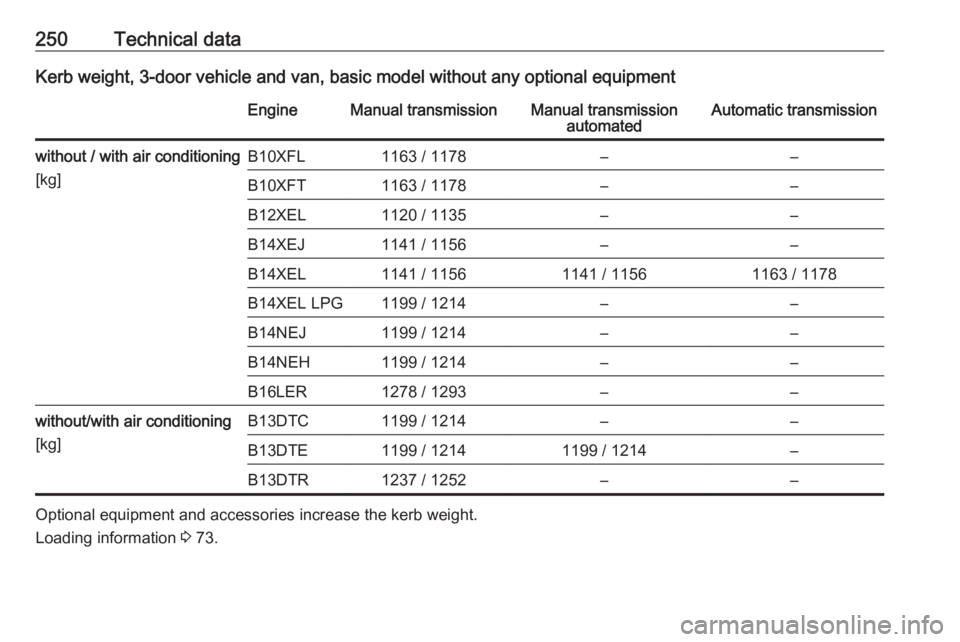
250Technical dataKerb weight, 3-door vehicle and van, basic model without any optional equipmentEngineManual transmissionManual transmissionautomatedAutomatic transmissionwithout / with air conditioning
[kg]B10XFL1163 / 1178––B10XFT1163 / 1178––B12XEL1120 / 1135––B14XEJ1141 / 1156––B14XEL1141 / 11561141 / 11561163 / 1178B14XEL LPG1199 / 1214––B14NEJ1199 / 1214––B14NEH1199 / 1214––B16LER1278 / 1293––without/with air conditioning
[kg]B13DTC1199 / 1214––B13DTE1199 / 12141199 / 1214–B13DTR1237 / 1252––
Optional equipment and accessories increase the kerb weight.
Loading information 3 73.
Page 253 of 269
![OPEL CORSA E 2017.5 Service Manual Technical data251Vehicle dimensions5-door vehicle3-door vehicleOPCLength [mm]402140214036Width without exterior mirrors [mm]174617361736Width with two exterior mirrors [mm]194419441944Height (without](/img/37/18826/w960_18826-252.png "OPEL CORSA E 2017.5 Service Manual Technical data251Vehicle dimensions5-door vehicle3-door vehicleOPCLength [mm]402140214036Width without exterior mirrors [mm]174617361736Width with two exterior mirrors [mm]194419441944Height (without")
Technical data251Vehicle dimensions5-door vehicle3-door vehicleOPCLength [mm]402140214036Width without exterior mirrors [mm]174617361736Width with two exterior mirrors [mm]194419441944Height (without antenna) [mm]4)1466 - 15161466 - 15011466 - 1501Length of load compartment floor [mm]705705705Length of load compartment with folded rear seats [mm]137213721372Load compartment width [mm]944944944Load compartment height with cover [mm]542542542Load compartment height without cover [mm]876843843Wheelbase [mm]251025102510Turning circle diameter [m]5)11.0 - 11.911.0 - 11.911.0 - 11.94)
Depending on options.
5) Depending on body- and equipment variants.