brake OPEL CORSA E 2018.5 Manual user
[x] Cancel search | Manufacturer: OPEL, Model Year: 2018.5, Model line: CORSA E, Model: OPEL CORSA E 2018.5Pages: 271, PDF Size: 7.99 MB
Page 217 of 271

Vehicle care215pressure sensors were replaced. The
tyre pressure sensor matching
process should also be performed
after replacing a spare wheel with a
road wheel containing a tyre pressure sensor.
The malfunction light w and the
warning message or code should
extinguish at the next ignition cycle.
The sensors are matched to the
wheel positions, using a relearn tool,
in the following order: left side front
wheel, right side front wheel, right
side rear wheel and left side rear
wheel. The turn light at the current
active position is illuminated until
sensor is matched.
Consult a workshop for service. There
are 2 minutes to match the first wheel position, and 5 minutes overall to
match all four wheel positions. If it
takes longer, the matching process
stops and must be restarted.
The tyre pressure sensor matching
process is:
1. Apply the parking brake.
2. Turn the ignition on.3. On vehicles with automatic transmission: set the selector
lever to P.
On vehicles with manual
transmission automated: Keep
brake pedal depressed. Move and hold the selector lever for
5 seconds to position N until P is
displayed in the Driver
Information Centre. P indicates
that the tyre pressure sensor
matching process can be started.
On vehicles with manual
transmission: select neutral.
4. Use MENU on the stalk to select
the Vehicle Information
Menu ? in the Driver
Information Centre.
5. Turn the adjuster wheel to scroll to
the tyre pressure menu.
Midlevel display:
Uplevel display:
Page 219 of 271

Vehicle care217Changing tyre and wheelsize
If tyres of a different size than those
fitted at the factory are used, it may be necessary to reprogramme the
nominal tyre pressure and to make
other vehicle modifications.
After converting to a different tyre size, have the label with tyre
pressures replaced.
Tyre pressure monitoring system 3 212.Caution
When converting to wheels with
14 inch diameter, the ground
clearance will be reduced. This
must be considered when passing
over obstacles.
9 Warning
The use of unsuitable tyres or
wheels may lead to accidents and will invalidate the vehicle
operating permit.
Wheel covers
Wheel covers and tyres that are
factory approved for the respective
vehicle and comply with all of the
relevant wheel and tyre combination
requirements must be used.
If the wheel covers and tyres used are
not factory approved, the tyres must
not have a rim protection ridge.
Wheel covers must not impair brake
cooling.9 Warning
Use of unsuitable tyres or wheel
covers could lead to sudden
pressure loss and thereby
accidents.
Steel wheels: When using locking
wheel nuts, do not attach wheel
covers.
Tyre chains
Tyre chains are only permitted on the
front wheels.
Always use fine mesh chains that add no more than 10 mm to the tyre tread
and the inboard sides (including chain lock).
9 Warning
Damage may lead to tyre blowout.
Tyre chains are permitted on tyres of
size 175/70 R14, 185/70 R14,
185/65 R15, 205/45 R17.
Page 220 of 271
218Vehicle careTyre chains are permitted on tyres of
size 195/55 R16 with rims of size
16 x 6 and 16 x 6.5, the latter only in combination with limited steering
angle. Seek the assistance of a
workshop.
Tyre chains are not permitted on tyres of size 215/45 R17 and 215/40 R18.
The use of tyre chains is not permitted on the temporary spare wheel.
Tyre repair kit Minor damage to the tyre tread can be
repaired with the tyre repair kit.
Do not remove foreign bodies from
the tyres.
Tyre damage exceeding 4 mm or that is at the tyre's side wall near the rim
cannot be repaired with the tyre repair kit.9 Warning
Do not drive faster than 80 km/h.
Do not use for a lengthy period.
Steering and handling may be
affected.
If you have a flat tyre:
Apply the parking brake and engage
first gear, reverse gear or P.
The tyre repair kit is stowed in the load
compartment.
Depending on the equipment, the tyre repair kit is in a compartment in the
right sidewall or in a compartment
under the floor cover.
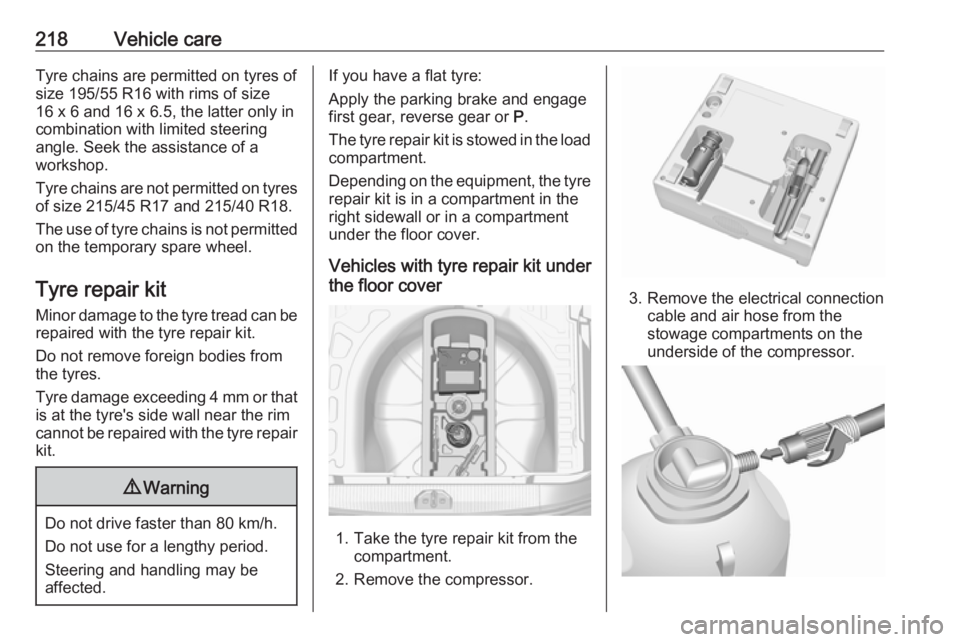
Vehicles with tyre repair kit under
the floor cover
1. Take the tyre repair kit from the compartment.
2. Remove the compressor.
3. Remove the electrical connection cable and air hose from the
stowage compartments on the
underside of the compressor.
Page 225 of 271

Vehicle care223Wheel changing
Make the following preparations and observe the following information:
● Park the vehicle on a level, firm and non-skid surface. The front
wheels must be in the straight- ahead position.
● Apply the parking brake and engage first gear, reverse gear or
P .
● Never change more than one wheel at once.
● Use the jack only to change wheels in case of puncture, not
for seasonal winter or summer
tyre change.
● The jack is maintenance-free. ● If the ground on which the vehicle
is standing is soft, a solid board
(max. 1 cm thick) should be
placed under the jack.
● Take heavy objects out of the vehicle before jacking up.
● No people or animals may be in the vehicle when it is jacked-up.
● Never crawl under a jacked-up vehicle.●Do not start the vehicle when it is
raised on the jack.
● Before screwing in the wheel bolts, clean them and lightly coat
the taper of each wheel bolt with
commercially available grease.9 Warning
Do not grease the thread of the
wheel bolt.
1. Steel wheels:
Pull off the wheel cover.
Alloy wheels with bolt caps: Disengage wheel bolt caps with a
screwdriver and remove. To
protect the wheel, place a soft
cloth between the screwdriver
and the alloy wheel.2. Install the wheel wrench ensuring that it locates securely and loosen
each wheel bolt by half a turn.
The wheels might be protected by
locking wheel bolts. To loosen
these specific bolts, first attach
the adapter for the locking wheel
bolts onto the head of the bolt
before installing the wheel
wrench. The adapter is located in
the glovebox.
Page 230 of 271

228Vehicle care● Apply the parking brake,transmission in neutral,
automatic transmission in P.
● Open the positive terminal protection caps of both vehiclebatteries.
Lead connection order:
1. Connect the red lead to the positive terminal of the booster
vehicle battery.
2. Connect the other end of the red lead to the positive terminal of the
discharged vehicle battery.
3. Connect the black lead to the negative terminal of the booster
vehicle battery.
4. Connect the other end of the black
lead to a vehicle grounding point,
such as the engine block or an
engine mounting bolt. Connect as far away from the discharged
vehicle battery as possible,
however at least 60 cm.
Route the leads so that they cannot
catch on rotating parts in the engine
compartment.
To start the engine: 1. Start the engine of the vehicle providing the jump.
2. After 5 minutes, start the other engine. Start attempts should be
made for no longer than
15 seconds at an interval of
1 minute.
3. Allow both engines to idle for approx. 3 minutes with the leads
connected.4. Switch on electrical consumers (e.g. headlights, heated rear
window) of the vehicle receiving
the jump start.
5. Reverse above sequence exactly when removing leads.
Page 231 of 271

Vehicle care229Towing
Towing the vehicle
Wrap a cloth around the tip of a flat
screwdriver to prevent paint damage.
Insert the screwdriver in the slot at the
lower part of the cap. Release the cap by carefully moving the screwdriver
downwards.
The towing eye is stowed with the
vehicle tools 3 209.
Screw in the towing eye as far as it will
go until it stops in a horizontal
position.
Attach a tow rope – or better still a tow
rod – to the towing eye.
The towing eye must only be used for
towing and not for recovering the
vehicle.
Switch on ignition to release steering wheel lock and to permit operation of
brake lights, horn and windscreen
wiper.
Switch the selector lever to neutral.
Release the parking brake.
Caution
Drive slowly. Do not drive jerkily.
Excessive tractive force can
damage the vehicle.
When the engine is not running,
considerably more force is needed to
brake and steer.
To prevent the entry of exhaust gases from the towing vehicle, switch on the
air recirculation and close the
windows.
Vehicles with automatic transmission: the vehicle must be towed facing
forwards, not faster than 80 km/h nor further than 100 km. In all other cases
and when the transmission is
defective, the front axle must be
raised off the ground.
Vehicles with manual transmission
automated: the vehicle must only be
towed facing forwards with the front axle raised off the ground.
Seek the assistance of a workshop. After towing, unscrew the towing eye.
Insert cap at the top and engage
downwards.
Page 238 of 271

236Service and maintenanceUse of engine oils for all petrol
engines with only ACEA quality is
prohibited, since it can cause engine
damage under certain operating
conditions.
Select the appropriate engine oil
based on its quality and on the
minimum ambient temperature
3 239.
Additional engine oil additives
The use of additional engine oil
additives could cause damage and
invalidate the warranty.
Engine oil viscosity grades
The SAE viscosity grade gives
information of the thickness of the oil.
Multigrade oil is indicated by two
figures, e.g. SAE 5W-30. The first
figure, followed by a W, indicates the
low temperature viscosity and the
second figure the high temperature
viscosity.
Select the appropriate viscosity grade
depending on the minimum ambient
temperature 3 239.All of the recommended viscosity
grades are suitable for high ambient
temperatures.
Coolant and antifreeze
Use only silicate-free long life coolant (LLC) antifreeze. Consult a
workshop.
The system is factory filled with
coolant designed for excellent
corrosion protection and frost
protection down to approx. -28 °C. In
northern countries with very low
temperatures the factory filled coolant
provides frost protection down to
approx. -37 °C. This concentration
should be maintained all year round.
The use of additional coolant
additives that intend to give additional
corrosion protection or seal against
minor leaks can cause function
problems. Liability for consequences
resulting from the use of additional
coolant additives will be rejected.Washer fluid
Use only washer fluid approved for
the vehicle to prevent damage of
wiper blades, paintwork, plastic and
rubber parts. Consult a workshop.
Brake and clutch fluid Over time, brake fluid absorbs
moisture which will reduce braking
effectiveness. The brake fluid should therefore be replaced at the specified
interval.
Page 263 of 271

Customer information261This data includes, for example:● Vehicle status information (e.g. wheel rotation rate, speed,
movement delay, lateral
acceleration, "seatbelts
fastened" display),
● Ambient conditions (e.g. temperature, rain sensor,
distance sensor).
Most of this data is volatile and is processed only in the vehicle itself,and not beyond the operating time.
Moreover, many control units include
data storage device (amongst others the vehicle key). This is used to allow
information to be documented
temporarily or permanently on vehicle
condition, component stress,
maintenance requirements and
technical events and errors.
The following information, for
example, is stored:
● System component operating states (e.g. fill level, tyre
pressure, battery status),
● State of charge of the high voltage battery, estimated range
(in the case of electric vehicles),● Faults and defects in important system components (e.g. lights,
brakes),
● System reactions in special driving situations (e.g. triggeringof an airbag, actuation of the
stability control systems),
● Information on events damaging the vehicle.
In special cases (e.g. if the vehicle
has detected a malfunction), it may be
necessary to save data that would
otherwise just be volatile.
When you use services, the operating data saved can be read together withthe vehicle identification number andused if necessary. Staff working for
the service net-work (e.g. garages,
manufacturers) or third parties (e.g.
breakdown services) can read the
data from the vehicle. Services
include repair services, maintenance
processes, warranty cases and
quality assurance measures.
Data is generally read via the OBD
(On-Board Diagnostics) port
prescribed by law in the vehicle. The operating data which has been read
out documents the technical conditionof the vehicle or individual
components and assists with fault
diagnosis, compliance with warranty
obligations and quality improvement.
This data, in particular information on
component stress, technical events,
operator errors and other faults, is
transmitted to the manufacturer
where appropriate, together with the vehicle identification number. The
manufacturer is also subject to
product liability. The manufacturer
potentially also needs operating data
from vehicles for product recalls.
Fault memories in the vehicle can be
reset by a service company when
carrying out servicing or repairs.
Comfort and infotainment
functions
Comfort settings and custom settings can be stored in the vehicle and
changed at any time.
Page 266 of 271

264IndexAAccessories and vehicle modifications .......................... 188
Adjustable air vents ...................131
Airbag and belt tensioners ...........91
Airbag deactivation ................49, 92
Airbag label................................... 44 Airbag system .............................. 44
Air conditioning regular operation ................................ 132
Air conditioning system .............. 124
Air intake .................................... 131
Air vents...................................... 131
Antilock brake system ................ 149
Antilock brake system (ABS) .......93
Anti-theft alarm system ................28
Anti-theft locking system .............. 28
Appearance care ........................231
Ashtrays ....................................... 83
Automatic anti-dazzle ..................31
Automatic light control ...............114
Automatic locking ........................26
Automatic transmission .............141
Autostop ............................... 96, 136
B Battery discharge protection ......122
Battery voltage ........................... 105
Belts.............................................. 41
Bicycle rack .................................. 59Bonnet ....................................... 190
Brake and clutch fluid .................235
Brake and clutch system .............93
Brake assist ............................... 150
Brake fluid .................................. 193
Brakes ............................... 149, 193
Breakdown.................................. 229
Bulb replacement ....................... 196
C Capacities .................................. 251
Car Pass ...................................... 23
Catalytic converter .....................141
Central locking system ................24
Centre high-mounted brake light 203
Changing tyre and wheel size ...217
Charging system .......................... 92
Child locks ................................... 26
Child restraint installation locations ................................... 54
Child restraints.............................. 50
Child restraint systems ................50
Cigarette lighter ........................... 83
City mode ................................... 153
Climate control ............................. 17
Climate control systems .............123
Clock ............................................ 80
Code ........................................... 103
Control indicators.......................... 88
Control of the vehicle .................134
Page 267 of 271

265Controls........................................ 76
Convex shape .............................. 30
Coolant and antifreeze ...............235
Corner lighting ............................ 116
Cruise control ...................... 96, 154
Cupholders .................................. 57
Curtain airbag system .................. 49
D Danger, Warnings and Cautions ...4
Daytime running lights ...............116
Declaration of conformity ............255
Diesel fuel system bleeding .......195
Door open .................................... 96
Doors ............................................ 27
Driver assistance systems ..........154
Driver Information Centre .............97
Driving characteristics and towing tips .............................. 183
Driving hints ................................ 134
E Easy entry..................................... 39
Electric adjustment ......................30
Electrical system......................... 204
Electronic climate control system 126
Electronic driving programmes . ........................................ 143, 148
Electronic Stability Control.......... 152
Electronic Stability Control and Traction Control system ............94Electronic Stability Control off....... 94
End-of-life vehicle recovery .......189
Engine compartment fuse box ...205
Engine coolant ........................... 192
Engine coolant temperature gauge ....................................... 87
Engine data ............................... 242
Engine exhaust .......................... 140
Engine identification ...................238
Engine oil ................... 191, 235, 239
Engine oil pressure ......................95
Entry lighting .............................. 121
Event data recorders ..................260
Exhaust filter ......................... 94, 140
Exit lighting ................................ 121
Exterior care .............................. 231
Exterior light ................................. 96
Exterior lighting ....................14, 113
Exterior mirrors ............................. 30
F Fault ................................... 144, 148
First aid ......................................... 72
First aid kit ................................... 72
Fixed air vents ........................... 131
Flex-Fix system ............................ 59
Fog light ....................................... 96
Fog lights ................................... 200
Folding mirrors ............................. 30
Following distance indication ......160Forward collision alert................. 157
Front airbag system .....................47
Front fog lights ........................... 118
Front seats.................................... 37
Front storage ................................ 58
Front turn lights .......................... 200
Fuel............................................. 177
Fuel for diesel engines ..............179
Fuel for liquid gas operation .......179
Fuel for petrol engines ...............177
Fuel gauge ................................... 85 Fuel selector ................................ 86
Fuses ......................................... 204
G Gauges ......................................... 84
Gear shifting ................................. 93
General information ...................183
Glovebox ..................................... 57
H
Halogen headlights ....................196
Hand brake ......................... 149, 150
Hazard warning flashers ............117
Headlight flash ........................... 115
Headlight range adjustment ......115
Headlights................................... 113 Headlights when driving abroad 115
Head restraint adjustment .............8
Head restraints ............................ 36
Heated mirrors ............................. 31