clutch OPEL CORSA E 2019 Manual user
[x] Cancel search | Manufacturer: OPEL, Model Year: 2019, Model line: CORSA E, Model: OPEL CORSA E 2019Pages: 231, PDF Size: 6.87 MB
Page 125 of 231
Driving and operating123Conditions for an Autostop
The stop-start system checks if each
of the following conditions is fulfilled:
● The stop-start system is not manually deactivated.
● The bonnet is fully closed.
● The driver's door is closed or the driver's seat belt is fastened.
● The vehicle battery is sufficiently charged and in good condition.
● The engine is warmed-up.
● The engine coolant temperature is not too high.
● The engine exhaust temperature is not too high, e.g. after driving
with high engine load.
● The ambient temperature is above -5 °C.
● The climate control system allows an Autostop.
● The brake vacuum is sufficient.
● The self-cleaning function of the exhaust filter is not active.
● The vehicle was driven at least at
walking speed since the last
Autostop.Otherwise an Autostop will be
inhibited.
Certain settings of the climate control
system may inhibit an Autostop. See
'Climate control' chapter for further
information 3 110.
Immediately after motorway driving
an Autostop may be inhibited.
New vehicle running-in 3 120.
Vehicle battery discharge protection
To ensure reliable engine restarts,
several vehicle battery discharge
protection features are implemented
as part of the stop-start system.
Power saving measures
During an Autostop, several electrical
features, e.g. the rear window
heating, are disabled or switched into
a power saving mode. The fan speed of the climate control system is
reduced to save power.
Restart of the engine by the driverVehicles with manual transmission
Depress the clutch pedal to restart the
engine.When the engine is restarted, control
indicator D in the Driver Information
Centre extinguishes.
If the selector lever is shifted out of
neutral before depressing the clutch
pedal first, control indicator -
illuminates or is shown as a symbol in
the Driver Information Centre.
Control indicator - 3 79.
Restart of the engine by the stop- start system
The selector lever must be in neutral to enable an automatic restart.
If one of the following conditions occurs during an Autostop, the
engine will be restarted automatically
by the stop-start system:
● The stop-start system is manually deactivated.
● The bonnet is opened.
● The driver's seat belt is unfastened and the driver's door
is opened.
● The engine temperature is too low.
Page 132 of 231
130Driving and operating
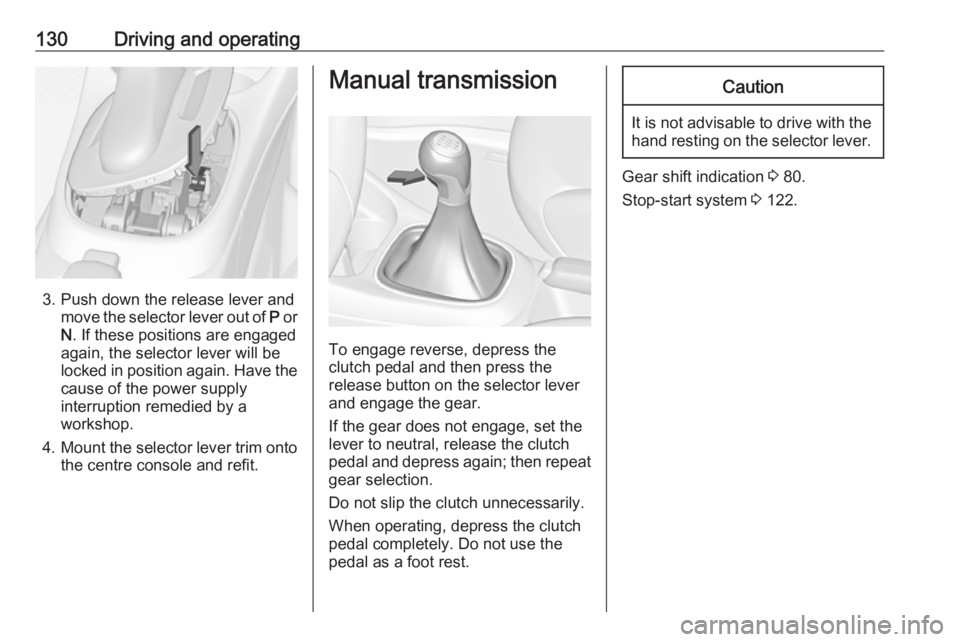
3. Push down the release lever andmove the selector lever out of P or
N . If these positions are engaged
again, the selector lever will be
locked in position again. Have the cause of the power supply
interruption remedied by a
workshop.
4. Mount the selector lever trim onto
the centre console and refit.
Manual transmission
To engage reverse, depress the
clutch pedal and then press the
release button on the selector lever
and engage the gear.
If the gear does not engage, set the
lever to neutral, release the clutch
pedal and depress again; then repeat
gear selection.
Do not slip the clutch unnecessarily.
When operating, depress the clutch
pedal completely. Do not use the
pedal as a foot rest.
Caution
It is not advisable to drive with the hand resting on the selector lever.
Gear shift indication 3 80.
Stop-start system 3 122.
Page 138 of 231
136Driving and operatingSwitching on the system
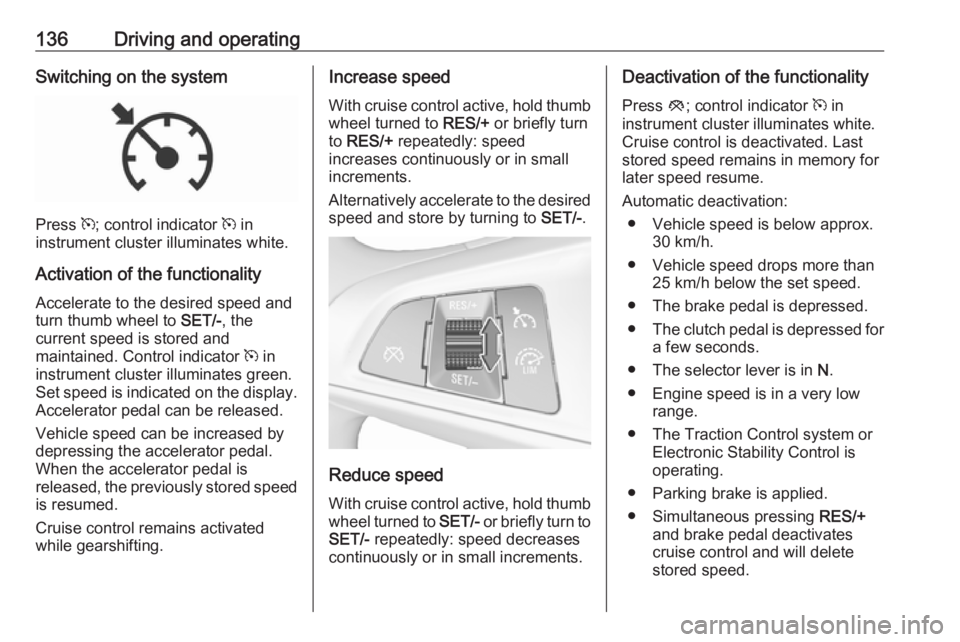
Press m; control indicator m in
instrument cluster illuminates white.
Activation of the functionality Accelerate to the desired speed and
turn thumb wheel to SET/-, the
current speed is stored and
maintained. Control indicator m in
instrument cluster illuminates green.
Set speed is indicated on the display. Accelerator pedal can be released.
Vehicle speed can be increased by
depressing the accelerator pedal.
When the accelerator pedal is
released, the previously stored speed
is resumed.
Cruise control remains activated
while gearshifting.
Increase speed
With cruise control active, hold thumb
wheel turned to RES/+ or briefly turn
to RES/+ repeatedly: speed
increases continuously or in small
increments.
Alternatively accelerate to the desired speed and store by turning to SET/-.
Reduce speed
With cruise control active, hold thumb
wheel turned to SET/- or briefly turn to
SET/- repeatedly: speed decreases
continuously or in small increments.
Deactivation of the functionality
Press y; control indicator m in
instrument cluster illuminates white.
Cruise control is deactivated. Last
stored speed remains in memory for
later speed resume.
Automatic deactivation: ● Vehicle speed is below approx. 30 km/h.
● Vehicle speed drops more than 25 km/h below the set speed.
● The brake pedal is depressed.
● The clutch pedal is depressed for
a few seconds.
● The selector lever is in N.
● Engine speed is in a very low range.
● The Traction Control system or Electronic Stability Control is
operating.
● Parking brake is applied.
● Simultaneous pressing RES/+
and brake pedal deactivates
cruise control and will delete
stored speed.
Page 164 of 231

162Vehicle care
The brake fluid level must be betweenthe MIN and MAX marks.
If fluid level is below the MIN mark,
seek the assistance of a workshop.
Brake and clutch fluid 3 203.
Vehicle battery
The vehicle battery is maintenance-
free provided that the driving profile
allows sufficient charging of the
battery. Short-distance-driving and
frequent engine starts can discharge
the vehicle battery. Avoid the use of
unnecessary electrical consumers.
Batteries do not belong in household
waste. They must be disposed of at
an appropriate recycling collection
point.
Laying up the vehicle for more than
four weeks can lead to vehicle battery
discharge. Disconnect the clamp from
the negative terminal of the vehicle
battery.
Ensure the ignition is switched off
before connecting or disconnecting
the vehicle battery.
Battery discharge protection 3 108.
Disconnecting the battery
If the vehicle's battery is to be
disconnected (e.g. for maintenance
work), the alarm siren must be
deactivated as follows: Switch the
ignition on then off, then disconnect
the vehicle's battery within
15 seconds.
Replacing the vehicle battery
Note
Any deviation from the instructions
given in this section may lead to
temporary deactivation or
disturbance of the stop-start system.
When the vehicle battery is being
replaced, please ensure that there
are no open ventilation holes in the
vicinity of the positive terminal. If a
ventilation hole is open in this area, it
must be closed off with a dummy cap,
and the ventilation in the vicinity of the negative terminal must be opened.
Ensure that the battery is always
replaced by the same type of battery.
We recommend the use of an original
Opel battery.
Note
Using an AGM vehicle battery
different from the original Opel
vehicle battery may result in a lower performance.
We recommend that you have the
vehicle battery replaced by a
workshop.
Page 176 of 231
174Vehicle careNo.Circuit1-2-3Battery sensor4Chassis control module, fuel
pump5ABS6Low beam and daytime running
light left, Xenon high beam7–8LPG control module9Body control module10Headlamp levelling11Rear wiper12Heated rear window13Low beam and daytime running
light right14Heated exterior mirror15–No.Circuit16Brake booster kit17Ignition signal, waterpump18Engine control module19Fuel pump20–21Engine solenoids, engine
sensors22–23Ignition coils, injectors24Washer system25–26Engine sensors27Engine management28Engine control module29Engine control module30Engine control module31High beam left, Xenon low
beam leftNo.Circuit32High beam right, Xenon low
beam right33Engine control module34Horn35Air condition compressor clutch36Front fog lights
Page 206 of 231
204Service and maintenanceSelect the appropriate engine oil
based on its quality and on the
minimum ambient temperature
3 207.
Additional engine oil additives
The use of additional engine oil
additives could cause damage and
invalidate the warranty.
Engine oil viscosity grades
The SAE viscosity grade gives
information of the thickness of the oil.
Multigrade oil is indicated by two
figures, e.g. SAE 5W-30. The first
figure, followed by a W, indicates the
low temperature viscosity and the
second figure the high temperature viscosity.
Select the appropriate viscosity grade
depending on the minimum ambient
temperature 3 207.
All of the recommended viscosity
grades are suitable for high ambient
temperatures.Coolant and antifreeze
Use only silicate-free long life coolant (LLC) antifreeze. Consult a
workshop.
The system is factory filled with
coolant designed for excellent
corrosion protection and frost
protection down to approx. -28 °C. In
northern countries with very low
temperatures the factory filled coolant
provides frost protection down to
approx. -37 °C. This concentration
should be maintained all year round.
The use of additional coolant
additives that intend to give additional
corrosion protection or seal against
minor leaks can cause function
problems. Liability for consequences
resulting from the use of additional
coolant additives will be rejected.
Washer fluid Use only washer fluid approved for
the vehicle to prevent damage of wiper blades, paintwork, plastic and
rubber parts. Consult a workshop.Brake and clutch fluid
Over time, brake fluid absorbs
moisture which will reduce braking
effectiveness. The brake fluid should therefore be replaced at the specified interval.
Page 226 of 231
224IndexAAccessories and vehicle modifications .......................... 156
Adjustable air vents ...................117
Airbag and belt tensioners ...........78
Airbag deactivation ................47, 79
Airbag label................................... 42 Airbag system .............................. 42
Air conditioning regular operation ................................ 118
Air conditioning system .............. 111
Air intake .................................... 118
Air vents...................................... 117
Antilock brake system ................ 131
Antilock brake system (ABS) .......80
Anti-theft alarm system ................27
Anti-theft locking system .............. 27
Appearance care ........................198
Ashtrays ....................................... 70
Automatic anti-dazzle ..................30
Automatic light control ...............101
Automatic locking ........................25
Automatic transmission .............127
Autostop ............................... 82, 122
B Battery discharge protection ......108
Battery voltage ............................. 92
Belts.............................................. 39
Bonnet ....................................... 158Brake and clutch fluid.................203
Brake and clutch system .............79
Brake assist ............................... 132
Brake fluid .................................. 161 Brakes ............................... 131, 161
Breakdown.................................. 196
Bulb replacement ....................... 164
C Capacities .................................. 212
Catalytic converter .....................126
Central locking system ................23
Centre high-mounted brake light 171
Changing tyre and wheel size ...184
Charging system .......................... 79
Child locks ................................... 25
Child restraint installation locations ................................... 52
Child restraints.............................. 48
Child restraint systems ................48
Cigarette lighter ........................... 70
City mode ................................... 134
Climate control ............................. 17
Climate control systems .............110
Clock ............................................ 68
Code ............................................. 89
Control indicators.......................... 75
Control of the vehicle .................119
Controls ........................................ 64
Convex shape .............................. 29