eco OPEL CORSA E 2019 Manual PDF
[x] Cancel search | Manufacturer: OPEL, Model Year: 2019, Model line: CORSA E, Model: OPEL CORSA E 2019Pages: 231, PDF Size: 6.87 MB
Page 201 of 231

Vehicle care199If using a car wash, comply with the
car wash manufacturer's instructions.
The windscreen wiper and rear
window wiper must be switched off.
Remove antenna and external
accessories such as roof racks etc.
If you wash your vehicle by hand,
make sure that the insides of the
wheel housings are also thoroughly
rinsed out.
Clean edges and folds on opened
doors and the bonnet as well as the
areas they cover.
Clean bright metal mouldings with a
cleaning solution approved for
aluminium to avoid damages.Caution
Always use a cleaning agent with
a pH value of 4 to 9.
Do not use cleaning agents on hot surfaces.
Have the door hinges of all doors
greased by a workshop.
Do not clean the engine compartment with a steam-jet or high-pressure jet
cleaner.
Thoroughly rinse and leather-off the vehicle. Rinse leather frequently. Use
separate leathers for painted and
glass surfaces: remnants of wax on
the windows will impair vision.
Do not use hard objects to remove
spots of tar. Use tar removal spray on
painted surfaces.
Exterior lights
Headlight and other light covers are
made of plastic. Do not use any
abrasive or caustic agents, do not use
an ice scraper, and do not clean them
dry.
Polishing and waxing
Wax painted parts of the vehicle
regularly (at the latest when water no longer beads). Otherwise, the
paintwork will dry out.
Polishing is necessary only if the paint
has become dull or if solid deposits
have become attached to it.
Paintwork polish with silicone forms a
protective film, making waxing
unnecessary.Unpainted plastic body parts must not
be treated with wax or polishing
agents.
Matt filmed body parts or decor tapes must not be polished, to avoid
gleaming. Do not use hot wax
programmes in automatic car washes if the vehicle is equipped with theseparts.
Matt painted decor parts, e.g. mirror
housing cover, must not be polished.
Otherwise these parts would become agleam or the colour would be
dissolved.
Windows and wiper blades Switch off wipers before handling intheir areas.
Use a soft lint-free cloth or chamois
leather together with window cleaner
and insect remover.
When cleaning the rear window from
inside, always wipe in parallel to the
heating element to prevent damage.
Page 204 of 231

202Service and maintenanceService and
maintenanceGeneral information ...................202
Service information ..................202
Recommended fluids, lubricants
and parts .................................... 203
Recommended fluids and lubricants ................................ 203General information
Service information In order to ensure economical and
safe vehicle operation and to
maintain the value of your vehicle, it
is of vital importance that all
maintenance work is carried out at the proper intervals as specified.
The detailed, up-to-date service
schedule for your vehicle is available
at the workshop.
Service display 3 74.
European service intervals
Maintenance of your vehicle is
required every 30,000 km or after one year, whichever occurs first.
Additional engine oil and filter change
is indicated by the engine oil life
system, when required earlier than
maintenance.
A shorter service interval can be valid for severe driving behaviour, e.g. for
taxis and police vehicles.
The European service intervals are
valid for the following countries:Andorra, Austria, Belgium, Bosnia-
Herzegovina, Bulgaria, Croatia,
Cyprus, Czech Republic, Denmark,
Estonia, Finland, France, Germany,
Greece, Greenland, Hungary,
Iceland, Ireland, Italy, Latvia,
Liechtenstein, Lithuania,
Luxembourg, Macedonia, Malta,
Monaco, Montenegro, Netherlands,
Norway, Poland, Portugal, Romania, San Marino, Serbia, Slovakia,
Slovenia, Spain, Sweden,
Switzerland, United Kingdom.
Service display 3 74.
International service intervals
Maintenance of your vehicle is
required every 15,000 km or after one year, whichever occurs first.
Additional engine oil and filter change
is indicated by the engine oil life
system, when required earlier than
maintenance.
Severe operating conditions exist if
one or more of the following
circumstances occur frequently: Cold
starting, stop and go operation, trailer operation, mountain driving, driving
on poor and sandy road surfaces,
Page 205 of 231
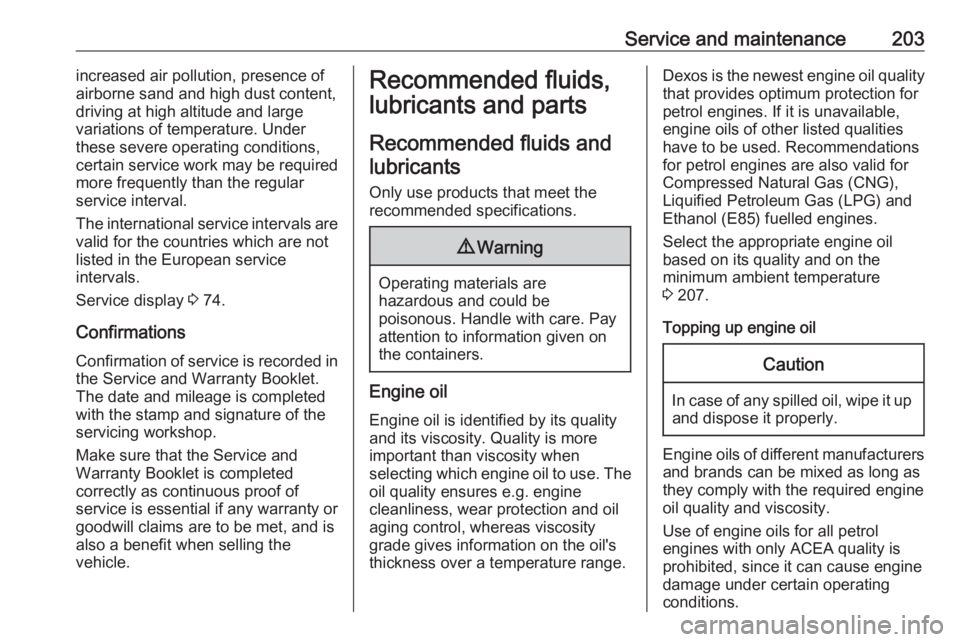
Service and maintenance203increased air pollution, presence of
airborne sand and high dust content,
driving at high altitude and large
variations of temperature. Under
these severe operating conditions,
certain service work may be required more frequently than the regularservice interval.
The international service intervals are
valid for the countries which are not
listed in the European service
intervals.
Service display 3 74.
Confirmations
Confirmation of service is recorded in the Service and Warranty Booklet.
The date and mileage is completed
with the stamp and signature of the
servicing workshop.
Make sure that the Service and
Warranty Booklet is completed
correctly as continuous proof of
service is essential if any warranty or goodwill claims are to be met, and is
also a benefit when selling the
vehicle.Recommended fluids,
lubricants and parts
Recommended fluids andlubricants
Only use products that meet the
recommended specifications.9 Warning
Operating materials are
hazardous and could be
poisonous. Handle with care. Pay
attention to information given on
the containers.
Engine oil
Engine oil is identified by its quality
and its viscosity. Quality is more
important than viscosity when
selecting which engine oil to use. The oil quality ensures e.g. engine
cleanliness, wear protection and oil
aging control, whereas viscosity
grade gives information on the oil's
thickness over a temperature range.
Dexos is the newest engine oil quality
that provides optimum protection for
petrol engines. If it is unavailable,
engine oils of other listed qualities
have to be used. Recommendations
for petrol engines are also valid for
Compressed Natural Gas (CNG),
Liquified Petroleum Gas (LPG) and
Ethanol (E85) fuelled engines.
Select the appropriate engine oil
based on its quality and on the
minimum ambient temperature
3 207.
Topping up engine oilCaution
In case of any spilled oil, wipe it up and dispose it properly.
Engine oils of different manufacturersand brands can be mixed as long as
they comply with the required engine
oil quality and viscosity.
Use of engine oils for all petrol
engines with only ACEA quality is
prohibited, since it can cause engine
damage under certain operating
conditions.
Page 206 of 231
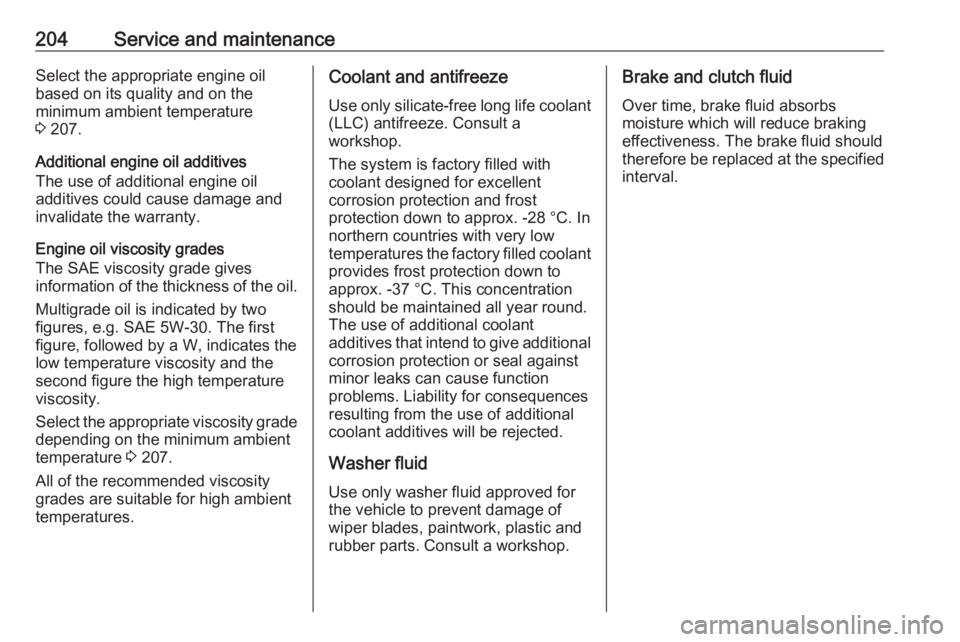
204Service and maintenanceSelect the appropriate engine oil
based on its quality and on the
minimum ambient temperature
3 207.
Additional engine oil additives
The use of additional engine oil
additives could cause damage and
invalidate the warranty.
Engine oil viscosity grades
The SAE viscosity grade gives
information of the thickness of the oil.
Multigrade oil is indicated by two
figures, e.g. SAE 5W-30. The first
figure, followed by a W, indicates the
low temperature viscosity and the
second figure the high temperature viscosity.
Select the appropriate viscosity grade
depending on the minimum ambient
temperature 3 207.
All of the recommended viscosity
grades are suitable for high ambient
temperatures.Coolant and antifreeze
Use only silicate-free long life coolant (LLC) antifreeze. Consult a
workshop.
The system is factory filled with
coolant designed for excellent
corrosion protection and frost
protection down to approx. -28 °C. In
northern countries with very low
temperatures the factory filled coolant
provides frost protection down to
approx. -37 °C. This concentration
should be maintained all year round.
The use of additional coolant
additives that intend to give additional
corrosion protection or seal against
minor leaks can cause function
problems. Liability for consequences
resulting from the use of additional
coolant additives will be rejected.
Washer fluid Use only washer fluid approved for
the vehicle to prevent damage of wiper blades, paintwork, plastic and
rubber parts. Consult a workshop.Brake and clutch fluid
Over time, brake fluid absorbs
moisture which will reduce braking
effectiveness. The brake fluid should therefore be replaced at the specified interval.
Page 207 of 231

Technical data205Technical dataVehicle identification..................205
Vehicle Identification Number ..205
Identification plate ...................206
Engine identification ................206
Vehicle data ............................... 207
Recommended fluids and lubricants ................................ 207
Engine data ............................. 210
Vehicle dimensions .................212
Capacities ................................ 212
Tyre pressures ........................ 214Vehicle identification
Vehicle IdentificationNumber
The Vehicle Identification Number is
stamped on the identification plate
and on the floor pan, under the floor
covering, visible under a cover.
The Vehicle Identification Number
may be embossed on the instrument
panel, visible through the windscreen,
or in the engine compartment on the
right body panel.
Page 209 of 231
Technical data207Vehicle data
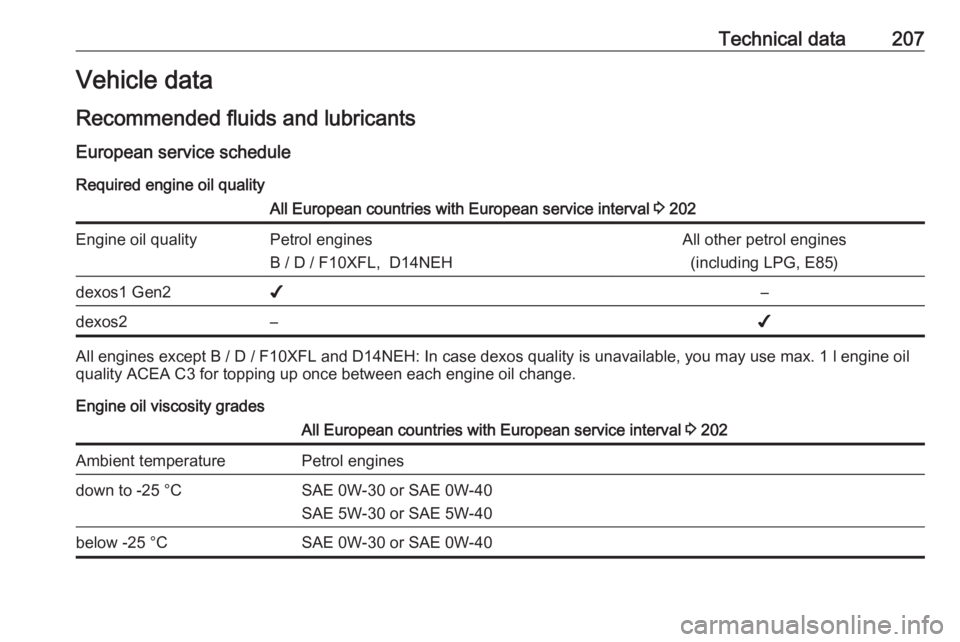
Recommended fluids and lubricants
European service schedule Required engine oil qualityAll European countries with European service interval 3 202Engine oil qualityPetrol engines
B / D / F10XFL, D14NEHAll other petrol engines (including LPG, E85)dexos1 Gen2✔–dexos2–✔
All engines except B / D / F10XFL and D14NEH: In case dexos quality is unavailable, you may use max. 1 l engine oilquality ACEA C3 for topping up once between each engine oil change.
Engine oil viscosity grades
All European countries with European service interval 3 202Ambient temperaturePetrol enginesdown to -25 °CSAE 0W-30 or SAE 0W-40
SAE 5W-30 or SAE 5W-40below -25 °CSAE 0W-30 or SAE 0W-40
Page 211 of 231

Technical data209Engine oil viscosity gradesAll countries with international service interval 3 202Ambient temperaturePetrol enginesdown to -25 °CSAE 0W-30 or SAE 0W-40
SAE 5W-30 or SAE 5W-40below -25 °CSAE 0W-30 or SAE 0W-40down to -20 °CSAE 10W-30 1)
or SAE 10W-40 1)1)
Permitted, but usage of engine oils with dexos quality is recommended.
Page 212 of 231
![OPEL CORSA E 2019 Manual PDF 210Technical dataEngine dataEngine identifier codeB / D / F10XFLB / D / F10XFTD12XELD14XEJSales designation1.01.01.21.4Engineering codeB10XFTB10XFTB12XERB14XERPiston displacement [cm3
]99999912291398E](/img/37/18831/w960_18831-211.png "OPEL CORSA E 2019 Manual PDF 210Technical dataEngine dataEngine identifier codeB / D / F10XFLB / D / F10XFTD12XELD14XEJSales designation1.01.01.21.4Engineering codeB10XFTB10XFTB12XERB14XERPiston displacement [cm3
]99999912291398E")
210Technical dataEngine dataEngine identifier codeB / D / F10XFLB / D / F10XFTD12XELD14XEJSales designation1.01.01.21.4Engineering codeB10XFTB10XFTB12XERB14XERPiston displacement [cm3
]99999912291398Engine power [kW]66855155at rpm3700 - 60005000 - 600056004200 - 6000Torque [Nm]170170115130at rpm1800 - 37001800 - 450040004000Fuel typePetrolPetrolPetrolPetrolOctane rating RON 2)recommended95959595possible91919898possible98989191Additional fuel type––––2)
A country-specific label at the fuel filler flap can supersede the engine-specific requirement.
Page 213 of 231
![OPEL CORSA E 2019 Manual PDF Technical data211Engine identifier codeD14XELD14NEJD14XELD14NEHSales designation1.41.41.4 LPG1.4 TurboEngineering codeB14XERB14NELB14XERB14NETPiston displacement [cm3
]1398136413981364Engine power [kW](/img/37/18831/w960_18831-212.png "OPEL CORSA E 2019 Manual PDF Technical data211Engine identifier codeD14XELD14NEJD14XELD14NEHSales designation1.41.41.4 LPG1.4 TurboEngineering codeB14XERB14NELB14XERB14NETPiston displacement [cm3
]1398136413981364Engine power [kW")
Technical data211Engine identifier codeD14XELD14NEJD14XELD14NEHSales designation1.41.41.4 LPG1.4 TurboEngineering codeB14XERB14NELB14XERB14NETPiston displacement [cm3
]1398136413981364Engine power [kW]667466110at rpm60003500 - 600060005000Torque [Nm]130200130220at rpm40001850 - 350040003000 - 4500Fuel typePetrolPetrolLiquid gas / PetrolPetrolOctane rating RON 2)recommended95959598possible98989895possible919191–Additional fuel type-–Liquid gas (LPG)–2)
A country-specific label at the fuel filler flap can supersede the engine-specific requirement.
Page 216 of 231
![OPEL CORSA E 2019 Manual PDF 214Technical dataTyre pressuresComfort with up to 3 peopleECO with up to 3 peopleWith full loadEngineTyresfrontrearfrontrearfrontrear[kPa/bar]
([psi])[kPa/bar]
([psi])[kPa/bar]
([psi])[kPa/bar]
([psi]](/img/37/18831/w960_18831-215.png "OPEL CORSA E 2019 Manual PDF 214Technical dataTyre pressuresComfort with up to 3 peopleECO with up to 3 peopleWith full loadEngineTyresfrontrearfrontrearfrontrear[kPa/bar]
([psi])[kPa/bar]
([psi])[kPa/bar]
([psi])[kPa/bar]
([psi]")
214Technical dataTyre pressuresComfort with up to 3 peopleECO with up to 3 peopleWith full loadEngineTyresfrontrearfrontrearfrontrear[kPa/bar]
([psi])[kPa/bar]
([psi])[kPa/bar]
([psi])[kPa/bar]
([psi])[kPa/bar]
([psi])[kPa/bar]
([psi])D12XEL,
D14XEL,
D14XEL LPG175/70 R14,
185/70 R14,
185/65 R15,
195/55 R16,
215/45 R17210/2.1 (31)210/2.1 (31)270/2.7 (39)250/2.5 (37)260/2.6 (38)320/3.2 (46)D14XEJ175/70 R14,
185/70 R14,
185/65 R15,
215/45 R17210/2.1 (31)210/2.1 (31)270/2.7 (39)250/2.5 (37)260/2.6 (38)320/3.2 (46)195/55 R16210/2.1 (31)230/2.3 (34)270/2.7 (39)250/2.5 (37)260/2.6 (38)320/3.2 (46)B / D / F10XFL,
B / D / F10XFT,
D14NEJ, D14NEH185/65 R15,
195/55 R16,
215/45 R17230/2.3 (34)230/2.3 (34)270/2.7 (39)250/2.5 (37)260/2.6 (38)320/3.2 (46)B / D / F10XFT Sport,
D14NEH Sport195/55 R16230/2.3 (34)230/2.3 (34)270/2.7 (39)250/2.5 (37)260/2.6 (38)320/3.2 (46)215/45 R17240/2.4 (35)240/2.4 (35)270/2.7 (39)250/2.5 (37)260/2.6 (38)320/3.2 (46)