Sump OPEL CORSA F 2020 Owner's Manual
[x] Cancel search | Manufacturer: OPEL, Model Year: 2020, Model line: CORSA F, Model: OPEL CORSA F 2020Pages: 229, PDF Size: 21.14 MB
Page 61 of 229
Instruments and controls599Warning
The road surface may already be
icy even though the display
indicates a few degrees above
0 °C.
Clock
Date and time are shown in the InfoDisplay.
The adjustment of date and time is
described in the Infotainment Manual.
Info Display 3 75.
Power outlets
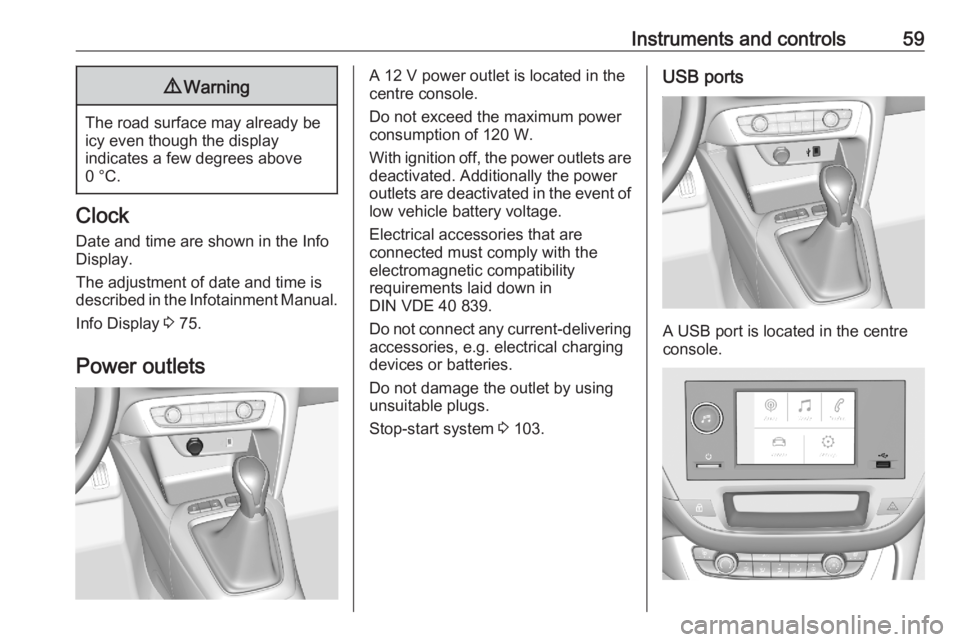
A 12 V power outlet is located in the
centre console.
Do not exceed the maximum power
consumption of 120 W.
With ignition off, the power outlets are
deactivated. Additionally the power
outlets are deactivated in the event of
low vehicle battery voltage.
Electrical accessories that are
connected must comply with the
electromagnetic compatibility
requirements laid down in
DIN VDE 40 839.
Do not connect any current-delivering
accessories, e.g. electrical charging
devices or batteries.
Do not damage the outlet by using
unsuitable plugs.
Stop-start system 3 103.USB ports
A USB port is located in the centre
console.
Page 76 of 229
74Instruments and controls
Turn the adjuster wheel to select a
page in the trip / fuel information
menu.
Press SET / CLR to confirm or reset
a function.
Vehicle and service messages are
popped up in the Driver Information
Centre, if required. Scroll messages
by turning the adjuster wheel.
Confirm messages by pressing
SET / CLR .
Vehicle messages 3 76.
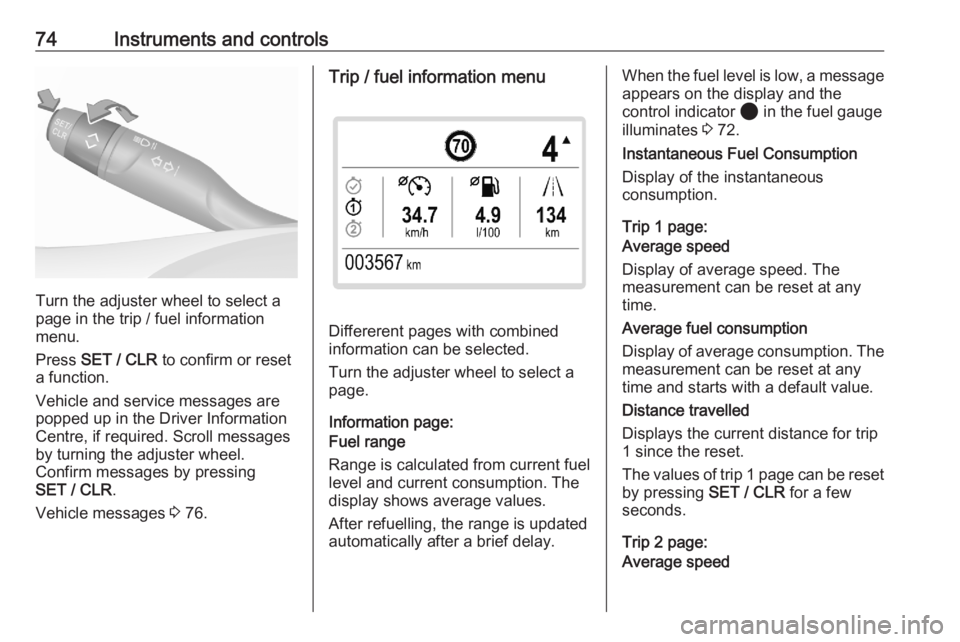
Trip / fuel information menu
Differerent pages with combined
information can be selected.
Turn the adjuster wheel to select a
page.
Information page:
Fuel range
Range is calculated from current fuel
level and current consumption. The
display shows average values.
After refuelling, the range is updated
automatically after a brief delay.
When the fuel level is low, a message appears on the display and the
control indicator 2 in the fuel gauge
illuminates 3 72.
Instantaneous Fuel Consumption
Display of the instantaneous
consumption.
Trip 1 page:
Average speed
Display of average speed. The
measurement can be reset at any
time.
Average fuel consumption
Display of average consumption. The
measurement can be reset at any
time and starts with a default value.
Distance travelled
Displays the current distance for trip
1 since the reset.
The values of trip 1 page can be reset by pressing SET / CLR for a few
seconds.
Trip 2 page:
Average speed
Page 77 of 229
Instruments and controls75Display of average speed. The
measurement can be reset at any
time.
Average fuel consumption
Display of average consumption. The
measurement can be reset at any
time and starts with a default value.
Distance travelled
Displays the current distance for trip
2 since a certain reset.
The values of trip 2 page can be reset by pressing SET / CLR for a few
seconds.
Digital speed page
Digital display of the instantaneous
speed.
Autostop time counter
A time counter calculates the time
spent in Autostop during a journey. It
resets to zero every time the ignition
is switched on.
Compass page
Displays the geographic direction of
driving.Blank page
No trip / fuel information is displayed.
Info Display The Info Display is located in the
instrument panel near the instrument
cluster.
The Info Display can indicate: ● time 3 59
● outside temperature 3 58
● date 3 59
● Infotainment system, see description in the Infotainment
Manual
● indication of rear view camera 3 150
● indication of panoramic view system 3 148
● navigation, see description in the
Infotainment Manual
● vehicle and system messages 3 76
● settings for vehicle personalisation 3 77
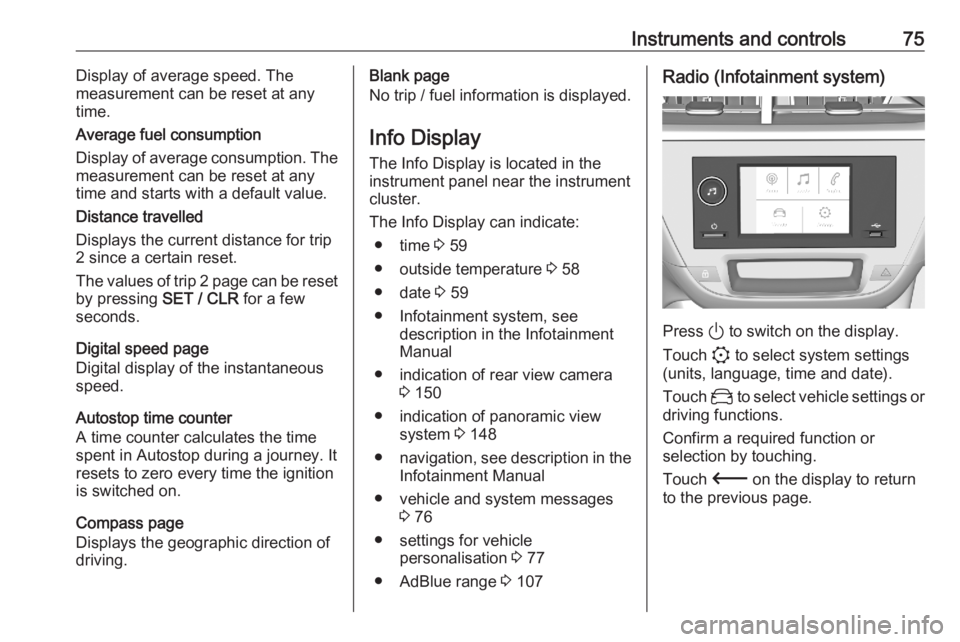
● AdBlue range 3 107Radio (Infotainment system)
Press ) to switch on the display.
Touch : to select system settings
(units, language, time and date).
Touch _ to select vehicle settings or
driving functions.
Confirm a required function or
selection by touching.
Touch 3 on the display to return
to the previous page.
Page 101 of 229
Driving and operating99Driving hints
Control of the vehicle
Never coast with engine not
running
Many systems will not function in this
situation ( e.g. brake servo unit, power
steering). Driving in this manner is a danger to yourself and others.
All systems function during an
Autostop.
Stop-start system 3 103.
Pedals
To ensure the pedal travel is uninhibited, there must be no mats in the area of the pedals.
Use only floor mats, which fit properly
and are fixed by the retainers on the
driver side.Steering
If power steering assist is lost
because the engine stops or due to a system malfunction, the vehicle can
be steered but may require increased
effort.Starting and operating
New vehicle running-in Do not brake unnecessarily hard for
the first few journeys.
During the first drive, smoke may
occur because of wax and oil
evaporating off the exhaust system.
Park the vehicle in the open for a
while after the first drive and avoid
inhaling the fumes.
During the running-in period, fuel and engine oil consumption may be
higher.
Additionally, the cleaning process of
the exhaust filter may take place more
often.
Exhaust filter 3 106.
Ignition switch positions
Turn key:
Page 110 of 229

108Driving and operatingCaution
Avoid contact of the paintwork withAdBlue.
In case of contact, rinse off with water.
AdBlue freezes at a temperature of
approx. -11 °C. As the vehicle is
equipped with an AdBlue pre-heater,
the emissions reduction at low
temperatures is ensured. The AdBlue
pre-heater works automatically.
Note
Frozen and again liquefied AdBlue is usable without quality loss.
The typical AdBlue consumption is
approx. 0.85 l per 1000 km, but can
also be higher depending on driving
behaviour (e.g. high load or towing).
Level warnings
Depending on the calculated range of AdBlue, different messages are
displayed in the Driver Information
Centre. The messages and the
restrictions are a legal requirement.
1. The first warning level is entered when the estimated AdBlue range
is between 2400 km and 800 km.
When switching on the ignition,
this warning will show up once
briefly with the calculated range.
Additionally, control indicator u
will illuminate and a chime will
sound. Driving is possible without
any restrictions.
2. The next warning level is entered when the estimated AdBlue rangeis below 800 km. The message
with the current range will always
be displayed when ignition is
switched on. Additionally, control
indicator u will flash and a chime
will sound. Refill AdBlue before
entering the next warning level.
3. The next warning level is entered with a range below 100 km. The
message with the current range
will always be displayed when
ignition is switched on.
Additionally, control indicator u
will flash and a chime will sound.
Refill AdBlue as soon as possible
before the AdBlue tank iscompletely empty. Otherwise, a
restart of the engine will not be
possible.
4. The last warning level is entered when the AdBlue tank is empty.
Restart of the engine is not
possible.
A message appears in the Driver
Information Centre. Additionally,
control indicator u will flash and
a chime will sound.
Refill the tank to a level of at least
5 l of AdBlue, otherwise restarting
of the engine is not possible.
High emission warnings In the event of a fault with the
emissions control system, different messages are displayed in the Driver Information Centre.
The messages and the restrictions
are a legal requirement. The warning
messages are accompanied by the
control indicators u, C and W.
Additionally, a chime will sound.
Follow the instructions of the warning
messages. If starting is prevented,
seek the assistance of a workshop.
Page 115 of 229
Driving and operating113
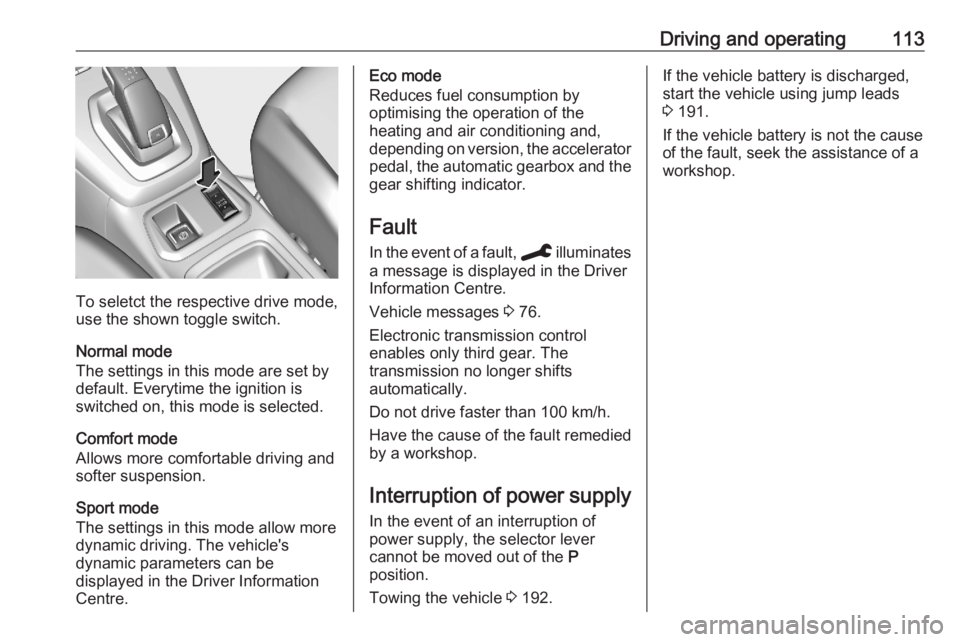
To seletct the respective drive mode,
use the shown toggle switch.
Normal mode
The settings in this mode are set by
default. Everytime the ignition is
switched on, this mode is selected.
Comfort mode
Allows more comfortable driving and softer suspension.
Sport mode
The settings in this mode allow more
dynamic driving. The vehicle's
dynamic parameters can be
displayed in the Driver Information
Centre.
Eco mode
Reduces fuel consumption by
optimising the operation of the
heating and air conditioning and,
depending on version, the accelerator
pedal, the automatic gearbox and the gear shifting indicator.
Fault
In the event of a fault, C illuminates
a message is displayed in the Driver
Information Centre.
Vehicle messages 3 76.
Electronic transmission control
enables only third gear. The
transmission no longer shifts
automatically.
Do not drive faster than 100 km/h.
Have the cause of the fault remedied by a workshop.
Interruption of power supply In the event of an interruption of
power supply, the selector lever
cannot be moved out of the P
position.
Towing the vehicle 3 192.If the vehicle battery is discharged,
start the vehicle using jump leads
3 191.
If the vehicle battery is not the cause
of the fault, seek the assistance of a
workshop.
Page 157 of 229
Driving and operating155The counting of driving time alert is
reset when the ignition has been
switched off for a few minutes.
Driver drowsiness detection
The system monitors the driver's level
of vigilance at speeds above
65 km/h. A camera at the top of the
windscreen detects variations in
trajectory compared to the lane
markings.
If the trajectory of the vehicle
suggests a certain level of
drowsiness or inattention by the
driver, the system triggers the first
level of alert. The driver is notified by
a message and an audible signal is
given.
After three first level alerts, the
system triggers a new alert with a message, accompanied by a more
pronounced audible signal.
In certain driving conditions (poor
road surface or strong winds), the
system may give alerts independent of the driver's level of vigilance.The driver drowsiness detection is
reinitialised when the ignition has
been switched off for a few minutes or the speed remains below 65 km/h for
a few minutes.
System limitationsIn the following situations, the system
may not operate properly or even not
operate at all:
● poor visibility caused by inadequate lighting of the
roadway, falling snow, heavy
rain, dense fog etc.
● dazzle caused by headlamps of an oncoming vehicles, low sun,
reflections on damp roads,
leaving a tunnel, alternating
shade and light etc.
● windscreen area in front of the camera covered by dirt, snow,
stickers etc.
● no lane markings detected or multiple lane markings due to
roadworks
● close vehicles ahead
● winding roads or narrow roadsFuel
Fuel for petrol engines
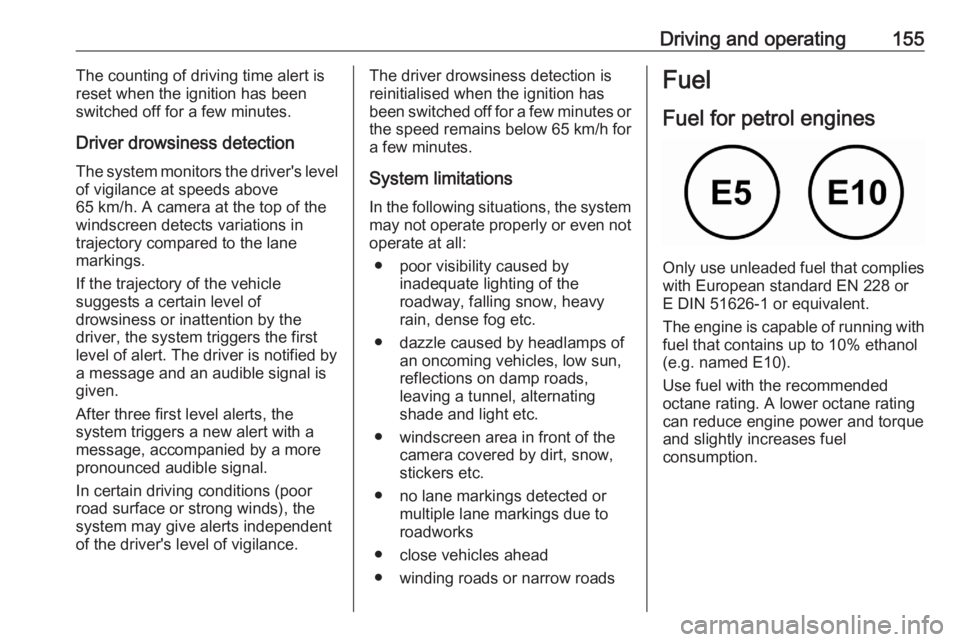
Only use unleaded fuel that complies
with European standard EN 228 or
E DIN 51626-1 or equivalent.
The engine is capable of running with
fuel that contains up to 10% ethanol
(e.g. named E10).
Use fuel with the recommended octane rating. A lower octane rating can reduce engine power and torque
and slightly increases fuel
consumption.
Page 163 of 229
Vehicle care161Vehicle careGeneral Information...................161
Accessories and vehicle modifications .......................... 161
Vehicle storage ........................162
End-of-life vehicle recovery .....162
Vehicle checks ........................... 163
Performing work ......................163
Bonnet ..................................... 163
Engine oil ................................. 164
Engine coolant ......................... 165
Washer fluid ............................ 165
Brakes ..................................... 166
Brake fluid ............................... 166
Vehicle battery ......................... 166
Diesel fuel system bleeding .....168
Wiper blade replacement ........168
Bulb replacement .......................169
Halogen headlights ..................169
LED headlights ........................ 171
Front fog lights ......................... 171
Front turn lights .......................171
Tail lights ................................. 172
Number plate light ...................174
Interior lights ............................ 174Electrical system........................174
Fuses ....................................... 174
Engine compartment fuse box . 175
Instrument panel fuse box .......176
Vehicle tools .............................. 178
Tools ........................................ 178
Wheels and tyres .......................179
Winter tyres ............................. 179
Tyre designations ....................179
Tyre pressure .......................... 179
Tyre deflation detection system .................................... 180
Tread depth ............................. 181
Changing tyre and wheel size . 182
Wheel covers ........................... 182
Tyre chains .............................. 182
Tyre repair kit .......................... 183
Wheel changing .......................186
Spare wheel ............................ 187
Jump starting ............................. 191
Towing ....................................... 192
Towing the vehicle ...................192
Towing another vehicle ...........193
Appearance care .......................194
Exterior care ............................ 194
Interior care ............................. 196
Floor mats ............................... 196General Information
Accessories and vehicle modifications
We recommend the use of genuine parts and accessories and factory
approved parts specific for your
vehicle type. We cannot assess or
guarantee reliability of other products - even if they have a regulatory or
otherwise granted approval.
Any modification, conversion or other
changes made to standard vehicle
specifications (including, without
limitation, software modifications,
modifications of the electronic control units) may invalidate the warranty
offered by Opel. Furthermore, such
changes may affect driver assistance
systems, may impact fuel
consumption, CO 2 emissions and
other emissions of the vehicle and
cause the vehicle to no longer
conform to the operating permit,
impacting the validity of your vehicle
registration.
Page 166 of 229
164Vehicle careClosing
Before closing the bonnet, press the
support into the holder.
Lower the bonnet and let it fall into the latch from a low height (20-25 cm).
Check that the bonnet is engaged.Caution
Do not press the bonnet into the
latch to avoid dents.
Engine oil
Check the engine oil level manually
on a regular basis to prevent damage
to the engine. Ensure that the correct
specification of oil is used.
Recommended fluids and lubricants
3 201.
The maximum engine oil
consumption is 0.6 l per 1000 km.
Check with the vehicle on a level
surface. The engine must be at
operating temperature and switched
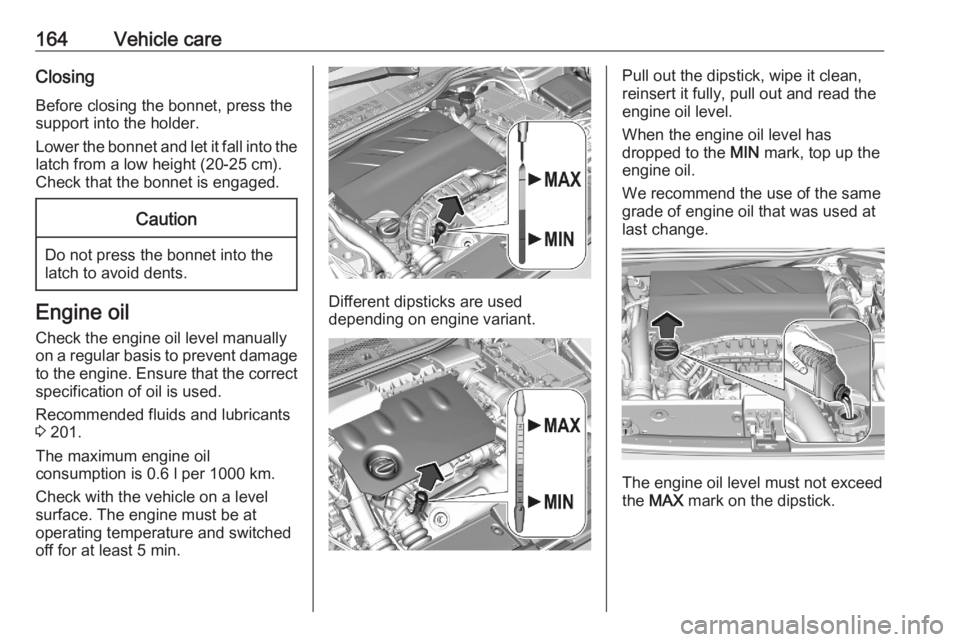
off for at least 5 min.Different dipsticks are used
depending on engine variant.
Pull out the dipstick, wipe it clean,
reinsert it fully, pull out and read the
engine oil level.
When the engine oil level has
dropped to the MIN mark, top up the
engine oil.
We recommend the use of the same
grade of engine oil that was used at
last change.
The engine oil level must not exceed
the MAX mark on the dipstick.