automatic transmission OPEL CROSSLAND X 2018.5 Manual user
[x] Cancel search | Manufacturer: OPEL, Model Year: 2018.5, Model line: CROSSLAND X, Model: OPEL CROSSLAND X 2018.5Pages: 261, PDF Size: 8.04 MB
Page 138 of 261
136Driving and operatingHeating functionalitiesNote
Individual heating functionalities,
such as heated seats or heated
steering wheel, may be temporarily
unavailable in the event of electrical
loading constraints. Functions will
be resumed after some minutes.
Turbo engine warm-up
Upon start-up, engine available
torque may be limited for a short time,
especially when the engine
temperature is cold. The limitation is
to allow the lubrication system to fully
protect the engine.
Overrun cut-off
The fuel supply is automatically cut off
during overrun, i.e. when the vehicle
is driven with a gear engaged but accelerator pedal is released.
Depending on driving conditions, the
overrun cut-off may be deactivated.Stop-start system
The stop-start system helps to save
fuel and to reduce the exhaust
emissions. When conditions allow, it
switches off the engine as soon as the
vehicle is at a low speed or at a
standstill, e.g. at a traffic light or in a
traffic jam.
Activation The stop-start system is available as
soon as the engine is started, the
vehicle starts-off and the conditions
as stated below in this section are
fulfilled.
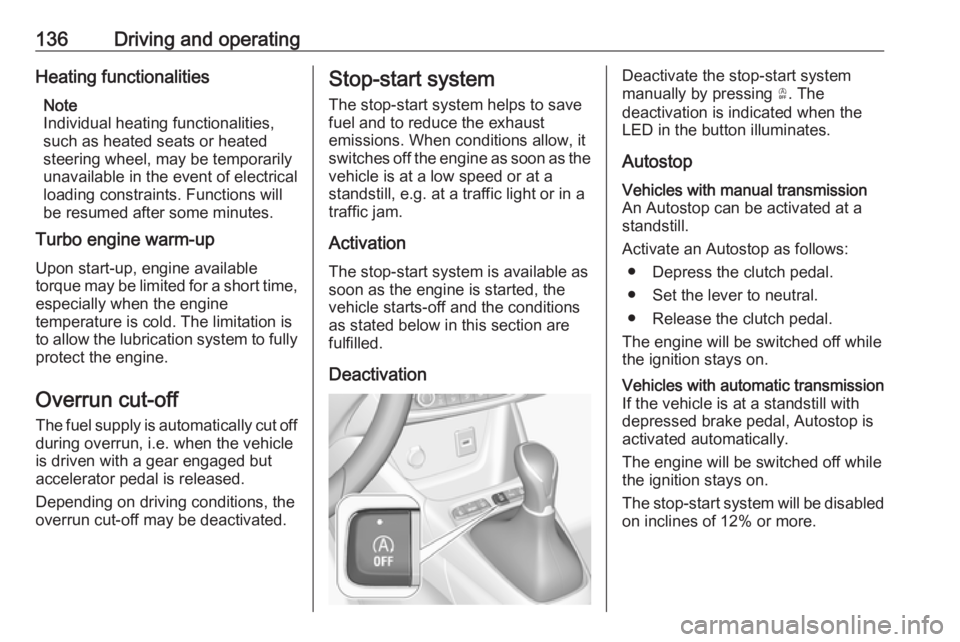
DeactivationDeactivate the stop-start system
manually by pressing Ò. The
deactivation is indicated when the
LED in the button illuminates.
AutostopVehicles with manual transmission
An Autostop can be activated at a
standstill.
Activate an Autostop as follows: ● Depress the clutch pedal.
● Set the lever to neutral.
● Release the clutch pedal.
The engine will be switched off while
the ignition stays on.Vehicles with automatic transmission If the vehicle is at a standstill with
depressed brake pedal, Autostop is
activated automatically.
The engine will be switched off while the ignition stays on.
The stop-start system will be disabled
on inclines of 12% or more.
Page 145 of 261
Driving and operating1439. Unscrew the hose from the fillerneck.
10. Mount the protective cap and turn
clockwise until it engages.
Note
Dispose of AdBlue canister
according to environmental
requirements. Hose can be reused
after flushing with clear water before AdBlue dries out.Automatic transmission
The automatic transmission permits
automatic gearshifting (automatic
mode) or manual gearshifting
(manual mode).
Manual shifting is possible in manual
mode by tapping the selector lever to + or - 3 144.
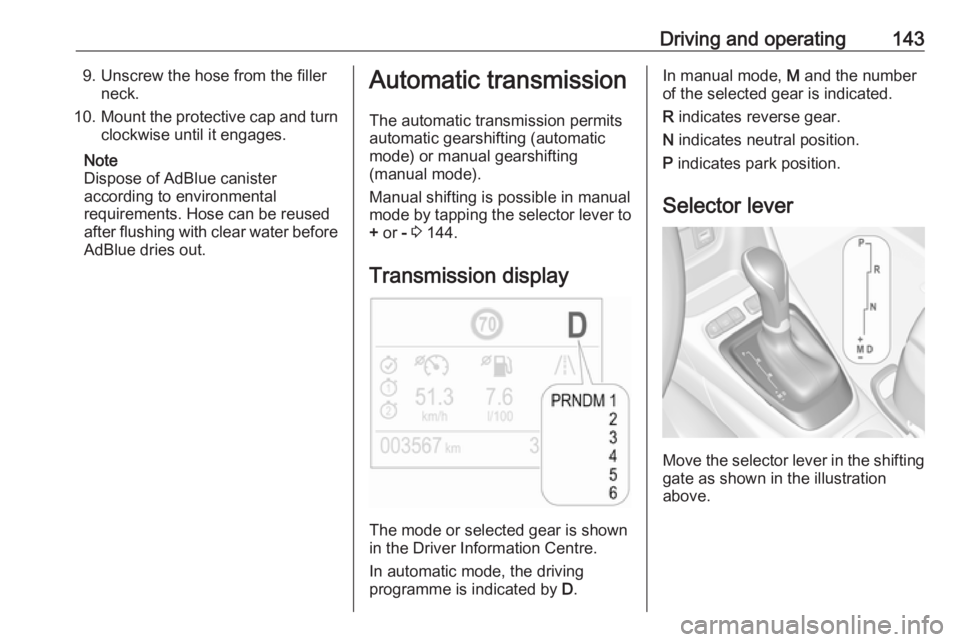
Transmission display
The mode or selected gear is shown
in the Driver Information Centre.
In automatic mode, the driving
programme is indicated by D.
In manual mode, M and the number
of the selected gear is indicated.
R indicates reverse gear.
N indicates neutral position.
P indicates park position.
Selector lever
Move the selector lever in the shifting
gate as shown in the illustration
above.
Page 147 of 261
Driving and operating145In manual mode, no automatic
shifting to a higher gear takes place
at high engine revolutions.
Gear shift indication
R with the number of a higher gear is
indicated, when upshifting is
recommended for fuel saving
reasons.
Shift indication appears only in
manual mode.
Electronic driving programmes
● Following a cold start, the operating temperature
programme increases engine
speed to quickly bring the
catalytic converter to the required
temperature.
● Special programmes automatically adapt the shifting
points when driving up inclines or
down hills.
● In snowy or icy conditions or on other slippery surfaces, the
electronic transmission controlenables the driver to select
manually first, second or third
gear for starting off.
Kickdown Pressing down the accelerator pedal
beyond the kickdown detent will lead to maximum acceleration
independent of selected driving
mode. The transmission shifts to a
lower gear depending on engine
speed.
Fault
In the event of a fault a message is
displayed in the Driver Information
Centre. Vehicle messages 3 100.
Electronic transmission control
enables only third gear. The
transmission no longer shifts
automatically.
Do not drive faster than 100 km/h.
Have the cause of the fault remedied
by a workshop.Interruption of power supply
In the event of an interruption of
power supply, the selector lever
cannot be moved out of the P
position. The ignition key cannot be
removed from the ignition switch.
If the vehicle battery is discharged,
start the vehicle using jump leads
3 219.
If the vehicle battery is not the cause
of the fault, release the selector lever.
1. Apply the parking brake.
2. Release the selector lever trim from the centre console. Poke
with a finger into the leather
socket below the selector lever
and push the trim upwards.
Page 152 of 261
150Driving and operatingESC and TC are also reactivated the
next time the ignition is switched on.
Fault
If there is a fault in the system, the control indicator b illuminates
continuously and a message appears
in the Driver Information Centre. The
system is not operational.
Have the cause of the fault remedied
by a workshop.Driver assistance
systems9 Warning
Driver assistance systems are
developed to support the driver
and not to replace the driver's
attention.
The driver stays in full control of
the vehicle and accepts full
responsibility when driving the
vehicle.
When using driver assistance
systems, always take care
regarding the current traffic
situation and follow applicable
traffic rules.
Cruise control
The cruise control can store and
maintain speeds above 40 km/h.
Additionally at least the third gear
must be engaged on manual
transmission, on automatic
transmission position D or the second
or a higher gear in position M must be
selected.
Deviations from the stored speeds
may occur when driving uphill or
downhill.
The system maintains the vehicle
speed at the preset speed by the
driver, without any action on the
accelerator pedal.
The preset speed can be exceeded
temporarily by pressing the
accelerator pedal firmly.
The status and preset speed is
displayed in the Driver Information Centre.
Do not use the cruise control if it is not advisable to maintain a constant
speed.
Control indicator m 3 94.
Page 222 of 261
220Vehicle care● A discharged vehicle battery canalready freeze at a temperature
of 0 °C. Defrost the frozen battery before connecting jump leads.
● Wear eye protection and protective clothing when
handling a battery.
● Use a booster battery with the same voltage (12 V). Its capacity
(Ah) must not be much less than
that of the discharged vehicle
battery.
● Use jump leads with insulated terminals and a cross section of
at least 16 mm 2
(25 mm 2
for
diesel engines).
● Do not disconnect the discharged
vehicle battery from the vehicle.
● Switch off all unnecessary electrical consumers.
● Do not lean over the vehicle battery during jump starting.
● Do not allow the terminals of one
lead to touch those of the other
lead.● The vehicles must not come into contact with each other during
the jump starting process.
● Apply the parking brake, transmission in neutral,
automatic transmission in P.
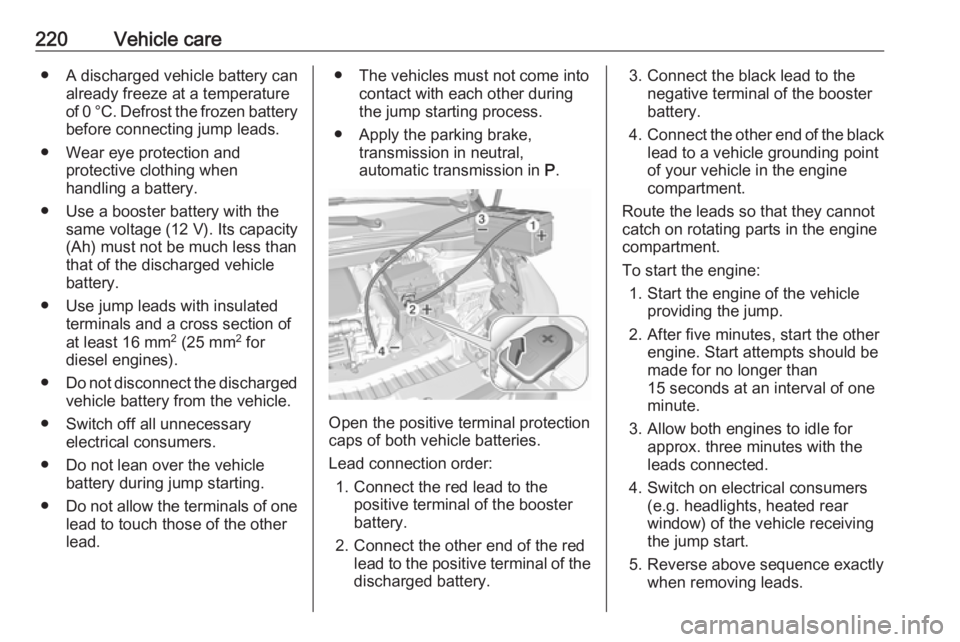
Open the positive terminal protection
caps of both vehicle batteries.
Lead connection order: 1. Connect the red lead to the positive terminal of the booster
battery.
2. Connect the other end of the red lead to the positive terminal of the
discharged battery.
3. Connect the black lead to the negative terminal of the boosterbattery.
4. Connect the other end of the black
lead to a vehicle grounding point
of your vehicle in the engine
compartment.
Route the leads so that they cannot
catch on rotating parts in the engine
compartment.
To start the engine: 1. Start the engine of the vehicle providing the jump.
2. After five minutes, start the other engine. Start attempts should be
made for no longer than
15 seconds at an interval of one
minute.
3. Allow both engines to idle for approx. three minutes with the
leads connected.
4. Switch on electrical consumers (e.g. headlights, heated rear
window) of the vehicle receiving
the jump start.
5. Reverse above sequence exactly when removing leads.
Page 223 of 261
Vehicle care221Towing
Towing the vehicle
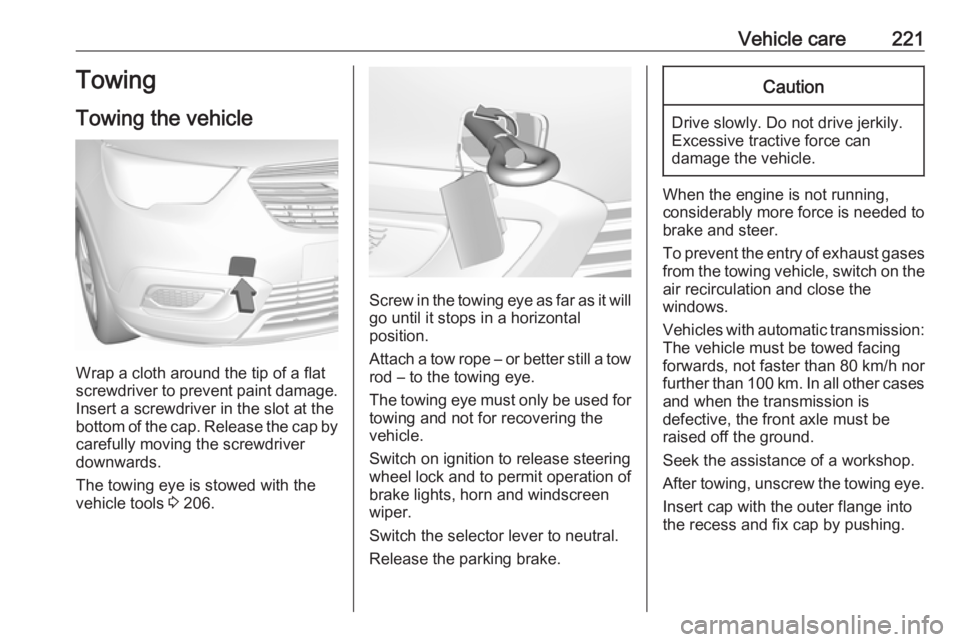
Wrap a cloth around the tip of a flat
screwdriver to prevent paint damage.
Insert a screwdriver in the slot at the
bottom of the cap. Release the cap by carefully moving the screwdriver
downwards.
The towing eye is stowed with the vehicle tools 3 206.
Screw in the towing eye as far as it will
go until it stops in a horizontal
position.
Attach a tow rope – or better still a tow
rod – to the towing eye.
The towing eye must only be used for
towing and not for recovering the
vehicle.
Switch on ignition to release steering
wheel lock and to permit operation of
brake lights, horn and windscreen
wiper.
Switch the selector lever to neutral.
Release the parking brake.
Caution
Drive slowly. Do not drive jerkily.
Excessive tractive force can
damage the vehicle.
When the engine is not running,
considerably more force is needed to
brake and steer.
To prevent the entry of exhaust gases from the towing vehicle, switch on the
air recirculation and close the
windows.
Vehicles with automatic transmission: The vehicle must be towed facing
forwards, not faster than 80 km/h nor further than 100 km. In all other cases
and when the transmission is
defective, the front axle must be
raised off the ground.
Seek the assistance of a workshop.
After towing, unscrew the towing eye.
Insert cap with the outer flange into
the recess and fix cap by pushing.
Page 239 of 261
![OPEL CROSSLAND X 2018.5 Manual user Technical data237PerformanceEngineB12xE
B12xE
LPG
B12xHTB12xHT
Maximum speed [km/h]Manual transmission170170188 4)2065)Automatic transmission––187–4)
5-gear transmission
5) 6-gear transmissionEn](/img/37/18839/w960_18839-238.png "OPEL CROSSLAND X 2018.5 Manual user Technical data237PerformanceEngineB12xE
B12xE
LPG
B12xHTB12xHT
Maximum speed [km/h]Manual transmission170170188 4)2065)Automatic transmission––187–4)
5-gear transmission
5) 6-gear transmissionEn")
Technical data237PerformanceEngineB12xE
B12xE
LPG
B12xHTB12xHT
Maximum speed [km/h]Manual transmission170170188 4)2065)Automatic transmission––187–4)
5-gear transmission
5) 6-gear transmissionEngineB16DTB16DTHMaximum speed [km/h]Manual transmission180187Automatic transmission––
Page 240 of 261
![OPEL CROSSLAND X 2018.5 Manual user 238Technical dataVehicle weight
Kerb weight, basic model without any optional equipmentEngineManual
transmissionAutomatic
transmissionwithout / with
air conditioning
[kg]B12xE1163/1174–B12xE
LPG1234](/img/37/18839/w960_18839-239.png "OPEL CROSSLAND X 2018.5 Manual user 238Technical dataVehicle weight
Kerb weight, basic model without any optional equipmentEngineManual
transmissionAutomatic
transmissionwithout / with
air conditioning
[kg]B12xE1163/1174–B12xE
LPG1234")
238Technical dataVehicle weight
Kerb weight, basic model without any optional equipmentEngineManual
transmissionAutomatic
transmissionwithout / with
air conditioning
[kg]B12xE1163/1174–B12xE
LPG1234/1245–B12xHT1234/1245 6)1278/1289B12xHT1263/1274 7)–B16DT1278/1289–B16DTH1306/1319–B16DTH1308/13198)–6)
5-gear transmission
7) 6-gear transmission
8) ECO
Optional equipment and accessories increase the kerb weight.
Loading information 3 70.
Page 256 of 261
254IndexAAccessories and vehicle modifications .......................... 186
Active emergency braking ....94, 157
Adaptive forward lighting ...........111
AdBlue .................................. 92, 140
Adjustable air vents ...................127
Advanced parking assist ............163
Airbag and belt tensioners ...........89
Airbag deactivation ................56, 89
Airbag label................................... 51 Airbag system .............................. 51
Air conditioning regular operation ................................ 129
Air conditioning system .............. 119
Air intake .................................... 128
Air vents...................................... 127
Antilock brake system ................ 147
Antilock brake system (ABS) .......91
Anti-theft alarm system ................32
Anti-theft locking system .............. 31
Appearance care ........................223
Armrest ................................... 46, 47
Ashtrays ....................................... 79 Automatic anti-dazzle ..................36
Automatic light control ...............110
Automatic locking ........................28
Automatic transmission .............143
Autostop ............................... 93, 136
Auxiliary heater ........................... 126B
Battery discharge protection ......117
Battery voltage ........................... 101 Belts.............................................. 48
BlueInjection ............................... 140
Bonnet ....................................... 188
Brake and clutch fluid .................228
Brake and clutch system .............90
Brake assist ............................... 148
Brake fluid .................................. 191
Brakes ............................... 147, 191
Breakdown.................................. 221
Bulb replacement ....................... 193
C Capacities .................................. 240
Catalytic converter .....................140
Central locking system ................24
Centre console lighting ..............116
Centre console storage ...............64
Changing tyre and wheel size ...210
Charging system .......................... 89
Child locks ................................... 29
Child restraint installation locations ................................... 60
Child restraints.............................. 57
Child restraint systems ................57
Cigarette lighter ........................... 79
Climate control ............................. 16
Climate control systems .............118