transmission OPEL CROSSLAND X 2018 Manual user
[x] Cancel search | Manufacturer: OPEL, Model Year: 2018, Model line: CROSSLAND X, Model: OPEL CROSSLAND X 2018Pages: 257, PDF Size: 7.81 MB
Page 204 of 257
202Vehicle careNo.Circuit10Engine control11Engine control12Engine cooling unit13Body control module14Intelligent battery sensor15–16Front fog light17–18High beam right19High beam left20Engine control fuel pump21Starter22–23Starter24Trailer hitch25Instrument panel fuse box26Transmission control moduleNo.Circuit27Body control module28Engine control module29Front wiper30Body control module
After having changed defective fuses,
close the fuse box cover and press
until it engages.
If the fuse box cover is not closed
correctly, malfunction may occur.
Instrument panel fuse box
Fuse box on the left side of the
instrument panel
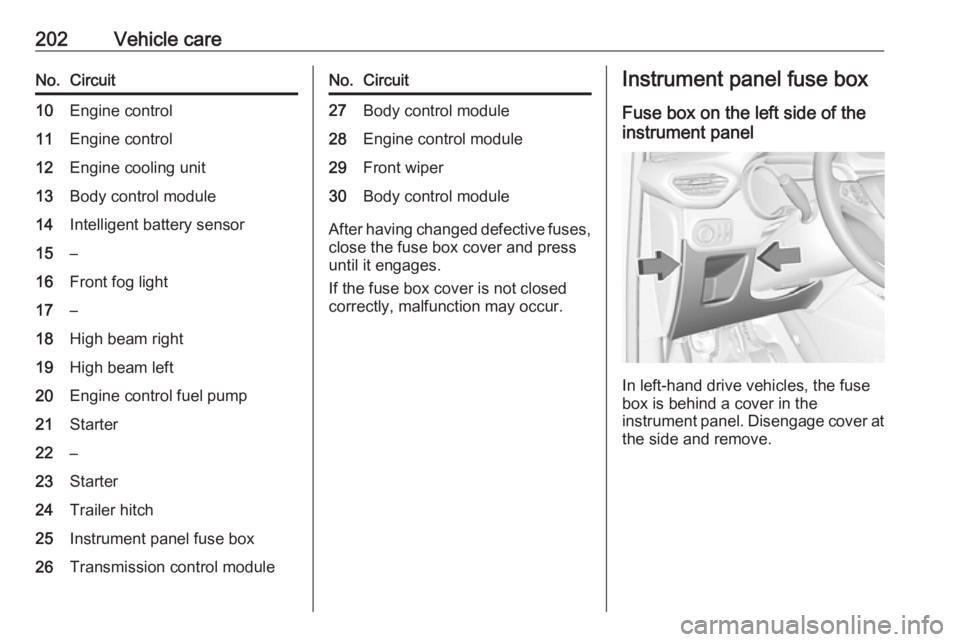
In left-hand drive vehicles, the fuse
box is behind a cover in the
instrument panel. Disengage cover at
the side and remove.
Page 206 of 257

204Vehicle careNo.Circuit28–29Infotainment30–31Infotainment32Power outlet front33–34Heated exterior mirrors / Door
module35Instrument cluster / Light
switch / Advanced parking
assist/ Transmission control
module36Courtesy lights / Sunvisor
lights / Glovebox lightFuse box on the right side of the
instrument panel
In left-hand drive vehicles, the fuse
box is located behind a cover in the
glovebox. Open the glovebox and
remove the cover. Remove the
bracket.
In right-hand drive vehicles, the fuse
box is behind a cover in the
instrument panel. Disengage cover at
the side and remove.
Page 220 of 257
218Vehicle care● A discharged vehicle battery canalready freeze at a temperature
of 0 °C. Defrost the frozen battery before connecting jump leads.
● Wear eye protection and protective clothing when
handling a battery.
● Use a booster battery with the same voltage (12 Volts). Its
capacity (Ah) must not be much less than that of the discharged
vehicle battery.
● Use jump leads with insulated terminals and a cross section of
at least 16 mm 2
(25 mm 2
for
diesel engines).
● Do not disconnect the discharged
vehicle battery from the vehicle.
● Switch off all unnecessary electrical consumers.
● Do not lean over the vehicle battery during jump starting.
● Do not allow the terminals of one
lead to touch those of the other
lead.● The vehicles must not come into contact with each other during
the jump starting process.
● Apply the parking brake, transmission in neutral,
automatic transmission in P.
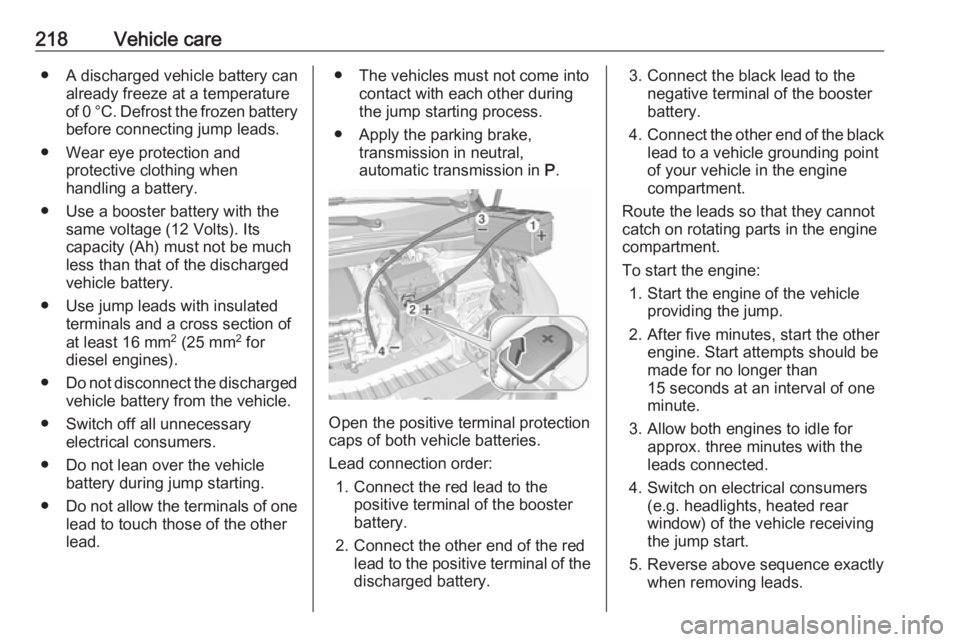
Open the positive terminal protection
caps of both vehicle batteries.
Lead connection order: 1. Connect the red lead to the positive terminal of the booster
battery.
2. Connect the other end of the red lead to the positive terminal of the
discharged battery.
3. Connect the black lead to the negative terminal of the boosterbattery.
4. Connect the other end of the black
lead to a vehicle grounding point
of your vehicle in the engine
compartment.
Route the leads so that they cannot
catch on rotating parts in the engine
compartment.
To start the engine: 1. Start the engine of the vehicle providing the jump.
2. After five minutes, start the other engine. Start attempts should be
made for no longer than
15 seconds at an interval of one
minute.
3. Allow both engines to idle for approx. three minutes with the
leads connected.
4. Switch on electrical consumers (e.g. headlights, heated rear
window) of the vehicle receiving
the jump start.
5. Reverse above sequence exactly when removing leads.
Page 221 of 257
Vehicle care219Towing
Towing the vehicle
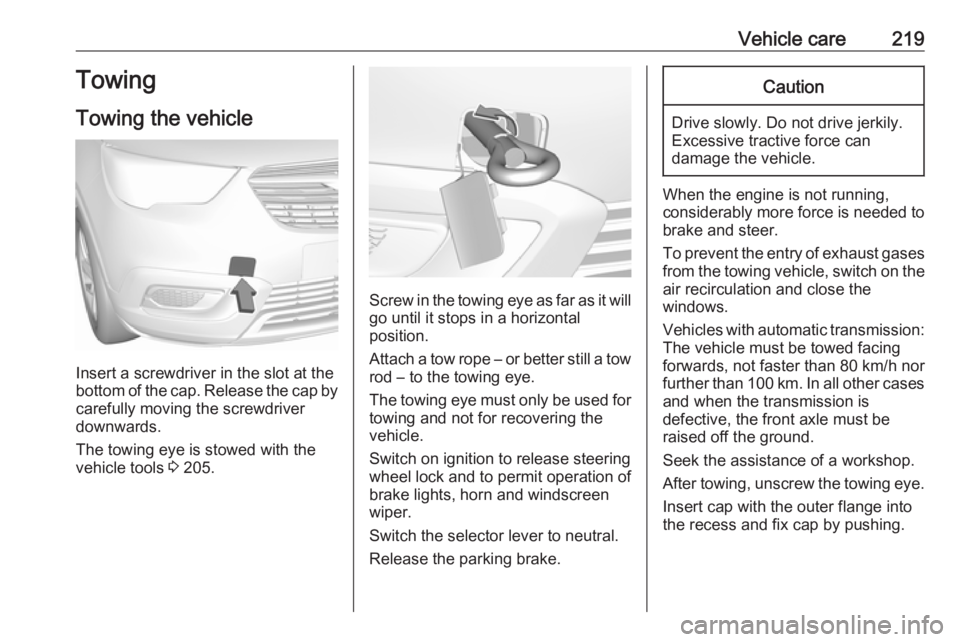
Insert a screwdriver in the slot at the
bottom of the cap. Release the cap by
carefully moving the screwdriver
downwards.
The towing eye is stowed with the vehicle tools 3 205.
Screw in the towing eye as far as it will
go until it stops in a horizontal
position.
Attach a tow rope – or better still a tow
rod – to the towing eye.
The towing eye must only be used for towing and not for recovering the
vehicle.
Switch on ignition to release steering wheel lock and to permit operation of
brake lights, horn and windscreen
wiper.
Switch the selector lever to neutral.
Release the parking brake.
Caution
Drive slowly. Do not drive jerkily.
Excessive tractive force can
damage the vehicle.
When the engine is not running,
considerably more force is needed to
brake and steer.
To prevent the entry of exhaust gases from the towing vehicle, switch on the
air recirculation and close the
windows.
Vehicles with automatic transmission: The vehicle must be towed facing
forwards, not faster than 80 km/h nor further than 100 km. In all other cases
and when the transmission is
defective, the front axle must be
raised off the ground.
Seek the assistance of a workshop.
After towing, unscrew the towing eye.
Insert cap with the outer flange into
the recess and fix cap by pushing.
Page 237 of 257
![OPEL CROSSLAND X 2018 Manual user Technical data235PerformanceEngineB12xE
B12xE
LPG
B12xHTB12xHT
Maximum speed [km/h]Manual transmission170170188 3)2064)Automatic transmission––187–3)
5-gear transmission
4) 6-gear transmissionEn](/img/37/18837/w960_18837-236.png "OPEL CROSSLAND X 2018 Manual user Technical data235PerformanceEngineB12xE
B12xE
LPG
B12xHTB12xHT
Maximum speed [km/h]Manual transmission170170188 3)2064)Automatic transmission––187–3)
5-gear transmission
4) 6-gear transmissionEn")
Technical data235PerformanceEngineB12xE
B12xE
LPG
B12xHTB12xHT
Maximum speed [km/h]Manual transmission170170188 3)2064)Automatic transmission––187–3)
5-gear transmission
4) 6-gear transmissionEngineB16DTB16DTHMaximum speed [km/h]Manual transmission180187Automatic transmission––
Page 238 of 257
![OPEL CROSSLAND X 2018 Manual user 236Technical dataVehicle weight
Kerb weight, basic model without any optional equipmentEngineManual
transmissionAutomatic
transmissionwithout/with
air conditioning
[kg]B12xE1163/1174–B12xE
LPG1159/1](/img/37/18837/w960_18837-237.png "OPEL CROSSLAND X 2018 Manual user 236Technical dataVehicle weight
Kerb weight, basic model without any optional equipmentEngineManual
transmissionAutomatic
transmissionwithout/with
air conditioning
[kg]B12xE1163/1174–B12xE
LPG1159/1")
236Technical dataVehicle weight
Kerb weight, basic model without any optional equipmentEngineManual
transmissionAutomatic
transmissionwithout/with
air conditioning
[kg]B12xE1163/1174–B12xE
LPG1159/1170–B12xHT1234/1245 5)1278/1289B12xHT1263/1274 6)–B16DT1278/1289–B16DTH1306/1319–5)
5-gear transmission
6) 6-gear transmission
Optional equipment and accessories increase the kerb weight.
Loading information 3 72.
Page 242 of 257
![OPEL CROSSLAND X 2018 Manual user 240Technical dataComfort with up to 3 peopleECO with up to 3 peopleWith full loadEngineTyresfrontrearfrontrearfrontrear[kPa/bar]
([psi])[kPa/bar]
([psi])[kPa/bar]
([psi])[kPa/bar]
([psi])[kPa/bar]
([p](/img/37/18837/w960_18837-241.png "OPEL CROSSLAND X 2018 Manual user 240Technical dataComfort with up to 3 peopleECO with up to 3 peopleWith full loadEngineTyresfrontrearfrontrearfrontrear[kPa/bar]
([psi])[kPa/bar]
([psi])[kPa/bar]
([psi])[kPa/bar]
([psi])[kPa/bar]
([p")
240Technical dataComfort with up to 3 peopleECO with up to 3 peopleWith full loadEngineTyresfrontrearfrontrearfrontrear[kPa/bar]
([psi])[kPa/bar]
([psi])[kPa/bar]
([psi])[kPa/bar]
([psi])[kPa/bar]
([psi])[kPa/bar]
([psi])B16DTH195/60 R16 89H230/2.3 (33)230/2.3 (33)250/2.5 (36)250/2.5 (36)240/2.4 (35)290/2.9 (42)215/50 R17 91H230/2.3 (33)230/2.3 (33)250/2.5 (36)250/2.5 (36)240/2.4 (35)270/2.7 (39)205/60 R16 92H230/2.3 (33)230/2.3 (33)250/2.5 (36)250/2.5 (36)240/2.4 (35)270/2.7 (39)AllTemporary spare
wheel
125/85 R16420/4.2 (60)420/4.2 (60)––420/4.2 (60)420/4.2 (60)7) 6-gear manual transmission / 96kW
Page 250 of 257

248Customer information● vehicle reactions in particulardriving situations ( e.g. inflation of
an airbag, activation of the
stability regulation system)
● environmental conditions (e.g. temperature)
These data are exclusively technical
and help identifying and correcting
errors as well as optimising vehicle
functions.
Motion profiles indicating travelled
routes cannot be created with these
data.
If services are used (e.g. repair
works, service processes, warranty
cases, quality assurance),
employees of the service network
(manufacturer included) are able to
read out this technical information
from the event and error data storage
modules applying special diagnostic
devices. If required, you will receive
further information at these
workshops. After an error has been
corrected, the data are deleted from
the error storage module or they are
constantly overwritten.When using the vehicle, situations
may occur in which these technical
data related to other information
(accident report, damages on the
vehicle, witness statements etc.) may be associated with a specific person -possibly, with the assistance of an
expert.
Additional functions contractually
agreed upon with the client (e.g.
vehicle location in emergency cases)
allow the transmission of particular
vehicle data from the vehicle.
Radio Frequency
Identification (RFID)
RFID technology is used in some
vehicles for functions such as tyre
pressure monitoring and ignition
system security. It is also used in
connection with conveniences such
as radio remote controls for door
locking/unlocking and starting, and in-
vehicle transmitters for garage door
openers. RFID technology in Opel
vehicles does not use or record
personal information or link with any
other Opel system containing
personal information.
Page 252 of 257
250IndexAAccessories and vehicle modifications .......................... 185
Active emergency braking ..........157
Adaptive forward lighting ...........113
AdBlue .................................. 94, 142
Adjustable air vents ...................129
Advanced parking assist ............164
Airbag and belt tensioners ...........91
Airbag deactivation ................57, 91
Airbag label................................... 52 Airbag system .............................. 52
Air conditioning regular operation ................................ 131
Air conditioning system .............. 121
Air intake .................................... 130
Air vents...................................... 129
Antilock brake system ................ 149
Antilock brake system (ABS) .......92
Anti-theft alarm system ................33
Anti-theft locking system .............. 32
Appearance care ........................221
Armrest ................................... 47, 48
Ashtrays ....................................... 81
Automatic anti-dazzle ..................37
Automatic light control ...............112
Automatic locking ........................29
Automatic transmission .............145
Autostop ............................... 95, 138
Auxiliary heater ........................... 128B
Battery discharge protection ......119
Battery voltage ........................... 102 Belts.............................................. 49
BlueInjection ............................... 142
Bonnet ....................................... 187
Brake and clutch fluid .................226
Brake and clutch system .............92
Brake assist ............................... 150
Brake fluid .................................. 190
Brakes ............................... 149, 190
Breakdown.................................. 219
Bulb replacement ....................... 192
C
Capacities .................................. 238
Catalytic converter .....................141
Central locking system ................25
Centre console lighting ..............118
Centre console storage ...............66
Changing tyre and wheel size ...209
Charging system .......................... 91
Child locks ................................... 30
Child restraint installation locations ................................... 61
Child restraints.............................. 58
Child restraint systems ................58
Cigarette lighter ........................... 81
Climate control ............................. 16
Climate control systems .............120
Page 254 of 257
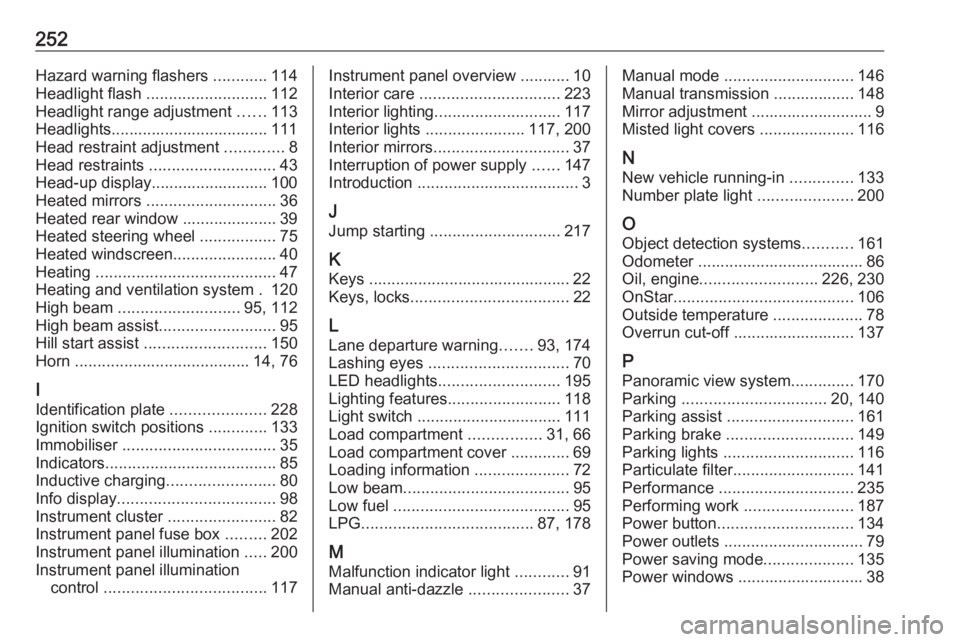
252Hazard warning flashers ............114
Headlight flash ........................... 112
Headlight range adjustment ......113
Headlights................................... 111
Head restraint adjustment .............8
Head restraints ............................ 43
Head-up display.......................... 100 Heated mirrors ............................. 36
Heated rear window ..................... 39
Heated steering wheel .................75
Heated windscreen .......................40
Heating ........................................ 47
Heating and ventilation system . 120
High beam ........................... 95, 112
High beam assist ..........................95
Hill start assist ........................... 150
Horn ....................................... 14, 76
I
Identification plate .....................228
Ignition switch positions .............133
Immobiliser .................................. 35
Indicators ...................................... 85
Inductive charging ........................80
Info display ................................... 98
Instrument cluster ........................82
Instrument panel fuse box .........202
Instrument panel illumination .....200
Instrument panel illumination control .................................... 117Instrument panel overview ........... 10
Interior care ............................... 223
Interior lighting ............................ 117
Interior lights ...................... 117, 200
Interior mirrors .............................. 37
Interruption of power supply ......147
Introduction .................................... 3
J Jump starting ............................. 217
K Keys ............................................. 22
Keys, locks ................................... 22
L
Lane departure warning .......93, 174
Lashing eyes ............................... 70
LED headlights ........................... 195
Lighting features .........................118
Light switch ................................ 111
Load compartment ................31, 66
Load compartment cover .............69
Loading information .....................72
Low beam ..................................... 95
Low fuel ....................................... 95
LPG ...................................... 87, 178
M Malfunction indicator light ............91
Manual anti-dazzle ......................37Manual mode ............................. 146
Manual transmission .................. 148
Mirror adjustment ........................... 9
Misted light covers .....................116
N New vehicle running-in ..............133
Number plate light .....................200
O Object detection systems ...........161
Odometer ..................................... 86
Oil, engine .......................... 226, 230
OnStar ........................................ 106
Outside temperature ....................78
Overrun cut-off ........................... 137
P
Panoramic view system ..............170
Parking ................................ 20, 140
Parking assist ............................ 161
Parking brake ............................ 149
Parking lights ............................. 116
Particulate filter ........................... 141
Performance .............................. 235
Performing work ........................187
Power button .............................. 134
Power outlets ............................... 79
Power saving mode ....................135
Power windows ............................ 38