towing OPEL CROSSLAND X 2019.75 Manual user
[x] Cancel search | Manufacturer: OPEL, Model Year: 2019.75, Model line: CROSSLAND X, Model: OPEL CROSSLAND X 2019.75Pages: 253, PDF Size: 7.76 MB
Page 176 of 253
174Vehicle careVehicle careGeneral Information...................174
Accessories and vehicle modifications .......................... 174
Vehicle storage ........................175
End-of-life vehicle recovery .....175
Vehicle checks ........................... 176
Performing work ......................176
Bonnet ..................................... 176
Engine oil ................................. 177
Engine coolant ......................... 178
Washer fluid ............................ 178
Brakes ..................................... 179
Brake fluid ............................... 179
Vehicle battery ......................... 179
Diesel fuel system bleeding .....181
Wiper blade replacement ........181
Bulb replacement .......................182
Halogen headlights ..................182
LED headlights ........................ 185
Front fog lights ......................... 185
Tail lights ................................. 185
Side turn lights ......................... 189
Number plate light ...................190
Interior lights ............................ 190Electrical system........................190
Fuses ....................................... 190
Engine compartment fuse box . 191
Instrument panel fuse box .......192
Vehicle tools .............................. 194
Tools ........................................ 194
Wheels and tyres .......................195
Winter tyres ............................. 195
Tyre designations ....................195
Tyre pressure .......................... 196
Tyre deflation detection system .................................... 197
Tread depth ............................. 198
Changing tyre and wheel size . 198
Wheel covers ........................... 198
Tyre chains .............................. 199
Tyre repair kit .......................... 199
Wheel changing .......................202
Spare wheel ............................ 203
Jump starting ............................. 207
Towing ....................................... 208
Towing the vehicle ...................208
Towing another vehicle ...........209
Appearance care .......................210
Exterior care ............................ 210
Interior care ............................. 212
Floor mats ............................... 213General Information
Accessories and vehicle modifications
We recommend the use of genuine parts and accessories and factory
approved parts specific for this
vehicle type. We cannot assess or
guarantee reliability of other products - even if they have a regulatory or
otherwise granted approval.
Any modification, conversion or other
changes made to standard vehicle
specifications (including, without
limitation, software modifications,
modifications of the electronic control units) may invalidate the warranty
offered by Opel.
Any modification, conversion or other changes made to standard vehiclespecifications (including, without
limitation, software modifications,
modifications of the electronic control units) may invalidate the warrantyoffered by Vauxhall.
Furthermore, such changes may
affect driver assistance systems, may
impact fuel consumption, CO 2
Page 196 of 253
194Vehicle careNo.Circuit1Heated rear window2Heated exterior mirrors3Front power window4Driver's door control unit5Rear power window6Heated seats7–8Infotainment9–No.Circuit10Power outlet rear11–12–Vehicle tools
Tools
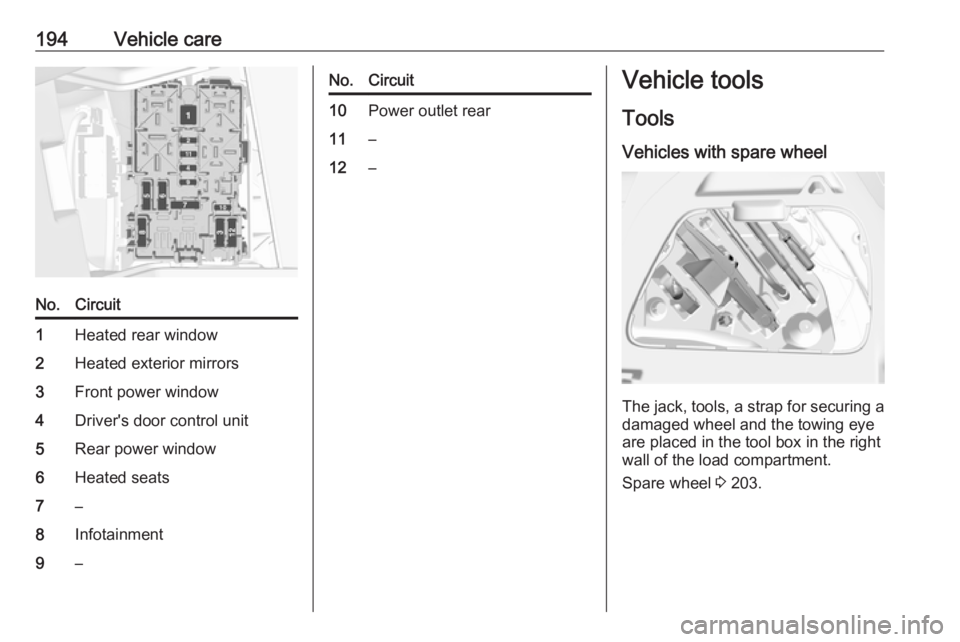
Vehicles with spare wheel
The jack, tools, a strap for securing a damaged wheel and the towing eye
are placed in the tool box in the right
wall of the load compartment.
Spare wheel 3 203.
Page 197 of 253
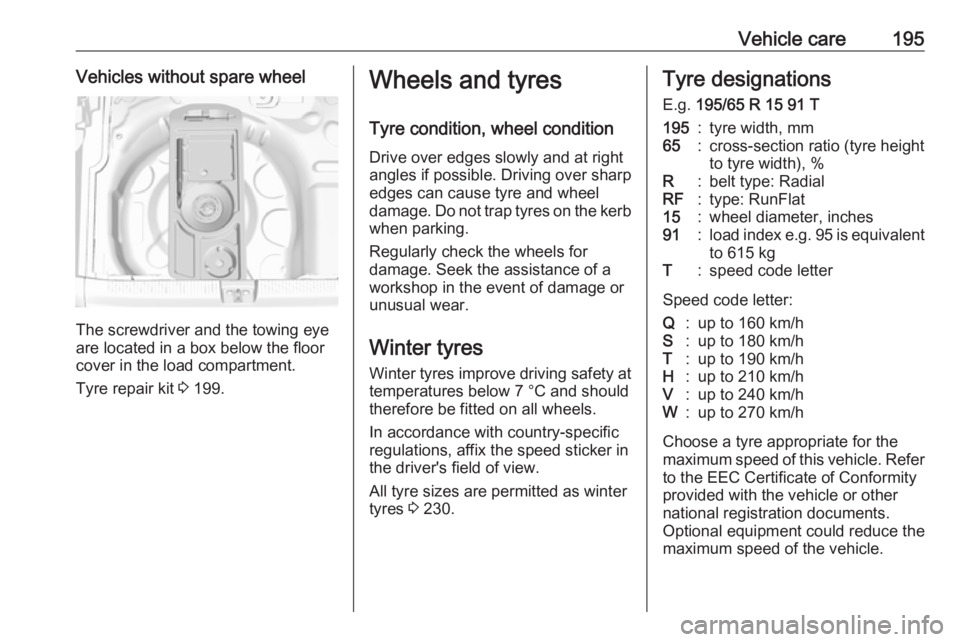
Vehicle care195Vehicles without spare wheel
The screwdriver and the towing eye
are located in a box below the floor
cover in the load compartment.
Tyre repair kit 3 199.
Wheels and tyres
Tyre condition, wheel condition Drive over edges slowly and at right
angles if possible. Driving over sharp
edges can cause tyre and wheel
damage. Do not trap tyres on the kerb when parking.
Regularly check the wheels for
damage. Seek the assistance of a
workshop in the event of damage or
unusual wear.
Winter tyres
Winter tyres improve driving safety at temperatures below 7 °C and shouldtherefore be fitted on all wheels.
In accordance with country-specific
regulations, affix the speed sticker in
the driver's field of view.
All tyre sizes are permitted as winter
tyres 3 230.Tyre designations
E.g. 195/65 R 15 91 T195:tyre width, mm65:cross-section ratio (tyre height
to tyre width), %R:belt type: RadialRF:type: RunFlat15:wheel diameter, inches91:load index e.g. 95 is equivalent
to 615 kgT:speed code letter
Speed code letter:
Q:up to 160 km/hS:up to 180 km/hT:up to 190 km/hH:up to 210 km/hV:up to 240 km/hW:up to 270 km/h
Choose a tyre appropriate for the
maximum speed of this vehicle. Refer to the EEC Certificate of Conformity
provided with the vehicle or other
national registration documents.
Optional equipment could reduce the
maximum speed of the vehicle.
Page 208 of 253
206Vehicle careAttach wheel wrench and with the
jack correctly aligned rotate wheel wrench until wheel is clear of the
ground.
5. Unscrew the wheel nuts. 6. Change the wheel.
7. Screw on the wheel nuts.
8. Lower the vehicle and remove jack.
9. Install the wheel wrench ensuring that it is located securely and
tighten each bolt in a crosswise
sequence. Tightening torque is
100 Nm.
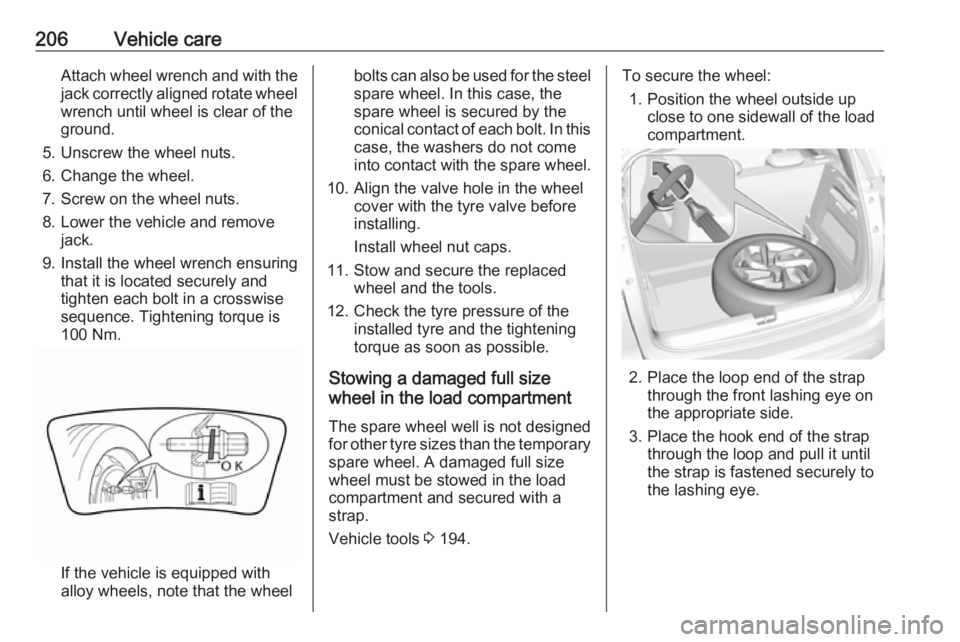
If the vehicle is equipped with
alloy wheels, note that the wheel
bolts can also be used for the steel spare wheel. In this case, the
spare wheel is secured by the
conical contact of each bolt. In this
case, the washers do not come
into contact with the spare wheel.
10. Align the valve hole in the wheel cover with the tyre valve before
installing.
Install wheel nut caps.
11. Stow and secure the replaced wheel and the tools.
12. Check the tyre pressure of the installed tyre and the tightening
torque as soon as possible.
Stowing a damaged full size
wheel in the load compartment
The spare wheel well is not designed for other tyre sizes than the temporary
spare wheel. A damaged full size
wheel must be stowed in the load
compartment and secured with a
strap.
Vehicle tools 3 194.To secure the wheel:
1. Position the wheel outside up close to one sidewall of the load
compartment.
2. Place the loop end of the strap through the front lashing eye on
the appropriate side.
3. Place the hook end of the strap through the loop and pull it until
the strap is fastened securely to
the lashing eye.
Page 209 of 253
Vehicle care207
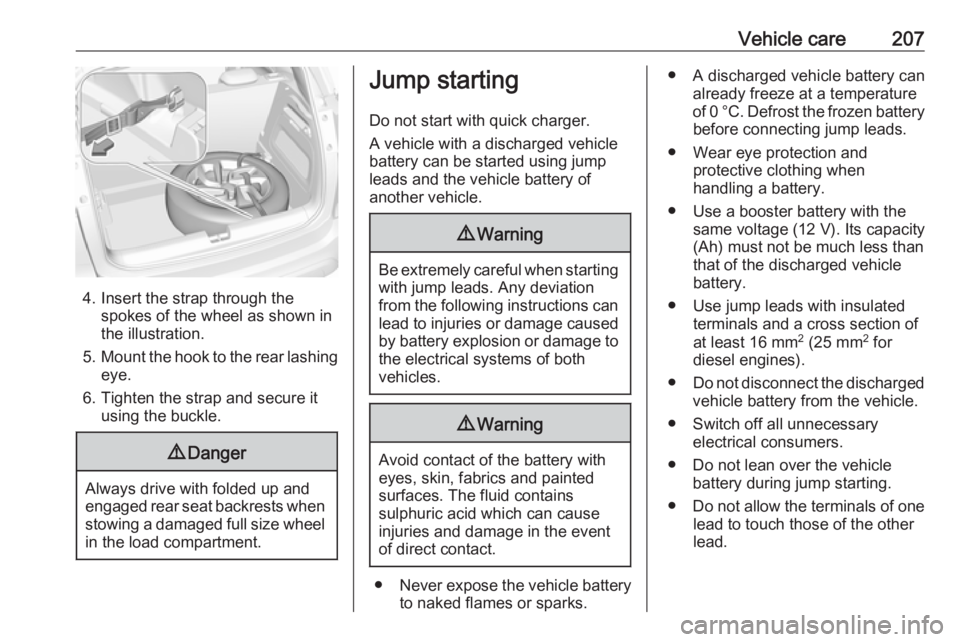
4. Insert the strap through thespokes of the wheel as shown in
the illustration.
5. Mount the hook to the rear lashing
eye.
6. Tighten the strap and secure it using the buckle.
9 Danger
Always drive with folded up and
engaged rear seat backrests when stowing a damaged full size wheel
in the load compartment.
Jump starting
Do not start with quick charger.
A vehicle with a discharged vehicle
battery can be started using jump
leads and the vehicle battery of
another vehicle.9 Warning
Be extremely careful when starting
with jump leads. Any deviation
from the following instructions can
lead to injuries or damage caused
by battery explosion or damage to the electrical systems of both
vehicles.
9 Warning
Avoid contact of the battery with
eyes, skin, fabrics and painted
surfaces. The fluid contains
sulphuric acid which can cause
injuries and damage in the event
of direct contact.
● Never expose the vehicle battery
to naked flames or sparks.
● A discharged vehicle battery can already freeze at a temperature
of 0 °C. Defrost the frozen battery before connecting jump leads.
● Wear eye protection and protective clothing when
handling a battery.
● Use a booster battery with the same voltage (12 V). Its capacity
(Ah) must not be much less than
that of the discharged vehicle battery.
● Use jump leads with insulated terminals and a cross section of
at least 16 mm 2
(25 mm 2
for
diesel engines).
● Do not disconnect the discharged
vehicle battery from the vehicle.
● Switch off all unnecessary electrical consumers.
● Do not lean over the vehicle battery during jump starting.
● Do not allow the terminals of one
lead to touch those of the other
lead.
Page 210 of 253
208Vehicle care● The vehicles must not come intocontact with each other during
the jump starting process.
● Apply the parking brake, transmission in neutral,
automatic transmission in P.
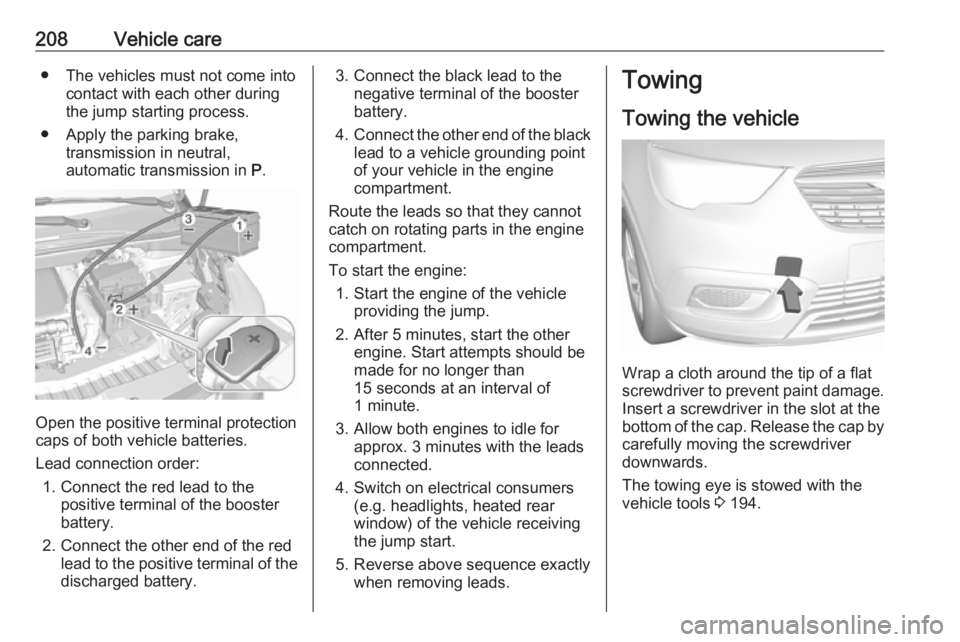
Open the positive terminal protection
caps of both vehicle batteries.
Lead connection order: 1. Connect the red lead to the positive terminal of the booster
battery.
2. Connect the other end of the red lead to the positive terminal of the
discharged battery.
3. Connect the black lead to the negative terminal of the boosterbattery.
4. Connect the other end of the black
lead to a vehicle grounding point
of your vehicle in the engine
compartment.
Route the leads so that they cannot
catch on rotating parts in the engine
compartment.
To start the engine: 1. Start the engine of the vehicle providing the jump.
2. After 5 minutes, start the other engine. Start attempts should be
made for no longer than
15 seconds at an interval of
1 minute.
3. Allow both engines to idle for approx. 3 minutes with the leads
connected.
4. Switch on electrical consumers (e.g. headlights, heated rear
window) of the vehicle receiving
the jump start.
5. Reverse above sequence exactly when removing leads.Towing
Towing the vehicle
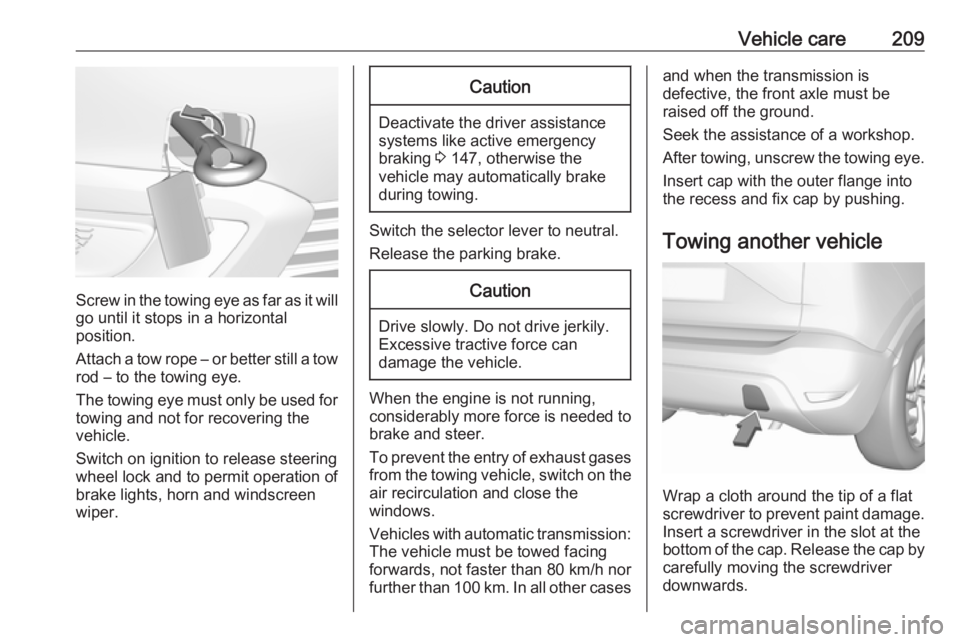
Wrap a cloth around the tip of a flat
screwdriver to prevent paint damage.
Insert a screwdriver in the slot at the
bottom of the cap. Release the cap by carefully moving the screwdriver
downwards.
The towing eye is stowed with the vehicle tools 3 194.
Page 211 of 253
Vehicle care209
Screw in the towing eye as far as it will
go until it stops in a horizontal
position.
Attach a tow rope – or better still a tow
rod – to the towing eye.
The towing eye must only be used for towing and not for recovering the
vehicle.
Switch on ignition to release steering
wheel lock and to permit operation of
brake lights, horn and windscreen
wiper.
Caution
Deactivate the driver assistance
systems like active emergency
braking 3 147, otherwise the
vehicle may automatically brake during towing.
Switch the selector lever to neutral.
Release the parking brake.
Caution
Drive slowly. Do not drive jerkily.
Excessive tractive force can
damage the vehicle.
When the engine is not running,
considerably more force is needed to
brake and steer.
To prevent the entry of exhaust gases from the towing vehicle, switch on the
air recirculation and close the
windows.
Vehicles with automatic transmission: The vehicle must be towed facing
forwards, not faster than 80 km/h nor further than 100 km. In all other cases
and when the transmission is
defective, the front axle must be
raised off the ground.
Seek the assistance of a workshop.
After towing, unscrew the towing eye.
Insert cap with the outer flange into
the recess and fix cap by pushing.
Towing another vehicle
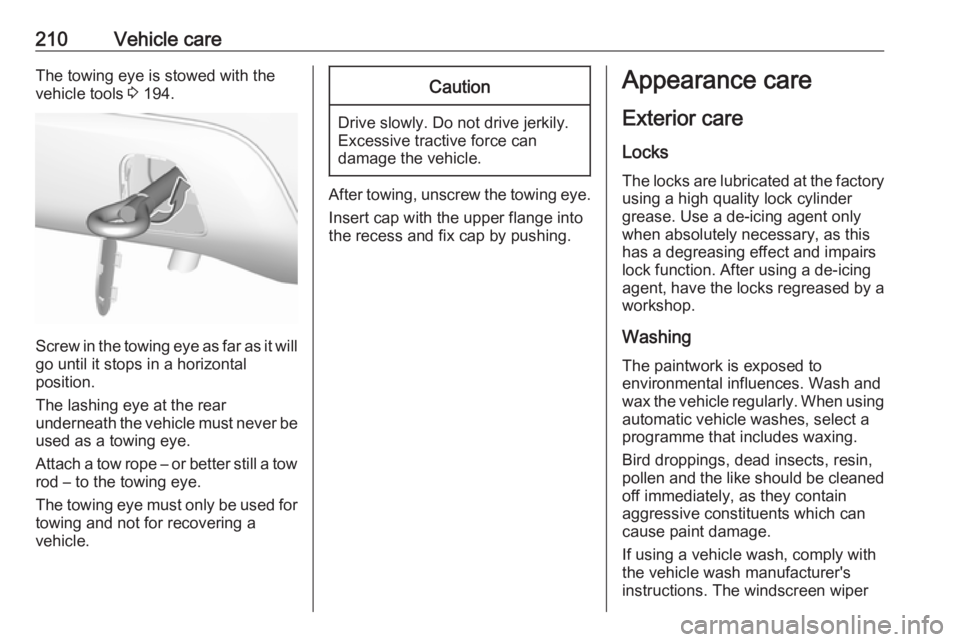
Wrap a cloth around the tip of a flat
screwdriver to prevent paint damage.
Insert a screwdriver in the slot at the
bottom of the cap. Release the cap by carefully moving the screwdriver
downwards.
Page 212 of 253
210Vehicle careThe towing eye is stowed with thevehicle tools 3 194.
Screw in the towing eye as far as it will
go until it stops in a horizontal
position.
The lashing eye at the rear
underneath the vehicle must never be used as a towing eye.
Attach a tow rope – or better still a tow
rod – to the towing eye.
The towing eye must only be used for towing and not for recovering a
vehicle.
Caution
Drive slowly. Do not drive jerkily.
Excessive tractive force can
damage the vehicle.
After towing, unscrew the towing eye.
Insert cap with the upper flange into
the recess and fix cap by pushing.
Appearance care
Exterior care LocksThe locks are lubricated at the factoryusing a high quality lock cylinder
grease. Use a de-icing agent only
when absolutely necessary, as this
has a degreasing effect and impairs
lock function. After using a de-icing
agent, have the locks regreased by a
workshop.
WashingThe paintwork is exposed to
environmental influences. Wash and
wax the vehicle regularly. When using
automatic vehicle washes, select a
programme that includes waxing.
Bird droppings, dead insects, resin,
pollen and the like should be cleaned
off immediately, as they contain
aggressive constituents which can
cause paint damage.
If using a vehicle wash, comply with
the vehicle wash manufacturer's
instructions. The windscreen wiper
Page 214 of 253
212Vehicle careIce residues, pollution and continuouswiping on dry windows will damage or
even destroy the wiper blades.
Glass panel
Never clean with solvents or abrasive agents, fuels, aggressive media
(e.g. paint cleaner, acetone-
containing solutions etc.), acidic or
highly alkaline media or abrasive
pads.
Wheels and tyres Do not use high-pressure jet
cleaners.
Clean rims with a pH-neutral wheel
cleaner.
Rims are painted and can be treated
with the same agents as the body.
Paintwork damage Rectify minor paintwork damage witha touch-up pen before rust forms.
Have more extensive damage or rust areas repaired by a workshop.Underbody
Some areas of the vehicle underbody
have a PVC undercoating while other critical areas have a durable
protective wax coating.
After the underbody is washed, check
the underbody and have it waxed if
necessary.
Bitumen / rubber materials could damage the PVC coating. Have
underbody work carried out by a
workshop.
Before and after winter, wash the
underbody and have the protective
wax coating checked.
Towing equipment
Do not clean the coupling ball bar with a steam-jet or high-pressure jet
cleaner.Interior care
Interior and upholstery Only clean the vehicle interior,
including the instrument panel fascia
and panelling, with a dry cloth or
interior cleaner.
Clean the leather upholstery with
clear water and a soft cloth. In case of
heavy soiling, use leather care.
The instrument cluster and the
displays should only be cleaned using
a soft damp cloth. If necessary use a weak soap solution.
Clean fabric upholstery with a
vacuum cleaner and brush. Remove
stains with an upholstery cleaner.
Clothing fabrics may not be
colourfast. This could cause visible
discolourations, especially on light-
coloured upholstery. Removable
stains and discolourations should be
cleaned as soon as possible.
Clean seat belts with lukewarm water or interior cleaner.
Page 249 of 253
247Control indicators.......................... 81
Control of the vehicle .................122
Controls ........................................ 70
Convex shape .............................. 33
Coolant and antifreeze ...............219
Cornering lights .......................... 103
Cruise control ...................... 87, 140
Cupholders .................................. 61
Curtain airbag system .................. 53
D Danger, Warnings and Cautions ...4
Daytime running lights ...............103
Declaration of conformity ............232
DEF ............................................ 130
Deflation detection system ...........85
Diesel exhaust fluid ....................130
Diesel fuel system bleeding .......181
Door open .................................... 87
Doors ............................................ 29
Driver alert .................................. 164
Driver assistance systems ..........140
Driver Information Centre .............88
Driving characteristics and towing tips .............................. 169
Driving hints ................................ 122
E Electric adjustment ......................33
Electrical system......................... 190
Electronic climate control system 113Electronic driving programmes ..135
Electronic key system ...................22
Electronic Stability Control and Traction Control system ....84, 139
Electronic Stability Control and Traction Control system off .......85
Emergency call ............................. 98
End-of-life vehicle recovery .......175
Engine compartment fuse box ...191
Engine coolant ........................... 178
Engine coolant temperature ........85
Engine coolant temperature gauge ....................................... 79
Engine data ............................... 226
Engine exhaust .......................... 129
Engine identification ...................222
Engine oil ...........177, 219, 223, 230
Engine oil level monitor ................79
Engine oil pressure ......................85
Entry lighting .............................. 107
Event data recorders ..................240
Exhaust filter ......................... 85, 129
Exit lighting ................................ 107
Exterior care .............................. 210
Exterior light ................................. 86
Exterior lighting ....................12, 100
Exterior mirrors ............................. 33F
Fault ........................................... 135
First aid ......................................... 66
First aid kit ................................... 66
Fixed air vents ........................... 119
Floor mats................................... 213
Folding mirrors ............................. 34
Forward collision alert................. 145
Front airbag system .....................52
Front fog lights .............86, 104, 185
Front pedestrian protection ........149
Front seats.................................... 41
Fuel............................................. 166
Fuel for diesel engines ..............166
Fuel for petrol engines ...............166
Fuel gauge ................................... 79 Fuel tank ..................................... 230
Fuses ......................................... 190
G
Gauges ......................................... 77
Gear selection ........................... 134
Gear shifting ................................. 84
General information ...................169
Glass panel .................................. 39
Glovebox ..................................... 61
H Halogen headlights ....................182
Hand brake ......................... 137, 138
Hazard warning flashers ............103