belt OPEL CROSSLAND X 2019.75 Manual user
[x] Cancel search | Manufacturer: OPEL, Model Year: 2019.75, Model line: CROSSLAND X, Model: OPEL CROSSLAND X 2019.75Pages: 253, PDF Size: 7.76 MB
Page 122 of 253

120Climate control● functionality and pressure test
● heating functionality
● leakage check
● check of drive belts
● cleaning of condenser and evaporator drainage
● performance check
● cabin air filter check
Page 129 of 253
Driving and operating127The engine will be switched off whilethe ignition stays on.Vehicles with automatic transmission
If the vehicle is at a standstill with
depressed brake pedal, Autostop is
activated automatically.
The engine will be switched off while
the ignition stays on.
The stop-start system will be disabled
on inclines of 12% or more.
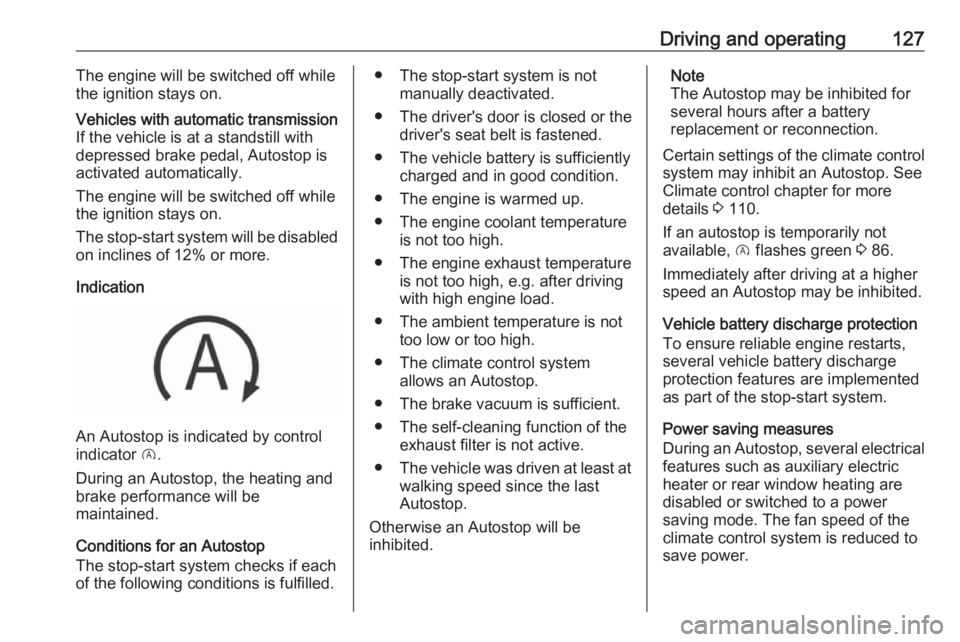
Indication
An Autostop is indicated by control
indicator D.
During an Autostop, the heating and
brake performance will be
maintained.
Conditions for an Autostop
The stop-start system checks if each
of the following conditions is fulfilled.
● The stop-start system is not manually deactivated.
● The driver's door is closed or the driver's seat belt is fastened.
● The vehicle battery is sufficiently charged and in good condition.
● The engine is warmed up.
● The engine coolant temperature is not too high.
● The engine exhaust temperature is not too high, e.g. after driving
with high engine load.
● The ambient temperature is not too low or too high.
● The climate control system allows an Autostop.
● The brake vacuum is sufficient.
● The self-cleaning function of the exhaust filter is not active.
● The vehicle was driven at least at
walking speed since the last
Autostop.
Otherwise an Autostop will be
inhibited.Note
The Autostop may be inhibited for
several hours after a battery
replacement or reconnection.
Certain settings of the climate control
system may inhibit an Autostop. See
Climate control chapter for more
details 3 110.
If an autostop is temporarily not
available, D flashes green 3 86.
Immediately after driving at a higher
speed an Autostop may be inhibited.
Vehicle battery discharge protection
To ensure reliable engine restarts,
several vehicle battery discharge
protection features are implemented
as part of the stop-start system.
Power saving measures
During an Autostop, several electrical
features such as auxiliary electric
heater or rear window heating are
disabled or switched to a power
saving mode. The fan speed of the
climate control system is reduced to
save power.
Page 130 of 253
128Driving and operatingRestart of the engine by the driver
Vehicles with manual transmission
Depress the clutch pedal without
depressing the brake pedal to restart the engine.
Vehicles with automatic transmission The engine is restarted if
● the brake pedal is released while
the selector lever is in position D
or M
● or the brake pedal is released or the selector lever is in position N
when the selector lever is moved
to position D or M
● or the selector lever is moved to position R.
Restart of the engine by the stop- start system
The selector lever must be in neutral to enable an automatic restart.
If one of the following conditions
occurs during an Autostop, the
engine will be restarted automatically
by the stop-start system:● The stop-start system is manually deactivated.
● The driver's seat belt is unfastened or the driver's door is
opened.
● The engine temperature is too low.
● The charging level of the vehicle battery is below a defined level.
● The brake vacuum is not sufficient.
● The climate control system requests an engine start.
If an electrical accessory, e.g. a
portable CD player, is connected to
the power outlet, a brief power drop
during the restart might be noticeable.
Parking9 Warning
● Do not park the vehicle on an
easily ignitable surface. The
high temperature of the
exhaust system could ignite the
surface.
● Always apply the parking brake. Activate the parking
brake without pressing the
release button. Apply as firmly
as possible on a downhill slope
or uphill slope. Depress brake
pedal at the same time to
reduce operating force.
● Switch off the engine.
● If the vehicle is on a level surface or uphill slope, engage
first gear or set the selector
lever to position P. On an uphill
slope, turn the front wheels
away from the kerb.
If the vehicle is on a downhill
slope, engage reverse gear or
set the selector lever to position
P . Turn the front wheels
towards the kerb.
● Close the windows.
● Remove the ignition key from the ignition switch or switch off
ignition on vehicles with power
button. Turn the steering wheel until the steering wheel lock is
felt to engage.
Page 150 of 253
148Driving and operatingA precondition is that forward collision
alert with front camera system is not
deactivated in the vehicle
personalisation menu 3 95.
The system includes: ● emergency automatic braking● forward looking brake assist
● forward collision alert
● front pedestrian protection
Emergency automatic braking
After activation of brake preparation
system and just before the imminent
collision, this function automatically
applies limited braking to reduce the
impact speed of the collision or
prohibit a crash. If active emergency
braking is applied, m flashes in the
instrument cluster. Depending on the
situation, the vehicle may
automatically brake moderately or
hard. This front automatic braking can
only occur if a vehicle or a pedestrian
ahead is detected.
Forward collision alert 3 145
Front pedestrian protection 3 149Emergency automatic braking may
slow the vehicle to a complete stop to
try to avoid a potential crash.9 Warning
Emergency automatic braking is
an emergency crash preparation
feature and is not designed to
avoid crashes. Do not rely on the
system to brake the vehicle.
Emergency automatic braking will
not brake outside of its operating speed range and only responds to
detected vehicles and
pedestrians.
Forward looking brake assist
In addition to emergency automatic
braking, the forward looking brake
assist function makes the brake assist more sensitive. Therefore, pressing
the brake pedal less strongly results in immediate hard braking. This
function helps the driver brake
quicker and harder before the
imminent collision.
9 Warning
Active emergency braking is not
designed to apply hard
autonomous braking or to
automatically avoid a collision. It is designed to reduce the vehicle
speed before a collision. It may not
react to animals. After a sudden
lane change, the system needs a
certain time to detect the next
preceding vehicle.
The complete attention of the
driver is always required while
driving. The driver must always be
ready to take action and apply the brakes and steer to avoid
collisions.
The system is designed to work with
all occupants wearing their seat belts.
Forward collision alert 3 145.
Front pedestrian protection 3 149.
Page 197 of 253
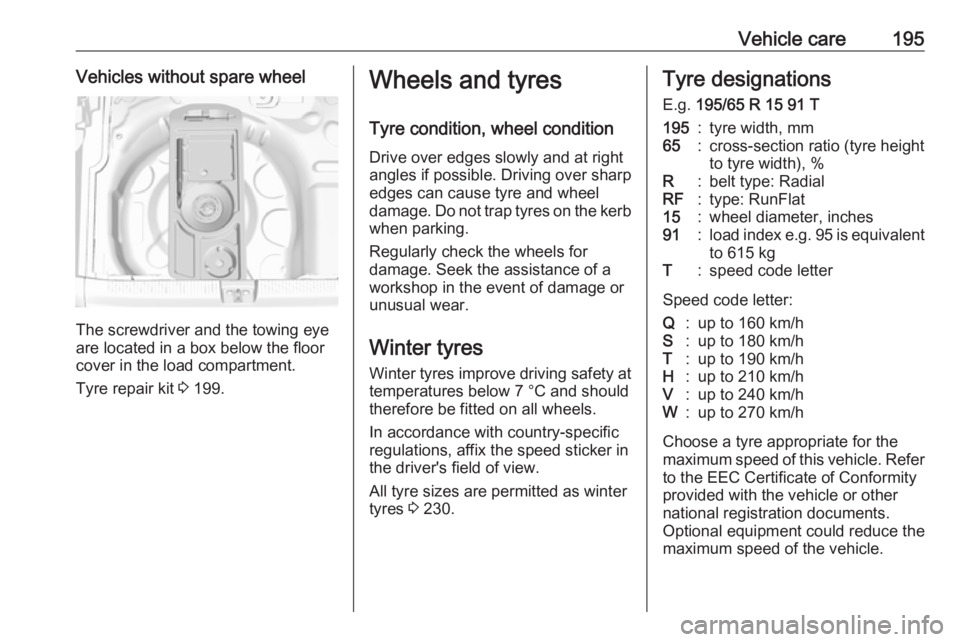
Vehicle care195Vehicles without spare wheel
The screwdriver and the towing eye
are located in a box below the floor
cover in the load compartment.
Tyre repair kit 3 199.
Wheels and tyres
Tyre condition, wheel condition Drive over edges slowly and at right
angles if possible. Driving over sharp
edges can cause tyre and wheel
damage. Do not trap tyres on the kerb when parking.
Regularly check the wheels for
damage. Seek the assistance of a
workshop in the event of damage or
unusual wear.
Winter tyres
Winter tyres improve driving safety at temperatures below 7 °C and shouldtherefore be fitted on all wheels.
In accordance with country-specific
regulations, affix the speed sticker in
the driver's field of view.
All tyre sizes are permitted as winter
tyres 3 230.Tyre designations
E.g. 195/65 R 15 91 T195:tyre width, mm65:cross-section ratio (tyre height
to tyre width), %R:belt type: RadialRF:type: RunFlat15:wheel diameter, inches91:load index e.g. 95 is equivalent
to 615 kgT:speed code letter
Speed code letter:
Q:up to 160 km/hS:up to 180 km/hT:up to 190 km/hH:up to 210 km/hV:up to 240 km/hW:up to 270 km/h
Choose a tyre appropriate for the
maximum speed of this vehicle. Refer to the EEC Certificate of Conformity
provided with the vehicle or other
national registration documents.
Optional equipment could reduce the
maximum speed of the vehicle.
Page 214 of 253
212Vehicle careIce residues, pollution and continuouswiping on dry windows will damage or
even destroy the wiper blades.
Glass panel
Never clean with solvents or abrasive agents, fuels, aggressive media
(e.g. paint cleaner, acetone-
containing solutions etc.), acidic or
highly alkaline media or abrasive
pads.
Wheels and tyres Do not use high-pressure jet
cleaners.
Clean rims with a pH-neutral wheel
cleaner.
Rims are painted and can be treated
with the same agents as the body.
Paintwork damage Rectify minor paintwork damage witha touch-up pen before rust forms.
Have more extensive damage or rust areas repaired by a workshop.Underbody
Some areas of the vehicle underbody
have a PVC undercoating while other critical areas have a durable
protective wax coating.
After the underbody is washed, check
the underbody and have it waxed if
necessary.
Bitumen / rubber materials could damage the PVC coating. Have
underbody work carried out by a
workshop.
Before and after winter, wash the
underbody and have the protective
wax coating checked.
Towing equipment
Do not clean the coupling ball bar with a steam-jet or high-pressure jet
cleaner.Interior care
Interior and upholstery Only clean the vehicle interior,
including the instrument panel fascia
and panelling, with a dry cloth or
interior cleaner.
Clean the leather upholstery with
clear water and a soft cloth. In case of
heavy soiling, use leather care.
The instrument cluster and the
displays should only be cleaned using
a soft damp cloth. If necessary use a weak soap solution.
Clean fabric upholstery with a
vacuum cleaner and brush. Remove
stains with an upholstery cleaner.
Clothing fabrics may not be
colourfast. This could cause visible
discolourations, especially on light-
coloured upholstery. Removable
stains and discolourations should be
cleaned as soon as possible.
Clean seat belts with lukewarm water or interior cleaner.
Page 215 of 253
Vehicle care213Caution
Close Velcro fasteners as open
Velcro fasteners on clothing could damage seat upholstery.
The same applies to clothing with
sharp-edged objects, like zips or
belts or studded jeans.
Plastic and rubber parts
Plastic and rubber parts can be
cleaned with the same cleaner as
used to clean the body. Use interior cleaner if necessary. Do not use any
other agent. Avoid solvents and petrol in particular. Do not use high-
pressure jet cleaners.
Floor mats
9 Warning
If a floor mat has the wrong size or
is not properly installed, it can
interfere with the accelerator pedal
and/or brake pedal, what can
cause unintended acceleration
and/or increased stopping
distance which can cause a crash and injury.
Use the following guidelines for
proper floor mat usage.
● The original equipped floor mats were designed for your vehicle.
Have damaged floor mats only replaced by certified floor mats.
Always check that the floor mats
do not interfere with the pedals.
● Use the floor mat with the correct
side up. Do not turn it over.
● Do not place anything on top of the driver's side floor mat.
● Use only a single floor mat on the
driver's side.
Installing and removing the floor
mats
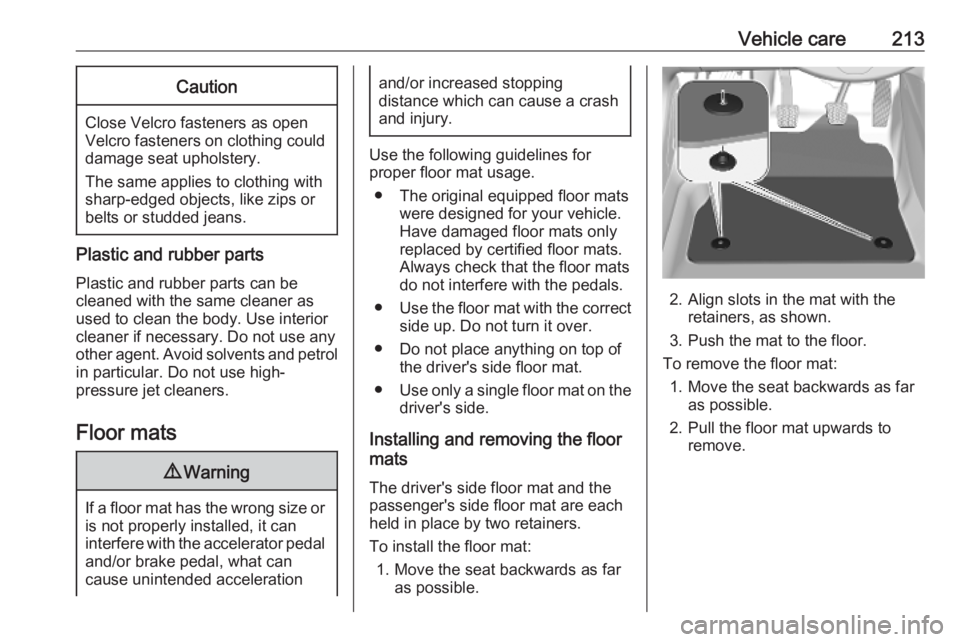
The driver's side floor mat and the
passenger's side floor mat are each
held in place by two retainers.
To install the floor mat: 1. Move the seat backwards as far as possible.
2. Align slots in the mat with the retainers, as shown.
3. Push the mat to the floor.
To remove the floor mat: 1. Move the seat backwards as far as possible.
2. Pull the floor mat upwards to remove.
Page 243 of 253
Customer information241Legal requirements for
information disclosure
Insofar as regulatory requirements
exist, manufacturers are strictly
bound to release data stored by the
manufacturer in individual cases to
the extent requested following a
request by state bodies (e.g. during
criminal investigations).
Government agencies are also
authorised, in the context of
applicable law, to read data in
individual cases from vehicles
themselves. Thus information that
may help with the investigation
resolution can possibly be read from
the airbag control unit in the event of
an accident.
Operating data in the vehicle Control units process data for
operation of the vehicle.This data includes, for example:
● vehicle status information (e.g. speed, movement delay, lateral
acceleration, wheel rotation rate, "seat belts fastened" display)
● ambient conditions (e.g. temperature, rain sensor,
distance sensor)
As a rule such data is transient and is
not stored for longer than an
operational cycle, and only processed
on board the vehicle itself. Often
control units include data storage
(including the vehicle key). This is
used to allow information to be
documented temporarily or
permanently on vehicle condition,
component stress, maintenance
requirements and technical events
and errors.
Depending on technical equipment
levels, the data stored is as follows:
● system component operating states (e.g. fill level, tyre
pressure, battery status)
● faults and defects in important system components (e.g. lights,brakes)● system reactions in special driving situations (e.g. triggering
of an airbag, actuation of the
stability control systems)
● information on events damaging the vehicle
● for electric vehicles the amount of
charge in the high-voltage
battery, estimated range
In special cases (e.g. if the vehicle
has detected a malfunction), it may be
necessary to save data that would
otherwise just be volatile.
When you use services (e.g. repairs,
maintenance), the operating data
saved can be read together with the
vehicle identification number and
used where necessary. Staff working
for the service network ( e.g. garages,
manufacturers) or third parties (e.g.
breakdown services) can read the
data from the vehicle. The same
applies to warranty work and quality
assurance measures.
Data is generally read via the OBD
(On-Board Diagnostics) port
prescribed by law in the vehicle. The operating data read documents the
technical condition of the vehicle or
Page 248 of 253
246IndexAAccessories and vehicle modifications .......................... 174
Active emergency braking ....87, 147
AdBlue .......................... 85, 130, 230
Adjustable air vents ...................118
Advanced parking assist ............153
Airbag and belt tensioners ...........82
Airbag deactivation ................54, 82
Airbag label................................... 49 Airbag system .............................. 49
Air conditioning regular operation ................................ 119
Air conditioning system .............. 110
Air intake .................................... 119
Air vents...................................... 118
Antilock brake system ................ 137
Antilock brake system (ABS) .......84
Anti-theft alarm system ................31
Anti-theft locking system .............. 30 Appearance care ........................210
Armrest ............................. 44, 45, 62
Ashtrays ....................................... 76
Automatic anti-dazzle ..................35
Automatic crash notification (ACN) 98
Automatic light control ...............101
Automatic locking ........................28
Automatic transmission .............133
Autostop ............................... 86, 126
Auxiliary heater ........................... 117B
Battery discharge protection ......108
Belts.............................................. 46
BlueInjection ............................... 130
Bonnet ....................................... 176
Brake and clutch system .............83
Brake assist ............................... 139
Brake fluid .......................... 179, 219
Brake light................................... 185
Brakes ............................... 137, 179
Breakdown.................................. 208
Bulb replacement ....................... 182
C Capacities .................................. 230
Catalytic converter .....................130
Central locking system ................23
Centre console lighting ..............107
Centre console storage ...............62
Changing tyre and wheel size ...198
Charging system .......................... 82
Child locks ................................... 28
Child restraint installation locations ................................... 58
Child restraints.............................. 55
Child restraint systems ................55
Cigarette lighter ........................... 76
Climate control ............................. 15
Climate control systems .............109
Clock............................................. 74
Page 251 of 253
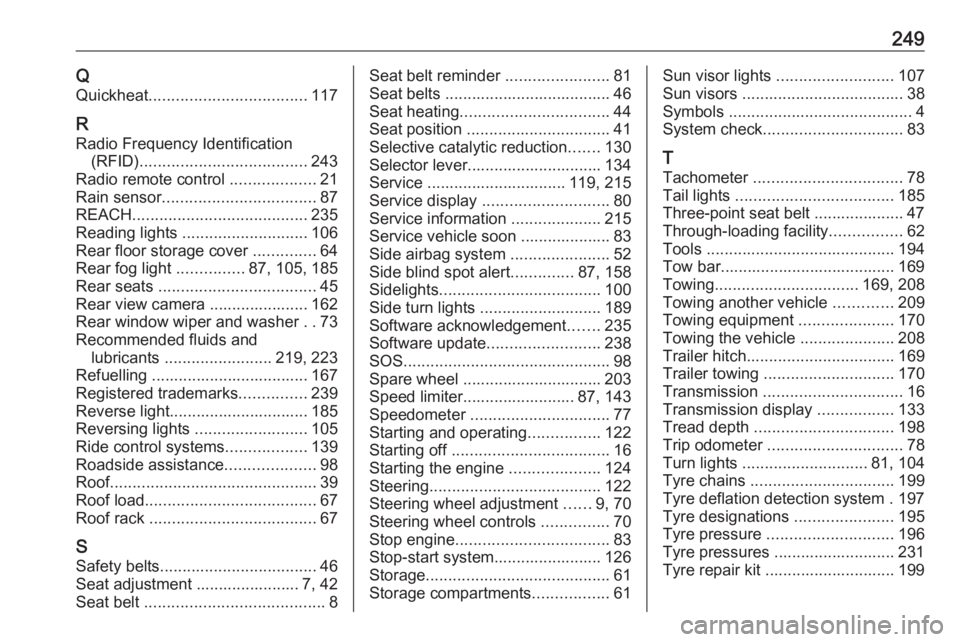
249QQuickheat ................................... 117
R
Radio Frequency Identification (RFID) ..................................... 243
Radio remote control ...................21
Rain sensor .................................. 87
REACH ....................................... 235
Reading lights ............................ 106
Rear floor storage cover ..............64
Rear fog light ...............87, 105, 185
Rear seats ................................... 45
Rear view camera ...................... 162
Rear window wiper and washer ..73
Recommended fluids and lubricants ........................ 219, 223
Refuelling ................................... 167
Registered trademarks ...............239
Reverse light............................... 185
Reversing lights .........................105
Ride control systems ..................139
Roadside assistance ....................98
Roof .............................................. 39
Roof load ...................................... 67
Roof rack ..................................... 67
S Safety belts ................................... 46
Seat adjustment ....................... 7, 42
Seat belt ........................................ 8Seat belt reminder .......................81
Seat belts ..................................... 46
Seat heating ................................. 44
Seat position ................................ 41
Selective catalytic reduction .......130
Selector lever.............................. 134
Service ............................... 119, 215
Service display ............................ 80
Service information ....................215
Service vehicle soon .................... 83
Side airbag system ......................52
Side blind spot alert ..............87, 158
Sidelights .................................... 100
Side turn lights ........................... 189
Software acknowledgement .......235
Software update ......................... 238
SOS .............................................. 98
Spare wheel ............................... 203
Speed limiter......................... 87, 143
Speedometer ............................... 77
Starting and operating ................122
Starting off ................................... 16
Starting the engine ....................124
Steering ...................................... 122
Steering wheel adjustment ......9, 70
Steering wheel controls ...............70
Stop engine .................................. 83
Stop-start system........................ 126
Storage ......................................... 61
Storage compartments .................61Sun visor lights .......................... 107
Sun visors .................................... 38
Symbols ......................................... 4
System check ............................... 83
T
Tachometer ................................. 78
Tail lights ................................... 185
Three-point seat belt .................... 47
Through-loading facility ................62
Tools .......................................... 194
Tow bar....................................... 169
Towing ................................ 169, 208
Towing another vehicle .............209
Towing equipment .....................170
Towing the vehicle .....................208
Trailer hitch ................................. 169
Trailer towing ............................. 170
Transmission ............................... 16
Transmission display .................133
Tread depth ............................... 198
Trip odometer .............................. 78
Turn lights ............................ 81, 104
Tyre chains ................................ 199
Tyre deflation detection system . 197
Tyre designations ......................195
Tyre pressure ............................ 196
Tyre pressures ........................... 231
Tyre repair kit ............................. 199