temperature OPEL GRANDLAND X 2018 Infotainment system
[x] Cancel search | Manufacturer: OPEL, Model Year: 2018, Model line: GRANDLAND X, Model: OPEL GRANDLAND X 2018Pages: 265, PDF Size: 7.5 MB
Page 221 of 265
Vehicle care219The tyre pressure information label
on the left door frame indicates the
original equipment tyres and the
correspondent tyre pressures.
The tyre pressure data refers to cold
tyres. It applies to summer and winter
tyres.
Always inflate the spare tyre to the
pressure specified for full load.
The ECO tyre pressure serves to
achieve the smallest amount of fuel
consumption possible.
Incorrect tyre pressures will impair
safety, vehicle handling, comfort and fuel economy and will increase tyre
wear.
Tyre pressures differ depending on
various options. For the correct tyre
pressure value, follow the procedure
below:
1. Identify the engine identifier code.
Engine data 3 245.
2. Identify the respective tyre.
The tyre pressure tables show all
possible tyre combinations 3 250.For the tyres approved for your
vehicle, refer to the EEC Certificate of
Conformity provided with your vehicle or other national registration
documents.
The driver is responsible for correct
adjustment of tyre pressure.9 Warning
If the pressure is too low, this can
result in considerable tyre warm-
up and internal damage, leading to tread separation and even to tyre
blow-out at high speeds.
9 Warning
For specific tyres the
recommended tyre pressure as
shown in the tyre pressure table may exceed the maximum tyre
pressure as indicated on the tyre.
Never exceed the maximum tyre
pressure as indicated on the tyre.
Temperature dependency
The tyre pressure depends on the
temperature of the tyre. During
driving, tyre temperature and
pressure increase. Tyre pressure
values provided on the tyre
information label and tyre pressure
chart are valid for cold tyres, which means at 20 °C.
The pressure increases by nearly
10 kPa for a 10 °C temperature
increase. This must be considered
when warm tyres are checked.
The tyre pressure value displayed in
the Driver Information Centre shows
the real tyre pressure. A cooled down
tyre will show a decreased value,
which does not indicate an air leak.
Tyre deflation detectionsystem
The tyre deflation detection system continually checks the rotation speed
of all four wheels and warns on low
tyre pressure condition once vehicle
is driving. This is achieved by
comparing tyre rolling circumference
with reference values.
Page 231 of 265
Vehicle care229
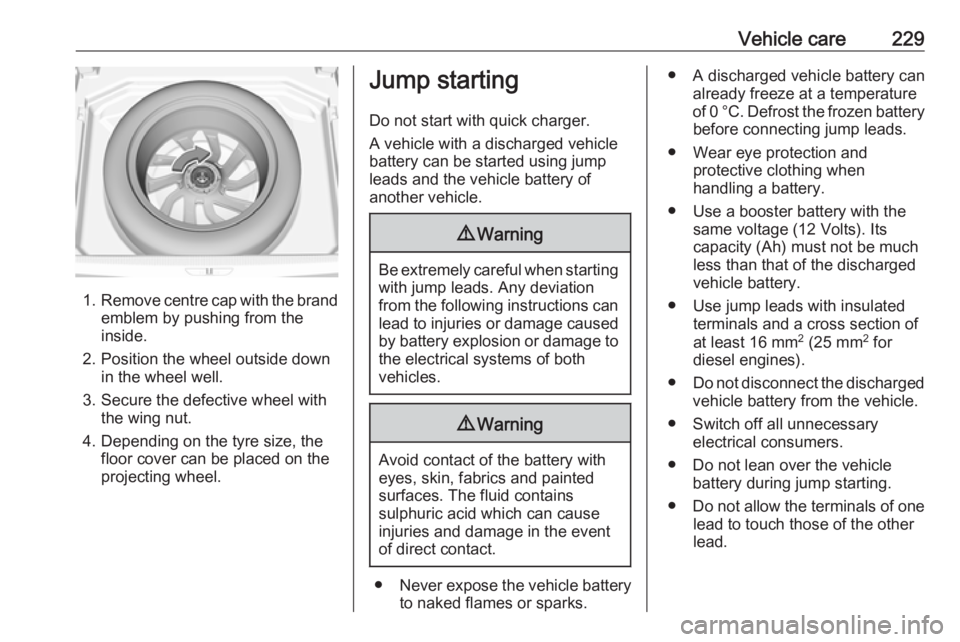
1.Remove centre cap with the brand
emblem by pushing from the
inside.
2. Position the wheel outside down in the wheel well.
3. Secure the defective wheel with the wing nut.
4. Depending on the tyre size, the floor cover can be placed on the
projecting wheel.
Jump starting
Do not start with quick charger.
A vehicle with a discharged vehicle
battery can be started using jump
leads and the vehicle battery of
another vehicle.9 Warning
Be extremely careful when starting
with jump leads. Any deviation
from the following instructions can
lead to injuries or damage caused
by battery explosion or damage to the electrical systems of both
vehicles.
9 Warning
Avoid contact of the battery with
eyes, skin, fabrics and painted
surfaces. The fluid contains
sulphuric acid which can cause
injuries and damage in the event
of direct contact.
● Never expose the vehicle battery
to naked flames or sparks.
● A discharged vehicle battery can already freeze at a temperature
of 0 °C. Defrost the frozen battery before connecting jump leads.
● Wear eye protection and protective clothing when
handling a battery.
● Use a booster battery with the same voltage (12 Volts). Its
capacity (Ah) must not be much less than that of the discharged
vehicle battery.
● Use jump leads with insulated terminals and a cross section of
at least 16 mm 2
(25 mm 2
for
diesel engines).
● Do not disconnect the discharged
vehicle battery from the vehicle.
● Switch off all unnecessary electrical consumers.
● Do not lean over the vehicle battery during jump starting.
● Do not allow the terminals of one
lead to touch those of the other
lead.
Page 236 of 265
234Vehicle careUnderbody
Some areas of the vehicle underbody
have a PVC undercoating while other critical areas have a durable
protective wax coating.
After the underbody is washed, check
the underbody and have it waxed if
necessary.
Bitumen/rubber materials could
damage the PVC coating. Have
underbody work carried out by a
workshop.
Before and after winter, wash the
underbody and have the protective
wax coating checked.
Liquid gas system9 Danger
Liquid gas is heavier than air and
can collect in sink points.
Take care when performing work
at the underbody in a pit.
For painting work and when using a
drying booth at a temperature above
60 °C, the liquid gas tank must be
removed.
Do not make any modifications to the
liquid gas system.
Towing equipment
Do not clean the coupling ball bar with a steam-jet or high-pressure jet
cleaner.
Interior care
Interior and upholstery
Only clean the vehicle interior,
including the instrument panel fascia
and panelling, with a dry cloth or
interior cleaner.
Clean the leather upholstery with
clear water and a soft cloth. In case of heavy soiling, use leather care.
The instrument cluster and the
displays should only be cleaned using
a soft damp cloth. If necessary use a
weak soap solution.Clean fabric upholstery with a
vacuum cleaner and brush. Remove
stains with an upholstery cleaner.
Clothing fabrics may not be
colourfast. This could cause visible
discolourations, especially on light-
coloured upholstery. Removable
stains and discolourations should be
cleaned as soon as possible.
Clean seat belts with lukewarm water or interior cleaner.Caution
Close Velcro fasteners as open
Velcro fasteners on clothing could
damage seat upholstery.
The same applies to clothing with
sharp-edged objects, like zips or
belts or studded jeans.
Page 238 of 265
236Service and maintenanceService and
maintenanceGeneral information ...................236
Service information ..................236
Recommended fluids, lubricants
and parts .................................... 237
Recommended fluids and lubricants ................................ 237General information
Service information In order to ensure economical and
safe vehicle operation and to
maintain the value of your vehicle, it
is of vital importance that all
maintenance work is carried out at the proper intervals as specified.
The detailed, up-to-date service
schedule for your vehicle is available
at the workshop.
Severe operating conditions exist if one or more of the following
circumstances occur frequently: Cold
starting, stop and go operation, e.g.
for taxis and police vehicles, trailer
operation, mountain driving, driving
on poor and sandy road surfaces,
increased air pollution, presence of
airborne sand and high dust content,
driving at high altitude and large
variations of temperature.
Under these severe operating
conditions, certain service work may
be required more frequently than the
regular service interval indicated inthe service display. Contact a
workshop for customised service
schedules.
Service display 3 93.
Service intervals - country group 1 Maintenance of your vehicle is
required every 25,000 km or after one
year, whichever occurs first, unless
otherwise indicated in the service
display.
These service intervals are valid for
the following countries:
Andorra, Austria, Belgium, Cyprus,
Denmark, Finland, France, Germany, Greece, Iceland, Ireland, Italy,
Liechtenstein, Luxembourg, Malta,
Monaco, Netherlands, Norway,
Portugal, San Marino, Spain,
Sweden, Switzerland, United
Kingdom.
Service intervals - country group 2
Maintenance of your vehicle is
required every 15,000 km or after one year, whichever occurs first, unless
otherwise indicated in the service
display.
Page 239 of 265
Service and maintenance237These service intervals are valid for
the following countries:
Albania, Estonia, Latvia, Lithuania,
Macedonia, Montenegro, Poland, Serbia, Slovenia.
Service intervals - country group 3 Maintenance of your vehicle
equipped with engine EB2DTS is
required every 10,000 km or after one year, whichever occurs first, unless
otherwise indicated in the service
display. Maintenance of your vehicle
with any other engine than mentioned
before is required every 15,000 km or after one year, whichever occurs first,
unless otherwise indicated in the
service display.
These service intervals are valid for
the following countries:
Bosnia-Herzegovina, Bulgaria,
Croatia, Czech Republic, Hungary,
Romania, Slovakia.Service intervals - country group 4
Maintenance of your vehicle is
required every 10,000 km or after one year, whichever occurs first, unless
otherwise indicated in the service
display.
These service intervals are valid for
the countries which are not listed in
country group 1, 2 or 3.
Confirmations
Confirmation of service is recorded in the Service and warranty booklet.
The date and mileage is completed
with the stamp and signature of the
servicing workshop.
Make sure that the Service and
warranty booklet is completed
correctly as continuous proof of
service is essential if any warranty or
goodwill claims are to be met, and is
also a benefit when selling the
vehicle.Recommended fluids,
lubricants and parts
Recommended fluids andlubricants
Only use products that meet the
recommended specifications.9 Warning
Operating materials are
hazardous and could be
poisonous. Handle with care. Pay
attention to information given on
the containers.
Engine oil
Engine oil is identified by its quality
and its viscosity. Quality is more
important than viscosity when
selecting which engine oil to use. The oil quality ensures e.g. engine
cleanliness, wear protection and oil
aging control, whereas viscosity
grade gives information on the oil's
thickness over a temperature range.
Page 240 of 265
238Service and maintenanceDexos is the newest engine oil quality
that provides optimum protection for
petrol and diesel engines. If it is
unavailable, engine oils of other listed qualities must be used.
Recommendations for petrol engines
are also valid for Compressed Natural
Gas (CNG), Liquified Petroleum Gas
(LPG) and Ethanol (E85) fuelled
engines.
Select the appropriate engine oil based on its quality and on the
minimum ambient temperature
3 242.
Topping up engine oilCaution
In case of any spilled oil, wipe it up and dispose it properly.
Engine oils of different manufacturersand brands can be mixed as long as
they comply with the required engine
oil quality and viscosity.
Use of engine oils for all petrol
engines with only ACEA quality is
prohibited, since it can cause engine
damage under certain operating
conditions.
Select the appropriate engine oil
based on its quality and on the
minimum ambient temperature
3 242.
Additional engine oil additives
The use of additional engine oil
additives could cause damage and
invalidate the warranty.
Engine oil viscosity grades
The SAE viscosity grade gives
information of the thickness of the oil.
Multigrade oil is indicated by two
figures, e.g. SAE 5W-30. The first
figure, followed by a W, indicates the
low temperature viscosity and the
second figure the high temperature viscosity.
Select the appropriate viscosity grade depending on the minimum ambient
temperature 3 242.All of the recommended viscosity
grades are suitable for high ambient
temperatures.
Coolant and antifreeze
Use only organic acid type-long life
coolant (LLC) antifreeze approved for
the vehicle. Consult a workshop.
The system is factory filled with
coolant designed for excellent
corrosion protection and frost
protection down to approx. -28 °C. In
cold regions with very low
temperatures the factory filled coolant
provides frost protection down to
approx. -37 °C. This concentration
should be maintained all year round.
The use of additional coolant
additives that intend to give additional
corrosion protection or seal against
minor leaks can cause function
problems. Liability for consequences
resulting from the use of additional
coolant additives will be rejected.
Page 244 of 265
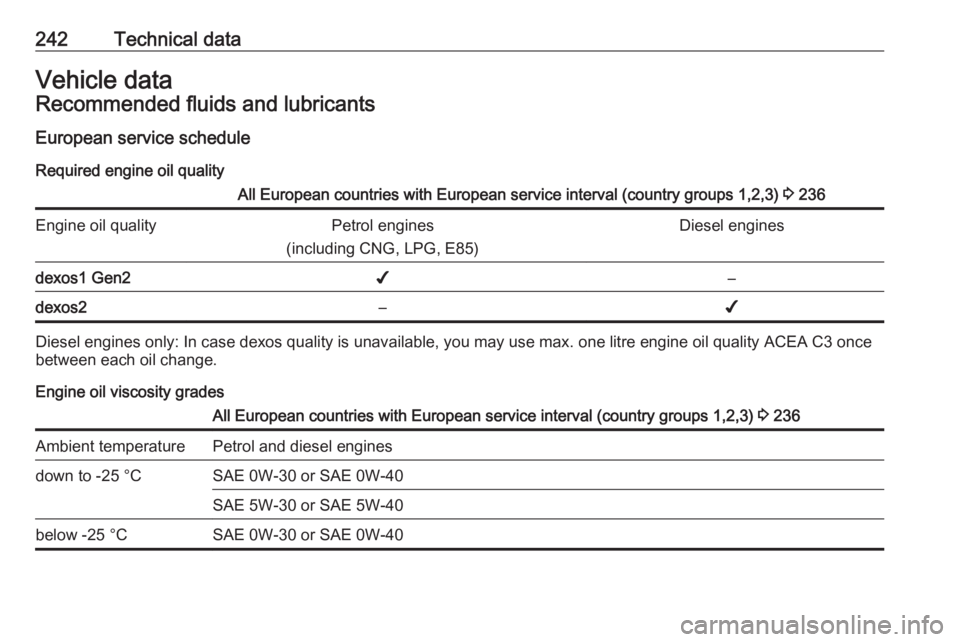
242Technical dataVehicle dataRecommended fluids and lubricantsEuropean service schedule Required engine oil qualityAll European countries with European service interval (country groups 1,2,3) 3 236Engine oil qualityPetrol engines
(including CNG, LPG, E85)Diesel enginesdexos1 Gen2✔–dexos2–✔
Diesel engines only: In case dexos quality is unavailable, you may use max. one litre engine oil quality ACEA C3 once
between each oil change.
Engine oil viscosity grades
All European countries with European service interval (country groups 1,2,3) 3 236Ambient temperaturePetrol and diesel enginesdown to -25 °CSAE 0W-30 or SAE 0W-40SAE 5W-30 or SAE 5W-40below -25 °CSAE 0W-30 or SAE 0W-40
Page 245 of 265
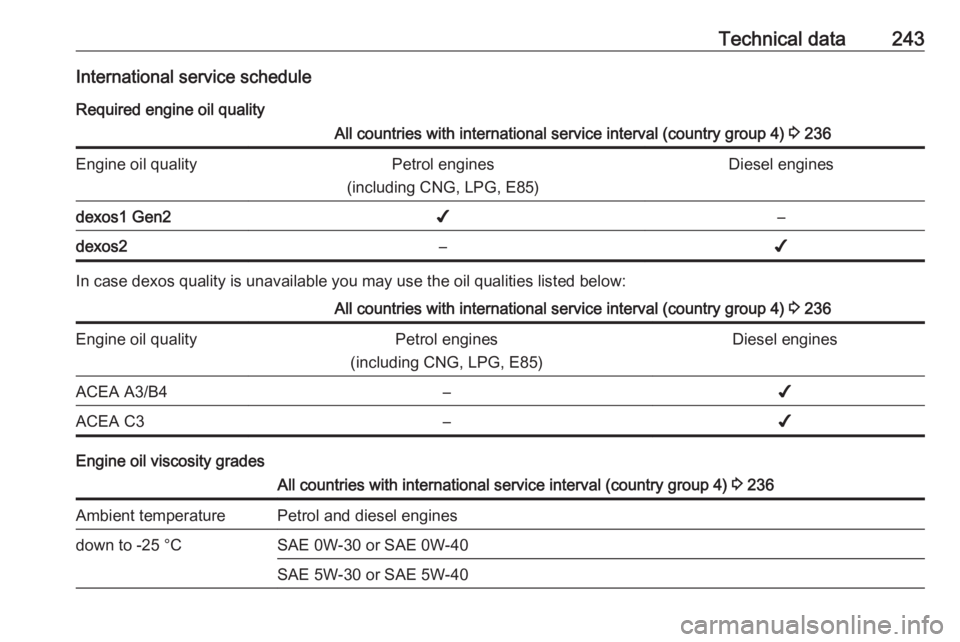
Technical data243International service scheduleRequired engine oil qualityAll countries with international service interval (country group 4) 3 236Engine oil qualityPetrol engines
(including CNG, LPG, E85)Diesel enginesdexos1 Gen2✔–dexos2–✔
In case dexos quality is unavailable you may use the oil qualities listed below:
All countries with international service interval (country group 4) 3 236Engine oil qualityPetrol engines
(including CNG, LPG, E85)Diesel enginesACEA A3/B4–✔ACEA C3–✔
Engine oil viscosity grades
All countries with international service interval (country group 4) 3 236Ambient temperaturePetrol and diesel enginesdown to -25 °CSAE 0W-30 or SAE 0W-40SAE 5W-30 or SAE 5W-40
Page 259 of 265
Customer information257● vehicle reactions in particulardriving situations ( e.g. inflation of
an airbag, activation of the
stability regulation system)
● environmental conditions (e.g. temperature)
These data are exclusively technical
and help identifying and correcting
errors as well as optimising vehicle
functions.
Motion profiles indicating travelled
routes cannot be created with these
data.
If services are used (e.g. repair
works, service processes, warranty
cases, quality assurance),
employees of the service network
(manufacturer included) are able to
read out this technical information
from the event and error data storage
modules applying special diagnostic
devices. If required, you will receive
further information at these
workshops. After an error has been
corrected, the data are deleted from
the error storage module or they are
constantly overwritten.When using the vehicle, situations
may occur in which these technical
data related to other information
(accident report, damages on the
vehicle, witness statements etc.) may
be associated with a specific person - possibly, with the assistance of an
expert.
Additional functions contractually
agreed upon with the client (e.g.
vehicle location in emergency cases)
allow the transmission of particular
vehicle data from the vehicle.
Radio Frequency
Identification (RFID)
RFID technology is used in some
vehicles for functions such as tyre
pressure monitoring and ignition
system security. It is also used in
connection with conveniences such
as radio remote controls for door
locking/unlocking and starting, and in-
vehicle transmitters for garage door
openers. RFID technology in Opel
vehicles does not use or record
personal information or link with any
other Opel system containing
personal information.
Page 261 of 265
259Climate control systems.............125
Clock............................................. 85
Collision damage repair ..............253
Control indicators.......................... 94
Control of the vehicle .................136
Controls ........................................ 81
Convex shape .............................. 39
Coolant and antifreeze ...............237
Cruise control ....................101, 159
Cupholders .................................. 70
Curtain airbag system .................. 61
Curve lighting.............................. 117
D Danger, Warnings and Cautions ...4
Daytime running lights ...............117
Declaration of conformity ............251
DEF ............................................ 145
Deflation detection system ...........99
Diesel exhaust fluid ....................145
Diesel fuel system bleeding .......210
Diesel particle filter ...............99, 144
Door open .................................. 101
Doors ............................................ 31
Driver alert .................................. 193
Driver assistance systems ..........159
Driver Information Centre ...........101
Driving characteristics and towing tips .............................. 198
Driving hints ................................ 136E
Electric adjustment ......................39
Electric parking brake ...97, 152, 153
Electric parking brake fault ...........97
Electronic climate control system 128
Electronic driving programmes ..150
Electronic key system ...................24
Electronic Stability Control and Traction Control system ....98, 155
End-of-life vehicle recovery .......205
Engine coolant ........................... 207
Engine coolant temperature ........98
Engine coolant temperature gauge ....................................... 93
Engine data ............................... 245
Engine exhaust .......................... 144
Engine identification ...................241
Engine oil ................... 206, 237, 242
Engine oil pressure ......................99
Entry lighting .............................. 123
Event data recorders ..................256
Exit lighting ................................ 124
Exterior care .............................. 232
Exterior light ............................... 100
Exterior lighting ....................13, 114
Exterior mirrors ............................. 39
F Fault ........................................... 150
First aid ......................................... 77First aid kit ................................... 77
Fixed air vents ........................... 134
Fog light ..................................... 100
Fog lights ................................... 212
Folding mirrors ............................. 39
Forward collision alert................. 170
Front airbag system .....................60
Front fog lights ........................... 121
Front pedestrian protection ........175
Front seats.................................... 47
Fuel............................................. 194
Fuel consumption - CO 2-
Emissions ............................... 197
Fuel for diesel engines ..............195
Fuel for petrol engines ...............194
Fuel gauge ................................... 93
G
Gauges ......................................... 91
Gear shifting ................................. 98
General information ...................198
Glass panel .................................. 44
Glovebox ..................................... 70
Glovebox cooler ......................... 134
H
Halogen headlights ....................211
Hazard warning flashers ............120
Headlight flash ........................... 116
Headlight range adjustment ......116
Headlights................................... 114