instrument panel OPEL GRANDLAND X 2020 Manual user
[x] Cancel search | Manufacturer: OPEL, Model Year: 2020, Model line: GRANDLAND X, Model: OPEL GRANDLAND X 2020Pages: 283, PDF Size: 22.19 MB
Page 194 of 283
192Driving and operatingAt speeds below 60 km/h the systemis inoperable.
Fault
In the event of a fault, C appears in
the instrument panel, accompanied
by a display message and a warning
chime. Contact a dealer or a qualified
workshop to have the system
checked.
System limitations The system performance may notoperate properly when:
● Vehicle speed is below 60 km/h.
● Windscreen is not clean or affected by foreign objects, e.g.
stickers.
● Driving on winding or hilly roads.
● During nighttime driving.
● Adverse environmental conditions like heavy rain, snow,
direct sunlight or shadows.
● The sensor in the windscreen is blocked by snow, ice, slush, mud,dirt, windscreen damage or
affected by foreign objects, e.g.
stickers.● The sun is shining directly into the camera lens.
● Close vehicles ahead.
● Driving on banked roads.
● Driving on road edges.
● Driving on roads with poor lane markings.
● Sudden lighting changes.
The system can not operate when no
lane marking is detected.
Lane keep assist
Lane keep assist helps to avoid
crashes due to unintentional lane
departures. The front camera
observes the lane markings between
which the vehicle is driving. If the
vehicle approaches a lane marking, the steering wheel is gently turned to
position the vehicle back into the lane. The driver will then notice a turning
movement of the steering wheel. Turn steering wheel in same direction, if
system steers not sufficient. Turn
steering wheel gently into opposite
direction, if lane change is intended.When the system steers to correct the trajectory of the vehicle, a flashes
yellow in the instrument cluster.
A warning message in the Driver
Information Centre accompanied by a
warning chime alerts the driver when
immediate driver´s action is required.
Unintended lane departure is not
assumed by the system when the turn lights are operated and during
20 seconds after turn lights have
been switched off.
Note
The system may be switched off if it
detects lanes which are too narrow,
too wide or too curved.
Following preconditions have to be
fullfilled:
● vehicle speed must be between 65 km/h and 180 km/h
● the driver must hold the steering wheel with both hands
● the change of trajectory is not accompanied by operation of theturn lights
● the Electronic Stability Control is activated and not in operation
Page 195 of 283
Driving and operating193● the vehicle is not connected to atrailer or an electric bicycle carrier
● normal driving behaviour (system
detects dynamic driving style, i.e.
pressure on the brake or
accelerator pedal)
● roads with poor lane markings
● no spare wheel is used
● the driver needs to be active during the correction
● the vehicle is not driven in a tight
corner
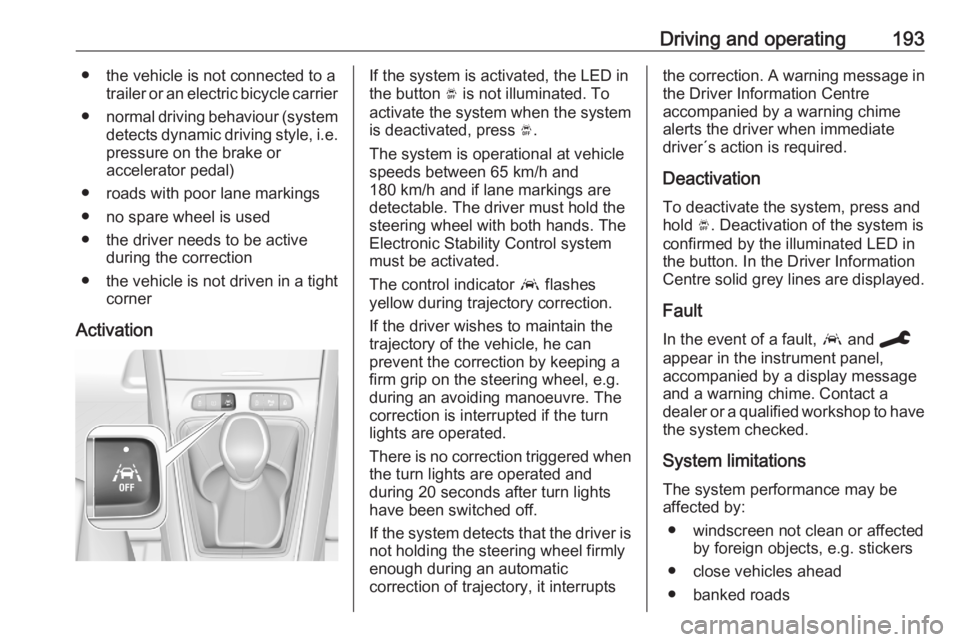
ActivationIf the system is activated, the LED in
the button Ó is not illuminated. To
activate the system when the system
is deactivated, press Ó.
The system is operational at vehicle
speeds between 65 km/h and
180 km/h and if lane markings are
detectable. The driver must hold the
steering wheel with both hands. The Electronic Stability Control system
must be activated.
The control indicator a flashes
yellow during trajectory correction.
If the driver wishes to maintain the
trajectory of the vehicle, he can
prevent the correction by keeping a
firm grip on the steering wheel, e.g.
during an avoiding manoeuvre. The correction is interrupted if the turn
lights are operated.
There is no correction triggered when
the turn lights are operated and
during 20 seconds after turn lights
have been switched off.
If the system detects that the driver is not holding the steering wheel firmly
enough during an automatic
correction of trajectory, it interruptsthe correction. A warning message in
the Driver Information Centre
accompanied by a warning chime
alerts the driver when immediate
driver´s action is required.
Deactivation
To deactivate the system, press and
hold Ó. Deactivation of the system is
confirmed by the illuminated LED in
the button. In the Driver Information
Centre solid grey lines are displayed.
Fault
In the event of a fault, a and C
appear in the instrument panel,
accompanied by a display message
and a warning chime. Contact a
dealer or a qualified workshop to have
the system checked.
System limitations
The system performance may be affected by:
● windscreen not clean or affected by foreign objects, e.g. stickers
● close vehicles ahead
● banked roads
Page 213 of 283
Vehicle care211Vehicle careGeneral Information...................211
Accessories and vehicle modifications .......................... 211
Vehicle storage ........................213
End-of-life vehicle recovery .....213
Vehicle checks ........................... 214
Performing work ......................214
Bonnet ..................................... 214
Engine oil ................................. 215
Engine coolant ......................... 216
Washer fluid ............................ 216
Brakes ..................................... 217
Brake fluid ............................... 217
Vehicle battery ......................... 217
Diesel fuel system bleeding .....219
Wiper blade replacement ........219
Bulb replacement .......................220
Halogen headlights ..................220
LED headlights ........................ 222
Front fog lights ......................... 222
Tail lights ................................. 222
Side turn lights ......................... 225
Number plate light ...................226
Interior lights ............................ 226Electrical system........................226
Fuses ....................................... 226
Engine compartment fuse box . 227
Instrument panel fuse box .......228
Vehicle tools .............................. 230
Tools ........................................ 230
Wheels and tyres .......................231
Winter tyres ............................. 231
Tyre designations ....................232
Tyre pressure .......................... 232
Tyre deflation detection system .................................... 233
Tread depth ............................. 234
Changing tyre and wheel size . 235
Wheel covers ........................... 235
Tyre chains .............................. 235
Tyre repair kit .......................... 236
Wheel changing .......................239
Spare wheel ............................ 240
Jump starting ............................. 244
Towing ....................................... 245
Towing the vehicle ...................245
Towing another vehicle ...........247
Appearance care .......................247
Exterior care ............................ 247
Interior care ............................. 249
Floor mats ............................... 250General Information
Accessories and vehicle modifications
We recommend the use of genuine parts and accessories and factory
approved parts specific for your
vehicle type. We cannot assess or
guarantee reliability of other products - even if they have a regulatory or
otherwise granted approval.
Any modification, conversion or other
changes made to standard vehicle
specifications (including, without
limitation, software modifications,
modifications of the electronic control units) may invalidate the warranty
offered by Opel. Furthermore, such
changes may affect driver assistance
systems, may impact fuel
consumption, CO 2 emissions and
other emissions of the vehicle and
cause the vehicle to no longer
conform to the operating permit,
impacting the validity of your vehicle
registration.
Page 228 of 283

226Vehicle care
2. Turn bulb socket clockwise andremove from light assembly.
3. Detach the bulb from the bulbsocket and replace the bulb.
4. Insert bulb socket and turnanticlockwise.
5. Insert left end of the light assembly, slide to the left and
insert right end.
Number plate light
Number plate lights are designed as LEDs and can not be changed.
Have lights repaired by a workshop in
case of failure.
Interior lights
Have the following bulbs replaced by
a workshop:
● courtesy light, reading lights
● load compartment light
● instrument panel illuminationElectrical system
Fuses Data on the replacement fuse mustmatch the data on the defective fuse.
There are two fuse boxes in the
vehicle:
● engine compartment
● instrument panel
Before replacing a fuse, turn off the
respective switch and the ignition.
A blown fuse can be recognised by its melted wire.Caution
Do not replace the fuse until the
cause of the fault has been
remedied.
Some functions are protected by
several fuses.
Fuses may also be inserted without
existence of a function.
Page 230 of 283

228Vehicle careNo.Circuit1Climate control2Steering wheel4Electric parking brake6Air vent16Front fog lights18Right high beam (Halogen) /
Right headlight (LED)19Left high beam (Halogen) /
Right headlight (LED)21StarterNo.Circuit22Heated windscreen26Additional Heater / Heated
windscreen
After having changed defective fuses,
close the fuse box cover and lock it.
If the fuse box cover is not closed
correctly, malfunction may occur.
Instrument panel fuse box
In left-hand drive vehicles, the fuse
box is behind a cover in the
instrument panel at the left side. Open
the cover and remove it by pressing
the lock.
In right-hand drive vehicles, the fuse
box is located behind a cover in the
glovebox. Open the glovebox and
remove the cover.
Depending on the version, different
instrument panel fuse boxes are
available:
Page 251 of 283
Vehicle care249Glass panelUse a soft lint-free cloth or chamoisleather together with window cleaner
to clean the glass panel.
Wheels and tyres Do not use high-pressure jet
cleaners.
Clean rims with a pH-neutral wheel
cleaner.
Rims are painted and can be treated
with the same agents as the body.
Paintwork damage Rectify minor paintwork damage witha touch-up pen before rust forms.
Have more extensive damage or rust areas repaired by a workshop.
Underbody
Some areas of the vehicle underbody
have a PVC undercoating while other critical areas have a durable
protective wax coating.
After the underbody is washed, check
the underbody and have it waxed if
necessary.Bitumen / rubber materials could
damage the PVC coating. Have
underbody work carried out by a
workshop.
Before and after winter, wash the
underbody and have the protective
wax coating checked.
Liquid gas system9 Danger
Liquid gas is heavier than air and
can collect in sink points.
Take care when performing work
at the underbody in a pit.
For painting work and when using a
drying booth at a temperature above
60 °C, the liquid gas tank must be
removed.
Do not make any modifications to the
liquid gas system.
Towing equipment
Do not clean the coupling ball bar with a steam-jet or high-pressure jet
cleaner.
Interior care
Interior and upholstery
Only clean the vehicle interior,
including the instrument panel fascia
and panelling, with a dry cloth or
interior cleaner.
Clean the leather upholstery with
clear water and a soft cloth. In case of heavy soiling, use leather care.
The instrument cluster and the
displays should only be cleaned using
a soft damp cloth. If necessary use a
weak soap solution.
Clean fabric upholstery with a
vacuum cleaner and brush. Remove
stains with an upholstery cleaner.
Clothing fabrics may not be
colourfast. This could cause visible
discolourations, especially on light-
coloured upholstery. Removable
stains and discolourations should be
cleaned as soon as possible.
Clean seat belts with lukewarm water or interior cleaner.
Page 259 of 283
Technical data257Technical dataVehicle identification..................257
Vehicle identification number ..257
Identification plate ...................257
Engine identification ................258
Vehicle data ............................... 259
Recommended fluids and lubricants ................................ 259
Engine data ............................. 261
Performance ............................ 264
Vehicle dimensions .................265
Capacities ................................ 266
Tyre pressures ........................ 267Vehicle identification
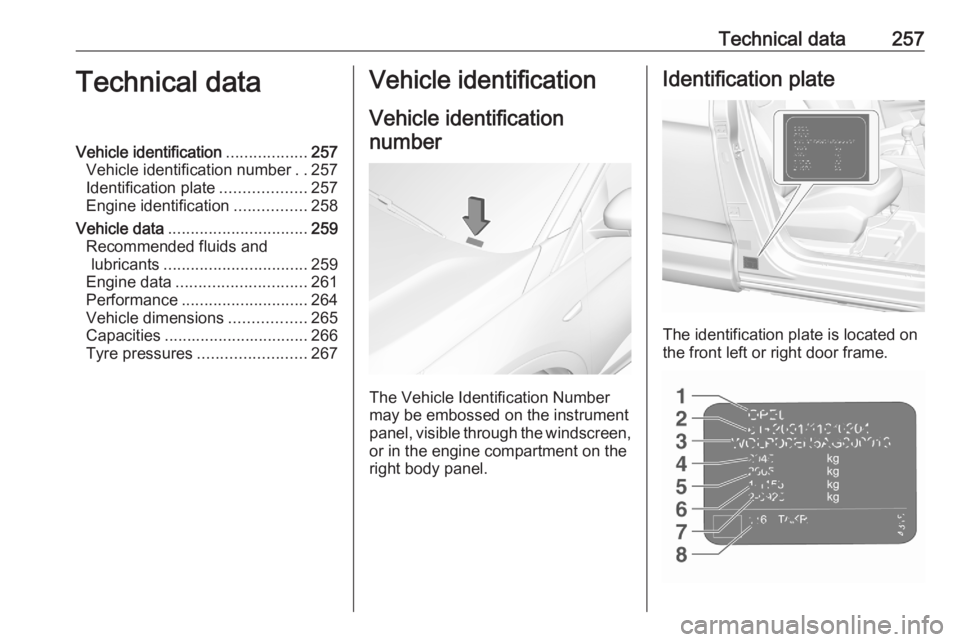
Vehicle identificationnumber
The Vehicle Identification Number
may be embossed on the instrument
panel, visible through the windscreen, or in the engine compartment on the
right body panel.
Identification plate
The identification plate is located on
the front left or right door frame.
Page 280 of 283
278Fuel gauge ................................... 91Fuses ......................................... 226
G
Gauges ......................................... 90
Gear selection ........................... 148
Gear shifting ................................. 97
General information ...................206
Glass panel .................................. 43
Glovebox ..................................... 69
Glovebox cooler ......................... 133
H Halogen headlights ....................220
Hazard warning flashers ............118
Headlight flash ........................... 114
Headlight range adjustment ......115
Headlights................................... 113
Headlights when driving abroad 115
Head restraint adjustment .............8
Head restraints ............................ 45
Heated mirrors ............................. 38
Heated rear window ..................... 41
Heated steering wheel .................81
Heated windscreen .......................42
Heating .................................. 51, 52
Heating and ventilation system . 123
High beam ......................... 100, 114
High beam assist ........................100
Hill start assist ........................... 156
Horn ....................................... 14, 81Hybrid system active....................96
Hybrid system fault .......................96
I Identification plate .....................257
Ignition switch positions .............135
Immobiliser .................................. 37
Indicators ...................................... 90
Inductive charging ........................87
Info Display ................................. 103
Instrument cluster ........................88
Instrument panel fuse box .........228
Instrument panel illumination control .................................... 120
Instrument panel overview ........... 10
Interior care ............................... 249
Interior lighting ............................ 120
Interior lights ...................... 121, 226
Interior mirrors .............................. 39
Interruption of power supply ......150
Introduction .................................... 3
J
Jump starting ............................. 244
K Keys ............................................. 21
Keys, locks ................................... 21L
Lane departure warning .......97, 191
Lane keep assist ..................97, 192
Lashing eyes ............................... 74
LED headlights ...........100, 115, 222
Lighting features .........................122
Light switch ................................ 113
Load compartment ................30, 70
Load compartment cover .............72
Loading information .....................77
Low beam ................................... 100
Low fuel ....................................... 99
M Malfunction indicator light ............95
Manual anti-dazzle ......................39
Manual mode ............................. 149
Manual seat adjustment ...............47
Manual transmission .................. 151
Mirror adjustment ........................... 9
Misted light covers .....................120
N
New vehicle running-in ..............135
Number plate light .....................226
O Object detection systems ...........177
Odometer ..................................... 90
Oil, engine .......................... 255, 259
Opel Connect.............................. 111