brake OPEL GT 2011 User Guide
[x] Cancel search | Manufacturer: OPEL, Model Year: 2011, Model line: GT, Model: OPEL GT 2011Pages: 190, PDF Size: 2.46 MB
Page 110 of 190

1 1 0 D r iv in g an d o p e ra t io n
Driving and operationD r iv in g h in t s
The first 1000 km (600 miles)
D ri v e y o ur v eh i cl e a t va r i o u s sp e ed s.
Do not use full throttle. Nev er allow
the e ngine to labour at low re vs .
Make good use of all ge ars . De pres s the
accele rator ped al a ma ximum of around
thre e quarters of the available p edal trave l
in all gea rs .
Do not d riv e faster than three quarte rs of
maximum spe ed .
D o no t b r a k e un n ec es sa r i l y ha rd f o r t he
first 200 km (120 miles).
Never coast w ith engine not running
Many units w ill not function in this situation
(e .g. brake se rvo unit, powe r ste ering).
Driv ing in this ma nne r is a dange r to
yo u rs e lf and o the rs.
Brake servo unit
When the engine is not running, the brake
servo unit is no longer effective once the
brake peda l has bee n depre ss e d once or
twice. Braking effe ct is not re duced , but
significantly gre ater force is re quired for
braking. Power steering
If th e po wer ste er in g f ails o r wh en be in g
towe d with the e ngine switched off, the
ve hicle c an still be s tee red, but
consid erably more force is required.
D riv ing in m ount ainous te rrain
The cooling fan is e lectrically op erate d.
Its cooling powe r is the refore inde pende nt
o f t h e en g i n e s p e ed.
S ince a c onsiderab le am ount of heat is
ge nerate d at high e ngine s pee ds and les s
at lowe r s pee ds, do not s hift down whe n
climb ing hills while the ve hic le is s till coping
with the gradient in the hig he r ge ar.
D riv ing wi th a roof loa d
N ot permitte d.
Sw itching off the engi ne
When y ou switch off the e ngine , fans in
the engine com partment m ay continue
running for a while , to c ool the engine .
If the engine te mpe rature is very high, e.g.
afte r driving in mountainous terrain, allow
the e ngine to idle for ap prox . 2 minutes , in
orde r to preve nt heat accumulation.
V eh i cl es w i t h t u r bo ch a r g ed en g i n e:
After running at high eng ine speeds or high
e ng ine loads, op erate the engine brie fly at
a low load or run in neutral for approx.
3 0 se c o n d s b ef o r e sw i t c h i n g o f f , i n o r d er
to protec t the turbocharger. D rivin g h in ts .... ..... .... ..... .... ..... .... .... ..... 11 0
Saving fuel, protecting the
en viro n men t . ..... .... ..... .... ..... .... .... ..... 11 2
F ue ls, ref u ellin g .... .... ..... .... ..... .... .... ..... 11 4
Ca ta lytic converter, exhaust g ases... 116
D rive co n tro l s ys tem s ... .... ..... .... .... ..... 11 8
Brake s ys te m ... ..... .... ..... .... ..... .... .... ..... 12 2
ABS u..... .... .... ..... .... ..... .... ..... .... .... ..... 12 4
W h ee ls , ty res ... ..... .... ..... .... ..... .... .... ..... 12 5
Page 112 of 190

1 1 2 D r iv in g an d o p e ra t io n
Sa ving fuel, p rotecting th e
environment
T re nd-s et ting te chnology
When dev eloping and manufac turing your
vehicle, Opel used environment-friendly
and prima rily recy clable materials . The
production methods used to ma ke your
vehicle are likewise environmenta lly-
compatible .
Recycling of production wastes keeps the
circulation of material clos ed. Re duction of
energy a nd water requirements a lso help s
to conserve natural resources.
T h e a dva n ced des i g n m a kes i t e a si e r
to dismantle the ve hicle at the end of
its se rvice life and s e parate m aterials
for recy cling .
Mate ria ls s uch as as bes tos and cadmium
a r e n ot us ed . T h e re f r i g er a n t i n t h e a i r
conditioning s ys tem is CF C-free .
Ne w painting te chnique s e mploy water
as a s olve nt. End-of-li fe v e hi cle rec ove ry
Information on end-of-life ve hicle recove ry
centres and the recy cling of end-of-life
vehicle s is av ailable at www.ope l.com.
Dr ive in an energy a nd environment-
consc ious w ay
zHigh fuel consumption, noise lev els and
exhaust em issions are often caused by a
driving s tyle that is not energy and
environment-conscious.
zYou should therefore drive with energy in
mind: "more kilometre s/ miles with le ss
fuel".
Reduce the noise level and exhaust
emissions b y adopting an environment-
consc ious driving s tyle. This is ex treme ly
worthwhile and im proves the quality of
life.
Fuel consum ption d epend s to a great
extent on your own personal d riv ing
style. The following hints are intended to
help you consume fuel at a rate that is as
clos e as poss ible to the spe cified le vels –
s ee page 1 77 .
C heck y our v ehicle’ s fuel consumption
e very time you refuel. This facilitates
e arly de tection of any irre gula ritie s
causing increased fuel consumption. Warm ing up
zFull throttle and w arming up at idle
speed increase w ear, fuel consumption,
ex haust em issions, the amount of
pollutant in the exhaust and the am ount
of noise.
zDriv e off as s oon as poss ible a fte r
st a r t i n g .
Uniform speed
zHectic driving s ignificantly increas e s fuel
consumption, the ex haust emissions, the
proportion of pollutant in the exhaust
g a s es a n d t h e no i s e l eve l .
zDo not accele rate a nd brake
unnecessarily . Drive at uniform speed.
Avoid frequent starting-off and
stopping, e.g. at traffic lights, in short
distance traffic and in que ue s of tra ffic,
by m eans of clev er planning. S ele ct
roa ds with good traffic flow.
I dling
zThe eng ine also consumes fuel when
idling .
zIf yo u h ave to wait f o r mo r e th an
1 minute , it is worthwhile s witching off
the e ng ine . F ive minute s of idling
corre s ponds to ap prox . 1 kilome tre
(0.6 m ile s) of driv ing .
Page 118 of 190

1 1 8 D r iv in g an d o p e ra t io n
Mai nt ena nc e
Hav e all maintenance work carried out
at the inte rvals specified by Ope l. W e
recom mend that y ou entrust this work
to your O pel Service Partner, who ha s
prope r equipme nt and trained pers onne l
ava ilab le. Elec tronic te sting s ys tems
pe rmit rapid dia gnos is and rem edy of
faults. This way you can b e certain that
all comp onents of the vehicle’s electric al,
injection and ignition sy ste ms operate
correctly , that your ve hicle has a low leve l
of pollutant e mission and that the c atalytic
converte r s yste m will hav e a long se rvice
life.
You are there by m aking an imp ortant
contrib ution towards kee ping the air cle an
and com plia nc e with e mis sions le gis lation.
The S ervice work include s te sting and
adjusting the fuel injection system and the
ignition system . F or this re ason, hav e a ll
Se rvice work carrie d out at the inte rv als
s p eci f i e d by Op e l ( se e ch a p t er " Ser v ic e,
Maintenance " on page 1 65 ).Drive co n trol systems
Ele ctronic Stab ility P rogram (E SP ) ,
Ele ctronic Stab ility Control (E SC)
Elec tronic S tability C ontrol (ES C) is a
component part of the Ele ctronic S tability
Program (ESP).
ESP im proves driving s tability w he n
ne ces s ary in any driving s ituation,
re gardle ss of the ty pe of road surface or
tyre g rip . It also pre vents the d riv e whe els
from spinning.
The system m onitors vehicle movements.
As soon as the ve hicle starts to swe rve
(understeers/oversteers) engine output is
re duce d (the s ound of the e ngine cha ng es )
and individual whe els are spe cifically
braked . This cons iderab ly improve s the
driving stability of the ve hicle on snow and
ice and on wet or s lippe ry road s urfa ces .E SP is ready for operation as s oon a s the
ignition is s witched on and control
indicator v goes out.
The E SP control proces s is disp la yed b y the
flashing of v.
The vehicle is now in a critical s itua tion;
E SP allows you to ke ep control of the
vehicle a nd reminds you to m atch your
spee d to the road conditions.
9 Wa r nin g
Do not le t this spe cial safety feature
tempt you into ta king risk s w he n driving.
Tra ffic safe ty can only b e ac hie ve d by
adopting a re spons ible d riv ing sty le .
Page 119 of 190
11 9Dr i vi ng and o pe r ati on
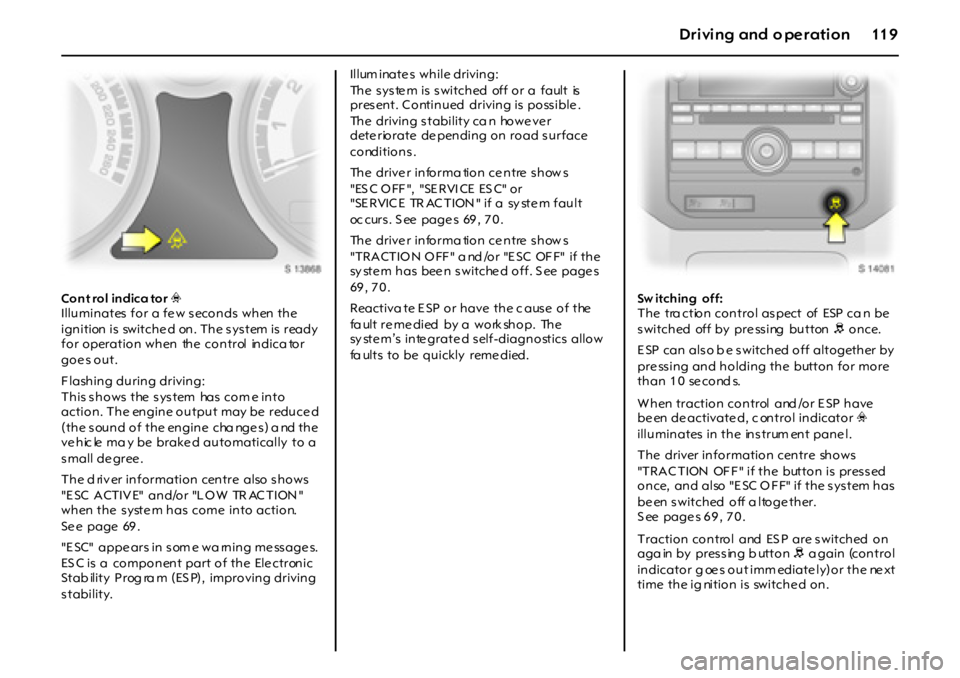
Con t rol in dica tor v
Illuminates for a few seconds when the
ignition is switche d on. The s ys tem is ready
for operation when the control indica tor
goe s out.
Flashing during driving:
This shows the system has com e into
action. The engine output may be reduce d
(the sound of the engine cha nges) a nd the
ve hic le ma y be brake d automatically to a
s mall de gree .
The d riv er information centre also s hows
"E SC A CT IV E" an d/o r "L O W TR AC T ION "
when the syste m has come into action.
Se e page 69 .
"E SC" appe ars in s om e wa rning me ss age s.
ES C is a component part of the Ele ctronic
Stab ility Prog ra m (ES P), improving driving
s tability.Illum inate s while driving:
The system is switched off or a fault is
pres ent. C ontinued driving is poss ible .
The driving s tability ca n howe ve r
dete riorate de pending on road s urface
conditions .
The drive r informa tion ce ntre s how s
"ES C O FF ", "SE RVI CE ES C" o r
"SE RVIC E TR AC T ION " if a sy ste m f au lt
oc curs . S ee page s 69 , 7 0 .
The drive r informa tion ce ntre s how s
"T RA CT IO N O FF " a nd /o r "E SC OF F" if th e
sy ste m has bee n s witche d off. S ee page s
69, 70.
Reactiva te E SP or have the c ause of the
fa ult re me died by a work shop. The
sy ste m’s inte grate d s elf-diagnostics allow
fa ults to be quickly reme died.Sw itching off:
The tra ction control as pect of ESP ca n be
switched off by pressing button R once.
E SP can als o b e s witched off altogether by
pre ss ing and holding the button for more
t h a n 1 0 se c o nd s.
W hen traction control and /or E SP have
be en de activate d, c ontrol indicator v
illuminates in the ins trum ent pane l.
T h e dr i ver i n f o r m a t i o n cen t r e sh o w s
"TRAC TION OF F " if the button is pressed
once, and also "ESC OFF" if the system has
be en s w i t ch ed o ff a l to g e t h er .
S ee page s 6 9 , 7 0 .
Traction control and ES P are s witched on
aga in by pres s ing b utton R a gain (control
indicator g oe s out imm ediate ly) or the ne xt
time the ig nition is switche d on.
Page 122 of 190

1 2 2 D r iv in g an d o p e ra t io n
Incr ease speed :
W i t h c r ui s e c o nt r o l a c t i v e, ho l d d o w n
button
8 or briefly pres s it repe atedly :
s pee d is incre as ed continuous ly or in ste ps
of 1.6 km/h (1 m ph) without using the
acce lerator pe dal.
W hen button
8 is released, the current
speed is stored and m aintained.
Alternative ly, use the acce lerator pe dal to
increase vehicle speed, press button
9
and rele ase it, then rele ase the acce lerator
pe dal.
W hen button
9 and the acce lerator
pe dal are rele ase d, the current s pee d is
s tore d and m ainta ine d.
Decrease speed:
W i t h c r ui s e c o nt r o l a c t i v e, ho l d d o w n
button
9 or brie fly pres s it rep eate dly:
s pee d is reduce d continuous ly or in s teps
of 1.6 km/h (1 m ph).
W hen button
9 is rele ased, the current
speed is stored and m aintained.
To dea ctiv ate :
Switch off cruis e control whe n not nee de d,
to avoid accid ental activa tion.
Pre ss button m: cruise control is s witched
off, the control indicator in the button goe s
out a nd the ve hicle s lowly d ece lerates .
To continue driv ing , de pres s the
accele rator ped al in the us ua l manner.
For re asons of safe ty, c ruise control
deactiv ates under ce rtain driving
conditions . F or exa mple:
zi f t h e veh i c l e ’s sp e ed d r o p s b el o w
approx . 3 0 km/ h (2 0 mph) or
zif the brake peda l is depre ss ed or
zif the clutch p edal is de pres s ed or
zif the Elec tronic S tability Program (E SP)
come s into a ction, to improve driving
s tability and lim it whee l spin.
Deactivating cruise control does not switch
of f t h e sy st e m .
Resumi ng the stored speed:
Brie fly pre ss button
8 at a spe ed above
30 k m /h ( 2 0 m p h ): s p ee d s el e c t ed b ef o r e
cruis e c ontrol was de activated is re sume d.
The value of the stored speed is deleted
w h en c r u i se c o n t r o l ha s b ee n sw i t c h e d o f f
by pre ss ing button m, and when the
ignition is turne d off.
Brake system
The effectiveness of the brakes is an
important factor for traffic sa fe ty.
To improve effectiveness, do not brake
unnecessarily hard for the first 200 k m
(120 mile s) a fte r new brake pads have
be en fitted .
Brake pad wea r must not e xce ed a
s pec ifie d limit. R egular ma inte na nce as
detailed in the chapter "Service,
Maintenance" on pag e 165 is therefore of
the utm os t importance for traffic safe ty.
Hav e w orn b ra ke p ads replace d by a
workshop. Pads which have be en te ste d
a n d a p p r o ved en s ur e o p t i m u m b ra ke
pe rforma nc e.
Brake pad s that hav e worn to their
minimum thickne ss ge nerate a grinding
noise . C ontinued driving is poss ible.
Hav e the brake pads re placed as soon
as pos sible by a works hop.
9 Warning
Disre gard of thes e ins truc tions may lead
to injuries or e ndanger live s .
Page 123 of 190
12 3Dr i vi ng and o pe r ati on
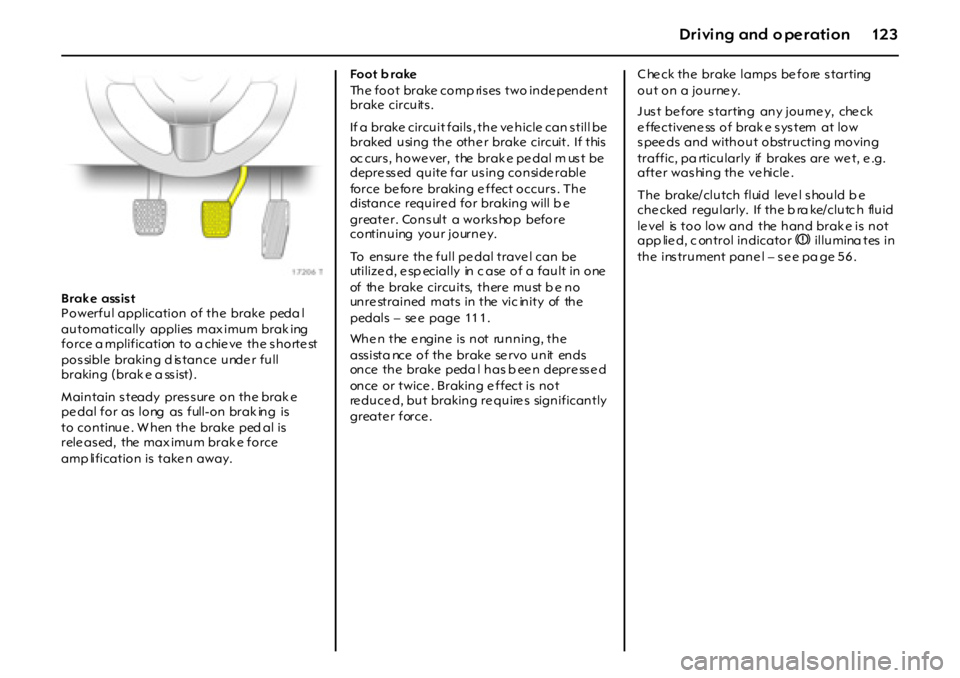
Brak e assist
Powerful application of the brake peda l
automatically applies max imum brak ing
force a mplification to a chie ve the s horte st
pos sible braking d is tance unde r full
braking (brak e a ss ist).
M a i n t a i n s t ea dy p r es s ur e o n t h e br a k e
pe dal for as long as full-on brak ing is
to continue . W hen the brake ped al is
rele as ed, the max imum brak e force
amp lification is take n away.Foot b rake
The foot brake comp rises two independent
brake circuits .
If a brake circuit fails , the ve hicle can s till be
braked using the othe r brake circuit. If this
oc curs , howe ver, the brak e pe dal m us t be
depre ss ed quite far us ing conside rable
force be fore braking e ffect occurs. The
distance require d for braking will b e
greate r. Consult a workshop before
continuing your journey.
To ensure the full pe dal trave l can be
utilize d, e sp ecially in c ase of a fault in one
of the brake circuits, there must be no
unre strained mats in the vic inity of the
pedals – se e page 11 1 .
When the engine is not running, the
a ss i st a nce o f t h e br a ke se r vo u n it en ds
once the brake peda l has b ee n depre ss e d
once or twice . Braking e ffect is not
re duce d, but braking re quire s significantly
greate r force .Check the brake lamps before starting
out on a journey.
Just before starting any journey, check
effectiveness of brak e system at low
s pee ds and without obstructing moving
traffic, pa rticularly if brakes are we t, e .g.
afte r was hing the ve hicle .
The brake/ clutch fluid leve l s hould b e
che cked regularly. If the b ra ke/clutc h fluid
level is too low and the hand brak e is not
app lie d, c ontrol indicatorR illumina tes in
the ins trument pane l – s e e pa ge 5 6 .
Page 124 of 190
1 2 4 D r iv in g an d o p e ra t io n
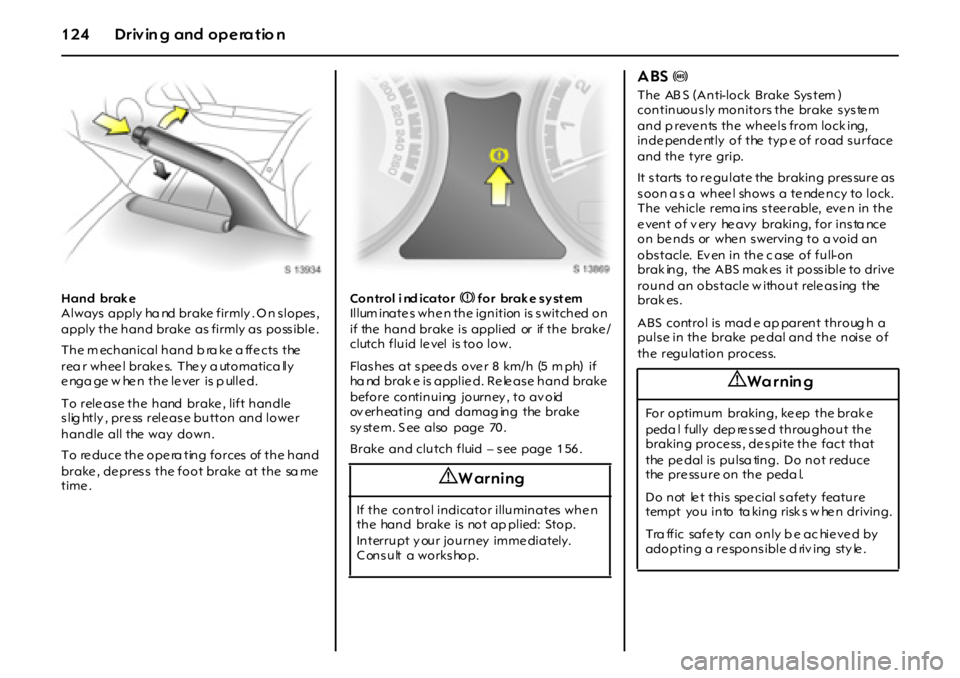
Hand brak e
Always apply ha nd brake firmly . O n s lopes ,
apply the hand brake as firmly as poss ible .
The m echanical hand b ra ke a ffe cts the
rea r wheel brakes. They a utomatica lly
enga ge w hen the lever is p ulled.
To release the hand brake, lift handle
s lig htly , pre ss rele as e button and lowe r
handle all the way down.
T o re du ce t h e o p e ra t in g f o r ces of t h e h a n d
brake , de pres s the foot brake at the sa me
time .Control i nd icator R f o r b r a k e s y st em
Illum inate s whe n the ignition is s witched on
if the hand brake is applied or if the brake/
clutch fluid le vel is too low.
Flas hes at s pee ds ove r 8 km/ h (5 m ph) if
ha nd brak e is applie d. Re le as e hand brake
b ef o r e c o nt i n u i ng j o ur n ey , t o a v o id
ov erheating and damag ing the brake
sy ste m. S ee also page 70 .
Brake and clutch fluid – s ee page 1 56 .
ABS u
T h e AB S ( A n ti-lo ck Brake Sys tem )
continuously monitors the brake system
a n d p r eve n ts t h e w h ee l s f r o m l o ck i ng ,
inde pende ntly of the typ e of road surface
and the tyre grip.
It s tarts to re gulate the braking pres sure as
soon a s a wheel shows a tendency to lock.
T h e veh i cl e r em a i ns s t ee r a bl e, eve n i n t h e
e vent of v ery he avy braking, for ins ta nce
on bends or when swerving to a void an
o bs t acl e. Ev en i n t h e c ase o f f u l l- o n
brak ing, the ABS mak es it poss ible to drive
round an obs tacle w ithout rele as ing the
brak es .
ABS control is mad e ap parent throug h a
puls e in the brake pe dal and the nois e of
the regulation process.
9 Warning
If the control indicator illuminates whe n
the hand brake is not ap plied: Stop.
Interrupt y our journey immediately.
C onsult a workshop.
9 Wa r nin g
For optimum braking, ke ep the brak e
peda l fully dep re s se d throughout the
braking proce ss , de s pite the fact that
the pe dal is pulsa ting. Do not reduce
the pre ssure on the peda l.
Do not le t this spe cial safety feature
tempt you into ta king risk s w he n driving.
Tra ffic safe ty can only b e ac hie ve d by
adopting a re spons ible d riv ing sty le .
Page 125 of 190
12 5Dr i vi ng and o pe r ati on
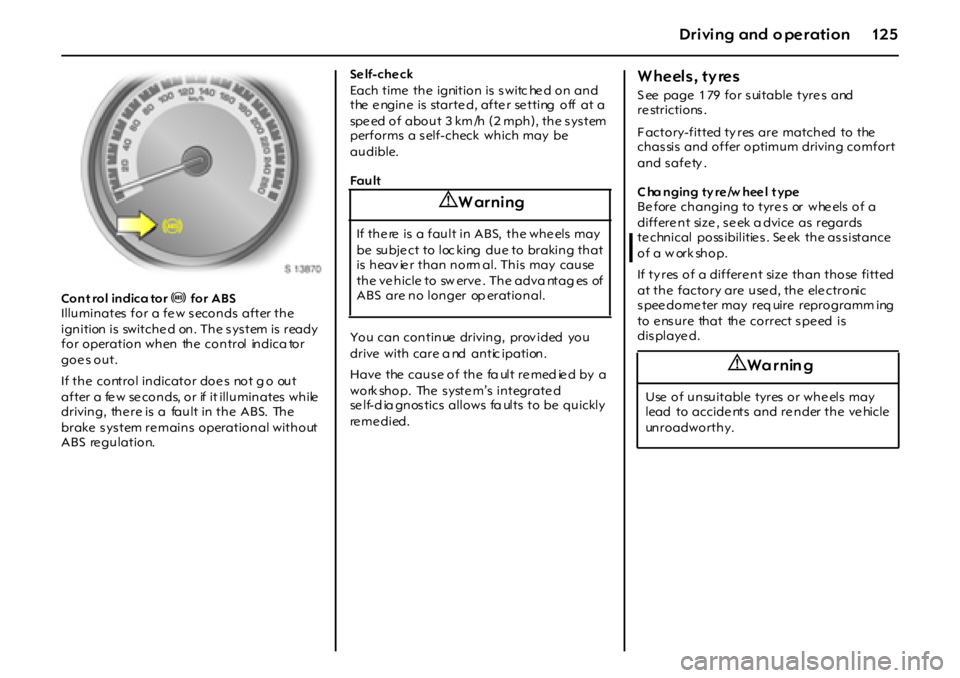
Con t rol in dica tor u for ABS
Illuminates for a few seconds after the
ignition is switche d on. The s ys tem is ready
for operation when the control indica tor
goe s out.
If the control indicator doe s not g o out
after a fe w se conds, or if it illuminates while
driving, there is a fault in the ABS. The
brake system remains operational without
ABS regulation.Se lf-che ck
Each time the ignition is switc he d on and
the e ngine is starte d, afte r se tting off at a
speed of about 3 km /h (2 mph), the system
performs a s elf-check which may be
audible.
Fa u lt
You can continue driving, prov ided you
drive with care a nd antic ipation.
Have the cause of the fa ult re med ie d by a
workshop. The system’s integrated
se lf-d ia gnos tics allows fa ults to be quickly
re m e d i e d .
Wheels, tyres
S ee page 1 79 for s uitable tyre s and
re strictions.
F actory-fitted ty res are matched to the
chas sis and offer optimum driving comfort
and s afe ty .
C ha nging ty re/w heel t ype
Be fore changing to tyre s or whe els of a
differe nt size , s e ek a dvice as regards
te chnical poss ibilitie s . Se ek the as s istance
of a w ork shop.
If ty res of a differe nt size than those fitted
at the factory are used, the electronic
spee dome ter may req uire reprogramm ing
to ensure that the correct speed is
dis playe d.
9 Warning
If the re is a fault in ABS, the whe els may
be subje ct to loc king due to braking that
is heav ie r than norm al. This may cause
t h e ve h i cl e t o sw er ve . T h e a dva nt a g es of
A B S a r e n o l o n g er op er a t i o n a l .
9 Wa r nin g
Use of unsuitable tyres or wheels may
lead to accide nts and re nder the ve hicle
unroadworthy.
Page 128 of 190
1 2 8 D r iv in g an d o p e ra t io n
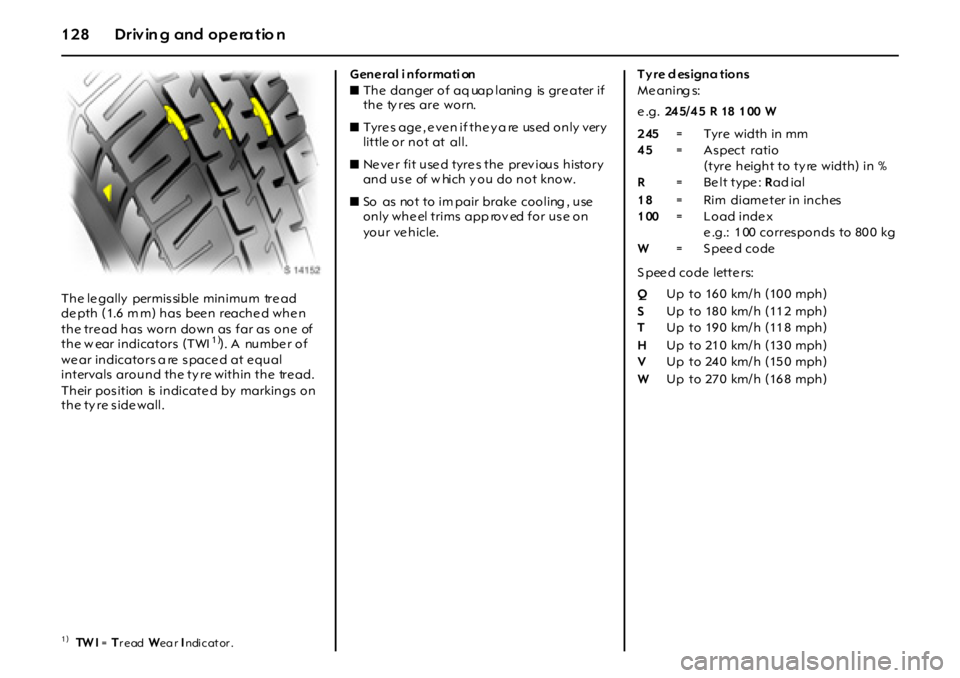
The le gally permis sible minimum tre ad
de pth (1.6 m m) has bee n reache d whe n
the tre ad has worn down as far as one of
the w ear indicators (TWI
1)). A numbe r of
we ar indicators a re s pace d at e qual
intervals around the ty re within the tre ad.
Their pos ition is indicate d by markings on
the ty re side wall. Gene ral i nformati on
zThe danger of aq uap laning is gre ater if
the ty res are worn.
zTyres age, even if they a re used only very
little or not at all.
zNever fit used tyres the prev ious history
and use of w hich y ou do not know.
zSo as not to im pair brake cooling , use
only whe el trims app rov ed for us e on
your vehicle. Tyre d esigna tions
Me aning s:
e.g. 24 5/ 4 5 R 18 1 00 W
S pee d code lette rs:
1)TW I = Tread Wea r Indi c at or .
245=Tyre width in mm
45= Aspect ratio
(tyre height to ty re width) in %
R= Be lt type : Rad ial
18= Rim diame ter in inches
100= L oad inde x
e.g.: 100 corresponds to 800 kg
W=Speed code
QUp to 160 km/h (100 mph)
SUp to 180 km/h (112 mph)
TUp to 190 km/h (118 mph)
HUp to 210 km/h (130 mph)
VUp to 240 km/h (150 mph)
WUp to 270 km/h (168 mph)
Page 134 of 190
134 Self-help, vehicle care
zDo not c onnec t leads to negative
te rminal of discharged battery!
zRoute the le ads so that the y ca nnot
catch on rotating p arts in the engine
com partment.
zStart the e ngine of the ve hicle p rov id ing
th e j u m p s t a r t .
zAfte r 5 minute s, sta rt the other e ngine .
Start attem pts should be made for no
longe r than 15 s econds at an interva l of
1 m i nu t e .
zAfte r the start, allow b oth engines to idle
for 3 minutes with the leads connected.
zIn ord er to av oid ex ces s voltage in the
el ec tr i ca l sy st e m , be f o r e r e m o vi n g a
le ad, switch on an e lectrical cons umer
(e .g. lamps , h ea te d re ar win do w) in th e
vehicle rece iving the jump start.
zReverse above sequence exactly when
re m o v i n g l e a d s .
Towing
Tow ing the vehicl e
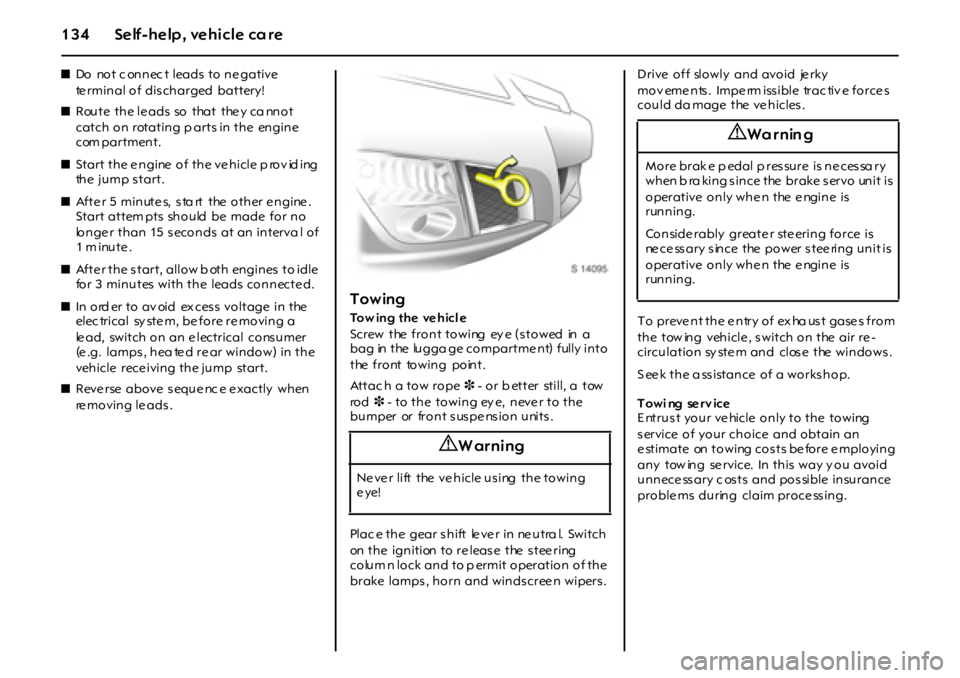
Screw the front towing ey e (stowed in a
bag in the lugga ge compartme nt) fully into
the front towing point.
Attac h a tow rope 3 - or b etter still, a tow
ro d 3 - to the towing ey e, neve r to the
bumper or front suspension units.
Plac e the gear s hift le ve r in ne utra l. Switch
on the ignition to re lease the stee ring
colum n lock and to p ermit operation of the
brake lamps , horn and winds cree n wipers . Drive off slowly and avoid jerky
mov eme nts . Impe rm iss ible trac tiv e force s
could da mage the ve hicles .
To prevent the entry of exha ust gases from
the tow ing vehicle , switch on the air re -
circulation sy stem and close the windows.
S ee k the a ss istance of a works hop.
Towi ng serv ice
E ntrust your ve hicle only to the towing
service of your choice and obtain an
e stimate on towing costs be fore e mploying
any tow ing se rvice. In this way y ou avoid
unnecessary c osts and possible insurance
proble ms during claim proce ss ing.
9 Warning
Ne ve r lift the ve hicle using the towing
eye!
9 Wa r nin g
More brake pedal pressure is necessary
w h en b ra ki n g s i n ce t he br a ke s er vo un i t i s
operative only when the engine is
running.
Conside rably greate r ste ering force is
necessary since the power steering unit is
operative only when the engine is
running.