fuel OPEL GT 2012 User Guide
[x] Cancel search | Manufacturer: OPEL, Model Year: 2012, Model line: GT, Model: OPEL GT 2012Pages: 190, PDF Size: 2.46 MB
Page 71 of 190
71Instru men ts, c ontrols
Warning buzzers
W hen s tarting the e ngine or while d riv ing:
zif d r iv e r ’ s s e a t b e l t i s n o t f a s t e n e d ,
zif passenger’s seat belt is not fa stened
whe n the s e at occupancy re cognition
system d etec ts tha t the passe nger’s se at
is occupie d,
zif the doors or the luggage comp artment
ha v e n o t be en p ro p e r l y cl o s ed w h en
st a r t i n g - o ff ,
zif the hand brake is applie d at s pee ds
ov er 8 km /h ( 5 mph ) ,
zwhile opera ting the indicators.
When the vehicle is parked and the driver’s
door is opened:
zif the head la mps or parking lam ps a re
sw i t c h ed o n ,
zwhe n the k ey is in the ignition switch,
zif any door remains open when the doors
are locke d with the remote control 3.
Driving hints - se e p age 11 0 ,
Saving fuel, protecting the environment -
s ee page 1 12 .
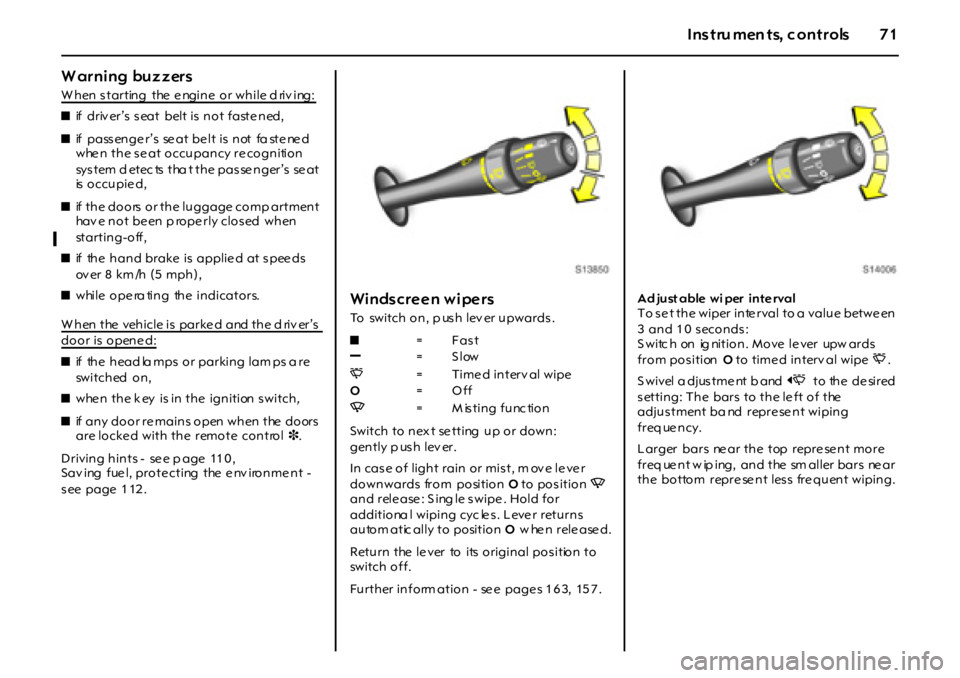
Windscreen wipers
To switch on, p us h lev er upwards .
Switch to n ex t se tting u p o r do wn :
gently p us h lev er.
In cas e o f ligh t rain o r mis t, m ov e le ve r
downwards from position O to position Q
and rele ase : S ing le s wipe . Hold for
additiona l wiping cyc le s. Leve r returns
autom atic ally to position O w hen released.
Return the le ver to its original pos ition to
switch off.
Further inform ation - se e page s 1 6 3, 15 7 .Ad just able wi per inte rval
To s e t the wiper inte rval to a value betwe en
3 and 10 seconds:
S witc h on ig nition. Move le ver upw ards
from positionO to time d interv al wipeP.
S w i v el a d j us t m e nt b a nd O to the de sired
setting: The bars to the le ft of the
adjus tment ba nd repre se nt wiping
freq ue ncy.
Larger bars ne ar the top repre se nt more
f r eq ue n t w ip i ng , a n d t he sm a l l er b a r s ne a r
the bottom repre se nt less fre quent wiping. z=Fast
]=Slow
P= Time d interv al wipe
O=Off
Q=Misting function
Page 110 of 190

1 1 0 D r iv in g an d o p e ra t io n
Driving and operationD r iv in g h in t s
The first 1000 km (600 miles)
D ri v e y o ur v eh i cl e a t va r i o u s sp e ed s.
Do not use full throttle. Nev er allow
the e ngine to labour at low re vs .
Make good use of all ge ars . De pres s the
accele rator ped al a ma ximum of around
thre e quarters of the available p edal trave l
in all gea rs .
Do not d riv e faster than three quarte rs of
maximum spe ed .
D o no t b r a k e un n ec es sa r i l y ha rd f o r t he
first 200 km (120 miles).
Never coast w ith engine not running
Many units w ill not function in this situation
(e .g. brake se rvo unit, powe r ste ering).
Driv ing in this ma nne r is a dange r to
yo u rs e lf and o the rs.
Brake servo unit
When the engine is not running, the brake
servo unit is no longer effective once the
brake peda l has bee n depre ss e d once or
twice. Braking effe ct is not re duced , but
significantly gre ater force is re quired for
braking. Power steering
If th e po wer ste er in g f ails o r wh en be in g
towe d with the e ngine switched off, the
ve hicle c an still be s tee red, but
consid erably more force is required.
D riv ing in m ount ainous te rrain
The cooling fan is e lectrically op erate d.
Its cooling powe r is the refore inde pende nt
o f t h e en g i n e s p e ed.
S ince a c onsiderab le am ount of heat is
ge nerate d at high e ngine s pee ds and les s
at lowe r s pee ds, do not s hift down whe n
climb ing hills while the ve hic le is s till coping
with the gradient in the hig he r ge ar.
D riv ing wi th a roof loa d
N ot permitte d.
Sw itching off the engi ne
When y ou switch off the e ngine , fans in
the engine com partment m ay continue
running for a while , to c ool the engine .
If the engine te mpe rature is very high, e.g.
afte r driving in mountainous terrain, allow
the e ngine to idle for ap prox . 2 minutes , in
orde r to preve nt heat accumulation.
V eh i cl es w i t h t u r bo ch a r g ed en g i n e:
After running at high eng ine speeds or high
e ng ine loads, op erate the engine brie fly at
a low load or run in neutral for approx.
3 0 se c o n d s b ef o r e sw i t c h i n g o f f , i n o r d er
to protec t the turbocharger. D rivin g h in ts .... ..... .... ..... .... ..... .... .... ..... 11 0
Saving fuel, protecting the
en viro n men t . ..... .... ..... .... ..... .... .... ..... 11 2
F ue ls, ref u ellin g .... .... ..... .... ..... .... .... ..... 11 4
Ca ta lytic converter, exhaust g ases... 116
D rive co n tro l s ys tem s ... .... ..... .... .... ..... 11 8
Brake s ys te m ... ..... .... ..... .... ..... .... .... ..... 12 2
ABS u..... .... .... ..... .... ..... .... ..... .... .... ..... 12 4
W h ee ls , ty res ... ..... .... ..... .... ..... .... .... ..... 12 5
Page 112 of 190

1 1 2 D r iv in g an d o p e ra t io n
Sa ving fuel, p rotecting th e
environment
T re nd-s et ting te chnology
When dev eloping and manufac turing your
vehicle, Opel used environment-friendly
and prima rily recy clable materials . The
production methods used to ma ke your
vehicle are likewise environmenta lly-
compatible .
Recycling of production wastes keeps the
circulation of material clos ed. Re duction of
energy a nd water requirements a lso help s
to conserve natural resources.
T h e a dva n ced des i g n m a kes i t e a si e r
to dismantle the ve hicle at the end of
its se rvice life and s e parate m aterials
for recy cling .
Mate ria ls s uch as as bes tos and cadmium
a r e n ot us ed . T h e re f r i g er a n t i n t h e a i r
conditioning s ys tem is CF C-free .
Ne w painting te chnique s e mploy water
as a s olve nt. End-of-li fe v e hi cle rec ove ry
Information on end-of-life ve hicle recove ry
centres and the recy cling of end-of-life
vehicle s is av ailable at www.ope l.com.
Dr ive in an energy a nd environment-
consc ious w ay
zHigh fuel consumption, noise lev els and
exhaust em issions are often caused by a
driving s tyle that is not energy and
environment-conscious.
zYou should therefore drive with energy in
mind: "more kilometre s/ miles with le ss
fuel".
Reduce the noise level and exhaust
emissions b y adopting an environment-
consc ious driving s tyle. This is ex treme ly
worthwhile and im proves the quality of
life.
Fuel consum ption d epend s to a great
extent on your own personal d riv ing
style. The following hints are intended to
help you consume fuel at a rate that is as
clos e as poss ible to the spe cified le vels –
s ee page 1 77 .
C heck y our v ehicle’ s fuel consumption
e very time you refuel. This facilitates
e arly de tection of any irre gula ritie s
causing increased fuel consumption. Warm ing up
zFull throttle and w arming up at idle
speed increase w ear, fuel consumption,
ex haust em issions, the amount of
pollutant in the exhaust and the am ount
of noise.
zDriv e off as s oon as poss ible a fte r
st a r t i n g .
Uniform speed
zHectic driving s ignificantly increas e s fuel
consumption, the ex haust emissions, the
proportion of pollutant in the exhaust
g a s es a n d t h e no i s e l eve l .
zDo not accele rate a nd brake
unnecessarily . Drive at uniform speed.
Avoid frequent starting-off and
stopping, e.g. at traffic lights, in short
distance traffic and in que ue s of tra ffic,
by m eans of clev er planning. S ele ct
roa ds with good traffic flow.
I dling
zThe eng ine also consumes fuel when
idling .
zIf yo u h ave to wait f o r mo r e th an
1 minute , it is worthwhile s witching off
the e ng ine . F ive minute s of idling
corre s ponds to ap prox . 1 kilome tre
(0.6 m ile s) of driv ing .
Page 113 of 190

11 3Dr i vi ng and o pe r ati on
O ve rrun
zThe fuel s upply is automatically shut off
during ov errun, e. g. whe n the ve hicle is
being drive n down long gradie nts or
whe n braking – s ee page 1 11 .
zTo enable the ove rrun cut-off to take
effect a nd sav e fue l, during overrun do
not ac cele ra te and do not declutch.
Corr ect ge ar sel ec tion
zHigh revs increas e engine w ear and fue l
consumption.
zDo not race your engine. Avoid d riv ing at
high e ngine s pee ds .
Dr i v in g w i t h a n ey e o n t h e t a ch om et e r
save s fuel. I f pos sib le , drive a t low rev s in
each ge ar and a t a consta nt s pe ed.
Driv e in top g ear as m uch a s p os s ible,
shift up as s oon as pos s ib le and do not
shift down until the e ngine is no longe r
running truly . High speed
zT h e f a s t er t h e sp ee d, t h e h i g h e r t he f u el
consump tion and the noise level. Driv ing
at full throttle use s up a gre at de al of fue l
and g enerates excessive noise and high
e miss ion leve ls.
zSlightly relea sing the acce le rator ped al
res ults in distinct fuel s avings with no
major los s of spe ed.
Drive at no more tha n around thre e
quarters of max imum spe ed and you will
use up to 50% less fue l, without losing a
gre at de al of time.
Ty re pre ssure
zInade quate ty re p re s sure, leading to
higher road res istance , cos ts m one y in
two wa ys: more fue l and increa se d tyre
we ar.
zRe gular checks (e very 14 d ays ) pay off.
Ele ctri cal lo a ds
zThe power cons um ption of e lectrical
equip ment increa ses fuel consumption.
zSw itch off ad ditional c ons umers (e. g.
air conditioning, heate d re ar window)
when they are no longer required. Re pai r and m ainte nance
zImprope r repairs or adjus tm ent and
maintenance work can increase fuel
consumption. Do not carry out w ork on
the eng ine yourself.
You ma y infring e environmental la ws out
of ignorance by not d isposing of
materials prope rly.
Appropriate parts might not b e re cycle d.
Contact with some of the mate ria ls
involved may pose a health hazard.
zWe re com mend that repair and
maintenance be entrusted to your O pel
Se rv ice Partner.
E xtr em e d riving conditions
zDriv ing up s te ep gradie nts , cornering,
driving on poor roads and winte r driving
all increas e fue l consumption.
Fue l consumption increa se s dramatically
i n ur b a n t ra ff i c a nd a t w i n t er
tempe ratures, e spe cially on short trip s
w h en t h e e n g i ne o p er a t i n g t e m p e ra tu r e
is not reached.
zFollow the hints given above to keep
consumption to a m inimum under suc h
cond itions .
Page 114 of 190
1 1 4 D r iv in g an d o p e ra t io n
Fuels, refu elling
Fuel c onsum ption
Fuel consump tion is determined und er
s pecific driv ing cond itions – s ee page 1 77 .
Special equipment increases the weight of
t h e v eh i cl e. A s a r es u l t , t h ey ca n i n cr ea s e
fuel consump tion and reduce the specified
max imum s pee d.
F or the first few thousa nd kilome tres/m ile s,
friction b etwe en the engine and
transm ission com pone nts is higher.
This increases fuel consump tion.
Fuel for petrol engines
Normal comme rc ia l hig h-q uality fue ls
with a m aximum ethanol conte nt of 5% in
accordance with DIN EN 22 8 are suitable
(Cataly tic converte r - s ee page 1 16 .
O ctane numbe rs - se e page 17 5 ). The
quality thereof has considerable effect on
performance, running and service life of
the e ngine. The additive s mixe d with the
fuel are extremely im portant. For this
r ea so n yo u mu s t o n ly r e fu e l with h igh-
quality fuels containing additives.Fuels with e thanol content of gre ater than
5% d o not com ply with DIN EN 228 and
must not be used unless the v ehicle has
bee n s pe cifica lly dev eloped a nd ap prov ed
for these fuels.
Fuel with too low an octane number can
cause pinking. Opel cannot b e held liable
for re sulting dam age.
Petrol with a higher octane number can
always be use d.
The ignition tim ing adjusts automatically
t o t h e g r a de o f f u el us e d ( o ct a n e n um ber
)– se e p age 17 5 .
Use of pe trol with an octane rating of 95 or
highe r will e ns ure e conom ical driving.
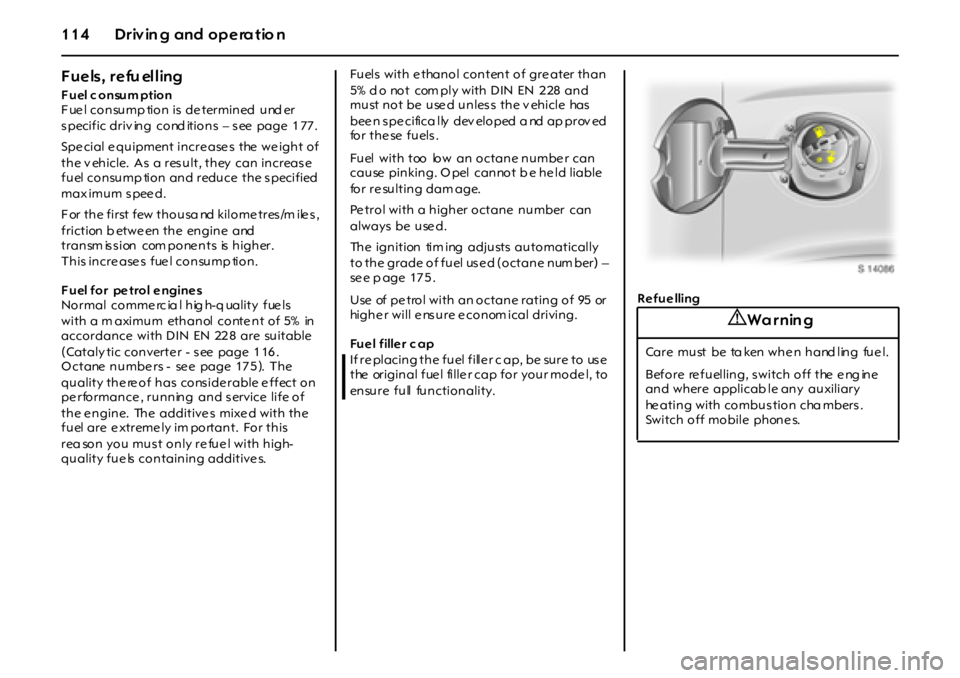
Fue l fille r c ap
If re placing the fuel fille r c ap, be sure to us e
the original fue l fille r cap for your mode l, to
ensure full functionality.Re fue lling
9 Wa r nin g
Care must be ta ken when hand ling fuel.
Before re fuelling, s witch off the e ng ine
and where applicab le any auxiliary
he ating with combus tion cha mbers .
Switch off mobile phones.
Page 115 of 190
11 5Dr i vi ng and o pe r ati on
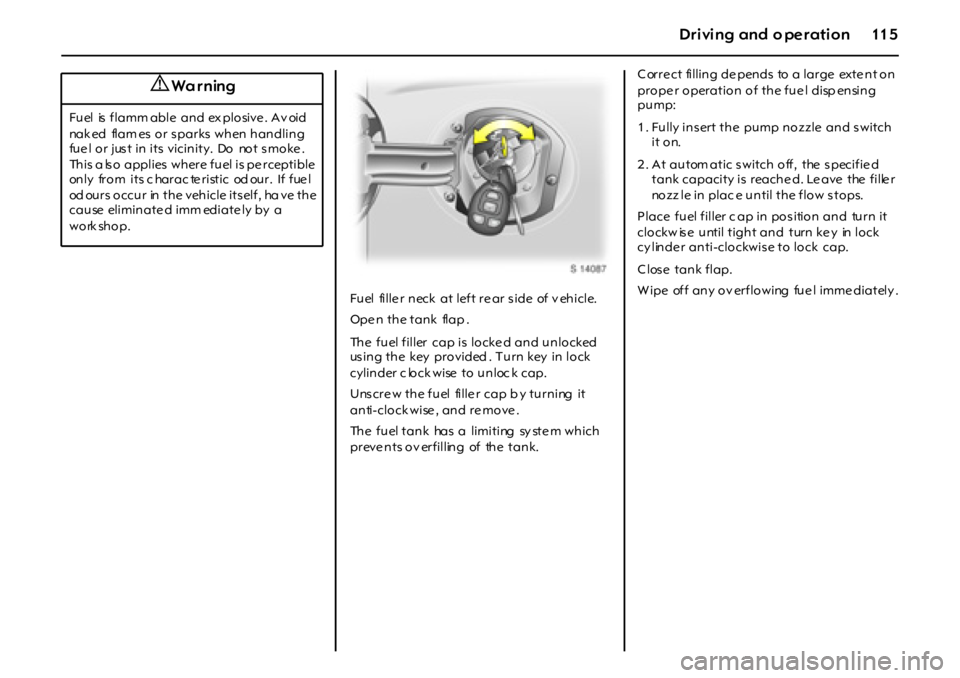
Fuel fille r neck at left re ar s ide of v ehicle.
Ope n the tank flap .
The fuel filler cap is locke d and unlocked
us ing the key provided . Turn key in lock
cylinder c lock wise to unloc k cap.
Uns cre w the fuel fille r cap b y turning it
anti-clock wise , and re move .
The fuel tank has a limiting sy ste m which
preve nts ov erfilling of the tank.C orre ct filling de pends to a large exte nt on
proper operation of the fuel disp ensing
pump:
1 . Fully ins ert the pump nozzle and s witch
it on.
2. At autom atic switch off, the specifie d
tank capacity is reache d. Le ave the fille r
nozz le in plac e until the flow s tops.
Place fuel filler c ap in pos ition and turn it
clockw ise until tight and turn ke y in lock
cy linde r anti-clockwis e to lock cap.
C los e tank flap.
W ipe off any ov erflowing fue l imme diately .
9 Wa r ning
Fu el is f l a m m a bl e a n d ex p l o si ve . A v oi d
nak ed flam es or s parks when handling
fuel or just in its vicinity. Do not smoke.
This a ls o applies where fuel is pe rceptible
only from its c harac te ristic od our. If fue l
od ours occur in the vehicle its elf, ha ve the
cause eliminate d imm ediate ly by a
work shop.
Page 116 of 190
1 1 6 D r iv in g an d o p e ra t io n
Cata ly tic conv erter, exhaust
ga s es
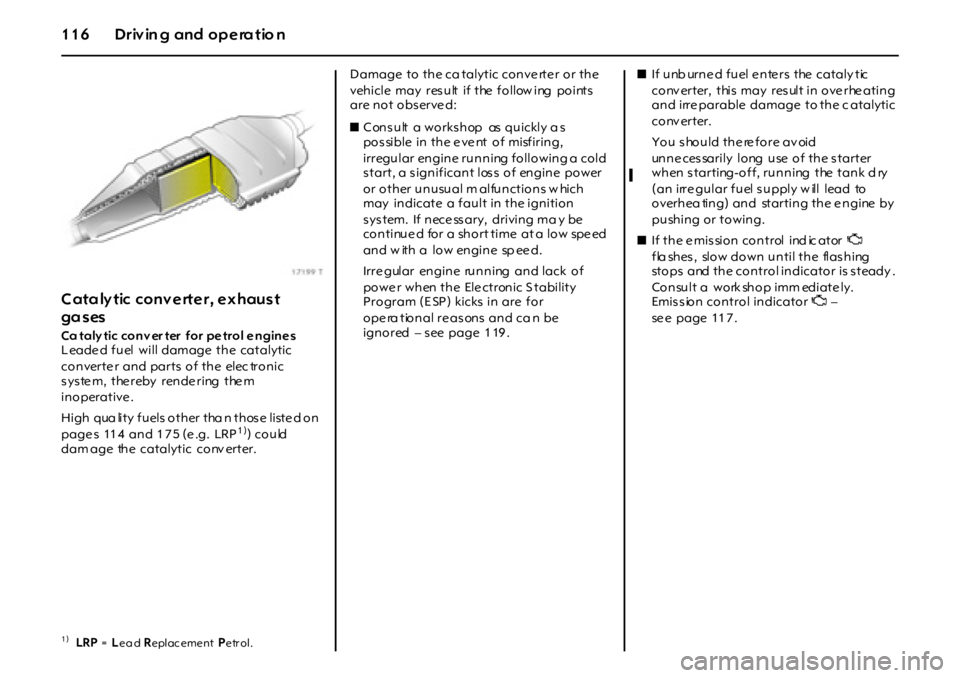
Ca taly tic con v er ter for pe trol e n gin e s
L eade d fuel will damage the catalytic
co n ver t e r a n d p a r t s o f t h e el ec tr o n i c
system, thereby rendering them
inoperative .
High qua lity fuels other tha n those liste d on
page s 11 4 and 1 7 5 (e .g. LRP
1)) could
dam age the catalytic conv erter.Damage to the ca talytic conve rte r or the
vehicle may res ult if the follow ing points
are not obs erve d:
zC onsult a workshop as quickly a s
pos sible in the e ve nt of misfiring,
irregular engine running following a cold
s tart, a s ignificant los s of engine power
or other unusual m alfunctions w hich
may indicate a fault in the ignition
system. If necessary, driving ma y be
continue d for a short time at a low spe ed
and w ith a low engine sp ee d.
Irregular engine running and lack of
powe r when the Ele ctronic S tability
Program (E SP) kicks in are for
ope ra tional re as ons and ca n be
ignored – s ee page 1 19 .zIf unburned fuel enters the catalytic
conv erter, this may res ult in ove rhe ating
and irre parable damage to the c atalytic
conv erter.
You should therefore avoid
unnecessarily long use of the starter
when starting-off, running the tank d ry
(an irre gular fuel s upply w ill lead to
overhea ting) and starting the e ngine by
pushing or towing.
zIf the e mis sion control ind ic ator Z
fla shes, slow down until the flashing
stops and the control indicator is s teady .
Consult a work shop imm ediately.
Emis s ion control indicator Z –
se e page 11 7 .
1)LR P = Lea d Replacement Petrol.
Page 117 of 190
11 7Dr i vi ng and o pe r ati on
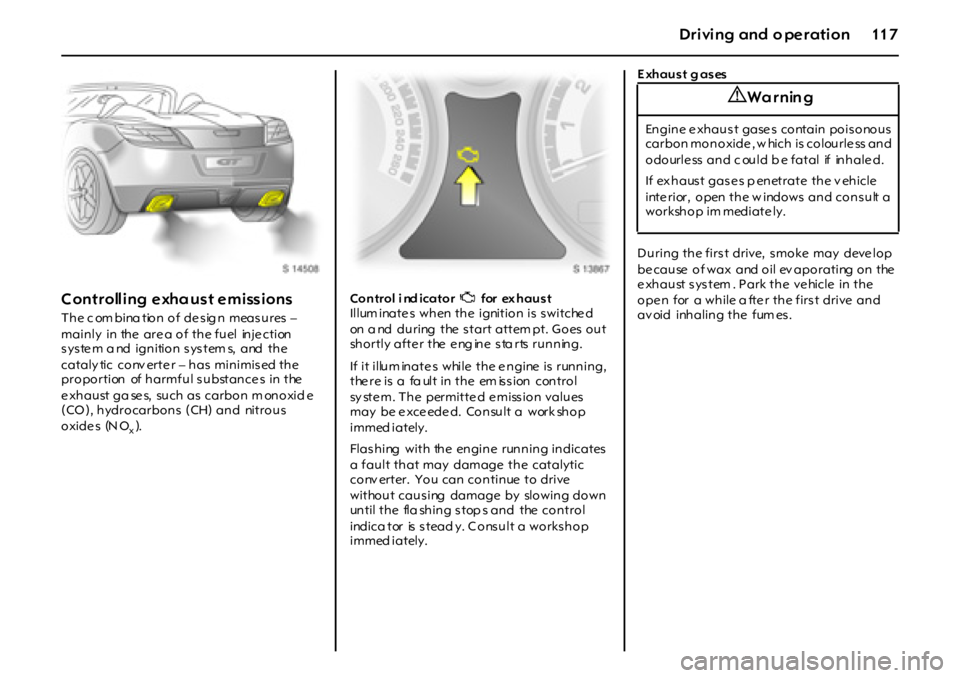
Controlling exha ust emissions
The combination of design measures –
mainly in the are a of the fuel inje ction
system a nd ignition system s, and the
cataly tic conv erte r – has minimis ed the
proportion of harmful substance s in the
e xh a u st g a se s, su c h a s c a r b o n m on o xi d e
(CO ), hydrocarbons (CH) and nitrous
oxides (N O
x).Control i nd icator Z for exhaust
Illum inate s when the ignition is s witche d
on a nd during the start attem pt. Goes out
shortly after the eng ine sta rts running.
If it illum inate s while the e ngine is running,
the re is a fa ult in the em ission control
sy ste m. The permitte d e miss ion values
m a y be e xce ede d. Co n su l t a w or k sh o p
immed iately.
Flashing with the engine running indicates
a fault that may damage the catalytic
conv erter. You can continue to drive
without caus ing damage by slowing down
until the fla shing stop s and the control
indica tor is stead y. C onsult a workshop
immed iately.Exhaust g ases
D u r i n g t h e f i r s t dr i ve, s m o ke m a y deve l o p
be cause of wax and oil ev aporating on the
exhaust system . Park the vehicle in the
ope n for a while a fte r the first drive and
av oid inhaling the fum es .
9 Wa r nin g
Engine e xhaus t gase s contain pois onous
carbon monoxide , w hich is colourle ss and
odourle ss and c ould b e fatal if inhale d.
If ex haust gase s p enetrate the v ehicle
inte rior, open the w indows and consult a
workshop im mediate ly.
Page 118 of 190

1 1 8 D r iv in g an d o p e ra t io n
Mai nt ena nc e
Hav e all maintenance work carried out
at the inte rvals specified by Ope l. W e
recom mend that y ou entrust this work
to your O pel Service Partner, who ha s
prope r equipme nt and trained pers onne l
ava ilab le. Elec tronic te sting s ys tems
pe rmit rapid dia gnos is and rem edy of
faults. This way you can b e certain that
all comp onents of the vehicle’s electric al,
injection and ignition sy ste ms operate
correctly , that your ve hicle has a low leve l
of pollutant e mission and that the c atalytic
converte r s yste m will hav e a long se rvice
life.
You are there by m aking an imp ortant
contrib ution towards kee ping the air cle an
and com plia nc e with e mis sions le gis lation.
The S ervice work include s te sting and
adjusting the fuel injection system and the
ignition system . F or this re ason, hav e a ll
Se rvice work carrie d out at the inte rv als
s p eci f i e d by Op e l ( se e ch a p t er " Ser v ic e,
Maintenance " on page 1 65 ).Drive co n trol systems
Ele ctronic Stab ility P rogram (E SP ) ,
Ele ctronic Stab ility Control (E SC)
Elec tronic S tability C ontrol (ES C) is a
component part of the Ele ctronic S tability
Program (ESP).
ESP im proves driving s tability w he n
ne ces s ary in any driving s ituation,
re gardle ss of the ty pe of road surface or
tyre g rip . It also pre vents the d riv e whe els
from spinning.
The system m onitors vehicle movements.
As soon as the ve hicle starts to swe rve
(understeers/oversteers) engine output is
re duce d (the s ound of the e ngine cha ng es )
and individual whe els are spe cifically
braked . This cons iderab ly improve s the
driving stability of the ve hicle on snow and
ice and on wet or s lippe ry road s urfa ces .E SP is ready for operation as s oon a s the
ignition is s witched on and control
indicator v goes out.
The E SP control proces s is disp la yed b y the
flashing of v.
The vehicle is now in a critical s itua tion;
E SP allows you to ke ep control of the
vehicle a nd reminds you to m atch your
spee d to the road conditions.
9 Wa r nin g
Do not le t this spe cial safety feature
tempt you into ta king risk s w he n driving.
Tra ffic safe ty can only b e ac hie ve d by
adopting a re spons ible d riv ing sty le .
Page 127 of 190
12 7Dr i vi ng and o pe r ati on
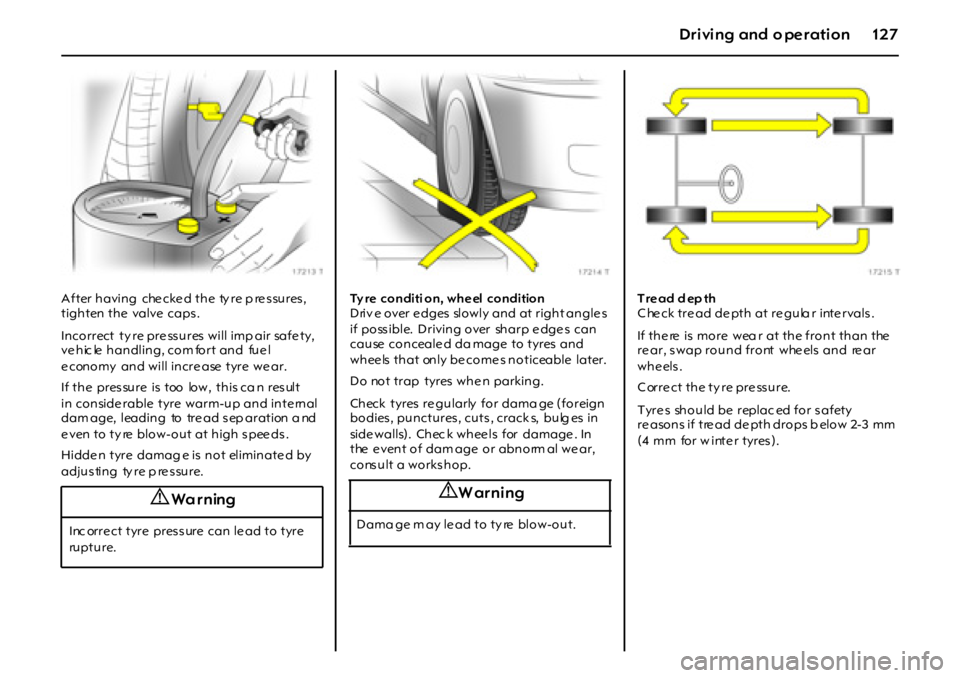
After having che cke d the ty re p re ssures,
tighten the valve caps.
Incorrect ty re pre ssures will imp air safe ty,
vehic le handling, com fort and fuel
e conomy and will incre ase tyre we ar.
If the pressure is too low, this ca n result
in conside rable tyre warm-up and inte rnal
dam age, leading to tre ad s ep aration a nd
e ven to ty re blo w-o u t at h igh s pee ds .
Hidde n tyre damag e is not eliminate d by
adjus ting ty re p re s sure.Ty re conditi on, wheel condition
Driv e over e dges slowly and at right angle s
if poss ible. Driving over sharp e dge s can
cause conceale d da mage to tyres and
whee ls that only be come s noticeable later.
Do not trap tyres whe n parking.
Check tyres re gularly for dama ge (foreign
bo dies , pu n ctu res , cu ts , crack s, bu lg es in
side walls). Chec k whee ls for damage . In
the e vent of dam age or abnorm al we ar,
cons ult a works hop.Tread depth
C he ck tre ad de pth at re gula r inte rvals .
If the re is more wea r at the front than the
re ar, s wap round front whe els and re ar
whe els.
C orre ct the ty re pre ssure.
Tyre s should be replac ed for safety
re asons if tre ad de pth drops b elow 2-3 mm
(4 mm for w inte r tyres).
9 Wa r ning
Inc orre ct tyre pressure can le ad to tyre
ru p t u r e .
9 Warning
Dama ge m ay le ad to ty re blow-out.