tow OPEL GT 2012 User Guide
[x] Cancel search | Manufacturer: OPEL, Model Year: 2012, Model line: GT, Model: OPEL GT 2012Pages: 190, PDF Size: 2.46 MB
Page 103 of 190
10 3Climate control
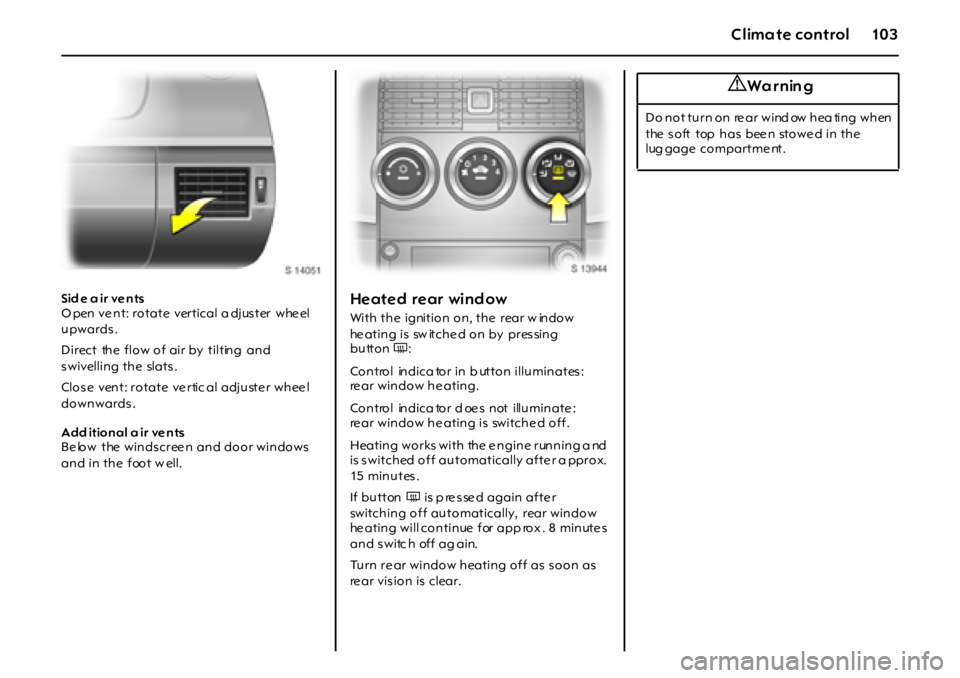
Sid e a ir ve nts
O pen ve nt: rotate vertical a djuster whe el
upwards.
Direct the flow of air by tilting and
s wivelling the slats .
Clo s e ven t: ro tate ve rtic al adju ste r wh ee l
downwards.
Add itional a ir vents
Be low the windscree n and door windows
and in the foot w ell.He ate d r e ar wi nd ow
With the ignition on, the rear w indow
he ating is sw itche d on by pres sing
buttonÜ:
Control indica tor in b utton illuminates :
re ar window he ating.
Control indica tor d oe s not illuminate :
re ar window he ating is switche d off.
Heating works with the engine running a nd
is s witched off automatically afte r a pprox.
15 minutes.
If buttonÜ is p re s se d again afte r
switching off automatically, rear window
he ating will continue for app rox . 8 minute s
and s witc h off ag ain.
Turn re ar window heating off as s oon as
re a r v i s i o n i s c l e a r .
9 Wa r nin g
Do not turn on re ar wind ow hea ting when
the soft top has been stowed in the
lug gage compartme nt.
Page 106 of 190
106 Climate c ontrol
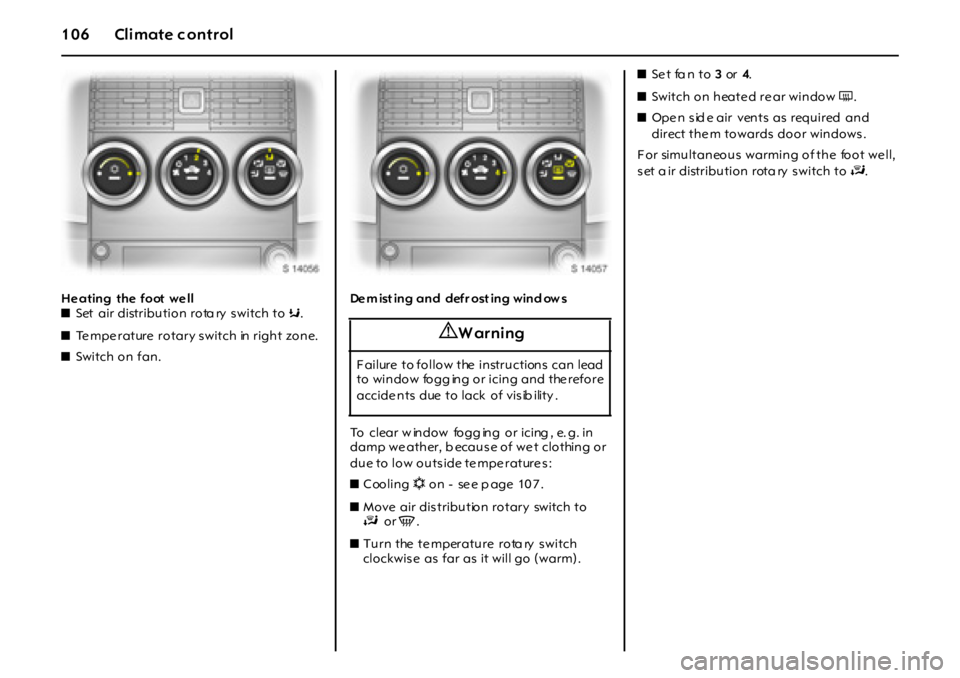
He ating the foot we ll
zSet air distribution rota ry switch toK.
zTe mpe rature rotary switch in right zone.
zSwitch o n f an .De m ist ing and defr ost ing wind ow s
To clear w indow fogg ing or icing , e. g. in
damp weather, b ecause of wet clothing or
due to low outside te mpe rature s:
zC oolingn on - se e p age 10 7 .
zMove air distribution rotary switch to
J or V.
zTurn the te mperature rota ry switch
clockwis e as far as it will go (warm).zSe t fa n to 3 or 4.
zSwitch on heate d re ar windowÜ.
zOpe n s id e air vents as required and
direct them towards door windows.
F or simultaneous warming of the foot we ll,
set a ir distribution rota ry switch toJ.
9 Warning
F ailure to follow the instructions can lead
to window fogg ing or icing and the refore
accide nts due to lack of vis ib ility .
Page 110 of 190

1 1 0 D r iv in g an d o p e ra t io n
Driving and operationD r iv in g h in t s
The first 1000 km (600 miles)
D ri v e y o ur v eh i cl e a t va r i o u s sp e ed s.
Do not use full throttle. Nev er allow
the e ngine to labour at low re vs .
Make good use of all ge ars . De pres s the
accele rator ped al a ma ximum of around
thre e quarters of the available p edal trave l
in all gea rs .
Do not d riv e faster than three quarte rs of
maximum spe ed .
D o no t b r a k e un n ec es sa r i l y ha rd f o r t he
first 200 km (120 miles).
Never coast w ith engine not running
Many units w ill not function in this situation
(e .g. brake se rvo unit, powe r ste ering).
Driv ing in this ma nne r is a dange r to
yo u rs e lf and o the rs.
Brake servo unit
When the engine is not running, the brake
servo unit is no longer effective once the
brake peda l has bee n depre ss e d once or
twice. Braking effe ct is not re duced , but
significantly gre ater force is re quired for
braking. Power steering
If th e po wer ste er in g f ails o r wh en be in g
towe d with the e ngine switched off, the
ve hicle c an still be s tee red, but
consid erably more force is required.
D riv ing in m ount ainous te rrain
The cooling fan is e lectrically op erate d.
Its cooling powe r is the refore inde pende nt
o f t h e en g i n e s p e ed.
S ince a c onsiderab le am ount of heat is
ge nerate d at high e ngine s pee ds and les s
at lowe r s pee ds, do not s hift down whe n
climb ing hills while the ve hic le is s till coping
with the gradient in the hig he r ge ar.
D riv ing wi th a roof loa d
N ot permitte d.
Sw itching off the engi ne
When y ou switch off the e ngine , fans in
the engine com partment m ay continue
running for a while , to c ool the engine .
If the engine te mpe rature is very high, e.g.
afte r driving in mountainous terrain, allow
the e ngine to idle for ap prox . 2 minutes , in
orde r to preve nt heat accumulation.
V eh i cl es w i t h t u r bo ch a r g ed en g i n e:
After running at high eng ine speeds or high
e ng ine loads, op erate the engine brie fly at
a low load or run in neutral for approx.
3 0 se c o n d s b ef o r e sw i t c h i n g o f f , i n o r d er
to protec t the turbocharger. D rivin g h in ts .... ..... .... ..... .... ..... .... .... ..... 11 0
Saving fuel, protecting the
en viro n men t . ..... .... ..... .... ..... .... .... ..... 11 2
F ue ls, ref u ellin g .... .... ..... .... ..... .... .... ..... 11 4
Ca ta lytic converter, exhaust g ases... 116
D rive co n tro l s ys tem s ... .... ..... .... .... ..... 11 8
Brake s ys te m ... ..... .... ..... .... ..... .... .... ..... 12 2
ABS u..... .... .... ..... .... ..... .... ..... .... .... ..... 12 4
W h ee ls , ty res ... ..... .... ..... .... ..... .... .... ..... 12 5
Page 116 of 190
1 1 6 D r iv in g an d o p e ra t io n
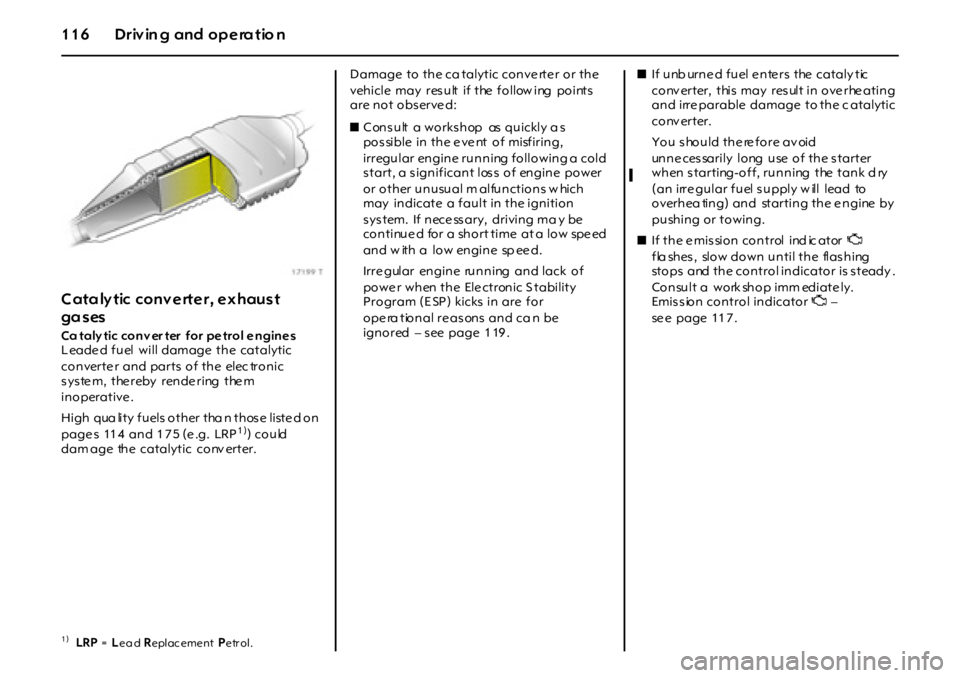
Cata ly tic conv erter, exhaust
ga s es
Ca taly tic con v er ter for pe trol e n gin e s
L eade d fuel will damage the catalytic
co n ver t e r a n d p a r t s o f t h e el ec tr o n i c
system, thereby rendering them
inoperative .
High qua lity fuels other tha n those liste d on
page s 11 4 and 1 7 5 (e .g. LRP
1)) could
dam age the catalytic conv erter.Damage to the ca talytic conve rte r or the
vehicle may res ult if the follow ing points
are not obs erve d:
zC onsult a workshop as quickly a s
pos sible in the e ve nt of misfiring,
irregular engine running following a cold
s tart, a s ignificant los s of engine power
or other unusual m alfunctions w hich
may indicate a fault in the ignition
system. If necessary, driving ma y be
continue d for a short time at a low spe ed
and w ith a low engine sp ee d.
Irregular engine running and lack of
powe r when the Ele ctronic S tability
Program (E SP) kicks in are for
ope ra tional re as ons and ca n be
ignored – s ee page 1 19 .zIf unburned fuel enters the catalytic
conv erter, this may res ult in ove rhe ating
and irre parable damage to the c atalytic
conv erter.
You should therefore avoid
unnecessarily long use of the starter
when starting-off, running the tank d ry
(an irre gular fuel s upply w ill lead to
overhea ting) and starting the e ngine by
pushing or towing.
zIf the e mis sion control ind ic ator Z
fla shes, slow down until the flashing
stops and the control indicator is s teady .
Consult a work shop imm ediately.
Emis s ion control indicator Z –
se e page 11 7 .
1)LR P = Lea d Replacement Petrol.
Page 118 of 190

1 1 8 D r iv in g an d o p e ra t io n
Mai nt ena nc e
Hav e all maintenance work carried out
at the inte rvals specified by Ope l. W e
recom mend that y ou entrust this work
to your O pel Service Partner, who ha s
prope r equipme nt and trained pers onne l
ava ilab le. Elec tronic te sting s ys tems
pe rmit rapid dia gnos is and rem edy of
faults. This way you can b e certain that
all comp onents of the vehicle’s electric al,
injection and ignition sy ste ms operate
correctly , that your ve hicle has a low leve l
of pollutant e mission and that the c atalytic
converte r s yste m will hav e a long se rvice
life.
You are there by m aking an imp ortant
contrib ution towards kee ping the air cle an
and com plia nc e with e mis sions le gis lation.
The S ervice work include s te sting and
adjusting the fuel injection system and the
ignition system . F or this re ason, hav e a ll
Se rvice work carrie d out at the inte rv als
s p eci f i e d by Op e l ( se e ch a p t er " Ser v ic e,
Maintenance " on page 1 65 ).Drive co n trol systems
Ele ctronic Stab ility P rogram (E SP ) ,
Ele ctronic Stab ility Control (E SC)
Elec tronic S tability C ontrol (ES C) is a
component part of the Ele ctronic S tability
Program (ESP).
ESP im proves driving s tability w he n
ne ces s ary in any driving s ituation,
re gardle ss of the ty pe of road surface or
tyre g rip . It also pre vents the d riv e whe els
from spinning.
The system m onitors vehicle movements.
As soon as the ve hicle starts to swe rve
(understeers/oversteers) engine output is
re duce d (the s ound of the e ngine cha ng es )
and individual whe els are spe cifically
braked . This cons iderab ly improve s the
driving stability of the ve hicle on snow and
ice and on wet or s lippe ry road s urfa ces .E SP is ready for operation as s oon a s the
ignition is s witched on and control
indicator v goes out.
The E SP control proces s is disp la yed b y the
flashing of v.
The vehicle is now in a critical s itua tion;
E SP allows you to ke ep control of the
vehicle a nd reminds you to m atch your
spee d to the road conditions.
9 Wa r nin g
Do not le t this spe cial safety feature
tempt you into ta king risk s w he n driving.
Tra ffic safe ty can only b e ac hie ve d by
adopting a re spons ible d riv ing sty le .
Page 131 of 190
13 1Self-help, vehicle care
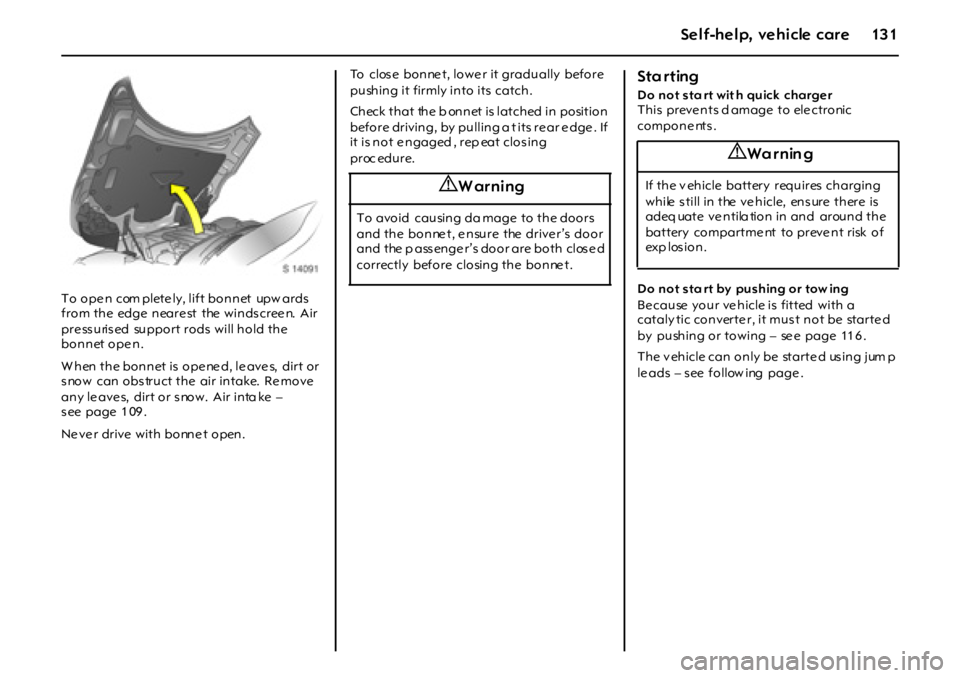
To ope n com plete ly, lift bonnet upw ards
from the edge neare st the windscree n. Air
pre ss uris ed support rods will hold the
bonnet open.
When the bonnet is opened, leaves, dirt or
snow can obstruct the air intake. Remove
any le ave s, dirt or s now. Air inta ke –
s ee page 1 09 .
Ne ve r drive with bonne t open.To clos e bonne t, lowe r it gradually before
pushing it firmly into its catch.
Check that the b onnet is latched in position
before driving, by pulling a t its re ar e dge . If
it is not e ngaged , rep eat clos ing
p r oc edu r e.
Sta rting
D o not s ta rt wit h quick charge r
This preve nts d amage to ele ctronic
compone nts .
D o not s ta rt by pus hing or tow ing
Be cause your ve hicle is fitted with a
cataly tic converte r, it must not be starte d
by pushing or towing – se e page 11 6 .
T h e v eh i cl e ca n o n l y be st a r t e d us i n g j um p
le ads – s ee follow ing page .
9 Warning
To avoid causing da mage to the doors
and the bonnet, ensure the driver’s door
and the p ass enge r’s door are both clos e d
correctly before closing the bonne t.
9 Wa r nin g
If t h e v eh i cl e ba t t er y r equ i r es ch a r g i n g
while s till in the ve hicle, ens ure there is
adeq uate ventila tion in and around the
battery compartme nt to preve nt risk of
exp l os i o n .
Page 134 of 190
134 Self-help, vehicle care
zDo not c onnec t leads to negative
te rminal of discharged battery!
zRoute the le ads so that the y ca nnot
catch on rotating p arts in the engine
com partment.
zStart the e ngine of the ve hicle p rov id ing
th e j u m p s t a r t .
zAfte r 5 minute s, sta rt the other e ngine .
Start attem pts should be made for no
longe r than 15 s econds at an interva l of
1 m i nu t e .
zAfte r the start, allow b oth engines to idle
for 3 minutes with the leads connected.
zIn ord er to av oid ex ces s voltage in the
el ec tr i ca l sy st e m , be f o r e r e m o vi n g a
le ad, switch on an e lectrical cons umer
(e .g. lamps , h ea te d re ar win do w) in th e
vehicle rece iving the jump start.
zReverse above sequence exactly when
re m o v i n g l e a d s .
Towing
Tow ing the vehicl e
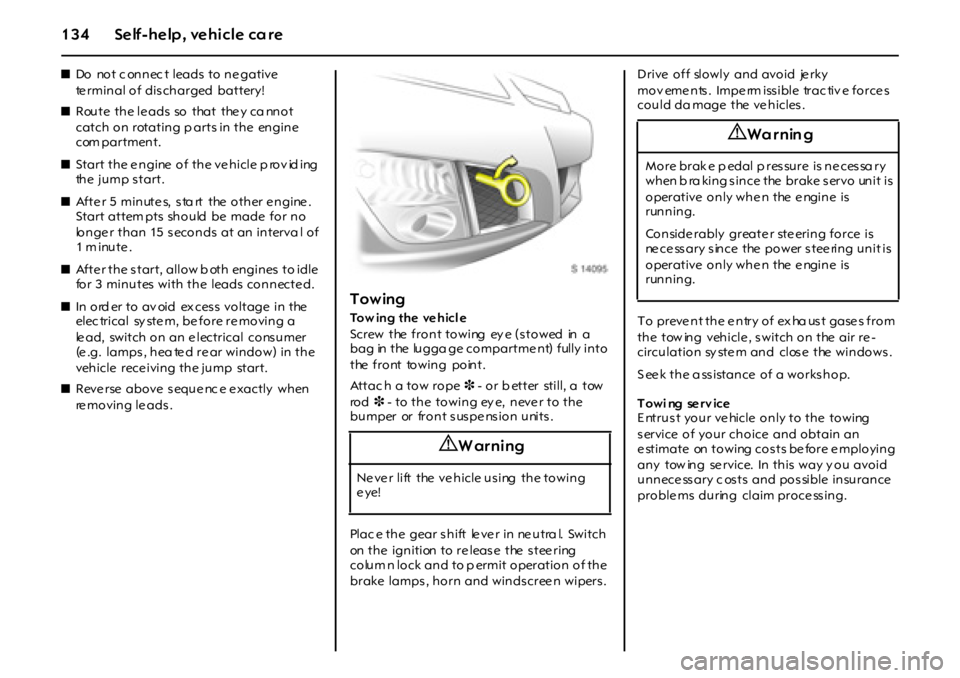
Screw the front towing ey e (stowed in a
bag in the lugga ge compartme nt) fully into
the front towing point.
Attac h a tow rope 3 - or b etter still, a tow
ro d 3 - to the towing ey e, neve r to the
bumper or front suspension units.
Plac e the gear s hift le ve r in ne utra l. Switch
on the ignition to re lease the stee ring
colum n lock and to p ermit operation of the
brake lamps , horn and winds cree n wipers . Drive off slowly and avoid jerky
mov eme nts . Impe rm iss ible trac tiv e force s
could da mage the ve hicles .
To prevent the entry of exha ust gases from
the tow ing vehicle , switch on the air re -
circulation sy stem and close the windows.
S ee k the a ss istance of a works hop.
Towi ng serv ice
E ntrust your ve hicle only to the towing
service of your choice and obtain an
e stimate on towing costs be fore e mploying
any tow ing se rvice. In this way y ou avoid
unnecessary c osts and possible insurance
proble ms during claim proce ss ing.
9 Warning
Ne ve r lift the ve hicle using the towing
eye!
9 Wa r nin g
More brake pedal pressure is necessary
w h en b ra ki n g s i n ce t he br a ke s er vo un i t i s
operative only when the engine is
running.
Conside rably greate r ste ering force is
necessary since the power steering unit is
operative only when the engine is
running.
Page 135 of 190
13 5Self-help, vehicle care
First-aid kit+3,
warning triangle¨3
Your first-aid kit and w arning triangle can
be accomm od ated in the luggage
compartme nt.
Vehicle tools
T h e f r o n t t o w i ng ey e s h o ul d be k ep t i n t h e
bag provided when not in use and s towed
in the lugga ge com partment.
Puncture
I n o r d er t o m i ni m i s e v eh i c l e w e i g ht , y o u r
vehicle is not fitte d with a jack or a spare
whee l.
It is recomm ended that whee l changing
and jacking of the vehicle are only carried
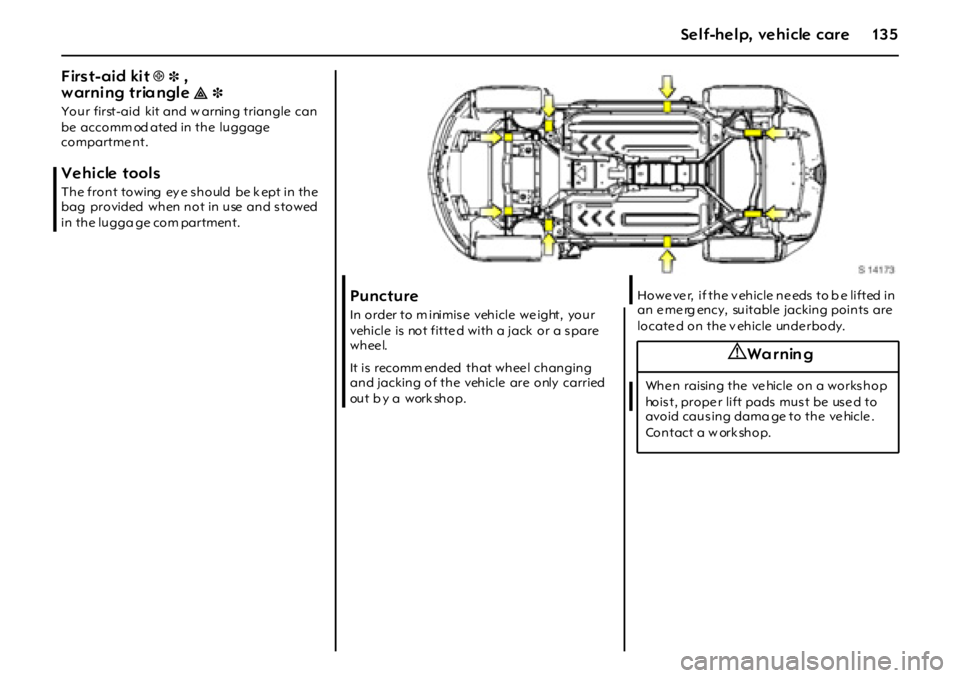
ou t b y a w or k sh o p .H o w e ve r, i f t h e v eh i cl e n e eds t o b e l i f t ed i n
an e me rg ency, suitable jacking points are
locate d on the v ehicle unde rbody.
9 Wa r nin g
When raising the vehicle on a workshop
hois t, prope r lift pads mus t be us e d to
avoid caus ing dama ge to the ve hicle .
Contact a w ork shop.
Page 136 of 190
136 Self-help, vehicle care
Tyre rep air k it
Minor damag e to the tyre tread, e.g . from
foreign bodie s, can be tem porarily
rep aire d using the ty re re pair kit.
Do not rem ov e foreign bodies from the
tyre s. Damage d are as bigger than 4 m m
and da mage at the ty re rim cannot be
rep aire d using the ty re re pair kit.
The tyre re pair k it can be use d to seal small
puncture s with a liquid seala nt. Use of the
sealant doe s not c onstitute a pe rmane nt
rep air but is des igned as an eme rgency
measure, to allow the vehicle to be driven
while awaiting tyre replace me nt.
The ty re re pair kit ca n also be used to
infla te the tyres to the c orre ct ty re pressure
(se e page 18 0 ) without us ing the s ea lant.For important information – s ee page 1 40 .
If you have a flat ty re:
zPark on a leve l, firm a nd non-s lippery
surface.
zSw itch on haz ard warning lamps , a pply
hand brak e, engage rev ers e ge ar and
switch off engine.
zC orre ctly s et up the warning triangle3.
W arning tria ngle – se e page 13 5 .
Nev er use the liquid sealant on more than
one tyre at a tim e.
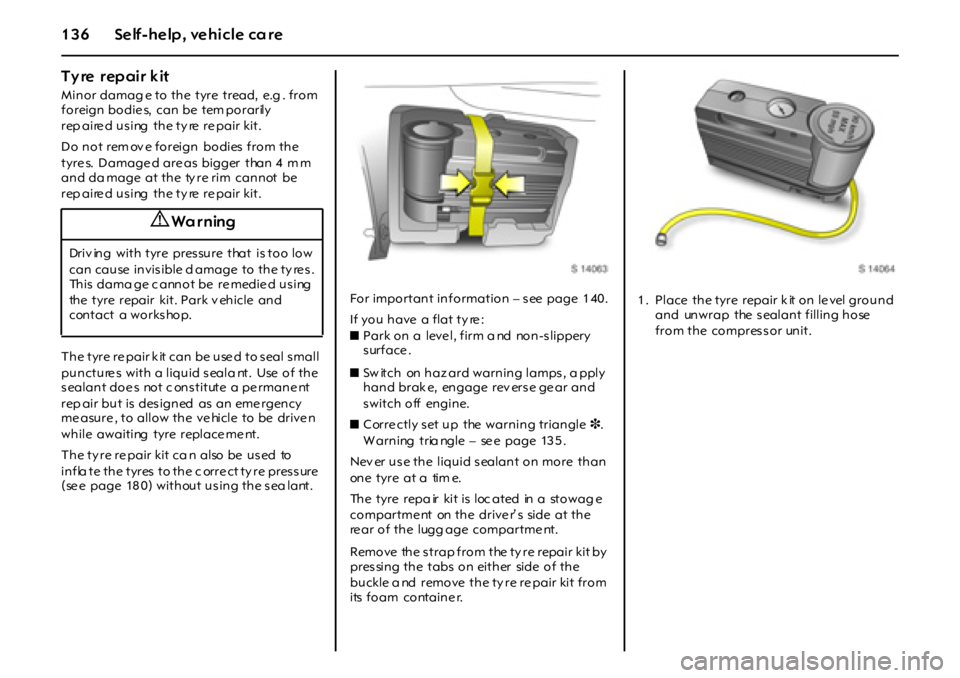
The tyre repa ir kit is loc ated in a stowag e
compartme nt on the drive r’ s side at the
re ar of the lugg age compartme nt.
Remove the strap from the ty re repair kit by
pressing the tabs on either side of the
buckle a nd remove the ty re re pair kit from
its foam containe r.
9 Wa r ning
Driv ing with tyre pressure that is too low
can cause invisible d amage to the ty re s.
This dama ge c annot be re medie d us ing
the tyre repair kit. Park v ehicle and
contact a works hop.
1 . Place the tyre repair k it on le vel ground
and unwrap the s ealant filling hose
from the compressor unit.
Page 138 of 190
138 Self-help, vehicle care
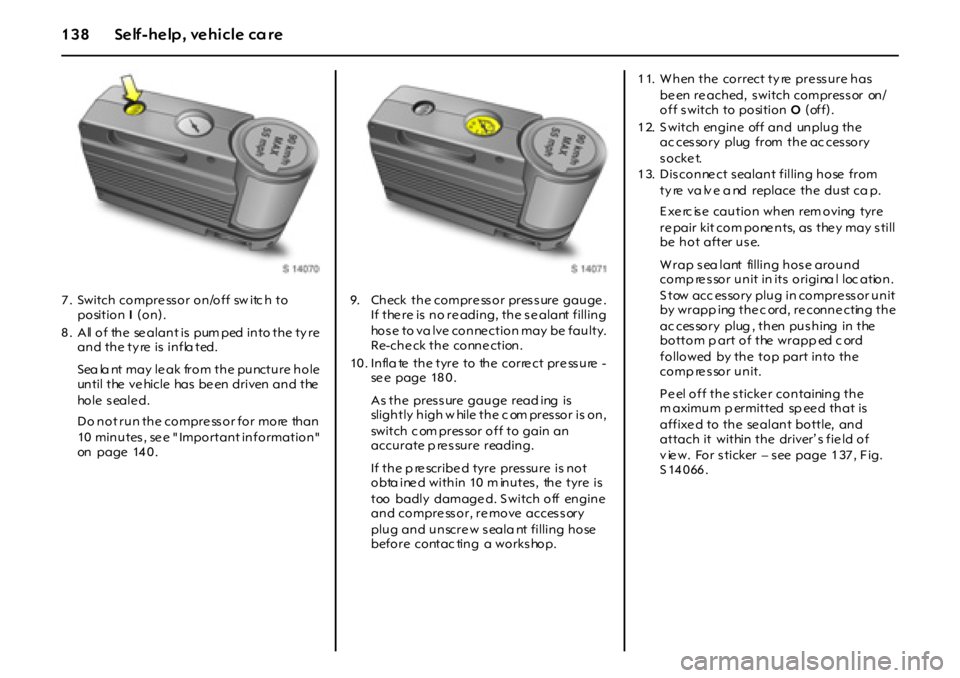
7 . Switch compre ss or on/off sw itc h to
position I(on).
8 . All of the se alant is pum ped into the ty re
and the ty re is infla ted.
Sea la nt may le ak from the puncture hole
un t i l t he v e hi c l e ha s b e en d r i v en a n d t he
ho l e s ea l e d .
Do not run the compressor for more than
10 minutes, see " Important information"
on page 14 0 .9. Check the compre ss or pres s ure gauge .
If the re is no re ading, the s e alant filling
hose to va lve conne ction may be faulty.
Re-che ck the conne ction.
10. Infla te the tyre to the corre ct pre ssure -
se e page 18 0 .
As the pres s ure gauge read ing is
slightly high w hile the c om pres sor is on,
switch c om pres sor off to gain an
accurate p re ssure reading.
If the p re scribe d tyre pressure is not
obta ine d within 10 m inutes , the tyre is
too badly damage d. S witch off engine
and compre ssor, re move accessory
plug and unscre w s eala nt filling hose
before contac ting a works hop.
11. When the correct ty re pressure has
be en re ached, switch compressor on/
off switch to position O(off).
1 2. S witch engine off and unplug the
ac ces sory plug from the ac ces sory
socket.
1 3. Dis conne ct s ealant filling hose from
ty re va lv e a nd replace the dust ca p.
E x e rc is e c a u t i o n w h en r em o v i ng t y r e
re pair kit com pone nts, as the y may s till
be hot after use.
W rap s ea lant filling hos e around
comp re s sor unit in its origina l loc ation.
S tow acc essory plug in compressor unit
by wrapp ing the c ord, re conne cting the
ac ces sory plug , then pus hing in the
bottom p art of the wrapp ed c ord
followed by the top part into the
comp ressor unit.
P e el o f f t h e s t i cke r co n t a i ni n g t h e
m aximum p ermitted sp ee d that is
affixe d to the se alant bottle, and
attach it within the driver’ s fie ld of
v ie w. For s ticker – s ee page 1 37 , F ig.
S14066.