automatic transmission OPEL GT-R 1973 Owner's Manual
[x] Cancel search | Manufacturer: OPEL, Model Year: 1973, Model line: GT-R, Model: OPEL GT-R 1973Pages: 625, PDF Size: 17.22 MB
Page 405 of 625
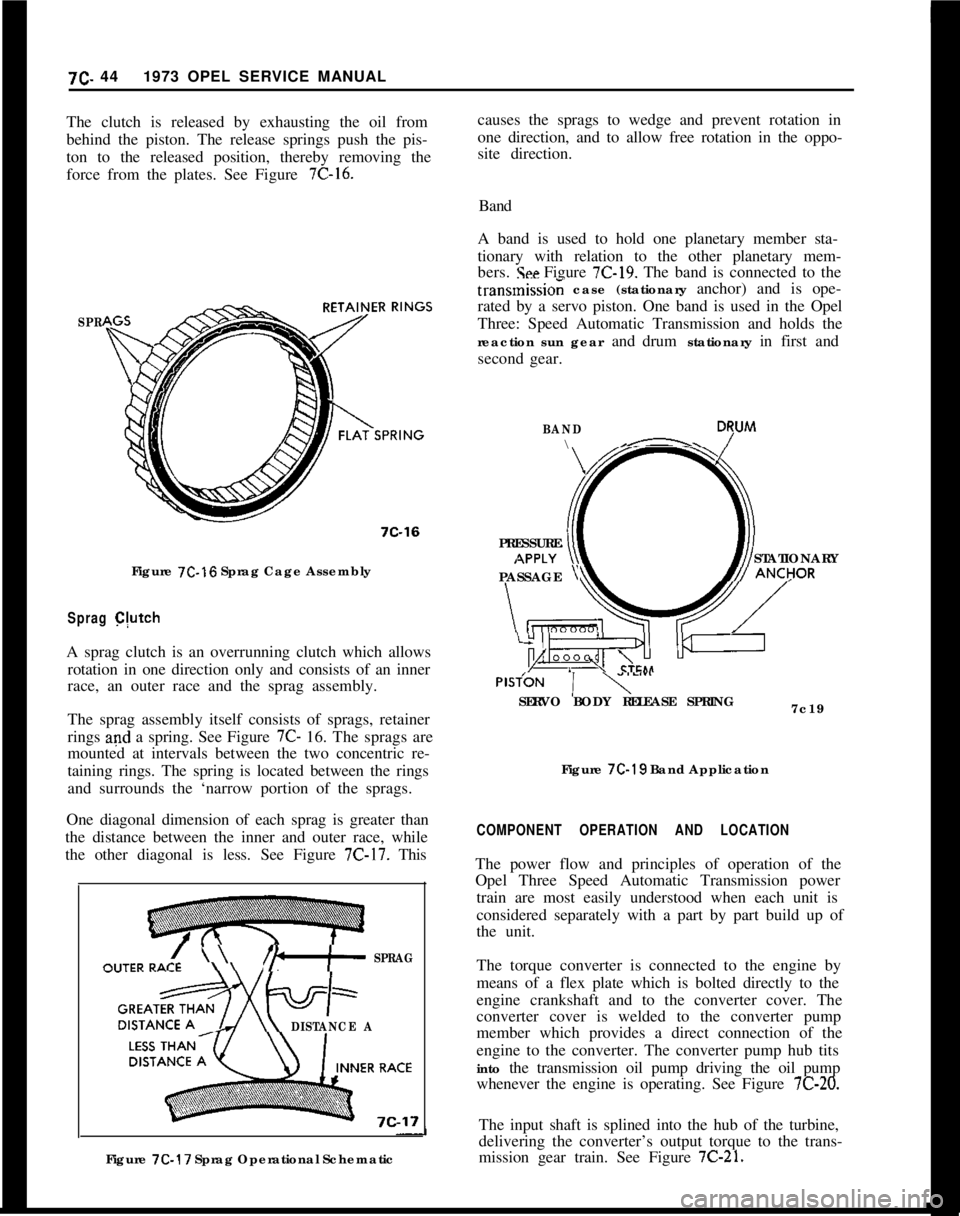
causes the sprags to wedge and prevent rotation in
one direction, and to allow free rotation in the oppo-
site direction.7C. 441973 OPEL SERVICE MANUAL
The clutch is released by exhausting the oil from
behind the piston. The release springs push the pis-
ton to the released position, thereby removing the
force from the plates. See Figure 7C-16.Band
A band is used to hold one planetary member sta-
tionary with relation to the other planetary mem-
bers.
!See Figure 7C-19. The band is connected to the
SPR
7C-16Figure
7C-16 Sprag Cage Assembly
Sprag C(utchA sprag clutch is an overrunning clutch which allows
rotation in one direction only and consists of an inner
race, an outer race and the sprag assembly.
The sprag assembly itself consists of sprags, retainer
rings and a spring. See Figure 7C- 16. The sprags are
mounted at intervals between the two concentric re-
taining rings. The spring is located between the rings
and surrounds the ‘narrow portion of the sprags.
One diagonal dimension of each sprag is greater than
the distance between the inner and outer race, while
the other diagonal is less. See Figure
7C-17. This
\ \I’b+ SPRAG
DISTANCE AFigure
7C-17 Sprag Operational Schematictransmissio; case (stationary anchor) and is ope-
rated by a servo piston. One band is used in the Opel
Three: Speed Automatic Transmission and holds the
reaction sun gear and drum stationary in first and
second gear.
BAND\- D7uM
PRESSURE
STATIONARY
PASSAGE
yPlSfON
1 y””SERVO BODY RELEASE SPRING
7c19
Figure
7C-19 Band Application
COMPONENT OPERATION AND LOCATIONThe power flow and principles of operation of the
Opel Three Speed Automatic Transmission power
train are most easily understood when each unit is
considered separately with a part by part build up of
the unit.
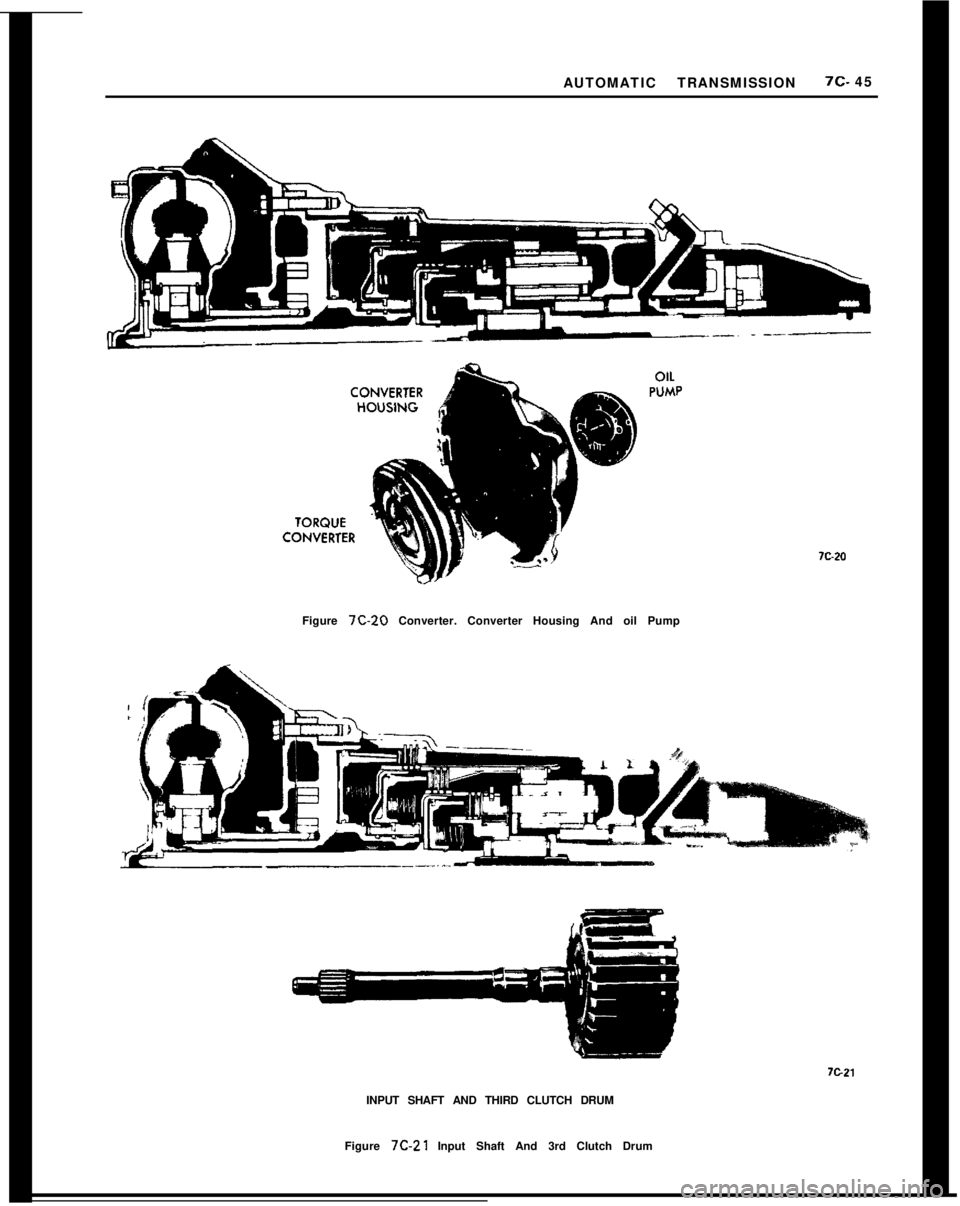
The torque converter is connected to the engine by
means of a flex plate which is bolted directly to the
engine crankshaft and to the converter cover. The
converter cover is welded to the converter pump
member which provides a direct connection of the
engine to the converter. The converter pump hub tits
into the transmission oil pump driving the oil pump
whenever the engine is operating. See Figure
7C-20.The input shaft is splined into the hub of the turbine,
delivering the converter’s output torque to the trans-
mission gear train. See Figure
7C-21.
Page 406 of 625
AUTOMATIC TRANSMISSION7c- 45
Figure 7C-20 Converter. Converter Housing And oil Pump
INPUT SHAFT AND THIRD CLUTCH DRUM
Figure 7C-21 Input Shaft And 3rd Clutch Drum
Page 408 of 625
AUTOMATIC TRANSMISSION7c- 47
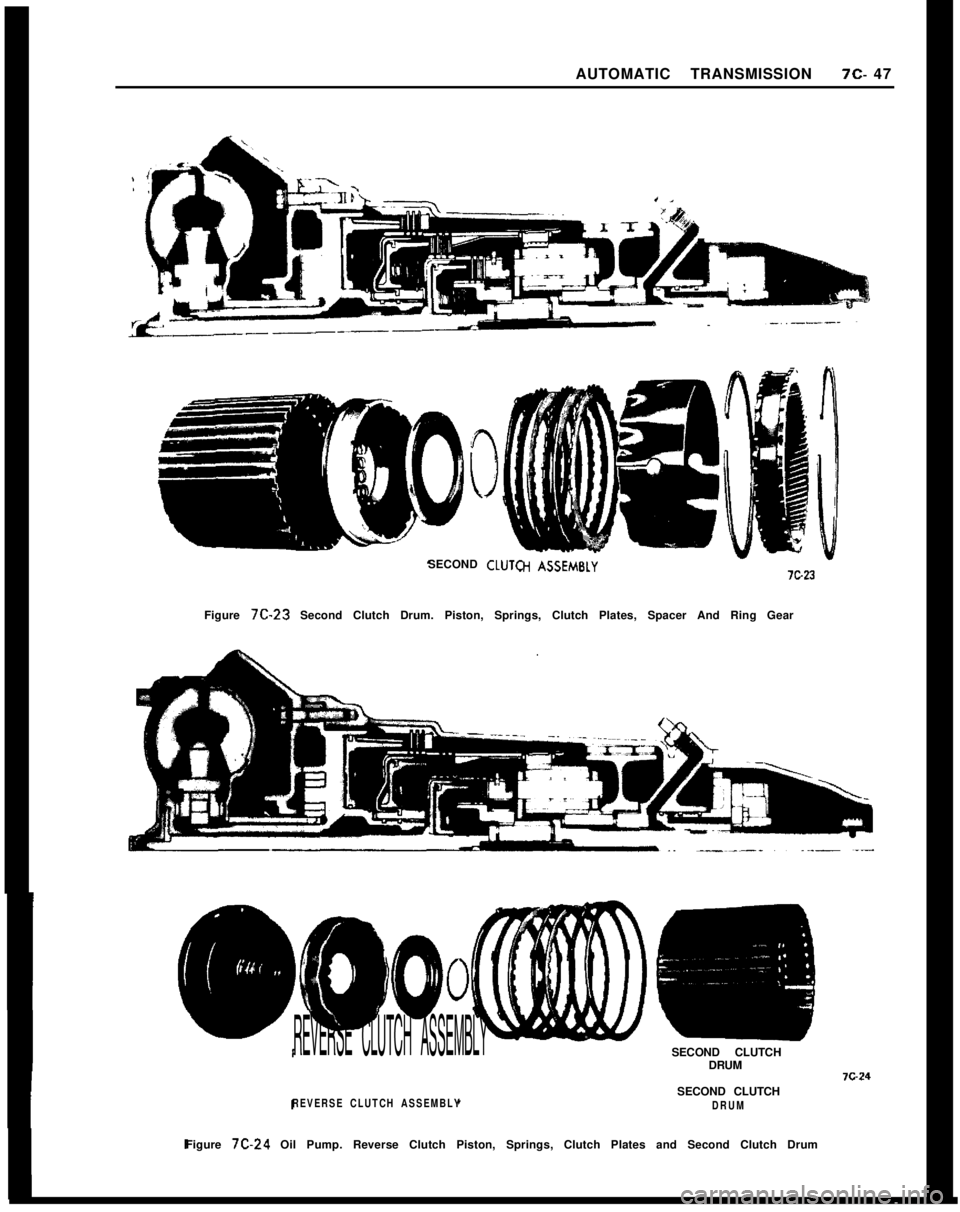
SECOND CtUTC7cz3
Figure 7C.23 Second Clutch Drum. Piston, Springs, Clutch Plates, Spacer And Ring Gear
REVERSE CLUTCH ASSEMBLYSECOND CLUTCH
DRUM
SECOND CLUTCH
REVERSE CLUTCH ASSEMBLY
DRUMFigure 7C-24 Oil Pump. Reverse Clutch Piston, Springs, Clutch Plates and Second Clutch Drum
Page 409 of 625
7C- 481973 OPEL SERVICE MANUAL
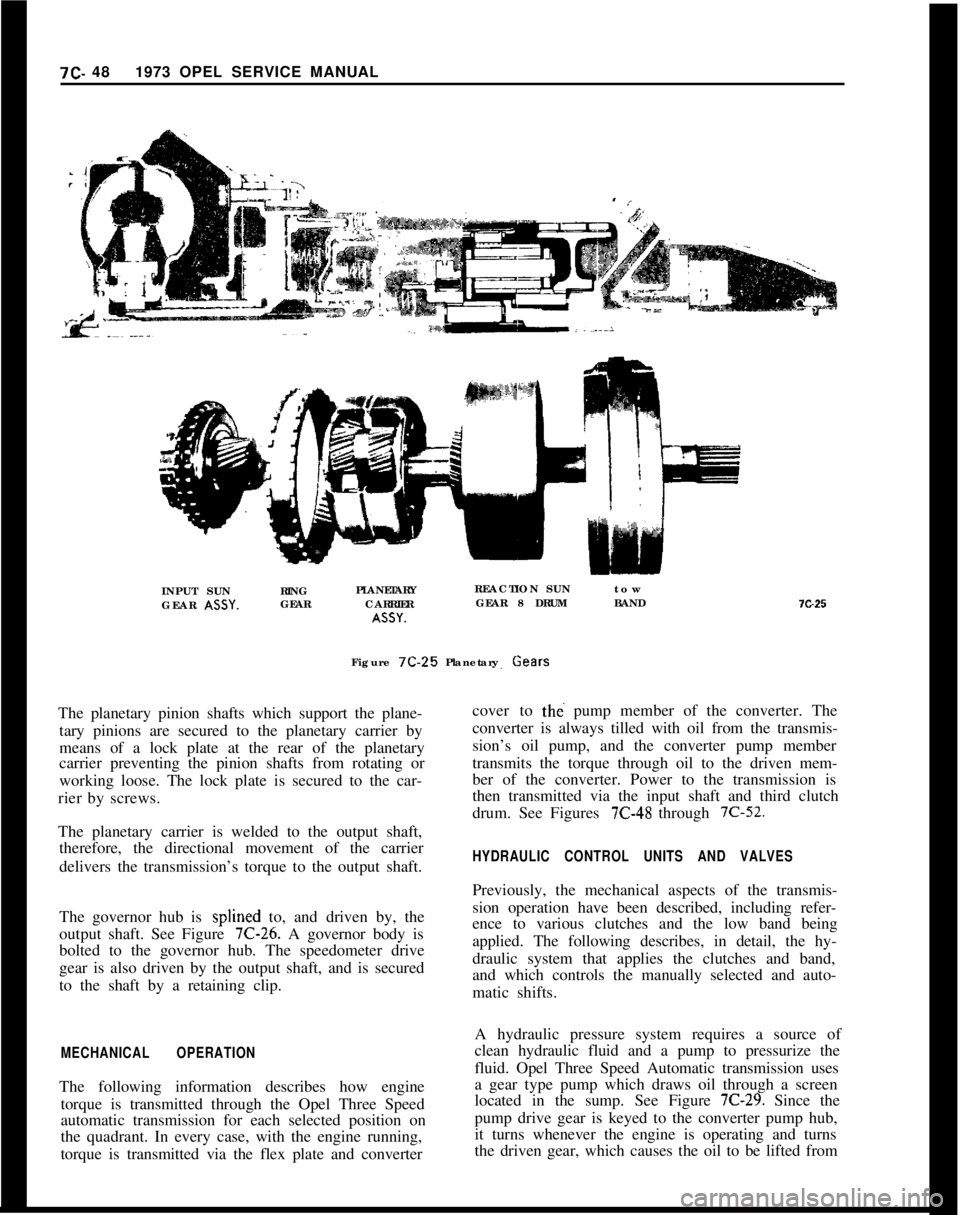
INPUT SUNRING
GEAR ASSY.GEARPLANETARY
CARRIERASSY.REACTION SUNtow
GEAR 8 DRUMBAND
Figure 7C-25Planetary Gears
The planetary pinion shafts which support the plane-
tary pinions are secured to the planetary carrier by
means of a lock plate at the rear of the planetary
carrier preventing the pinion shafts from rotating or
working loose. The lock plate is secured to the car-
rier by screws.
The planetary carrier is welded to the output shaft,
therefore, the directional movement of the carrier
delivers the transmission’s torque to the output shaft.
The governor hub is splined to, and driven by, the
output shaft. See Figure 7C-26. A governor body is
bolted to the governor hub. The speedometer drive
gear is also driven by the output shaft, and is secured
to the shaft by a retaining clip.
MECHANICAL OPERATIONThe following information describes how engine
torque is transmitted through the Opel Three Speed
automatic transmission for each selected position on
the quadrant. In every case, with the engine running,
torque is transmitted via the flex plate and converter7G25
cover to
tht? pump member of the converter. The
converter is always tilled with oil from the transmis-
sion’s oil pump, and the converter pump member
transmits the torque through oil to the driven mem-
ber of the converter. Power to the transmission is
then transmitted via the input shaft and third clutch
drum. See Figures
7C-48 through 7C-52.
HYDRAULIC CONTROL UNITS AND VALVESPreviously, the mechanical aspects of the transmis-
sion operation have been described, including refer-
ence to various clutches and the low band being
applied. The following describes, in detail, the hy-
draulic system that applies the clutches and band,
and which controls the manually selected and auto-
matic shifts.
A hydraulic pressure system requires a source of
clean hydraulic fluid and a pump to pressurize the
fluid. Opel Three Speed Automatic transmission uses
a gear type pump which draws oil through a screen
located in the sump. See Figure
7C-29. Since the
pump drive gear is keyed to the converter pump hub,
it turns whenever the engine is operating and turns
the driven gear, which causes the oil to be lifted from
Page 410 of 625
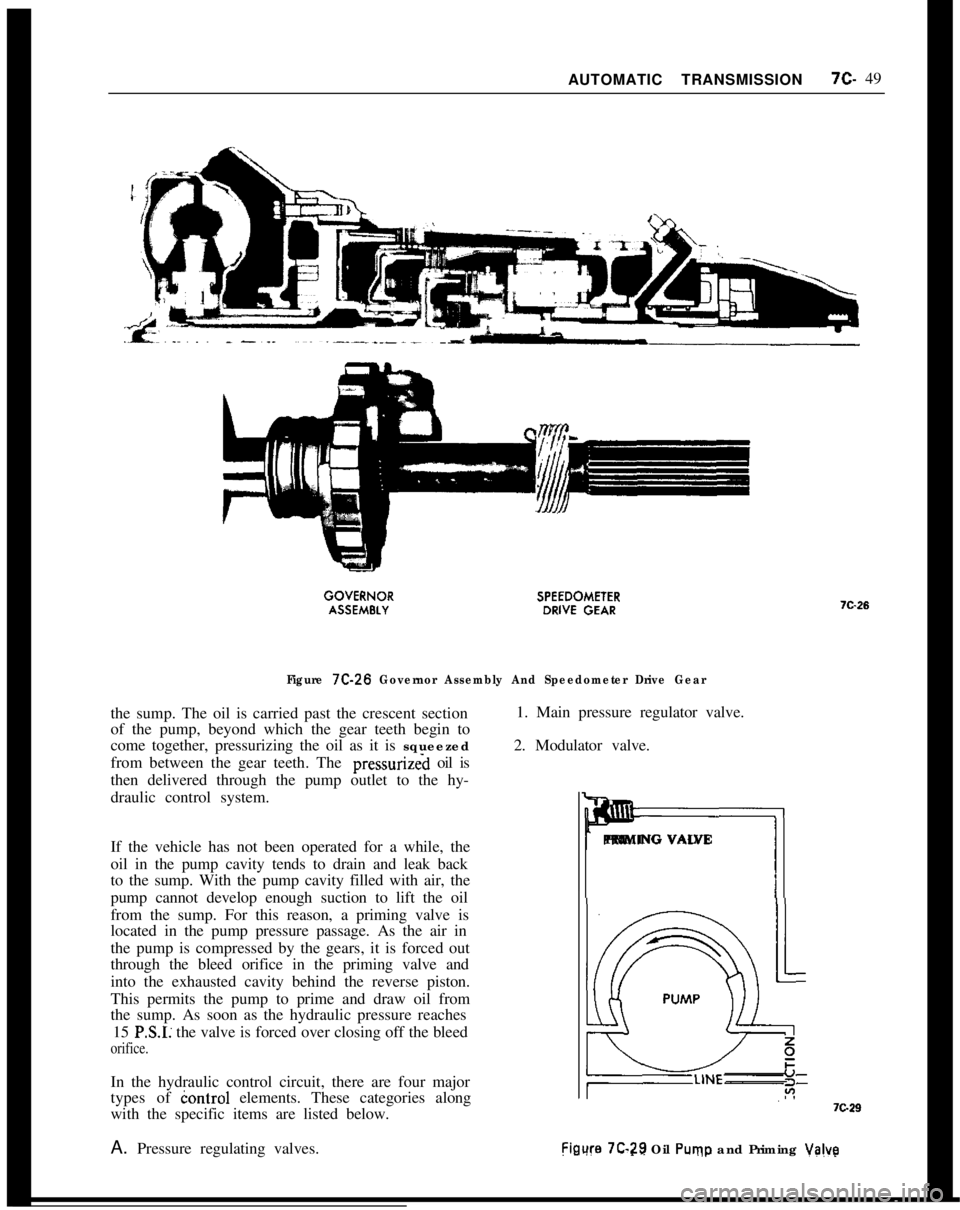
AUTOMATIC TRANSMISSION7c- 49Figure 7C-26 Governor Assembly And Speedometer Drive Gearthe sump. The oil is carried past the crescent section
of the pump, beyond which the gear teeth begin to
come together, pressurizing the oil as it is squeezed
from between the gear teeth. The pressurizeh oil is
then delivered through the pump outlet to the hy-
draulic control system.1. Main pressure regulator valve.
2. Modulator valve.
mPRIMING VALVE
If the vehicle has not been operated for a while, the
oil in the pump cavity tends to drain and leak back
to the sump. With the pump cavity filled with air, the
pump cannot develop enough suction to lift the oil
from the sump. For this reason, a priming valve is
located in the pump pressure passage. As the air in
the pump is compressed by the gears, it is forced out
through the bleed orifice in the priming valve and
into the exhausted cavity behind the reverse piston.
This permits the pump to prime and draw oil from
the sump. As soon as the hydraulic pressure reaches
15
PSI: the valve is forced over closing off the bleed
orifice.PRIMING VALVE
In the hydraulic control circuit, there are four major
types of iontrol elements. These categories along
with the specific items are listed below.
A. Pressure regulating valves.
Fieure 7C-7.9 Oil Puvp and Priming Valve
Page 412 of 625
AUTOMATIC TRANSMISSION7c-51VACUUM MODULATOR7c31
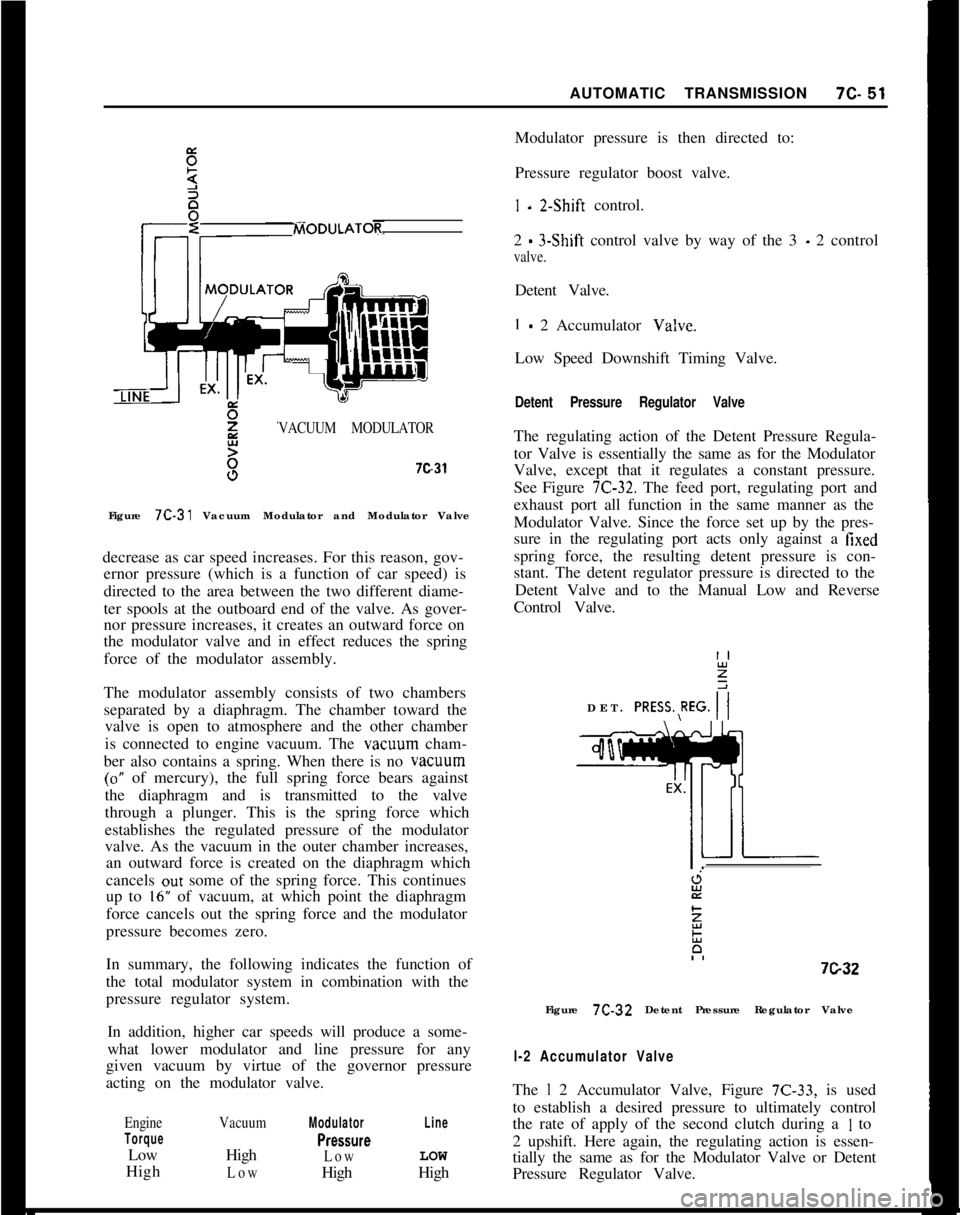
Figure 7C-31 Vacuum Modulator and Modulator Valve
decrease as car speed increases. For this reason, gov-
ernor pressure (which is a function of car speed) is
directed to the area between the two different diame-
ter spools at the outboard end of the valve. As gover-
nor pressure increases, it creates an outward force on
the modulator valve and in effect reduces the spring
force of the modulator assembly.
The modulator assembly consists of two chambers
separated by a diaphragm. The chamber toward the
valve is open to atmosphere and the other chamber
is connected to engine vacuum. The vacwm cham-
ber also contains a spring. When there is no vacuum
(0” of mercury), the full spring force bears against
the diaphragm and is transmitted to the valve
through a plunger. This is the spring force which
establishes the regulated pressure of the modulator
valve. As the vacuum in the outer chamber increases,
an outward force is created on the diaphragm which
cancels out some of the spring force. This continues
up to
16” of vacuum, at which point the diaphragm
force cancels out the spring force and the modulator
pressure becomes zero.
In summary, the following indicates the function of
the total modulator system in combination with the
pressure regulator system.
In addition, higher car speeds will produce a some-
what lower modulator and line pressure for any
given vacuum by virtue of the governor pressure
acting on the modulator valve.
Engine
TorqueLow
High
VacuumHigh
Low
Modulator
PreSSWe
LowHigh
LineLOW
HighModulator pressure is then directed to:
Pressure regulator boost valve.
I - 2.Shift control.
2
- 3-Shift control valve by way of the 3 - 2 control
valve.Detent Valve.
I - 2 Accumulator Va!ve.
Low Speed Downshift Timing Valve.
Detent Pressure Regulator ValveThe regulating action of the Detent Pressure Regula-
tor Valve is essentially the same as for the Modulator
Valve, except that it regulates a constant pressure.
See Figure
7C-32. The feed port, regulating port and
exhaust port all function in the same manner as the
Modulator Valve. Since the force set up by the pres-
sure in the regulating port acts only against a
fixedspring force, the resulting detent pressure is con-
stant. The detent regulator pressure is directed to the
Detent Valve and to the Manual Low and Reverse
Control Valve.
DET. PRESS.,REG.
i7G3-2
Figure 7C-32 Detent Pressure Regulator Valve
l-2 Accumulator ValveThe
I 2 Accumulator Valve, Figure 7C-33, is used
to establish a desired pressure to ultimately control
the rate of apply of the second clutch during a
I to
2 upshift. Here again, the regulating action is essen-
tially the same as for the Modulator Valve or Detent
Pressure Regulator Valve.
Page 414 of 625
AUTOMATIC TRANSMISSIONlC- 53
Manual ValveThe manual valve is mechanically connected to the
shift lever. Its function is to direct hydraulic pressure
to the various circuits to establish the base hydraulic
range of the transmission.
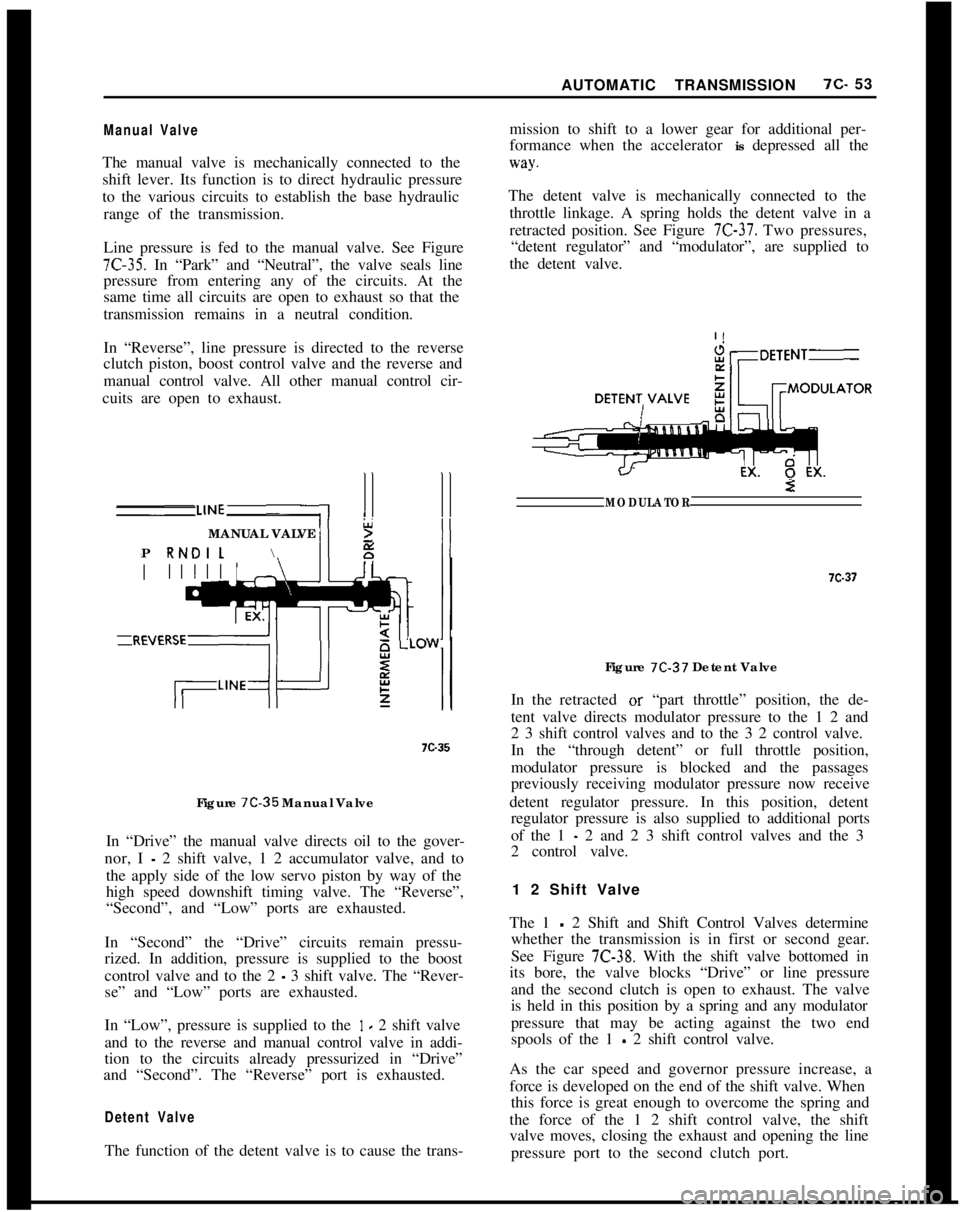
Line pressure is fed to the manual valve. See Figure
7C-35. In “Park” and “Neutral”, the valve seals line
pressure from entering any of the circuits. At the
same time all circuits are open to exhaust so that the
transmission remains in a neutral condition.
In “Reverse”, line pressure is directed to the reverse
clutch piston, boost control valve and the reverse and
manual control valve. All other manual control cir-
cuits are open to exhaust.
MANUAL VALVE
;i
\2
P RNDILII7D35
Figure
7C-35 Manual Valve
In “Drive” the manual valve directs oil to the gover-
nor, I
- 2 shift valve, 1 2 accumulator valve, and to
the apply side of the low servo piston by way of the
high speed downshift timing valve. The “Reverse”,
“Second”, and “Low” ports are exhausted.
In “Second” the “Drive” circuits remain pressu-
rized. In addition, pressure is supplied to the boost
control valve and to the 2
- 3 shift valve. The “Rever-
se” and “Low” ports are exhausted.
In “Low”, pressure is supplied to the
1 - 2 shift valve
and to the reverse and manual control valve in addi-
tion to the circuits already pressurized in “Drive”
and “Second”. The “Reverse” port is exhausted.
Detent ValveThe function of the detent valve is to cause the trans-mission to shift to a lower gear for additional per-
formance when the accelerator is depressed all the
way.The detent valve is mechanically connected to the
throttle linkage. A spring holds the detent valve in a
retracted position. See Figure
7C-37. Two pressures,
“detent regulator” and “modulator”, are supplied to
the detent valve.
iiiDETENTE2
MODULATORFigure
7C-37 Detent Valve
In the retracted or “part throttle” position, the de-
tent valve directs modulator pressure to the 1 2 and
2 3 shift control valves and to the 3 2 control valve.
In the “through detent” or full throttle position,
modulator pressure is blocked and the passages
previously receiving modulator pressure now receive
detent regulator pressure. In this position, detent
regulator pressure is also supplied to additional ports
of the 1
- 2 and 2 3 shift control valves and the 3
2 control valve.
1 2 Shift Valve
The 1
- 2 Shift and Shift Control Valves determine
whether the transmission is in first or second gear.
See Figure
7C-38. With the shift valve bottomed in
its bore, the valve blocks “Drive” or line pressure
and the second clutch is open to exhaust. The valve
is held in this position by a spring and any modulator
pressure that may be acting against the two end
spools of the 1
- 2 shift control valve.
As the car speed and governor pressure increase, a
force is developed on the end of the shift valve. When
this force is great enough to overcome the spring and
the force of the 1 2 shift control valve, the shift
valve moves, closing the exhaust and opening the line
pressure port to the second clutch port.
Page 416 of 625
AUTOMATIC TRANSMISSION7c- 55
valve will be held in downshifted, or second gear,
condition regardless of car speed.
Manual Low and Reverse Control Valve
As described in the text on “Mechanical Operation”,
the third clutch is applied in manual “Low” and in
“Reverse” to prevent a free wheeling condition. In
“Drive” range third gear, third clutch pressure is
also directed to the release side of the low servo (to
be covered later). This is the pressure which causes
the low band to release during a 2-3 upshift. How-
ever, in manual low, the band must remain applied
even though the third clutch is on.
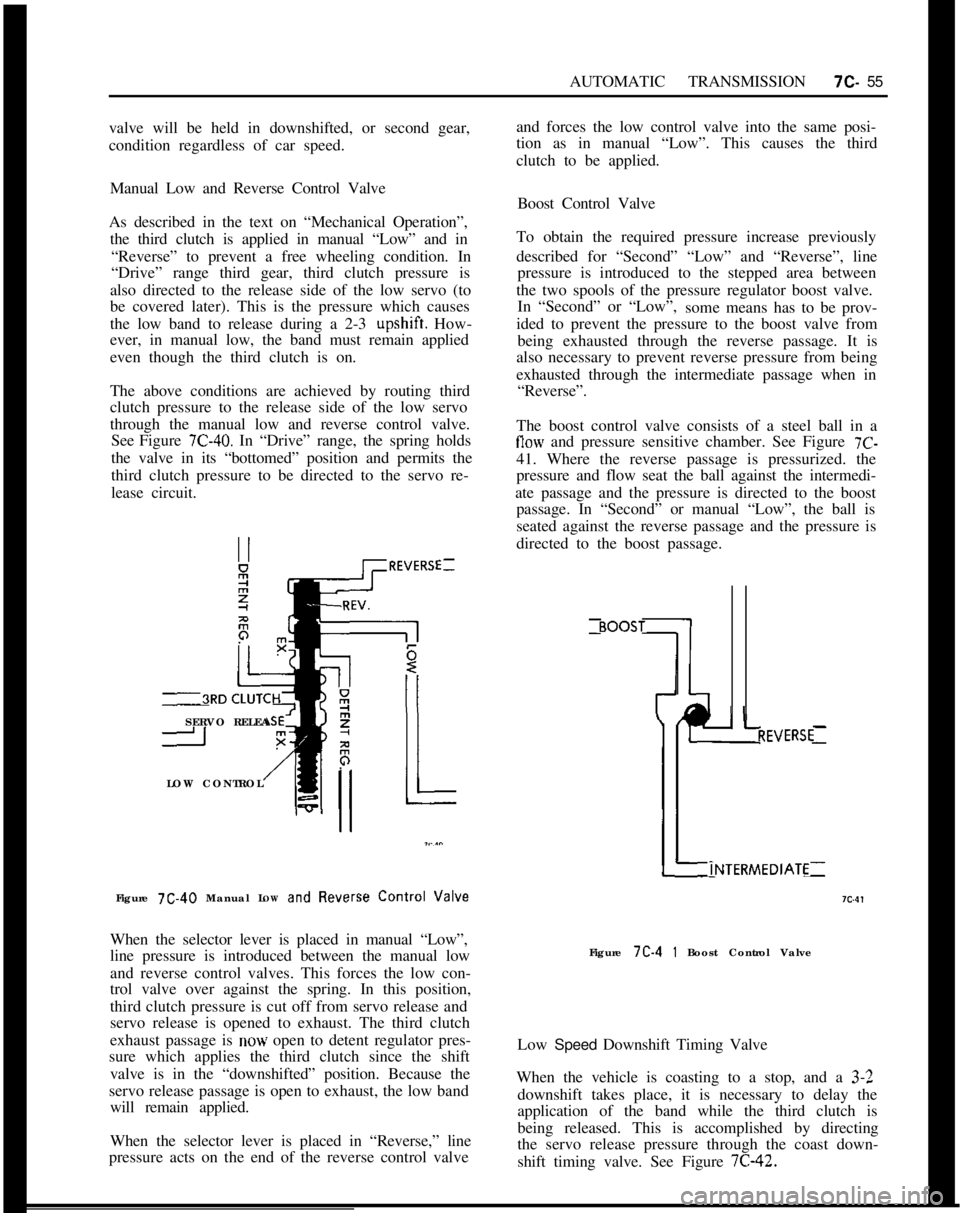
The above conditions are achieved by routing third
clutch pressure to the release side of the low servo
through the manual low and reverse control valve.
See Figure 7C-40. In “Drive” range, the spring holds
the valve in its “bottomed” position and permits the
third clutch pressure to be directed to the servo re-
lease circuit.
_~RDSERVO RELEA
ILOW CONTROL
Figure 7C-40 Manual LOW
and Ftever~e Control Valve
When the selector lever is placed in manual “Low”,
line pressure is introduced between the manual low
and reverse control valves. This forces the low con-
trol valve over against the spring. In this position,
third clutch pressure is cut off from servo release and
servo release is opened to exhaust. The third clutch
exhaust passage is now open to detent regulator pres-
sure which applies the third clutch since the shift
valve is in the “downshifted” position. Because the
servo release passage is open to exhaust, the low band
will remain applied.
When the selector lever is placed in “Reverse,” line
pressure acts on the end of the reverse control valveand forces the low control valve into the same posi-
tion as in manual “Low”. This causes the third
clutch to be applied.
Boost Control Valve
To obtain the required pressure increase previously
described for “Second” “Low” and “Reverse”, line
pressure is introduced to the stepped area between
the two spools of the pressure regulator boost valve.
In “Second” or “Low”,
some means has to be prov-
ided to prevent the pressure to the boost valve from
being exhausted through the reverse passage. It is
also necessary to prevent reverse pressure from being
exhausted through the intermediate passage when in
“Reverse”.
The boost control valve consists of a steel ball in a
flow and pressure sensitive chamber. See Figure 7C-41. Where the reverse passage is pressurized. the
pressure and flow seat the ball against the intermedi-
ate passage and the pressure is directed to the boost
passage. In “Second” or manual “Low”, the ball is
seated against the reverse passage and the pressure is
directed to the boost passage.
t-INTERMEDIATE
7c.4,
I I
REVERSE:Figure 7C-4
1 Boost Control Valve
Low Speed Downshift Timing Valve
When the vehicle is coasting to a stop, and a
3-2downshift takes place, it is necessary to delay the
application of the band while the third clutch is
being released. This is accomplished by directing
the servo release pressure through the coast down-
shift timing valve. See Figure 7C-42.
Page 418 of 625
AUTOMATIC TRANSMISSION7c-57
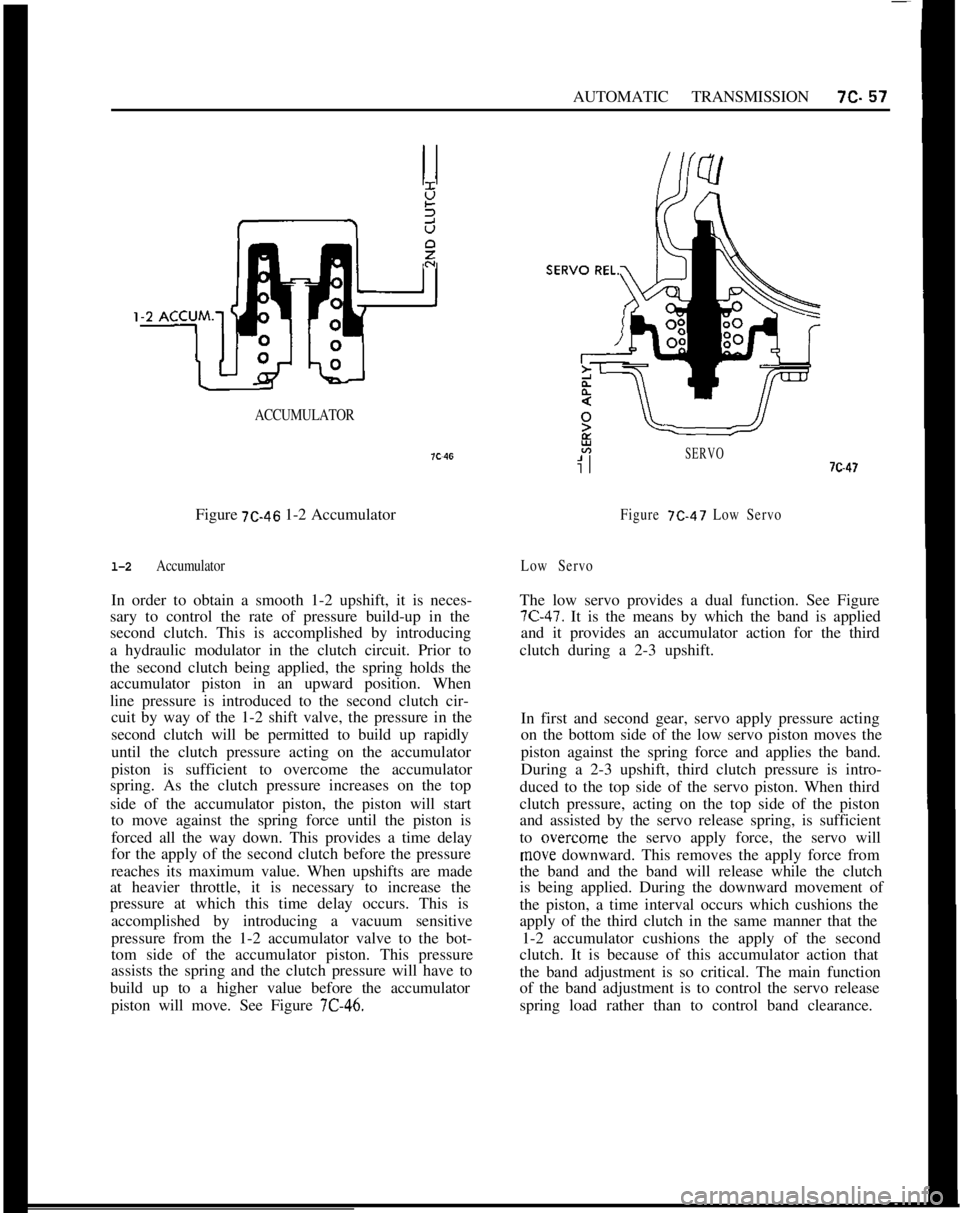
ACCUMULATORFigure
7C-46 1-2 Accumulator
l-2 AccumulatorIn order to obtain a smooth 1-2 upshift, it is neces-
sary to control the rate of pressure build-up in the
second clutch. This is accomplished by introducing
a hydraulic modulator in the clutch circuit. Prior to
the second clutch being applied, the spring holds the
accumulator piston in an upward position. When
line pressure is introduced to the second clutch cir-
cuit by way of the 1-2 shift valve, the pressure in the
second clutch will be permitted to build up rapidly
until the clutch pressure acting on the accumulator
piston is sufficient to overcome the accumulator
spring. As the clutch pressure increases on the top
side of the accumulator piston, the piston will start
to move against the spring force until the piston is
forced all the way down. This provides a time delay
for the apply of the second clutch before the pressure
reaches its maximum value. When upshifts are made
at heavier throttle, it is necessary to increase the
pressure at which this time delay occurs. This is
accomplished by introducing a vacuum sensitive
pressure from the 1-2 accumulator valve to the bot-
tom side of the accumulator piston. This pressure
assists the spring and the clutch pressure will have to
build up to a higher value before the accumulator
piston will move. See Figure
7C-46.
SERVO7c-47
Figure 7C-47 Low Servo
Low ServoThe low servo provides a dual function. See Figure
7C-47. It is the means by which the band is applied
and it provides an accumulator action for the third
clutch during a 2-3 upshift.
In first and second gear, servo apply pressure acting
on the bottom side of the low servo piston moves the
piston against the spring force and applies the band.
During a 2-3 upshift, third clutch pressure is intro-
duced to the top side of the servo piston. When third
clutch pressure, acting on the top side of the piston
and assisted by the servo release spring, is sufficient
to overcome the servo apply force, the servo will
move downward. This removes the apply force from
the band and the band will release while the clutch
is being applied. During the downward movement of
the piston, a time interval occurs which cushions the
apply of the third clutch in the same manner that the
1-2 accumulator cushions the apply of the second
clutch. It is because of this accumulator action that
the band adjustment is so critical. The main function
of the band adjustment is to control the servo release
spring load rather than to control band clearance.
Page 420 of 625
AUTOMATIC TRANSMISSION7c- 59
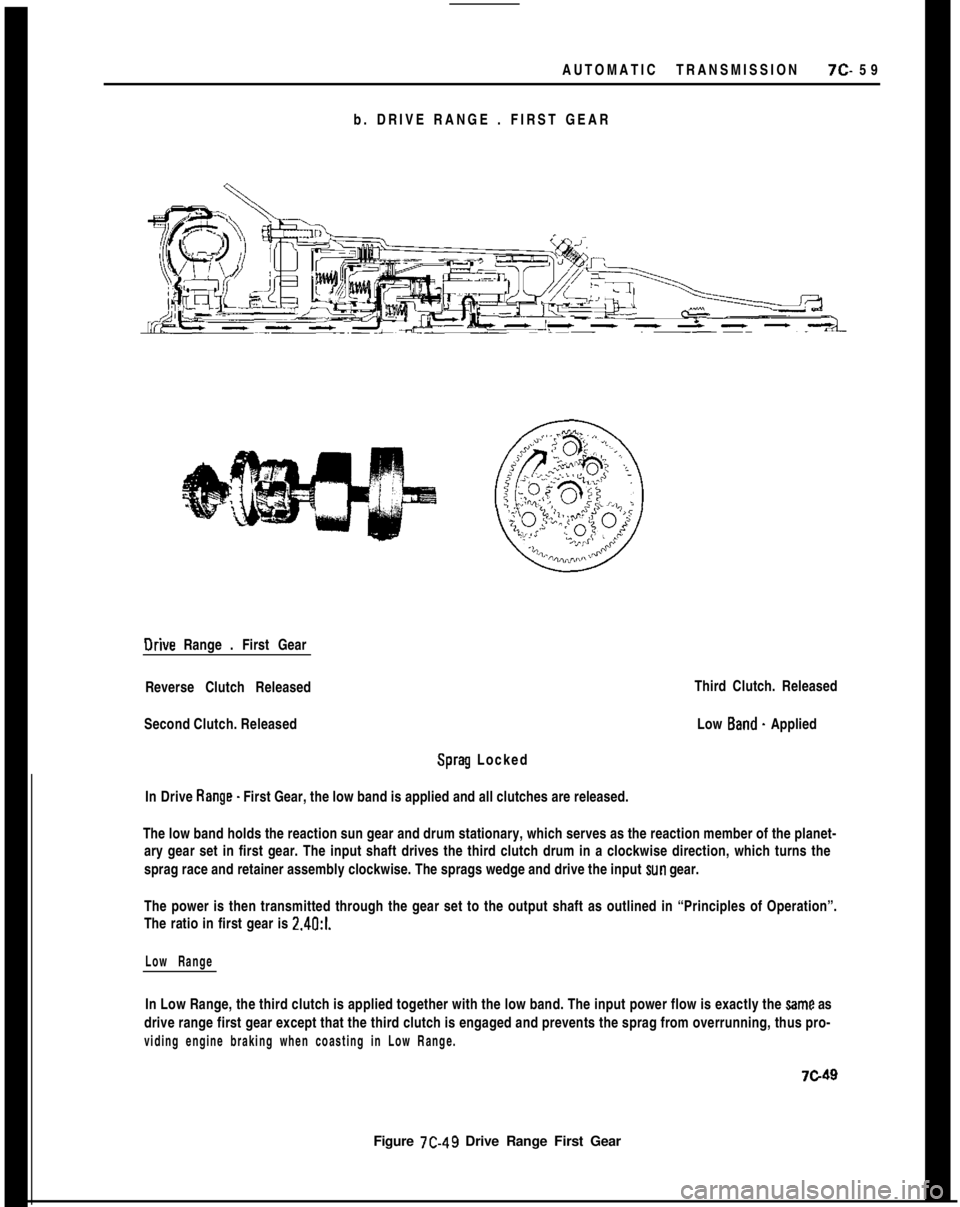
b. DRIVE RANGE . FIRST GEAROrive Range . First Gear
Reverse Clutch Released
Second Clutch. Released
Sprag Locked
In Drive Range. First Gear, the low band is applied and all clutches are released.
Figure 7C-49 Drive Range First GearThird Clutch. Released
Low Band. Applied
The low band holds the reaction sun gear and drum stationary, which serves as the reaction member of the planet-
ary gear set in first gear. The input shaft drives the third clutch drum in a clockwise direction, which turns the
sprag race and retainer assembly clockwise. The sprags wedge and drive the input
sun gear.
The power is then transmitted through the gear set to the output shaft as outlined in “Principles of Operation”.
The ratio in first gear is 2.4O:l.
Low RangeIn Low Range, the third clutch is applied together with the low band. The input power flow is exactly the
Same as
drive range first gear except that the third clutch is engaged and prevents the sprag from overrunning, thus pro-
viding engine braking when coasting in Low Range.
7c49