sport mode OPEL INSIGNIA 2017 Manual user
[x] Cancel search | Manufacturer: OPEL, Model Year: 2017, Model line: INSIGNIA, Model: OPEL INSIGNIA 2017Pages: 327, PDF Size: 9.3 MB
Page 173 of 327

Driving and operating171Temporary manual mode in drive
mode D
Manual paddle shifting is also
possible in automatic mode D. Upon
completion of manual shifting
operation, transmission changes to
automatic mode D after a defined
time.
To interrupt manual mode, do one of
the following:
● Press < paddle for 1 second.
● Move selector lever towards the left to manual mode and back to
position D.
If the vehicle is at a standstill and
engine is idling, the transmission will remain in temporary manual mode. It
changes to automatic mode when
accelerator pedal is operated for a
defined time, and no paddle shifting
at the steering wheel is performed.
General
If a higher gear is selected when
vehicle speed is too low, or a lower
gear when vehicle speed is too high,the shift is not executed. This can
cause a message in the Driver
Information Centre.
In manual mode, no automatic
shifting to a higher gear takes place
at high engine revolutions.
Gear shift indication
The symbol R with a number below it
is indicated when gearshifting is
recommended for fuel saving
reasons.
Shift indication appears only in
manual mode.
Electronic driving programmes
● Following a cold start, the operating temperature
programme increases engine
speed to quickly bring the
catalytic converter to the required
temperature.
● The automatic neutral shift function automatically shifts to
idling when the vehicle is stopped
with a forward gear engaged and the brake pedal is pressed.● When SPORT mode is engaged,
the vehicle shifts at higher engine
speeds (unless cruise control is
on). SPORT mode 3 179.
● Special programmes automatically adapt the shifting
points when driving up inclines or down hills.
● When starting off in snowy or icy conditions or on other slippery
surfaces, the electronic
transmission control selects a
higher gear automatically.
Kickdown
If the accelerator pedal is pressed
down completely in automatic mode, the transmission shifts to a lower gear
depending on engine speed.
Overheat protection In the event of transmission-
overheating due to high outside
temperatures or sporty driving style,
the torque and the maximum speed of
the engine can be temporarily
reduced.
Page 181 of 327
Driving and operating179Interactive driving systemFlex Ride
Flex Ride driving system allows the
driver to select between three driving
modes:
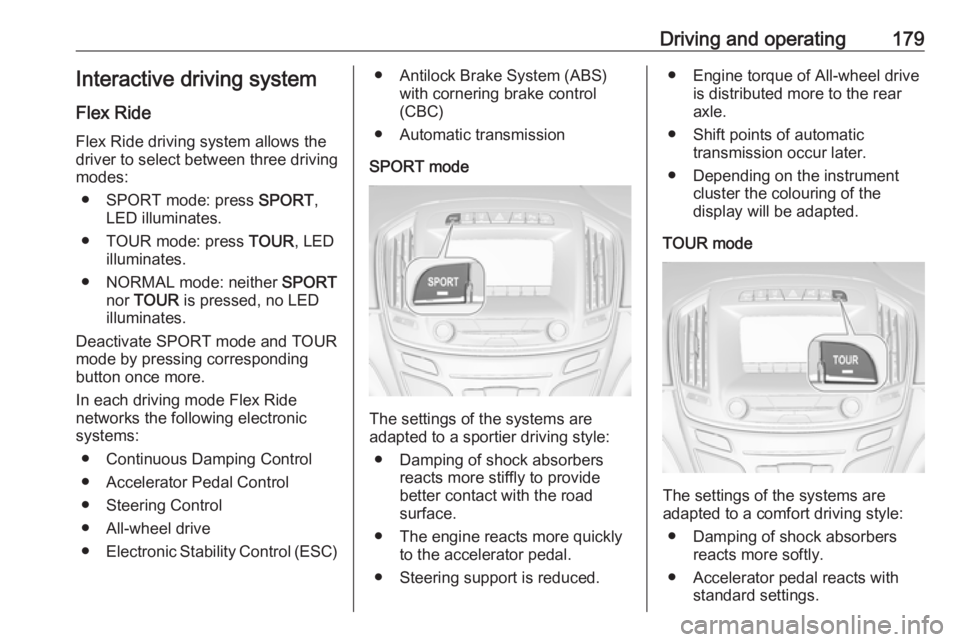
● SPORT mode: press SPORT,
LED illuminates.
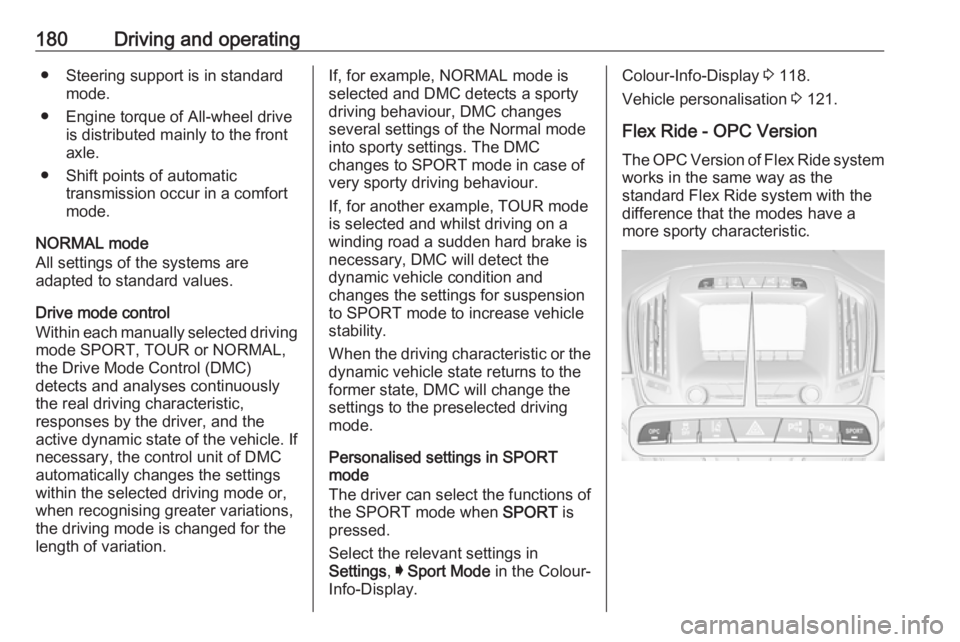
● TOUR mode: press TOUR, LED
illuminates.
● NORMAL mode: neither SPORT
nor TOUR is pressed, no LED
illuminates.
Deactivate SPORT mode and TOUR
mode by pressing corresponding
button once more.
In each driving mode Flex Ride
networks the following electronic
systems:
● Continuous Damping Control
● Accelerator Pedal Control
● Steering Control
● All-wheel drive
● Electronic Stability Control (ESC)● Antilock Brake System (ABS)
with cornering brake control
(CBC)
● Automatic transmission
SPORT mode
The settings of the systems are
adapted to a sportier driving style:
● Damping of shock absorbers reacts more stiffly to providebetter contact with the road
surface.
● The engine reacts more quickly to the accelerator pedal.
● Steering support is reduced.
● Engine torque of All-wheel drive is distributed more to the rear
axle.
● Shift points of automatic transmission occur later.
● Depending on the instrument cluster the colouring of the
display will be adapted.
TOUR mode
The settings of the systems are
adapted to a comfort driving style:
● Damping of shock absorbers reacts more softly.
● Accelerator pedal reacts with standard settings.
Page 182 of 327
180Driving and operating● Steering support is in standardmode.
● Engine torque of All-wheel drive is distributed mainly to the front
axle.
● Shift points of automatic transmission occur in a comfort
mode.
NORMAL mode
All settings of the systems are
adapted to standard values.
Drive mode control
Within each manually selected driving mode SPORT, TOUR or NORMAL,
the Drive Mode Control (DMC)
detects and analyses continuously the real driving characteristic,
responses by the driver, and the
active dynamic state of the vehicle. If
necessary, the control unit of DMC
automatically changes the settings
within the selected driving mode or, when recognising greater variations,
the driving mode is changed for the
length of variation.If, for example, NORMAL mode is
selected and DMC detects a sporty
driving behaviour, DMC changes
several settings of the Normal mode
into sporty settings. The DMC
changes to SPORT mode in case of
very sporty driving behaviour.
If, for another example, TOUR mode
is selected and whilst driving on a
winding road a sudden hard brake is
necessary, DMC will detect the
dynamic vehicle condition and
changes the settings for suspension
to SPORT mode to increase vehicle
stability.
When the driving characteristic or the
dynamic vehicle state returns to the
former state, DMC will change the
settings to the preselected driving
mode.
Personalised settings in SPORT
mode
The driver can select the functions of
the SPORT mode when SPORT is
pressed.
Select the relevant settings in
Settings , I Sport Mode in the Colour-
Info-Display.Colour-Info-Display 3 118.
Vehicle personalisation 3 121.
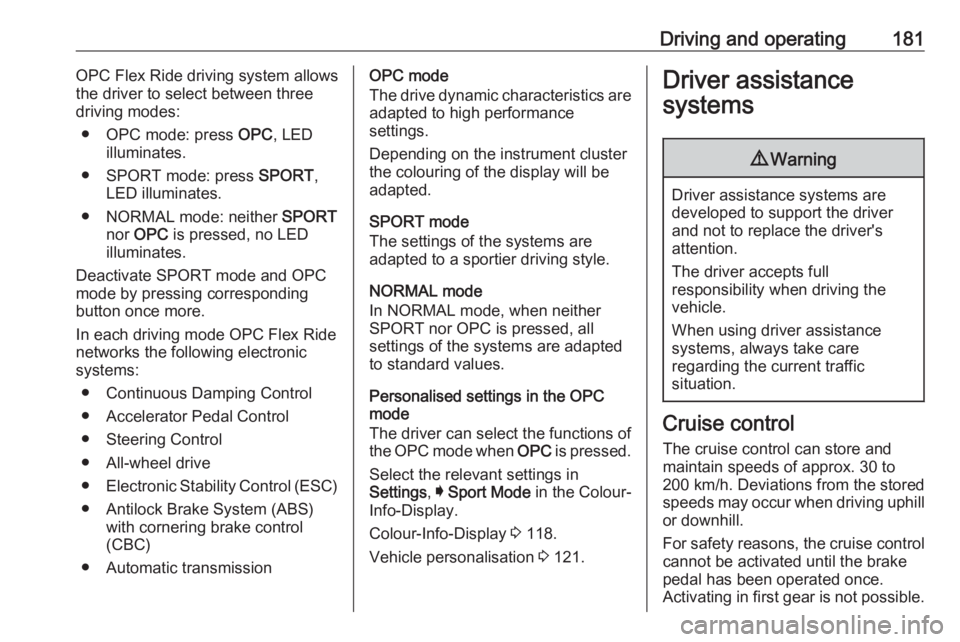
Flex Ride - OPC Version The OPC Version of Flex Ride system works in the same way as the
standard Flex Ride system with the
difference that the modes have a
more sporty characteristic.
Page 183 of 327
Driving and operating181OPC Flex Ride driving system allows
the driver to select between three
driving modes:
● OPC mode: press OPC, LED
illuminates.
● SPORT mode: press SPORT,
LED illuminates.
● NORMAL mode: neither SPORT
nor OPC is pressed, no LED
illuminates.
Deactivate SPORT mode and OPC
mode by pressing corresponding
button once more.
In each driving mode OPC Flex Ride
networks the following electronic
systems:
● Continuous Damping Control
● Accelerator Pedal Control
● Steering Control
● All-wheel drive
● Electronic Stability Control (ESC)
● Antilock Brake System (ABS) with cornering brake control
(CBC)
● Automatic transmissionOPC mode
The drive dynamic characteristics are
adapted to high performance
settings.
Depending on the instrument cluster the colouring of the display will beadapted.
SPORT mode
The settings of the systems are
adapted to a sportier driving style.
NORMAL mode
In NORMAL mode, when neither SPORT nor OPC is pressed, all
settings of the systems are adapted
to standard values.
Personalised settings in the OPC mode
The driver can select the functions of
the OPC mode when OPC is pressed.
Select the relevant settings in
Settings , I Sport Mode in the Colour-
Info-Display.
Colour-Info-Display 3 118.
Vehicle personalisation 3 121.Driver assistance
systems9 Warning
Driver assistance systems are
developed to support the driver
and not to replace the driver's
attention.
The driver accepts full
responsibility when driving the
vehicle.
When using driver assistance
systems, always take care
regarding the current traffic
situation.
Cruise control
The cruise control can store and
maintain speeds of approx. 30 to
200 km/h. Deviations from the stored
speeds may occur when driving uphill or downhill.
For safety reasons, the cruise control cannot be activated until the brake
pedal has been operated once.
Activating in first gear is not possible.
Page 186 of 327

184Driving and operating
Control indicator L in the instrument
cluster illuminates green.
If the vehicle is equipped with Uplevel
display and Sport mode is selected
3 111, the scale of the speedometer
is only indicated up to the set speed
limit. The speed limiter setting is
marked by a green dot, it changes to
white when the system is active but not engaged.
Change speed limit
With speed limiter active, hold or
briefly turn thumb wheel to RES/+ to
increase or SET/- to decrease the
desired maximum speed.
Exceeding the speed limit
When exceeding the limited speed
without driver input, the speed will
flash in the Driver Information Centre
and a chime sounds during this
period.
In the event of an emergency, it is possible to exceed the speed limit by
depressing the accelerator pedal
firmly nearly to the final point. In this
case no chime appears.
Release the accelerator pedal and
the speed limiter function is
reactivated once a speed lower than
the limit speed is obtained.
Deactivation Press y: speed limiter is deactivated
and the vehicle can be driven without
speed limit.
On midlevel or uplevel display L
changes to white. Additionally, a
corresponding message appears.
Speed limiter is deactivated, but not
switched off. Last stored speed
remains in memory for later speed
resume.Resume limit speed
Turn thumb wheel to RES/+. The
stored speed limit will be obtained.
Switching off Press L, the speed limit indication in
the Driver Information Centre extinguishes. The stored speed is
deleted.
By pressing m to activate cruise
control or adaptive cruise control,
speed limiter is also deactivated and
the stored speed is deleted.
By switching off the ignition, speed
limiter is also deactivated, but the
speed limit will be stored for next
speed limiter activation.
Adaptive cruise control
Adaptive cruise control (ACC) is an
enhancement to traditional cruise
control with the additional feature of maintaining a certain distance behind the vehicle ahead.
Adaptive cruise control automatically
decelerates the vehicle when
approaching a slower moving vehicle.
Page 293 of 327
![OPEL INSIGNIA 2017 Manual user Technical data291Kerb weight, basic model without any optional equipmentSports TourerEngineManual transmissionAutomatic transmission[kg]B14NET1613–B14NET LPG1664–B16SHL17011701B18XER1613–B20NHT1](/img/37/18860/w960_18860-292.png "OPEL INSIGNIA 2017 Manual user Technical data291Kerb weight, basic model without any optional equipmentSports TourerEngineManual transmissionAutomatic transmission[kg]B14NET1613–B14NET LPG1664–B16SHL17011701B18XER1613–B20NHT1")
Technical data291Kerb weight, basic model without any optional equipmentSports TourerEngineManual transmissionAutomatic transmission[kg]B14NET1613–B14NET LPG1664–B16SHL17011701B18XER1613–B20NHT17011733B20NHT - All-wheel drive18431843B28NER - All-wheel drive19401953[kg]B16DTJ1664–B16DTH16641701B20DTH17331743B20DTH - All-wheel drive18651901
Page 294 of 327
![OPEL INSIGNIA 2017 Manual user 292Technical dataKerb weight, basic model without any optional equipmentCountry TourerEngineManual transmissionAutomatic transmission[kg]B16SHL - Front-wheel-drive17011701B20NHT - All-wheel drive18431](/img/37/18860/w960_18860-293.png "OPEL INSIGNIA 2017 Manual user 292Technical dataKerb weight, basic model without any optional equipmentCountry TourerEngineManual transmissionAutomatic transmission[kg]B16SHL - Front-wheel-drive17011701B20NHT - All-wheel drive18431")
292Technical dataKerb weight, basic model without any optional equipmentCountry TourerEngineManual transmissionAutomatic transmission[kg]B16SHL - Front-wheel-drive17011701B20NHT - All-wheel drive18431843[kg]B20DTH - Front-wheel-drive17331733B20DTH - All-wheel drive18651929
Optional equipment and accessories increase the kerb weight.
Loading information 3 83.
Vehicle dimensions4-door Saloon5-door HatchbackSports TourerCountry TourerLength [mm]4842484249204920Width without exterior mirrors [mm]1856185618561856Width with two exterior mirrors [mm]2084208420842084Height (without antenna) [mm]1498149815201530Vehicle height - Rear compartment open [mm]1830217521842195Length of load compartment floor [mm]1003100310861086Length of load compartment with folded rear seats
[mm]1895189519081908
Page 297 of 327

Technical data295Tyre pressures
Tyre pressures differ depending on the model variant. The order of the listed car models is as follows: ● Vehicles with Front-wheel drive: 5-door Hatchback/4-door Saloon.
● Vehicles with Front-wheel drive: Sports Tourer. ● Vehicles with Front-wheel drive: Country Tourer.
● Vehicles with All-wheel drive: 5-door Hatchback/4-door Saloon.
● Vehicles with All-wheel drive: Sports Tourer.
● Vehicles with All-wheel drive: Country Tourer.
Refer to the table header to find the correct tyre pressure for your model.