manual transmission OPEL INSIGNIA 2017 User Guide
[x] Cancel search | Manufacturer: OPEL, Model Year: 2017, Model line: INSIGNIA, Model: OPEL INSIGNIA 2017Pages: 327, PDF Size: 9.3 MB
Page 173 of 327

Driving and operating171Temporary manual mode in drive
mode D
Manual paddle shifting is also
possible in automatic mode D. Upon
completion of manual shifting
operation, transmission changes to
automatic mode D after a defined
time.
To interrupt manual mode, do one of
the following:
● Press < paddle for 1 second.
● Move selector lever towards the left to manual mode and back to
position D.
If the vehicle is at a standstill and
engine is idling, the transmission will remain in temporary manual mode. It
changes to automatic mode when
accelerator pedal is operated for a
defined time, and no paddle shifting
at the steering wheel is performed.
General
If a higher gear is selected when
vehicle speed is too low, or a lower
gear when vehicle speed is too high,the shift is not executed. This can
cause a message in the Driver
Information Centre.
In manual mode, no automatic
shifting to a higher gear takes place
at high engine revolutions.
Gear shift indication
The symbol R with a number below it
is indicated when gearshifting is
recommended for fuel saving
reasons.
Shift indication appears only in
manual mode.
Electronic driving programmes
● Following a cold start, the operating temperature
programme increases engine
speed to quickly bring the
catalytic converter to the required
temperature.
● The automatic neutral shift function automatically shifts to
idling when the vehicle is stopped
with a forward gear engaged and the brake pedal is pressed.● When SPORT mode is engaged,
the vehicle shifts at higher engine
speeds (unless cruise control is
on). SPORT mode 3 179.
● Special programmes automatically adapt the shifting
points when driving up inclines or down hills.
● When starting off in snowy or icy conditions or on other slippery
surfaces, the electronic
transmission control selects a
higher gear automatically.
Kickdown
If the accelerator pedal is pressed
down completely in automatic mode, the transmission shifts to a lower gear
depending on engine speed.
Overheat protection In the event of transmission-
overheating due to high outside
temperatures or sporty driving style,
the torque and the maximum speed of
the engine can be temporarily
reduced.
Page 174 of 327
172Driving and operatingFault
In the event of a fault a vehicle
message is displayed in the Driver
Information Centre. Vehicle
messages 3 120.
The transmission no longer shifts
automatically. Continued travel is
possible with manual shifting.
Only the highest gear is available.
Depending on the fault, 2nd gear may also be available in manual mode.
Shift only when vehicle is stationary.
Have the cause of the fault remedied
by a workshop.
Interruption of power supply In the event of an interruption of
power supply, the selector lever
cannot be moved out of the P
position. The ignition key cannot be
removed from the ignition switch.
If the vehicle battery is discharged,
start the vehicle using jump leads
3 267.
If the vehicle battery is not the cause
of the fault, release the selector lever.
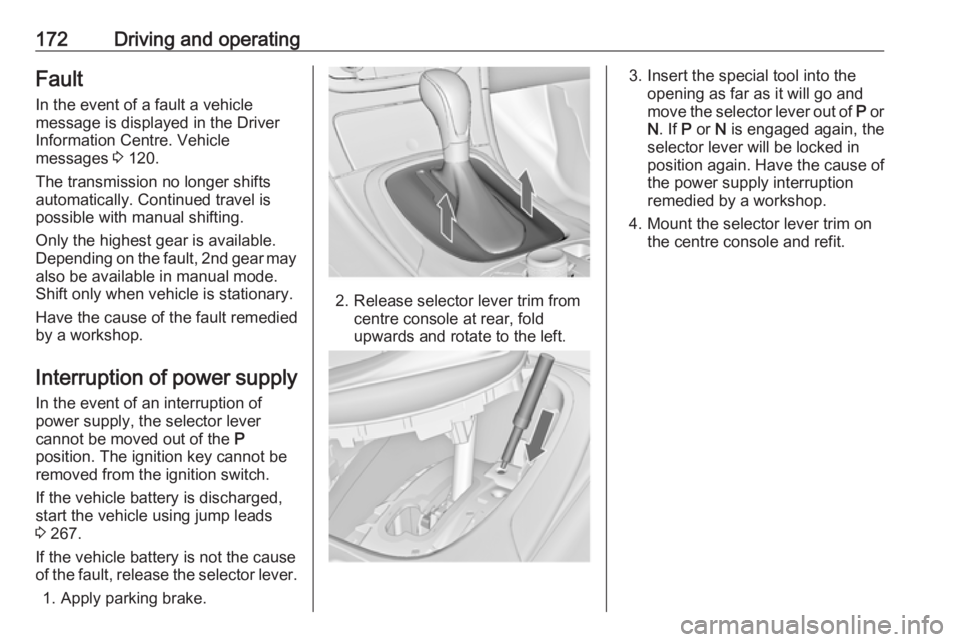
1. Apply parking brake.
2. Release selector lever trim from centre console at rear, fold
upwards and rotate to the left.
3. Insert the special tool into the opening as far as it will go and
move the selector lever out of P or
N . If P or N is engaged again, the
selector lever will be locked in
position again. Have the cause of
the power supply interruption
remedied by a workshop.
4. Mount the selector lever trim on the centre console and refit.
Page 175 of 327
Driving and operating173Manual transmission
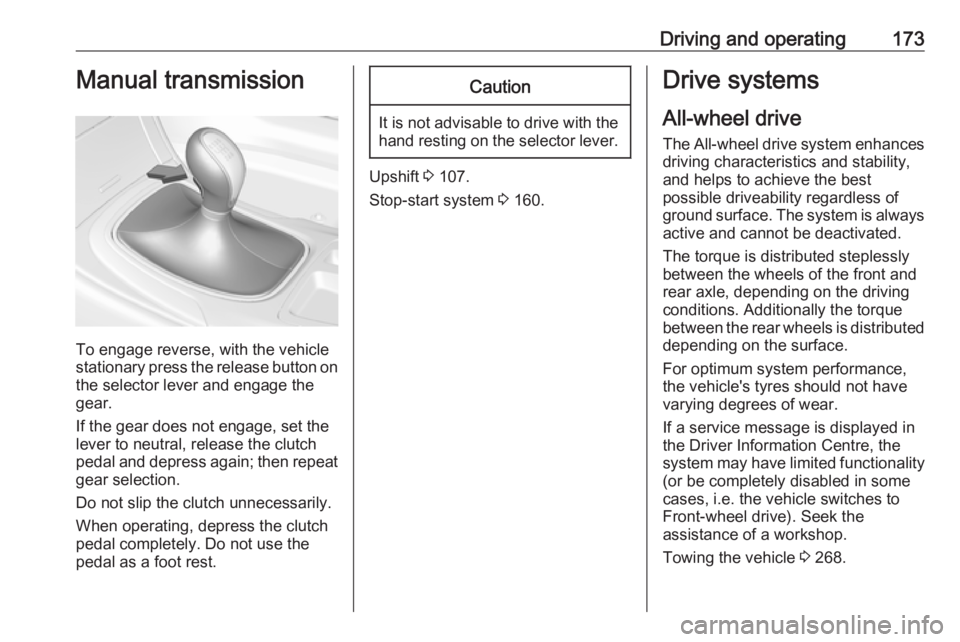
To engage reverse, with the vehicle
stationary press the release button on the selector lever and engage the
gear.
If the gear does not engage, set the
lever to neutral, release the clutch
pedal and depress again; then repeat
gear selection.
Do not slip the clutch unnecessarily.
When operating, depress the clutch
pedal completely. Do not use the
pedal as a foot rest.
Caution
It is not advisable to drive with the hand resting on the selector lever.
Upshift 3 107.
Stop-start system 3 160.
Drive systems
All-wheel drive
The All-wheel drive system enhances
driving characteristics and stability,
and helps to achieve the best
possible driveability regardless of
ground surface. The system is always
active and cannot be deactivated.
The torque is distributed steplessly
between the wheels of the front and rear axle, depending on the driving
conditions. Additionally the torque
between the rear wheels is distributed
depending on the surface.
For optimum system performance,
the vehicle's tyres should not have
varying degrees of wear.
If a service message is displayed in
the Driver Information Centre, the
system may have limited functionality (or be completely disabled in some
cases, i.e. the vehicle switches to
Front-wheel drive). Seek the
assistance of a workshop.
Towing the vehicle 3 268.
Page 177 of 327
Driving and operating175Parking brake
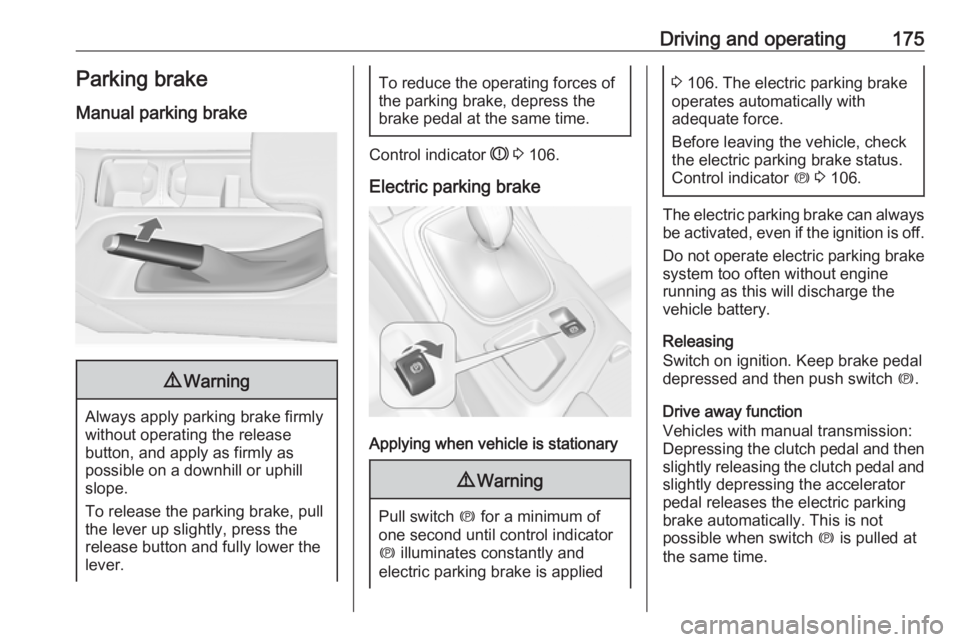
Manual parking brake9 Warning
Always apply parking brake firmly
without operating the release
button, and apply as firmly as
possible on a downhill or uphill
slope.
To release the parking brake, pull
the lever up slightly, press the
release button and fully lower the
lever.
To reduce the operating forces of
the parking brake, depress the
brake pedal at the same time.
Control indicator R 3 106.
Electric parking brake
Applying when vehicle is stationary
9 Warning
Pull switch m for a minimum of
one second until control indicator
m illuminates constantly and
electric parking brake is applied
3 106. The electric parking brake
operates automatically with
adequate force.
Before leaving the vehicle, check
the electric parking brake status.
Control indicator m 3 106.
The electric parking brake can always
be activated, even if the ignition is off.
Do not operate electric parking brake
system too often without engine
running as this will discharge the vehicle battery.
Releasing
Switch on ignition. Keep brake pedal
depressed and then push switch m.
Drive away function Vehicles with manual transmission:
Depressing the clutch pedal and then
slightly releasing the clutch pedal and slightly depressing the accelerator
pedal releases the electric parking
brake automatically. This is not
possible when switch m is pulled at
the same time.
Page 182 of 327
180Driving and operating● Steering support is in standardmode.
● Engine torque of All-wheel drive is distributed mainly to the front
axle.
● Shift points of automatic transmission occur in a comfort
mode.
NORMAL mode
All settings of the systems are
adapted to standard values.
Drive mode control
Within each manually selected driving mode SPORT, TOUR or NORMAL,
the Drive Mode Control (DMC)
detects and analyses continuously the real driving characteristic,
responses by the driver, and the
active dynamic state of the vehicle. If
necessary, the control unit of DMC
automatically changes the settings
within the selected driving mode or, when recognising greater variations,
the driving mode is changed for the
length of variation.If, for example, NORMAL mode is
selected and DMC detects a sporty
driving behaviour, DMC changes
several settings of the Normal mode
into sporty settings. The DMC
changes to SPORT mode in case of
very sporty driving behaviour.
If, for another example, TOUR mode
is selected and whilst driving on a
winding road a sudden hard brake is
necessary, DMC will detect the
dynamic vehicle condition and
changes the settings for suspension
to SPORT mode to increase vehicle
stability.
When the driving characteristic or the
dynamic vehicle state returns to the
former state, DMC will change the
settings to the preselected driving
mode.
Personalised settings in SPORT
mode
The driver can select the functions of
the SPORT mode when SPORT is
pressed.
Select the relevant settings in
Settings , I Sport Mode in the Colour-
Info-Display.Colour-Info-Display 3 118.
Vehicle personalisation 3 121.
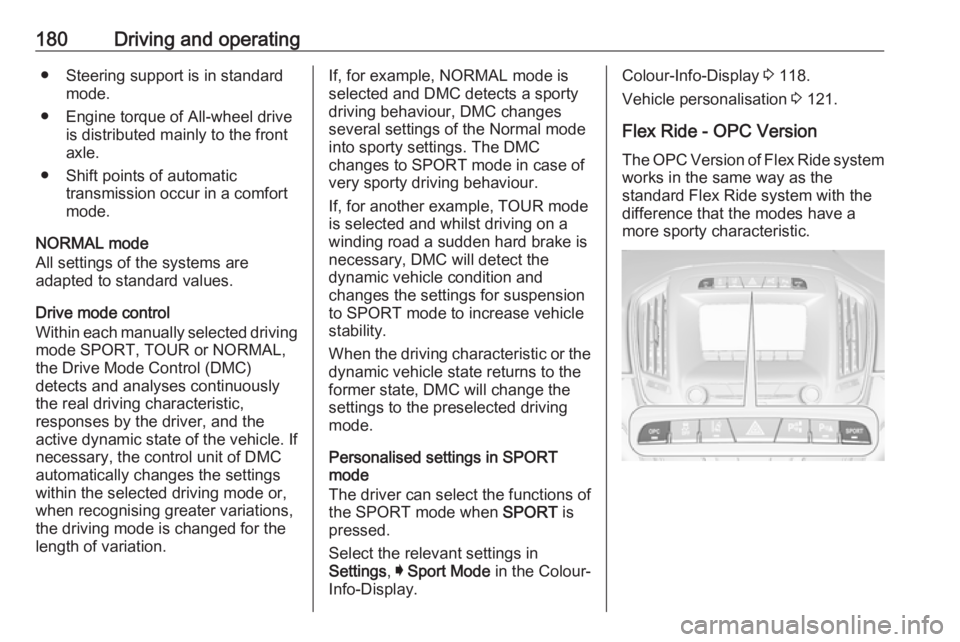
Flex Ride - OPC Version The OPC Version of Flex Ride system works in the same way as the
standard Flex Ride system with the
difference that the modes have a
more sporty characteristic.
Page 184 of 327

182Driving and operating
Do not use the cruise control if it is notadvisable to maintain a constant
speed.
On vehicles with automatic
transmission or manual transmission
automated cruise control can be
activated in automatic mode and
manual mode.
Control indicator m 3 110.
Switching on
Press m; control indicator m in
instrument cluster illuminates white.
Activation
Accelerate to the desired speed and
turn thumb wheel to SET/-, the
current speed is stored and
maintained. Control indicator m in
instrument cluster illuminates green.
Set speed is indicated on midlevel or
uplevel display with green illuminated
symbol m. Accelerator pedal can be
released.
Vehicle speed can be increased by depressing the accelerator pedal.
When the accelerator pedal is
released, the previously stored speed is resumed.
Cruise control remains activated
while gearshifting.
Increase speed
With cruise control active, hold thumb
wheel turned to RES/+ or briefly turn
to RES/+ repeatedly: speed
increases continuously or in small
increments.
Alternatively accelerate to the desired speed and store by turning to SET/-.
Reduce speed
With cruise control active, hold thumb wheel turned to SET/- or briefly turn to
SET/- repeatedly: speed decreases
continuously or in small increments.
Deactivation Press y; control indicator m in
instrument cluster illuminates white.
On midlevel or uplevel display m
changes to white.
Page 189 of 327

Driving and operating187Full speed range adaptive cruise
control on vehicles with automatic transmission
Full speed range adaptive cruisecontrol will maintain a following gap
behind a detected vehicle and can
slow your vehicle to a stop behind that
vehicle.
When the vehicle ahead drives away
within two minutes, turn thumb wheel to RES/+ or operate the acceleratorpedal to reach a speed of 10 km/h to
resume full speed range adaptive cruise control.
If the stopped vehicle ahead begins to move forward and full speed range
adaptive cruise control has not
resumed, the green illuminated
vehicle ahead control indicator A will
flash and a warning chime will sound
as a reminder that the vehicle ahead
is pulling away.
When the vehicle ahead stops for
more than two minutes, the electric
parking brake will apply automatically and the full speed range adaptive
cruise control is deactivated. In this
event, drive the vehicle normally byoperating the accelerator pedal. Turn
thumb wheel to RES/+ at a speed
above 10 km/h to resume full speed
range adaptive cruise control.9 Warning
When full speed range adaptive
cruise control is deactivated or
cancelled, the vehicle will no
longer be held at a stop and can
start to move. Always be prepared
to manually apply the brake pedal
to hold the vehicle stationary.
Do not leave the vehicle while it is being held at a stop by the full
speed range adaptive cruise
control. Always move selector
lever to park position P and switch
off the ignition before leaving the
vehicle.
Setting the following distance
When adaptive cruise control detects a slower moving vehicle in the driving
path, it will adjust the vehicle speed to maintain the following distance
selected by the driver.
The following distance can be set to
near, medium or far.
Press E, the current setting is shown
in the Driver Information Centre.
Press E again to change the
following distance. The setting is also displayed in the Driver Information
Centre.
Page 272 of 327

270Vehicle careCaution
Drive slowly. Do not drive jerkily.
Excessive tractive force can
damage the vehicle.
When the engine is not running,
considerably more force is needed to
brake and steer.
To prevent the entry of exhaust gases from the towing vehicle, switch on the
air recirculation and close the
windows.
Vehicles with manual transmission
and All-wheel drive: If the vehicle is
towed with all four wheels on the
ground then there are no technical
limitations for speed and distance. If
only one axle has been raised, the
maximum speed is 50 km/h. There is
no distance limitation.
Vehicles with automatic transmission and Front-wheel drive: The vehicle
must be towed facing forwards, not
faster than 80 km/h nor further than
100 km. In all other cases and when
the transmission is defective, the front axle must be raised off the ground.
Vehicles with automatic transmission
and All-wheel drive: The vehicle must
be towed facing forwards. If the
vehicle is towed with all four wheels
on the ground, the maximum speed is
50 km/h and for a maximum of
50 km. If the front axle has been
raised, the maximum speed is
50 km/h. There is no distance
limitation.
Seek the assistance of a workshop.
After towing, unscrew the towing eye.
5-door Hatchback, 4-door Saloon,
Sports Tourer: insert cap at the
bottom, turn slightly clockwise and
close cap.
Country Tourer: insert cap with the
upper flange into the recess and fix
cap by pushing.
OPC: insert cap with the lower flange
into the recess. Push the cap into the bumper.
Towing another vehicle
5-door Hatchback, 4-door Saloon,
Sports Tourer, OPC: disengage cap
at bottom and remove downwards.
Page 288 of 327
![OPEL INSIGNIA 2017 User Guide 286Technical dataPerformance
5-door Hatchback/4-door SaloonEngineB14NETB14NET LPGB16SHLB18XERB20NHT
B20NHT
AWD 4)
B28NER
Maximum speed [km/h]Manual transmission2051952202052502502505)
/270Automatic tr](/img/37/18860/w960_18860-287.png "OPEL INSIGNIA 2017 User Guide 286Technical dataPerformance
5-door Hatchback/4-door SaloonEngineB14NETB14NET LPGB16SHLB18XERB20NHT
B20NHT
AWD 4)
B28NER
Maximum speed [km/h]Manual transmission2051952202052502502505)
/270Automatic tr")
286Technical dataPerformance
5-door Hatchback/4-door SaloonEngineB14NETB14NET LPGB16SHLB18XERB20NHT
B20NHT
AWD 4)
B28NER
Maximum speed [km/h]Manual transmission2051952202052502502505)
/270Automatic transmission––210–245245250 5)
/2704) All wheel drive.
5) Limited speed.
EngineB16DTJB16DTHB20DTHB20DTHAWD 4)Maximum speed [km/h]Manual transmission195/200 6)205/2106)225215Automatic transmission–2002202104)
All wheel drive.
6) CO2 reduced.
Page 289 of 327
![OPEL INSIGNIA 2017 User Guide Technical data287Sports TourerEngineB14NETB14NET LPGB16SHLB18XERB20NHTB20NHTB28NERAWD4)Maximum speed [km/h]Manual transmission2001902152002452402505)
/270Automatic transmission––205–240235250 5)](/img/37/18860/w960_18860-288.png "OPEL INSIGNIA 2017 User Guide Technical data287Sports TourerEngineB14NETB14NET LPGB16SHLB18XERB20NHTB20NHTB28NERAWD4)Maximum speed [km/h]Manual transmission2001902152002452402505)
/270Automatic transmission––205–240235250 5)")
Technical data287Sports TourerEngineB14NETB14NET LPGB16SHLB18XERB20NHTB20NHTB28NERAWD4)Maximum speed [km/h]Manual transmission2001902152002452402505)
/270Automatic transmission––205–240235250 5)
/2704) All wheel drive.
5) Limited speed.
EngineB16DTJB16DTHB20DTHB20DTHAWD 4)Maximum speed [km/h]Manual transmission190/195 7)200/2057)220210Automatic transmission–1952152054)
All wheel drive.
7) CO2 reduced.