fluid OPEL INSIGNIA 2018 User Guide
[x] Cancel search | Manufacturer: OPEL, Model Year: 2018, Model line: INSIGNIA, Model: OPEL INSIGNIA 2018Pages: 323, PDF Size: 9.33 MB
Page 245 of 323
Vehicle care243Depending on the engine, the
position of the coolant container may be different.9 Warning
Allow the engine to cool before
opening the cap. Carefully open
the cap, relieving the pressure
slowly.
To top up, use a 1:1 mixture of
released coolant concentrate mixed
with clean tap water. If no coolant
concentrate is available, use clean
tap water. Install the cap tightly. Have the coolant concentration checked
and have the cause of the coolant
loss remedied by a workshop.
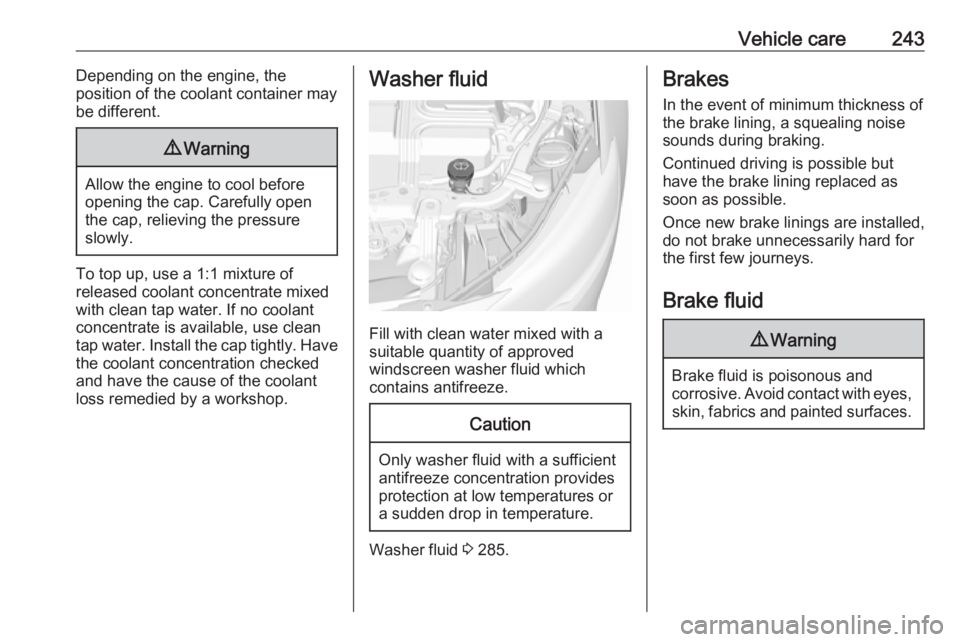
Washer fluid
Fill with clean water mixed with a
suitable quantity of approved
windscreen washer fluid which
contains antifreeze.
Caution
Only washer fluid with a sufficient
antifreeze concentration provides
protection at low temperatures or
a sudden drop in temperature.
Washer fluid 3 285.
Brakes
In the event of minimum thickness of
the brake lining, a squealing noise
sounds during braking.
Continued driving is possible but
have the brake lining replaced as
soon as possible.
Once new brake linings are installed,
do not brake unnecessarily hard for
the first few journeys.
Brake fluid9 Warning
Brake fluid is poisonous and
corrosive. Avoid contact with eyes, skin, fabrics and painted surfaces.
Page 246 of 323
244Vehicle care
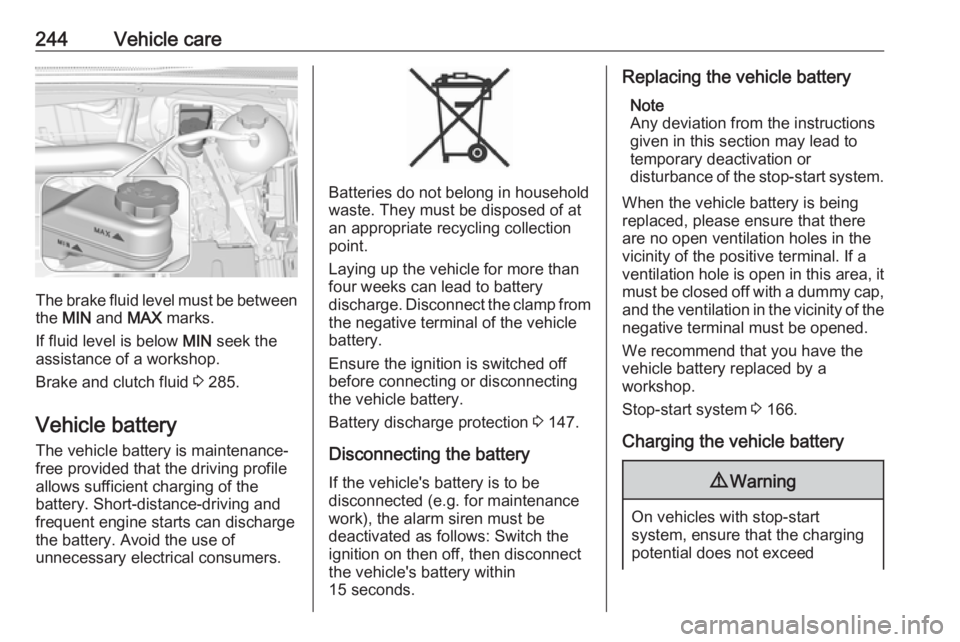
The brake fluid level must be betweenthe MIN and MAX marks.
If fluid level is below MIN seek the
assistance of a workshop.
Brake and clutch fluid 3 285.
Vehicle battery
The vehicle battery is maintenance-
free provided that the driving profile
allows sufficient charging of the
battery. Short-distance-driving and
frequent engine starts can discharge
the battery. Avoid the use of
unnecessary electrical consumers.
Batteries do not belong in household
waste. They must be disposed of at
an appropriate recycling collection
point.
Laying up the vehicle for more than
four weeks can lead to battery
discharge. Disconnect the clamp from the negative terminal of the vehicle
battery.
Ensure the ignition is switched off
before connecting or disconnecting
the vehicle battery.
Battery discharge protection 3 147.
Disconnecting the battery
If the vehicle's battery is to be
disconnected (e.g. for maintenance
work), the alarm siren must be
deactivated as follows: Switch the ignition on then off, then disconnect
the vehicle's battery within
15 seconds.
Replacing the vehicle battery
Note
Any deviation from the instructions
given in this section may lead to
temporary deactivation or
disturbance of the stop-start system.
When the vehicle battery is being
replaced, please ensure that there
are no open ventilation holes in the
vicinity of the positive terminal. If a
ventilation hole is open in this area, it
must be closed off with a dummy cap, and the ventilation in the vicinity of the
negative terminal must be opened.
We recommend that you have the
vehicle battery replaced by a
workshop.
Stop-start system 3 166.
Charging the vehicle battery9 Warning
On vehicles with stop-start
system, ensure that the charging potential does not exceed
Page 279 of 323
Vehicle care277Jump starting
Do not start with quick charger.
A vehicle with a discharged vehicle
battery can be started using jump
leads and the vehicle battery of
another vehicle.9 Warning
Be extremely careful when starting
with jump leads. Any deviation
from the following instructions can
lead to injuries or damage caused
by battery explosion or damage to the electrical systems of both
vehicles.
9 Warning
Avoid contact of the battery with
eyes, skin, fabrics and painted
surfaces. The fluid contains
sulphuric acid which can cause
injuries and damage in the event
of direct contact.
● Never expose the vehicle battery
to naked flames or sparks.
● A discharged vehicle battery can already freeze at a temperature
of 0 °C. Defrost the frozen battery before connecting jump leads.
● Wear eye protection and protective clothing when
handling a battery.
● Use a booster battery with the same voltage (12 Volts). Its
capacity (Ah) must not be much less than that of the discharged
vehicle battery.
● Use jump leads with insulated terminals and a cross section of
at least 16 mm 2
(25 mm 2
for
diesel engines).
● Do not disconnect the discharged
vehicle battery from the vehicle.
● Switch off all unnecessary electrical consumers.
● Do not lean over the vehicle battery during jump starting.
● Do not allow the terminals of one
lead to touch those of the other
lead.● The vehicles must not come into contact with each other during
the jump starting process.
● Apply the parking brake, transmission in neutral,
automatic transmission in P.
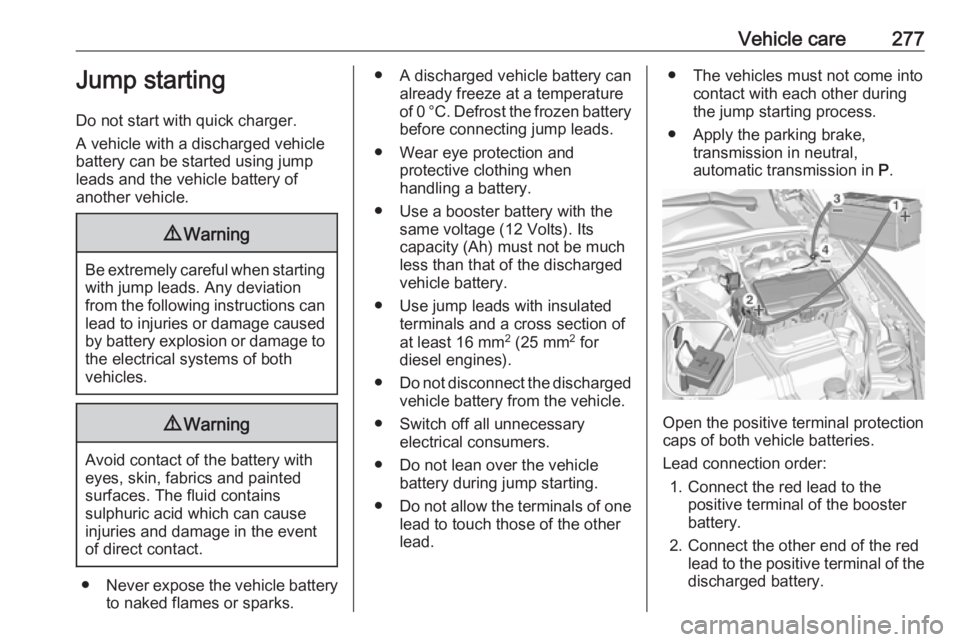
Open the positive terminal protection
caps of both vehicle batteries.
Lead connection order: 1. Connect the red lead to the positive terminal of the booster
battery.
2. Connect the other end of the red lead to the positive terminal of the
discharged battery.
Page 286 of 323
284Service and maintenanceService and
maintenanceGeneral information ...................284
Service information ..................284
Recommended fluids, lubricants
and parts .................................... 285
Recommended fluids and lubricants ................................ 285General information
Service information In order to ensure economical and
safe vehicle operation and to
maintain the value of your vehicle, it
is of vital importance that all
maintenance work is carried out at the proper intervals as specified.
The detailed, up-to-date service
schedule for your vehicle is available
at the workshop.
Service display 3 105.
European service intervals Maintenance of your vehicle is
required every 30,000 km or after
1 year , whichever occurs first, unless
otherwise indicated in the service display.
A shorter service interval can be valid for severe driving behaviour, e.g. for
taxis and police vehicles.
The European service intervals are
valid for the following countries:Andorra, Austria, Belgium, Bosnia-
Herzegovina, Bulgaria, Croatia,
Cyprus, Czech Republic, Denmark,
Estonia, Finland, France, Germany,
Greece, Greenland, Hungary,
Iceland, Ireland, Italy, Latvia,
Liechtenstein, Lithuania,
Luxembourg, Macedonia, Malta,
Monaco, Montenegro, Netherlands,
Norway, Poland, Portugal, Romania,
San Marino, Serbia, Slovakia,
Slovenia, Spain, Sweden,
Switzerland, United Kingdom.
Service display 3 105.
International service intervals
Maintenance of your vehicle is
required every 15,000 km or after
1 year , whichever occurs first, unless
otherwise indicated in the service
display.
Severe operating conditions exist if
one or more of the following
circumstances occur frequently: Cold starting, stop and go operation, trailer
operation, mountain driving, driving
on poor and sandy road surfaces,
increased air pollution, presence of
airborne sand and high dust content,
Page 287 of 323
Service and maintenance285driving at high altitude and large
variations of temperature. Under
these severe operating conditions, certain service work may be required
more frequently than the regular service interval.
The international service intervals are
valid for the countries which are not
listed in the European service
intervals.
Service display 3 105.
Confirmations Confirmation of service is recorded inthe Service and Warranty Booklet.
The date and mileage is completed
with the stamp and signature of the
servicing workshop.
Make sure that the Service and
Warranty Booklet is completed
correctly as continuous proof of
service is essential if any warranty or
goodwill claims are to be met, and is
also a benefit when selling the
vehicle.Service interval with remaining
engine oil life duration
The service interval is based on
several parameters depending on
usage.
The service display lets you know
when to change the engine oil.
Service display 3 105.Recommended fluids,
lubricants and parts
Recommended fluids andlubricants
Only use products that meet the
recommended specifications.9 Warning
Operating materials are
hazardous and could be
poisonous. Handle with care. Pay
attention to information given on
the containers.
Engine oil
Engine oil is identified by its quality
and its viscosity. Quality is more
important than viscosity when
selecting which engine oil to use. The oil quality ensures e.g. engine
cleanliness, wear protection and oil
aging control, whereas viscosity
grade gives information on the oil's
thickness over a temperature range.
Page 289 of 323
Service and maintenance287Washer fluidUse only washer fluid approved for
the vehicle to prevent damage of
wiper blades, paintwork, plastic and
rubber parts. Consult a workshop.
Brake and clutch fluid Over time, brake fluid absorbs
moisture which will reduce braking
effectiveness. The brake fluid should
therefore be replaced at the specified
interval.
AdBlue Only use AdBlue to reduce the
nitrogen oxides in the exhaust
emission 3 171.
Page 290 of 323
288Technical dataTechnical dataVehicle identification..................288
Vehicle Identification Number ..288
Identification plate ...................288
Engine identification ................289
Vehicle data ............................... 290
Recommended fluids and lubricants ................................ 290
Engine data ............................. 293
Performance ............................ 294
Vehicle weight ......................... 296
Vehicle dimensions .................299
Capacities ................................ 300
Tyre pressures ........................ 301
Towing hitch installation dimensions ............................. 305Vehicle identification
Vehicle IdentificationNumber
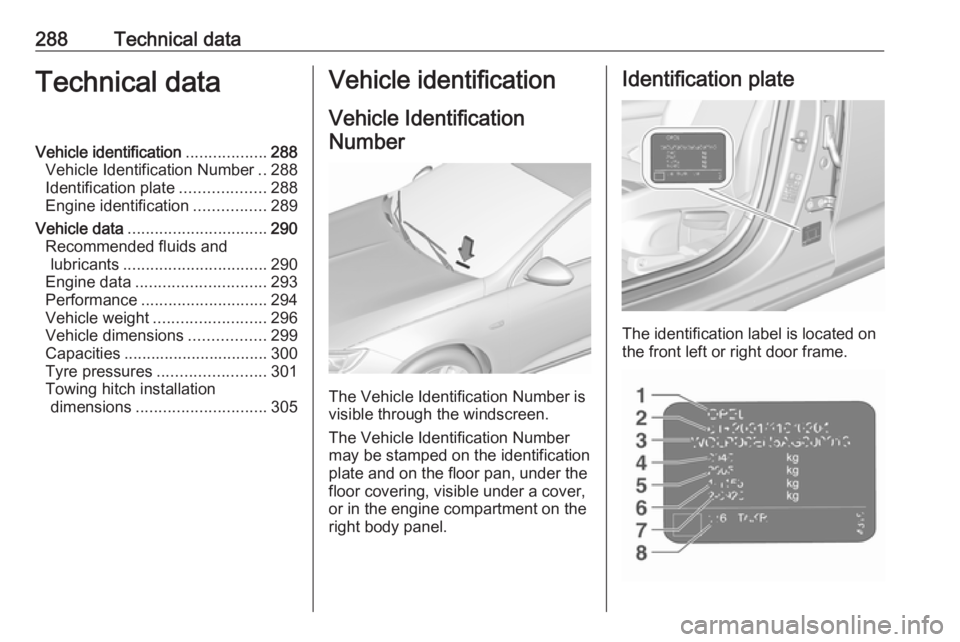
The Vehicle Identification Number is
visible through the windscreen.
The Vehicle Identification Number
may be stamped on the identification
plate and on the floor pan, under the floor covering, visible under a cover,
or in the engine compartment on the
right body panel.
Identification plate
The identification label is located on
the front left or right door frame.
Page 292 of 323
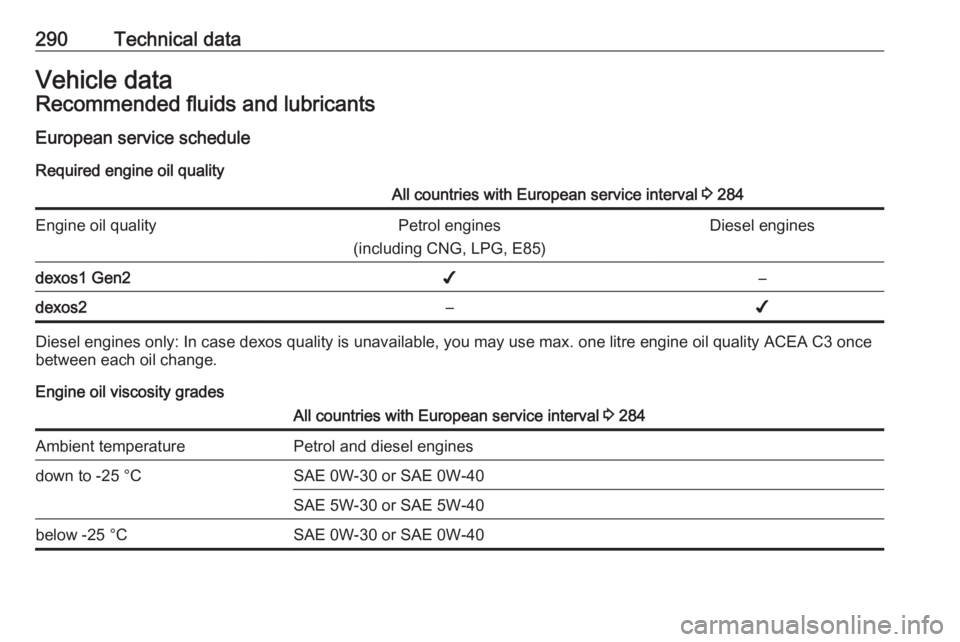
290Technical dataVehicle dataRecommended fluids and lubricantsEuropean service schedule Required engine oil qualityAll countries with European service interval 3 284Engine oil qualityPetrol engines
(including CNG, LPG, E85)Diesel enginesdexos1 Gen2✔–dexos2–✔
Diesel engines only: In case dexos quality is unavailable, you may use max. one litre engine oil quality ACEA C3 once
between each oil change.
Engine oil viscosity grades
All countries with European service interval 3 284Ambient temperaturePetrol and diesel enginesdown to -25 °CSAE 0W-30 or SAE 0W-40SAE 5W-30 or SAE 5W-40below -25 °CSAE 0W-30 or SAE 0W-40
Page 318 of 323
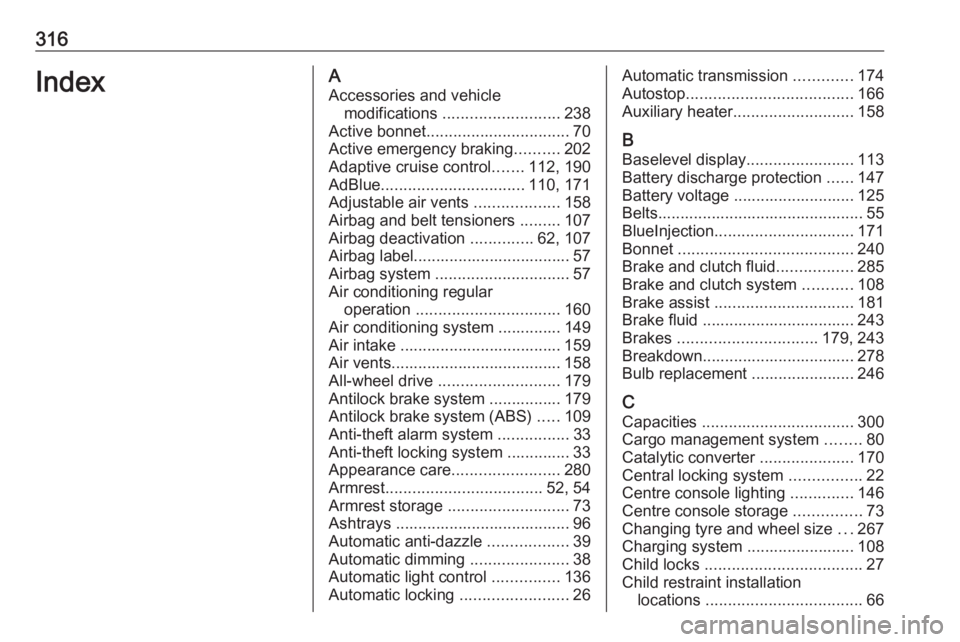
316IndexAAccessories and vehicle modifications .......................... 238
Active bonnet ................................ 70
Active emergency braking ..........202
Adaptive cruise control .......112, 190
AdBlue ................................ 110, 171
Adjustable air vents ...................158
Airbag and belt tensioners .........107
Airbag deactivation ..............62, 107
Airbag label................................... 57
Airbag system .............................. 57
Air conditioning regular operation ................................ 160
Air conditioning system .............. 149
Air intake .................................... 159
Air vents...................................... 158
All-wheel drive ........................... 179
Antilock brake system ................ 179
Antilock brake system (ABS) .....109
Anti-theft alarm system ................33
Anti-theft locking system .............. 33
Appearance care ........................280
Armrest ................................... 52, 54
Armrest storage ........................... 73
Ashtrays ....................................... 96 Automatic anti-dazzle ..................39
Automatic dimming ......................38
Automatic light control ...............136
Automatic locking ........................26Automatic transmission .............174
Autostop ..................................... 166
Auxiliary heater ........................... 158
B Baselevel display ........................113
Battery discharge protection ......147
Battery voltage ........................... 125
Belts.............................................. 55 BlueInjection ............................... 171
Bonnet ....................................... 240
Brake and clutch fluid .................285
Brake and clutch system ...........108
Brake assist ............................... 181
Brake fluid .................................. 243
Brakes ............................... 179, 243
Breakdown.................................. 278
Bulb replacement ....................... 246
C Capacities .................................. 300
Cargo management system ........80
Catalytic converter .....................170
Central locking system ................22
Centre console lighting ..............146
Centre console storage ...............73
Changing tyre and wheel size ...267
Charging system ........................ 108
Child locks ................................... 27
Child restraint installation locations ................................... 66
Page 319 of 323
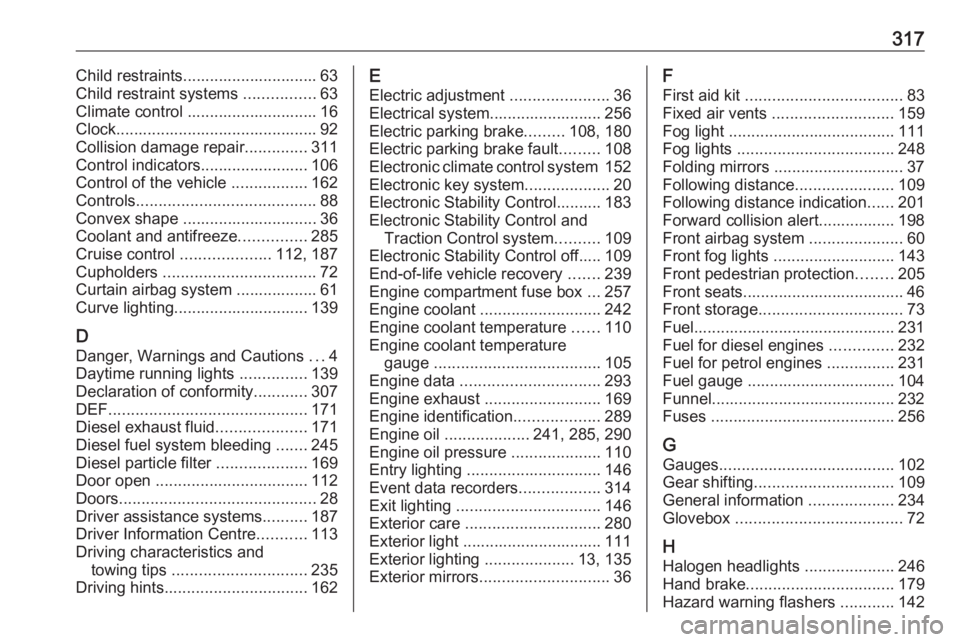
317Child restraints.............................. 63
Child restraint systems ................63
Climate control ............................. 16
Clock............................................. 92
Collision damage repair ..............311
Control indicators........................ 106
Control of the vehicle .................162
Controls ........................................ 88
Convex shape .............................. 36
Coolant and antifreeze ...............285
Cruise control ....................112, 187
Cupholders .................................. 72
Curtain airbag system .................. 61
Curve lighting.............................. 139
D Danger, Warnings and Cautions ...4
Daytime running lights ...............139
Declaration of conformity ............307
DEF ............................................ 171
Diesel exhaust fluid ....................171
Diesel fuel system bleeding .......245
Diesel particle filter ....................169
Door open .................................. 112
Doors ............................................ 28
Driver assistance systems ..........187
Driver Information Centre ...........113
Driving characteristics and towing tips .............................. 235
Driving hints ................................ 162E
Electric adjustment ......................36
Electrical system......................... 256
Electric parking brake .........108, 180
Electric parking brake fault .........108
Electronic climate control system 152
Electronic key system ...................20
Electronic Stability Control.......... 183
Electronic Stability Control and Traction Control system ..........109
Electronic Stability Control off..... 109
End-of-life vehicle recovery .......239
Engine compartment fuse box ...257
Engine coolant ........................... 242
Engine coolant temperature ......110
Engine coolant temperature gauge ..................................... 105
Engine data ............................... 293
Engine exhaust .......................... 169
Engine identification ...................289
Engine oil ................... 241, 285, 290
Engine oil pressure ....................110
Entry lighting .............................. 146
Event data recorders ..................314
Exit lighting ................................ 146
Exterior care .............................. 280
Exterior light ............................... 111
Exterior lighting ....................13, 135
Exterior mirrors ............................. 36F
First aid kit ................................... 83
Fixed air vents ........................... 159
Fog light ..................................... 111
Fog lights ................................... 248
Folding mirrors ............................. 37
Following distance ......................109
Following distance indication ......201
Forward collision alert................. 198
Front airbag system .....................60
Front fog lights ........................... 143
Front pedestrian protection ........205
Front seats.................................... 46
Front storage ................................ 73
Fuel............................................. 231
Fuel for diesel engines ..............232
Fuel for petrol engines ...............231
Fuel gauge ................................. 104
Funnel......................................... 232
Fuses ......................................... 256
G Gauges ....................................... 102
Gear shifting ............................... 109
General information ...................234
Glovebox ..................................... 72
H Halogen headlights ....................246
Hand brake ................................. 179
Hazard warning flashers ............142