belt OPEL INSIGNIA BREAK 2017.5 Manual user
[x] Cancel search | Manufacturer: OPEL, Model Year: 2017.5, Model line: INSIGNIA BREAK, Model: OPEL INSIGNIA BREAK 2017.5Pages: 303, PDF Size: 8.46 MB
Page 63 of 303

Seats, restraints61Suitable are restraint systems that
comply with valid UN ECE
regulations. Check local laws and
regulations for mandatory use of child
restraint systems.
The following child restraints are
recommended for the following
weight classes:
Maxi Cosi Cabriofix for children up to 13 kg for group 0, group 0+ and Duo
Plus for children from 13 kg to 18 kg in group I.
Ensure that the child restraint system to be installed is compatible with the
vehicle type.
Ensure that the mounting location of
the child restraint system within the
vehicle is correct, see following
tables.
Allow children to enter and exit the
vehicle only on the side facing away
from the traffic.
When the child restraint system is not in use, secure the seat with a seat beltor remove it from the vehicle.Note
Do not affix anything on the child
restraint systems and do not cover
them with any other materials.
A child restraint system which has
been subjected to stress in an
accident must be replaced.
Page 64 of 303

62Seats, restraintsChild restraint installation locations
Permissible options for fastening a child restraint system with a three-point seat belt
Weight class
On front passenger seat
On rear outboard seatsOn rear centre seat
activated airbagdeactivated airbagGroup 0: up to 10 kgXU 1,2U/L 3UGroup 0+: up to 13 kgXU1,2U/L 3UGroup I: 9 to 18 kgXU1,2U/L 3,4U4Group II: 15 to 25 kgU1,2XU/L 3,4U4Group III: 22 to 36 kgU1,2XU/L 3,4U4U:universal suitability in conjunction with three-point seat beltL:suitable for particular child restraint systems of the 'specific-vehicle', 'restricted' or 'semi-universal' categories. The
child restraint system must be approved for the specific vehicle type (refer to the vehicle type list of the child restraint
system)X:no child restraint system permitted in this weight class1:move seat forwards as far as necessary and adjust seat backrest as far as necessary to a vertical position to ensure that the belt runs forwards from the upper anchorage point2:move seat upwards as far as necessary and adjust seat backrest as far as necessary to a vertical position to ensurethat the belt is tight on the buckle side3:move the respective front seat ahead of the child restraint system forwards as far as necessary4:adjust the respective headrest as necessary or remove if required
Page 66 of 303

64Seats, restraintsIL:suitable for particular ISOFIX restraint systems of the 'specific-vehicle', 'restricted' or 'semi-universal' categories.
The ISOFIX restraint system must be approved for the specific vehicle type (refer to the vehicle type list of the child restraint system)IUF:suitable for ISOFIX forward-facing child restraint systems of universal category approved for use in this weight classX:no ISOFIX child restraint system approved in this weight class1:move seat forwards as far as necessary and adjust seat backrest inclination as far as necessary to a vertical positionto ensure that the belt runs forwards from the upper anchorage point2:move seat height adjustment upwards as far as necessary and adjust seat backrest inclination as far as necessary
to a vertical position to ensure that the belt is tight on the buckle side3:move the respective front seat ahead of the child restraint system forwards as far as necessary4:adjust the respective headrest as necessary or remove if required
ISOFIX size class and seat device
A – ISO/F3:forward-facing child restraint system for children of maximum size in the weight class 9 to 18 kgB – ISO/F2:forward-facing child restraint system for smaller children in the weight class 9 to 18 kgB1 – ISO/F2X:forward-facing child restraint system for smaller children in the weight class 9 to 18 kgC – ISO/R3:rear-facing child restraint system for children of maximum size in the weight class up to 18 kgD – ISO/R2:rear-facing child restraint system for smaller children in the weight class up to 18 kgE – ISO/R1:rear-facing child restraint system for young children in the weight class up to 13 kgF– ISO/L1:left lateral facing position child restraint system (carry-cot)G – ISO/L2:right lateral facing position child restraint system (carry-cot)
Permissible options for fitting an i-Size child restraint system with ISOFIX brackets
On front passenger seat
On rear outboard seatsOn rear centre seat
activated airbagdeactivated airbagi-Size child restraint systemsXXi - UX
Page 72 of 303
70Storage
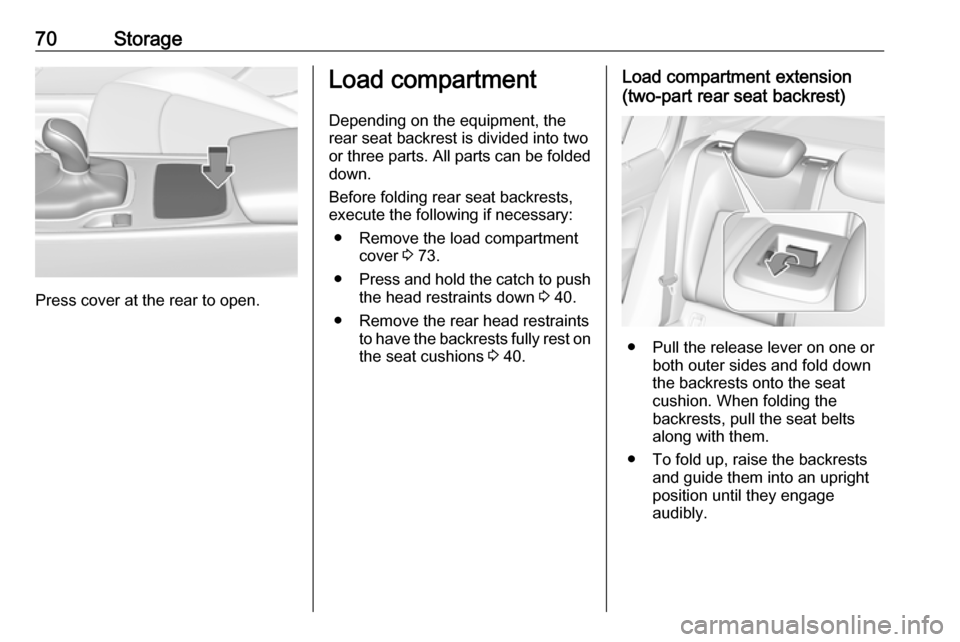
Press cover at the rear to open.
Load compartment
Depending on the equipment, the
rear seat backrest is divided into two or three parts. All parts can be folded
down.
Before folding rear seat backrests,
execute the following if necessary:
● Remove the load compartment cover 3 73.
● Press and hold the catch to push
the head restraints down 3 40.
● Remove the rear head restraints to have the backrests fully rest on
the seat cushions 3 40.Load compartment extension
(two-part rear seat backrest)
● Pull the release lever on one or both outer sides and fold down
the backrests onto the seat
cushion. When folding the
backrests, pull the seat belts along with them.
● To fold up, raise the backrests and guide them into an upright
position until they engage
audibly.
Page 73 of 303
Storage71
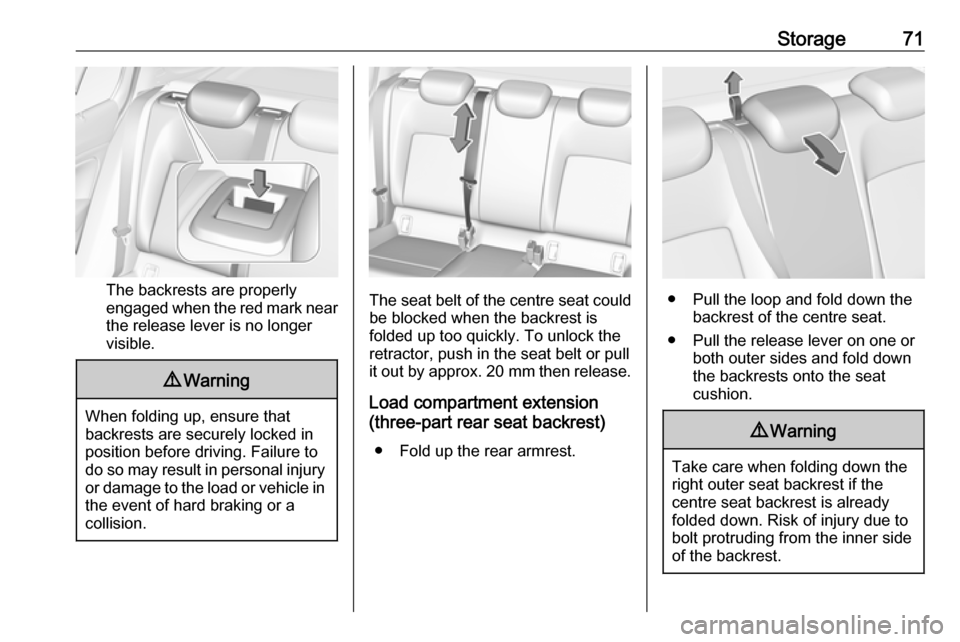
The backrests are properly
engaged when the red mark near the release lever is no longer
visible.
9 Warning
When folding up, ensure that
backrests are securely locked in
position before driving. Failure to
do so may result in personal injury or damage to the load or vehicle in the event of hard braking or a
collision.
The seat belt of the centre seat could
be blocked when the backrest is
folded up too quickly. To unlock the
retractor, push in the seat belt or pull
it out by approx. 20 mm then release.
Load compartment extension
(three-part rear seat backrest)
● Fold up the rear armrest.● Pull the loop and fold down the backrest of the centre seat.
● Pull the release lever on one or both outer sides and fold down
the backrests onto the seat
cushion.
9 Warning
Take care when folding down the
right outer seat backrest if the
centre seat backrest is already
folded down. Risk of injury due to
bolt protruding from the inner sideof the backrest.
Page 74 of 303

72Storage
● Pull the release lever on one orboth outer sides and fold down
the backrests onto the seat
cushion. When folding the
backrests, pull the seat belts along with them.
9 Warning
Take care when folding down the
right outer seat backrest if the
centre seat backrest is already
folded down. Risk of injury due to bolt protruding from the inner side
of the backrest.
● Alternatively fold seat backrests from the load compartment: pullswitch on left or right sidewall of
the load compartment to fold the
corresponding part of the rear
seat backrest.
9 Warning
Take care when operating the rear
backrests from the load
compartment. The backrest is
folded with considerable force.
Risk of injury, particularly to
children.
Ensure that nothing is attached to
the rear seats or located on the
seat cushion.
● To fold up, raise the backrests and guide them into an upright
position until they engage
audibly.
The backrests are properly
engaged when the red mark near the release lever is no longer
visible.
Page 75 of 303
Storage739Warning
When folding up, ensure that
backrests are securely locked in
position before driving. Failure to
do so may result in personal injury or damage to the load or vehicle in the event of hard braking or a
collision.
The seat belt of the centre seat could
be blocked when the backrest is
folded up too quickly. To unlock the
retractor, push in the seat belt or pull
it out by approx. 20 mm then release.
Load compartment cover
Do not place any objects on the cover.
Removing cover
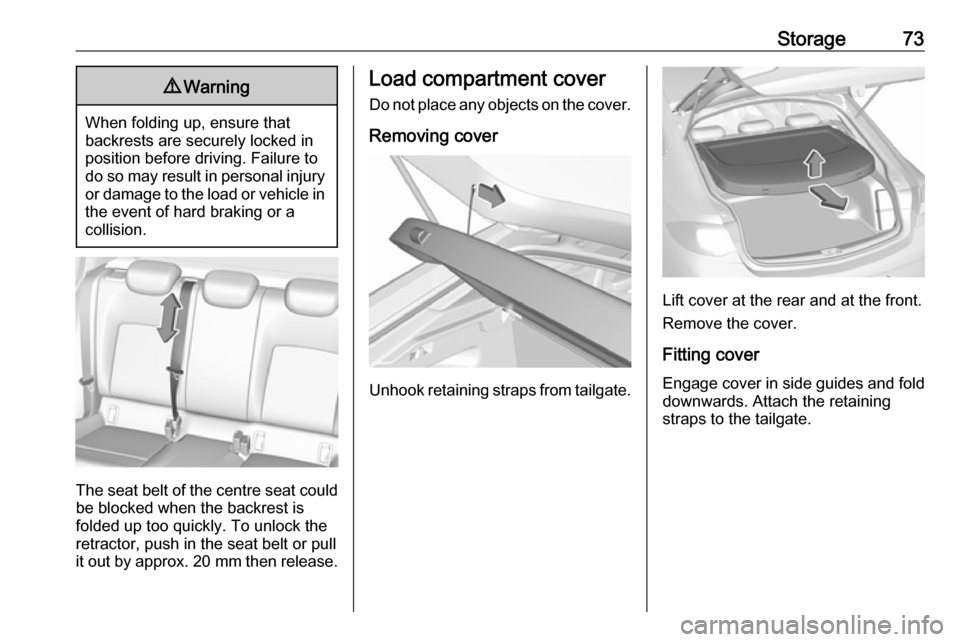
Unhook retaining straps from tailgate.
Lift cover at the rear and at the front.
Remove the cover.
Fitting cover Engage cover in side guides and fold downwards. Attach the retaining
straps to the tailgate.
Page 80 of 303

78Instruments and controlsInstruments and
controlsControls ....................................... 79
Steering wheel adjustment ........79
Steering wheel controls .............79
Heated steering wheel ...............80
Horn ........................................... 80
Windscreen wiper/washer .........80
Rear window wiper/washer .......82
Outside temperature ..................83
Clock ......................................... 83
Power outlets ............................. 85
Inductive charging .....................86
Ashtrays .................................... 86
Warning lights, gauges and indi‐ cators ........................................... 88
Instrument cluster ......................88
Speedometer ............................. 93
Odometer .................................. 94
Trip odometer ............................ 94
Tachometer ............................... 95
Fuel gauge ................................ 95
Engine coolant temperature gauge ....................................... 96
Service display .......................... 96
Control indicators ......................97Turn signal................................. 97
Seat belt reminder .....................97
Airbag and belt tensioners .........98
Airbag deactivation ....................98
Charging system .......................99
Malfunction indicator light ..........99
Brake and clutch system ...........99
Electric parking brake ................99
Electric parking brake fault ........99
Antilock brake system (ABS) ...100
Gear shifting ............................ 100
Following distance ...................100
Lane keep assist .....................100
Electronic Stability Control off . 100
Electronic Stability Control and Traction Control system .........100
Traction Control system off .....101
Engine coolant temperature ....101
Preheating ............................... 101
AdBlue ..................................... 101
Tyre pressure monitoring system .................................... 101
Engine oil pressure ..................101
Low fuel ................................... 102
Immobiliser .............................. 102
Exterior light ............................ 102
High beam ............................... 102
High beam assist .....................102
LED headlights ........................ 102
Fog light ................................... 102Rear fog light........................... 103
Cruise control .......................... 103
Adaptive cruise control ............103
Vehicle detected ahead ...........103
Pedestrian detection ................103
Speed limiter ........................... 103
Traffic sign assistant ................103
Door open ................................ 103
Information displays ...................104
Driver Information Centre ........104
Info display .............................. 111
Head-up display ......................113
Vehicle messages ......................115
Warning chimes .......................116
Battery voltage ........................ 116
Vehicle personalisation ..............117
Telematics service .....................121
OnStar ..................................... 121
Page 95 of 303

Instruments and controls93OverviewOTurn signal 3 97XSeat belt reminder 3 97vAirbag and belt tensioners
3 98VAirbag deactivation 3 98pCharging system 3 99ZMalfunction indicator light
3 99RBrake and clutch system 3 99mElectric parking brake 3 99jElectric parking brake fault
3 99uAntilock brake system (ABS)
3 100RGear shifting 3 100EFollowing distance 3 100aLane keep assist 3 100nElectronic Stability Control off
3 100bElectronic Stability Control and
Traction Control system 3 100kTraction Control system off
3 101WEngine coolant temperature
3 101!Preheating 3 101YAdBlue 3 101wTyre pressure monitoring
system 3 101IEngine oil pressure 3 101YLow fuel 3 102dImmobiliser 3 1028Exterior light 3 102CHigh beam 3 102fHigh beam assist 3 102fLED headlights 3 102>Fog light 3 102rRear fog light 3 103mCruise control 3 103CAdaptive cruise control 3 103AVehicle detected ahead 3 1037Pedestrian detected ahead
3 196LSpeed limiter 3 103LTraffic sign assistant 3 103hDoor open 3 103
Speedometer
Indicates vehicle speed.
Page 99 of 303

Instruments and controls97On Mid- and Uplevel display select
Info Menu by pressing è on steering
wheel. Press å to select Remaining
Oil Life page.
Remaining oil life duration is indicated
in percentage.
Reset On Baselevel display press
SET/CLR on turn signal lever for
several seconds to reset. The ignition must be switched on but engine not
running.
On Mid- and Uplevel display press
é on steering wheel to open the
subfolder. Select Reset and confirm
by pressing 9 for several seconds.
The ignition must be switched on but
engine not running.
The system must be reset every time
the engine oil is changed to allow
proper functionality. Seek the
assistance of a workshop.
Next service When the system has calculated that
engine oil life has been diminished,
Change Engine Oil Soon appears inthe Driver Information Centre. Have
engine oil and filter changed by a
workshop within one week or
500 km (whichever occurs first).
Service information 3 271.
Control indicators
The control indicators described are
not present in all vehicles. The
description applies to all instrument
versions. Depending on the
equipment, the position of the control indicators may vary. When the
ignition is switched on, most control
indicators will illuminate briefly as a
functionality test.
The control indicator colours mean:red:danger, important reminderyellow:warning, information, faultgreen:confirmation of activationblue:confirmation of activationwhite:confirmation of activation
See all control indicators on different
instrument clusters 3 88.
Turn signal O illuminates or flashes green.
Illuminates briefly
The parking lights are switched on.
Flashes
A turn signal or the hazard warning
flashers are activated.
Rapid flashing: failure of a turn signal light or associated fuse, failure of turn
signal light on trailer.
Bulb replacement 3 237, Fuses
3 244.
Turn signals 3 133.
Seat belt reminder
Seat belt reminder on front seats
X for driver's seat illuminates or
flashes red in the instrument cluster.