child seat OPEL INSIGNIA BREAK 2017.5 Manual user
[x] Cancel search | Manufacturer: OPEL, Model Year: 2017.5, Model line: INSIGNIA BREAK, Model: OPEL INSIGNIA BREAK 2017.5Pages: 303, PDF Size: 8.46 MB
Page 62 of 303
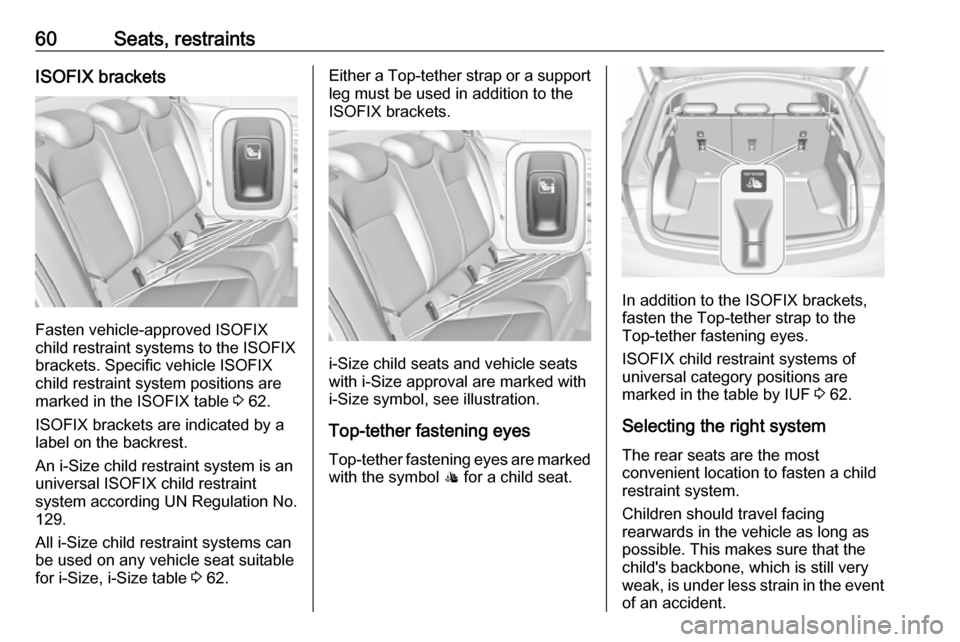
60Seats, restraintsISOFIX brackets
Fasten vehicle-approved ISOFIX
child restraint systems to the ISOFIX
brackets. Specific vehicle ISOFIX
child restraint system positions are
marked in the ISOFIX table 3 62.
ISOFIX brackets are indicated by a label on the backrest.
An i-Size child restraint system is an
universal ISOFIX child restraint
system according UN Regulation No.
129.
All i-Size child restraint systems can be used on any vehicle seat suitable
for i-Size, i-Size table 3 62.
Either a Top-tether strap or a support
leg must be used in addition to the
ISOFIX brackets.
i-Size child seats and vehicle seats
with i-Size approval are marked with
i-Size symbol, see illustration.
Top-tether fastening eyes
Top-tether fastening eyes are marked
with the symbol : for a child seat.
In addition to the ISOFIX brackets,
fasten the Top-tether strap to the
Top-tether fastening eyes.
ISOFIX child restraint systems of
universal category positions are
marked in the table by IUF 3 62.
Selecting the right system The rear seats are the most
convenient location to fasten a child
restraint system.
Children should travel facing
rearwards in the vehicle as long as
possible. This makes sure that the child's backbone, which is still very
weak, is under less strain in the event
of an accident.
Page 63 of 303

Seats, restraints61Suitable are restraint systems that
comply with valid UN ECE
regulations. Check local laws and
regulations for mandatory use of child
restraint systems.
The following child restraints are
recommended for the following
weight classes:
Maxi Cosi Cabriofix for children up to 13 kg for group 0, group 0+ and Duo
Plus for children from 13 kg to 18 kg in group I.
Ensure that the child restraint system to be installed is compatible with the
vehicle type.
Ensure that the mounting location of
the child restraint system within the
vehicle is correct, see following
tables.
Allow children to enter and exit the
vehicle only on the side facing away
from the traffic.
When the child restraint system is not in use, secure the seat with a seat beltor remove it from the vehicle.Note
Do not affix anything on the child
restraint systems and do not cover
them with any other materials.
A child restraint system which has
been subjected to stress in an
accident must be replaced.
Page 64 of 303

62Seats, restraintsChild restraint installation locations
Permissible options for fastening a child restraint system with a three-point seat belt
Weight class
On front passenger seat
On rear outboard seatsOn rear centre seat
activated airbagdeactivated airbagGroup 0: up to 10 kgXU 1,2U/L 3UGroup 0+: up to 13 kgXU1,2U/L 3UGroup I: 9 to 18 kgXU1,2U/L 3,4U4Group II: 15 to 25 kgU1,2XU/L 3,4U4Group III: 22 to 36 kgU1,2XU/L 3,4U4U:universal suitability in conjunction with three-point seat beltL:suitable for particular child restraint systems of the 'specific-vehicle', 'restricted' or 'semi-universal' categories. The
child restraint system must be approved for the specific vehicle type (refer to the vehicle type list of the child restraint
system)X:no child restraint system permitted in this weight class1:move seat forwards as far as necessary and adjust seat backrest as far as necessary to a vertical position to ensure that the belt runs forwards from the upper anchorage point2:move seat upwards as far as necessary and adjust seat backrest as far as necessary to a vertical position to ensurethat the belt is tight on the buckle side3:move the respective front seat ahead of the child restraint system forwards as far as necessary4:adjust the respective headrest as necessary or remove if required
Page 65 of 303

Seats, restraints63Permissible options for fitting an ISOFIX child restraint system with ISOFIX brackets
Weight classSize classFixture
On front passenger seatOn rear outboard
seatsOn rear centre
seatactivated airbagdeactivated airbagGroup 0: up to 10 kgGISO/L2XXXXFISO/L1XXXXEISO/R1XXIL 3XGroup 0+: up to 13 kgEISO/R1XXIL 3XDISO/R2XXIL3XCISO/R3XXIL3XGroup I: 9 to 18 kgDISO/R2XXIL3,4XCISO/R3XXIL3,4XBISO/F2XXIL, IUF 3,4XB1ISO/F2XXXIL, IUF3,4XAISO/F3XXIL, IUF 3,4XGroup II: 15 to 25 kgXXIL3,4XGroup III: 22 to 36 kgXXIL3,4X
Page 66 of 303

64Seats, restraintsIL:suitable for particular ISOFIX restraint systems of the 'specific-vehicle', 'restricted' or 'semi-universal' categories.
The ISOFIX restraint system must be approved for the specific vehicle type (refer to the vehicle type list of the child restraint system)IUF:suitable for ISOFIX forward-facing child restraint systems of universal category approved for use in this weight classX:no ISOFIX child restraint system approved in this weight class1:move seat forwards as far as necessary and adjust seat backrest inclination as far as necessary to a vertical positionto ensure that the belt runs forwards from the upper anchorage point2:move seat height adjustment upwards as far as necessary and adjust seat backrest inclination as far as necessary
to a vertical position to ensure that the belt is tight on the buckle side3:move the respective front seat ahead of the child restraint system forwards as far as necessary4:adjust the respective headrest as necessary or remove if required
ISOFIX size class and seat device
A – ISO/F3:forward-facing child restraint system for children of maximum size in the weight class 9 to 18 kgB – ISO/F2:forward-facing child restraint system for smaller children in the weight class 9 to 18 kgB1 – ISO/F2X:forward-facing child restraint system for smaller children in the weight class 9 to 18 kgC – ISO/R3:rear-facing child restraint system for children of maximum size in the weight class up to 18 kgD – ISO/R2:rear-facing child restraint system for smaller children in the weight class up to 18 kgE – ISO/R1:rear-facing child restraint system for young children in the weight class up to 13 kgF– ISO/L1:left lateral facing position child restraint system (carry-cot)G – ISO/L2:right lateral facing position child restraint system (carry-cot)
Permissible options for fitting an i-Size child restraint system with ISOFIX brackets
On front passenger seat
On rear outboard seatsOn rear centre seat
activated airbagdeactivated airbagi-Size child restraint systemsXXi - UX
Page 67 of 303

Seats, restraints65i - U:suitable for i-Size 'universal' forward and rearward facing child restraint systemsX:seating position not suitable for i-Size 'universal' child restraint systems
Page 74 of 303

72Storage
● Pull the release lever on one orboth outer sides and fold down
the backrests onto the seat
cushion. When folding the
backrests, pull the seat belts along with them.
9 Warning
Take care when folding down the
right outer seat backrest if the
centre seat backrest is already
folded down. Risk of injury due to bolt protruding from the inner side
of the backrest.
● Alternatively fold seat backrests from the load compartment: pullswitch on left or right sidewall of
the load compartment to fold the
corresponding part of the rear
seat backrest.
9 Warning
Take care when operating the rear
backrests from the load
compartment. The backrest is
folded with considerable force.
Risk of injury, particularly to
children.
Ensure that nothing is attached to
the rear seats or located on the
seat cushion.
● To fold up, raise the backrests and guide them into an upright
position until they engage
audibly.
The backrests are properly
engaged when the red mark near the release lever is no longer
visible.
Page 299 of 303

297Child restraint systems ................59
Climate control ............................. 16
Clock............................................. 83
Collision damage repair ..............290
Control indicators.......................... 97
Control of the vehicle .................153
Controls ........................................ 79
Convex shape .............................. 33
Coolant and antifreeze ...............272
Cruise control ....................103, 178
Cupholders .................................. 68
Curtain airbag system .................. 57
Curve lighting.............................. 130
D Danger, Warnings and Cautions ...4
Daytime running lights ...............130
Declaration of conformity ............288
DEF ............................................ 162
Diesel exhaust fluid ....................162
Diesel fuel system bleeding .......236
Diesel particle filter ....................160
Door open .................................. 103
Doors ............................................ 28
Driver assistance systems ..........178
Driver Information Centre ...........104
Driving characteristics and towing tips .............................. 225
Driving hints ................................ 153E
Electric adjustment ......................33
Electrical system......................... 244
Electric parking brake ...........99, 171
Electric parking brake fault ...........99
Electronic climate control system 143
Electronic key system ...................21
Electronic Stability Control.......... 174
Electronic Stability Control and Traction Control system ..........100
Electronic Stability Control off..... 100
End-of-life vehicle recovery .......230
Engine compartment fuse box ...245
Engine coolant ........................... 233
Engine coolant temperature ......101
Engine coolant temperature gauge ....................................... 96
Engine data ............................... 280
Engine exhaust .......................... 160
Engine identification ...................276
Engine oil ................... 232, 272, 277
Engine oil pressure ....................101
Entry lighting .............................. 137
Event data recorders ..................293
Exit lighting ................................ 137
Exterior care .............................. 268
Exterior light ............................... 102
Exterior lighting ....................13, 126
Exterior mirrors ............................. 33F
First aid ......................................... 75
First aid kit ................................... 75
Fixed air vents ........................... 150
Fog light ..................................... 102
Fog lights ................................... 239
Folding mirrors ............................. 33
Following distance ......................100
Following distance indication ......192
Forward collision alert................. 189
Front airbag system .....................56
Front fog lights ........................... 134
Front pedestrian protection ........196
Front seats.................................... 42
Front storage ................................ 69
Fuel............................................. 221
Fuel consumption - CO 2-
Emissions ............................... 224
Fuel for diesel engines ..............222
Fuel for petrol engines ...............221
Fuel gauge ................................... 95
Funnel......................................... 222
Fuses ......................................... 244
G Gauges ......................................... 93
Gear shifting ............................... 100
General information ...................225
Glovebox ..................................... 68