tyre pressure OPEL INSIGNIA BREAK 2017.5 Manual user
[x] Cancel search | Manufacturer: OPEL, Model Year: 2017.5, Model line: INSIGNIA BREAK, Model: OPEL INSIGNIA BREAK 2017.5Pages: 303, PDF Size: 8.46 MB
Page 261 of 303
Vehicle care259Do not run the compressor longerthan 10 minutes.
Type 1: if the tyre pressure is not
obtained within 10 minutes,
remove the tyre repair kit. Move
the vehicle one tyre rotation.
Reattach the tyre repair kit and
continue the filling procedure for
10 minutes. Check tyre pressure
once more. If the prescribed tyre
pressure is still not obtained, the
tyre is too badly damaged. Seek
the assistance of a workshop.
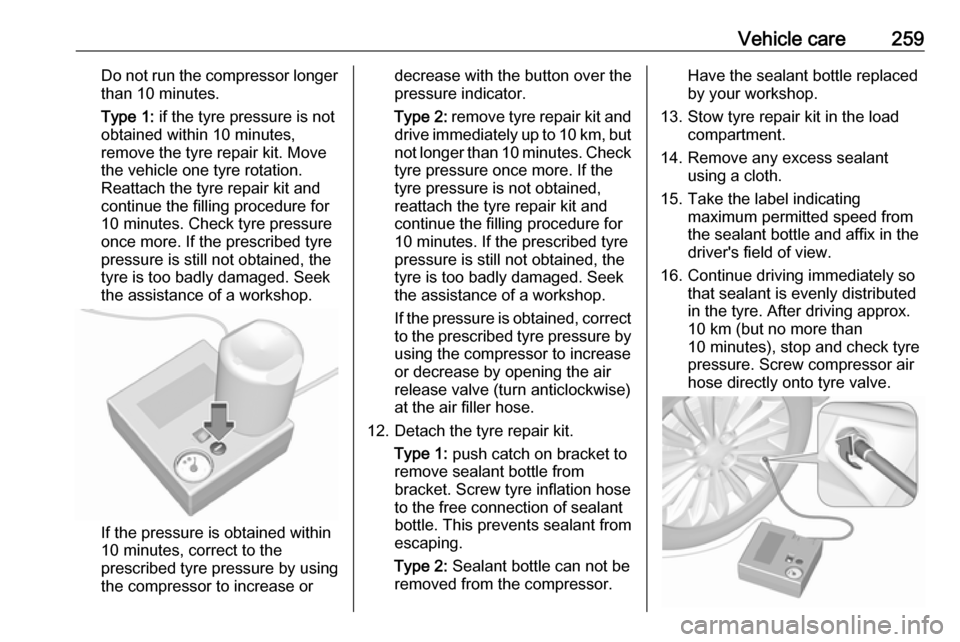
If the pressure is obtained within
10 minutes, correct to the
prescribed tyre pressure by using
the compressor to increase or
decrease with the button over the
pressure indicator.
Type 2: remove tyre repair kit and
drive immediately up to 10 km, but
not longer than 10 minutes. Check tyre pressure once more. If the
tyre pressure is not obtained,
reattach the tyre repair kit and
continue the filling procedure for
10 minutes. If the prescribed tyre
pressure is still not obtained, the
tyre is too badly damaged. Seek
the assistance of a workshop.
If the pressure is obtained, correct
to the prescribed tyre pressure by using the compressor to increase
or decrease by opening the air release valve (turn anticlockwise)
at the air filler hose.
12. Detach the tyre repair kit. Type 1: push catch on bracket to
remove sealant bottle from
bracket. Screw tyre inflation hose
to the free connection of sealant
bottle. This prevents sealant from
escaping.
Type 2: Sealant bottle can not be
removed from the compressor.Have the sealant bottle replaced
by your workshop.
13. Stow tyre repair kit in the load compartment.
14. Remove any excess sealant using a cloth.
15. Take the label indicating maximum permitted speed from
the sealant bottle and affix in the
driver's field of view.
16. Continue driving immediately so that sealant is evenly distributed
in the tyre. After driving approx.
10 km (but no more than
10 minutes), stop and check tyre
pressure. Screw compressor air
hose directly onto tyre valve.
Page 262 of 303

260Vehicle careIf tyre pressure is more than1.3 bar , set it to the correct value.
Repeat the procedure until there
is no more loss of pressure.
If the tyre pressure has fallen
below 1.3 bar, the vehicle must
not be used. Seek the assistance
of a workshop.
17. Stow away tyre repair kit in the box.
18. Fix the box with the screw.
Note
The driving characteristics of the repaired tyre is severely affected,
therefore have this tyre replaced.
If unusual noise is heard or the
compressor becomes hot, turn
compressor off for at least 30
minutes.
The built-in safety valve opens at a
pressure of 7 bar.
Note the expiry date of the kit. After
this date its sealing capability is no
longer guaranteed. Pay attention to
storage information on sealant
bottle.Replace the used sealant bottle. Dispose of the bottle as prescribed
by applicable laws.
The compressor and sealant can be used from approx. -30 °C.
The adapters supplied can be used
to pump up other items e.g.
footballs, air mattresses, inflatable
dinghies etc. They are located on the underside of the compressor. To
remove, screw on compressor air hose and withdraw adapter.
Wheel changing
Some vehicles are equipped with a
tyre repair kit instead of a spare wheel
3 256.
Make the following preparations and
observe the following information:
● Park the vehicle on a level, firm and non-skid surface. The front
wheels must be in the straight- ahead position.
● Apply the parking brake and engage first gear, reverse gear or
P .
● Remove the spare wheel 3 262.● Never change more than one
wheel at once.
● Use the jack only to change wheels in case of puncture, not
for seasonal winter or summer
tyre change.
● The jack is maintenance-free.
● If the ground on which the vehicle
is standing is soft, a solid board
(max. 1 cm thick) should be
placed under the jack.
● Take heavy objects out of the vehicle before jacking up.
● No people or animals may be in the vehicle when it is jacked-up.
● Never crawl under a jacked-up vehicle.
● Do not start the vehicle when it is
raised on the jack.
● Clean wheel nuts and thread with
a clean cloth before mounting the
wheel.9 Warning
Do not grease wheel bolt, wheel
nut and wheel nut cone.
Page 264 of 303
262Vehicle careAttach wheel wrench and with the
jack correctly aligned rotate wheel wrench until wheel is clear of the
ground.
5. Unscrew the wheel nuts. 6. Change the wheel. Spare wheel 3 262.
7. Screw on the wheel nuts.
8. Lower vehicle.
9. Install the wheel wrench ensuring that it locates securely and tighten
each nut in a crosswise
sequence. Tightening torque is
125 Nm.
10. Align the valve hole in the wheel cover with the tyre valve before
installing.
Install wheel nut caps.
11. Install vehicle jacking point cover.
12. Stow and secure the replaced wheel 3 262, the vehicle tools
3 249 and the adapter for the
locking wheel nuts 3 68.
13. Check the tyre pressure of the installed tyre and the wheel nut
torque as soon as possible.Have the defective tyre renewed or
repaired as soon as possible.
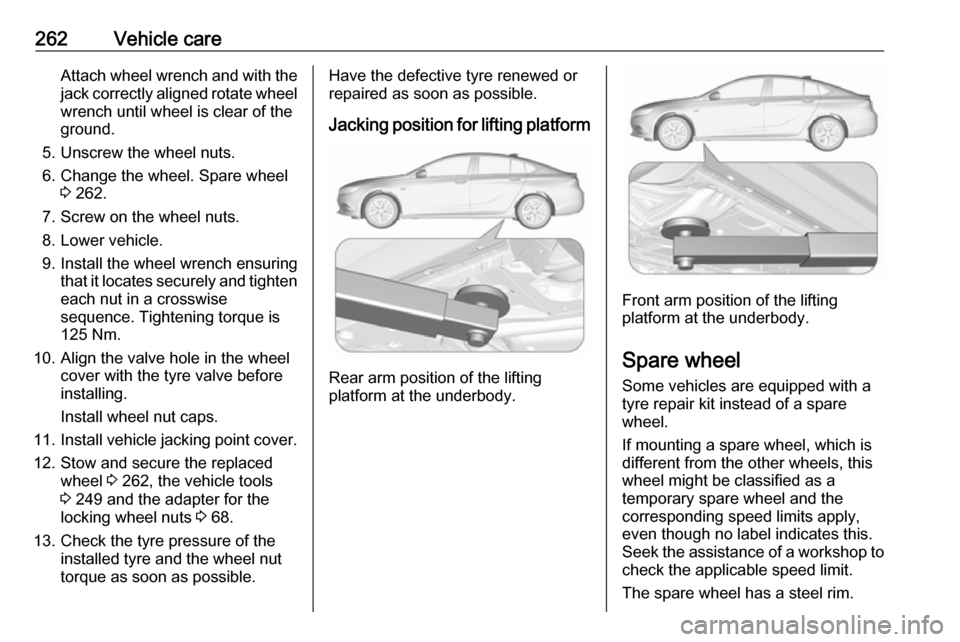
Jacking position for lifting platform
Rear arm position of the lifting
platform at the underbody.
Front arm position of the lifting
platform at the underbody.
Spare wheel Some vehicles are equipped with a
tyre repair kit instead of a spare
wheel.
If mounting a spare wheel, which is
different from the other wheels, this
wheel might be classified as a
temporary spare wheel and the
corresponding speed limits apply,
even though no label indicates this.
Seek the assistance of a workshop to
check the applicable speed limit.
The spare wheel has a steel rim.
Page 271 of 303

Vehicle care269Paintwork polish with silicone forms a
protective film, making waxing
unnecessary.
Plastic body parts must not be treated
with wax or polishing agents.
Windows and windscreen wiper
blades
Use a soft lint-free cloth or chamois
leather together with window cleaner
and insect remover.
When cleaning the rear window from
inside, always wipe in parallel to the
heating element to prevent damage.
For mechanical removal of ice, use a
sharp-edged ice scraper. Press the
scraper firmly against the glass so
that no dirt can get under it and
scratch the glass.
Clean smearing wiper blades with a
soft cloth and window cleaner.
Remove dirt residues from smearing
wiper blades by using a soft cloth and window cleaner. Also make sure to
remove any residues such as wax,
insect residues and similar from the
window.Ice residues, pollution and continuous wiping on dry windows will damage or
even destroy the wiper blades.
Sunroof Never clean with solvents or abrasive
agents, fuels, aggressive media
(e.g. paint cleaner, acetone-
containing solutions etc.), acidic or highly alkaline media or abrasive
pads. Do not apply wax or polishing
agents to the sunroof.
Wheels and tyres Do not use high-pressure jet
cleaners.
Clean rims with a pH-neutral wheel
cleaner.
Rims are painted and can be treated
with the same agents as the body.
Paintwork damage Rectify minor paintwork damage witha touch-up pen before rust forms.
Have more extensive damage or rust
areas repaired by a workshop.Underbody
Some areas of the vehicle underbody
have a PVC undercoating while other critical areas have a durable
protective wax coating.
After the underbody is washed, check
the underbody and have it waxed if
necessary.
Bitumen/rubber materials could
damage the PVC coating. Have
underbody work carried out by a
workshop.
Before and after winter, wash the
underbody and have the protective
wax coating checked.
Liquid gas system9 Danger
Liquid gas is heavier than air and
can collect in sink points.
Take care when performing work
at the underbody in a pit.
Page 277 of 303
Technical data275Technical dataVehicle identification..................275
Vehicle Identification Number ..275
Identification plate ...................275
Engine identification ................276
Vehicle data ............................... 277
Recommended fluids and lubricants ................................ 277
Engine data ............................. 280
Performance ............................ 282
Vehicle weight ......................... 283
Vehicle dimensions .................283
Capacities ................................ 285
Tyre pressures ........................ 286Vehicle identification
Vehicle IdentificationNumber
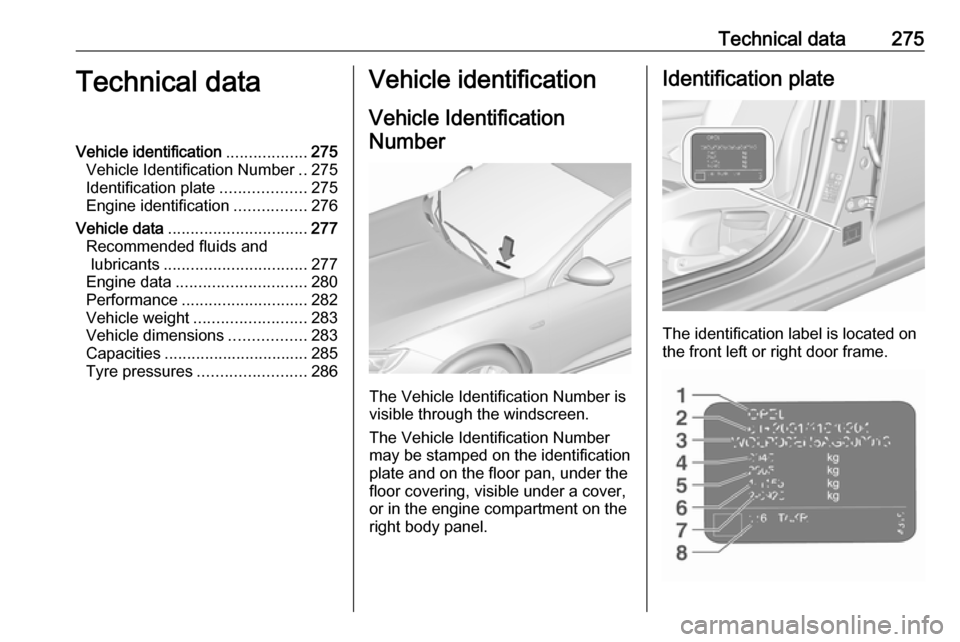
The Vehicle Identification Number is
visible through the windscreen.
The Vehicle Identification Number
may be stamped on the identification
plate and on the floor pan, under the floor covering, visible under a cover,
or in the engine compartment on the
right body panel.
Identification plate
The identification label is located on
the front left or right door frame.
Page 288 of 303
![OPEL INSIGNIA BREAK 2017.5 Manual user 286Technical dataTyre pressuresComfort with up to 3 peopleECO with up to 3 peopleWith full loadEngineTyresfrontrearfrontrearfrontrear[kPa/bar]
([psi])[kPa/bar]
([psi])[kPa/bar]
([psi])[kPa/bar]
([psi]](/img/37/18862/w960_18862-287.png "OPEL INSIGNIA BREAK 2017.5 Manual user 286Technical dataTyre pressuresComfort with up to 3 peopleECO with up to 3 peopleWith full loadEngineTyresfrontrearfrontrearfrontrear[kPa/bar]
([psi])[kPa/bar]
([psi])[kPa/bar]
([psi])[kPa/bar]
([psi]")
286Technical dataTyre pressuresComfort with up to 3 peopleECO with up to 3 peopleWith full loadEngineTyresfrontrearfrontrearfrontrear[kPa/bar]
([psi])[kPa/bar]
([psi])[kPa/bar]
([psi])[kPa/bar]
([psi])[kPa/bar]
([psi])[kPa/bar]
([psi])B15XHL,
B15XHT,
B16DTE,
B16DTH215/60 R16,220/2.2 (32)220/2.2 (32)270/2.7 (39)270/2.7 (39)240/2.4
(35)270/2.7
(39)225/55 R17,245/45 R18,235/45 R18215/55 R17,
225/55 R17 M+S240/2.4 (35)240/2.4 (35)270/2.7 (39)270/2.7 (39)240/2.4
(35)270/2.7
(39)
Page 296 of 303

294Customer informationWhen using the vehicle, situations
may occur in which these technical
data related to other information
(accident report, damages on the
vehicle, witness statements etc.) may be associated with a specific person -
possibly, with the assistance of an
expert.
Additional functions contractually
agreed upon with the client (e.g.
vehicle location in emergency cases)
allow the transmission of particular vehicle data from the vehicle.
Radio Frequency
Identification (RFID)
RFID technology is used in some
vehicles for functions such as tyre
pressure monitoring and ignition
system security. It is also used in
connection with conveniences such
as radio remote controls for door
locking/unlocking and starting, and in-
vehicle transmitters for garage door
openers. RFID technology in Opel
vehicles does not use or record
personal information or link with any
other Opel system containing
personal information.
Page 302 of 303

300Turn and lane-change signals ...133
Turn signal ................................... 97
Tyre chains ................................ 255
Tyre designations ......................251
Tyre pressure ............................ 251
Tyre pressure monitoring system ............................. 101, 252
Tyre pressures ........................... 286
Tyre repair kit ............................. 256
U
Ultrasonic parking assist............. 198
Upholstery .................................. 270
Uplevel display ........................... 104
Using this manual ..........................3
V Valet mode ................................. 111
Vehicle battery ........................... 235
Vehicle checks............................ 231
Vehicle data ................................ 277
Vehicle data recording and privacy ..................................... 293
Vehicle detected ahead ..............103
Vehicle dimensions .................... 283
Vehicle Identification Number ....275
Vehicle jack ................................ 249
Vehicle messages .....................115
Vehicle personalisation .............117
Vehicle security ............................ 29
Vehicle specific data ......................3Vehicle storage ........................... 230
Vehicle tools ............................... 249
Vehicle unlocking ........................... 6 Vehicle weight ........................... 283
Ventilating ..................................... 49
W
Warning chimes .........................116
Warning lights ............................... 93
Warning triangle .......................... 74
Washer and wiper systems .........14
Washer fluid ............................... 234
Wheel changing .........................260
Wheel covers ............................. 255
Wheels and tyres .......................250
Windows ....................................... 35
Windscreen................................... 35 Windscreen wiper/washer ...........80
Winter tyres ............................... 250
Wiper blade replacement ..........237