brakes OPEL INSIGNIA BREAK 2018.5 Manual user
[x] Cancel search | Manufacturer: OPEL, Model Year: 2018.5, Model line: INSIGNIA BREAK, Model: OPEL INSIGNIA BREAK 2018.5Pages: 329, PDF Size: 9.32 MB
Page 208 of 329

206Driving and operatingDeactivation
Active emergency braking can be
deactivated in the personalisation
menu 3 127. If deactivated a
message is displayed in the Driver
Information Centre.
System limitations In some cases, the active emergencybraking system may provide an
automatic braking in situations that
seem to be unnecessary, for instance
in parking garages, due to traffic signs in a curve or due to vehicles in
another lane. This is normal
operation, the vehicle does not need
service. Firmly apply the accelerator
pedal to override the automatic
braking if the situation and the
surroundings permit.
In the following cases, Active
emergency braking performance is
limited:
● Driving on winding or hilly roads.
● Detecting all vehicles, especially vehicles with a trailer, tractors,
muddy vehicles, etc.● Detecting a vehicle when weather limits visibility, such as infog, rain, or snow.
● During nighttime driving.
● Weather limits visibility, such as fog, rain, or snow.
● The sensor in the windscreen is blocked by snow, ice, slush, mud,
dirt, windscreen damage or
affected by foreign items, e.g.
stickers.
To avoid malfunction keep the areas
of the camera sensor in the
windscreen and the radar sensor in
the radiator grille always clean from
dirt, dust, ice and snow.
Complete attention is always required
while driving, and you should be
ready to take action and apply the
brakes and/or steer the vehicle to
avoid crashes.
Fault
In case the system requires a service, a message is displayed in the Driver
Information Centre.If the system does not work as it
should do, vehicle messages are
displayed in the Driver Information
Centre.
Vehicle messages 3 125.
Front pedestrian protection Front pedestrian protection may help
to avoid or reduce the harm caused
by front-end crashes with nearby
pedestrians when driving in a forward
gear.
The system uses the front camera in
the windscreen to detect a pedestrian directly ahead, in your path.
Front pedestrian protection can
detect and alert to pedestrians in a
forward gear at speeds between 8
km/h and 80 km/h. Additionally Front
pedestrian protection can provide a
boost to braking or automatically
brake the vehicle.
During daytime driving, the system detects pedestrians up to a distance
of approximately 40 metres. During
nighttime driving, system
performance is limited.
Page 209 of 329
Driving and operating207Front pedestrian protection can beset to Off, Alert, or Alert & Brake in
vehicle personalisation 3 127.9 Danger
Front pedestrian braking does not
provide an alert or automatically
brake the vehicle, unless it detects
a pedestrian.
The system may not detect
pedestrians, including children,
when the pedestrian is not directly ahead, not fully visible, not
standing upright, or when part of a
group.
Front pedestrian protection includes:
● detecting front pedestrian ahead● front pedestrian alert
● automatic braking
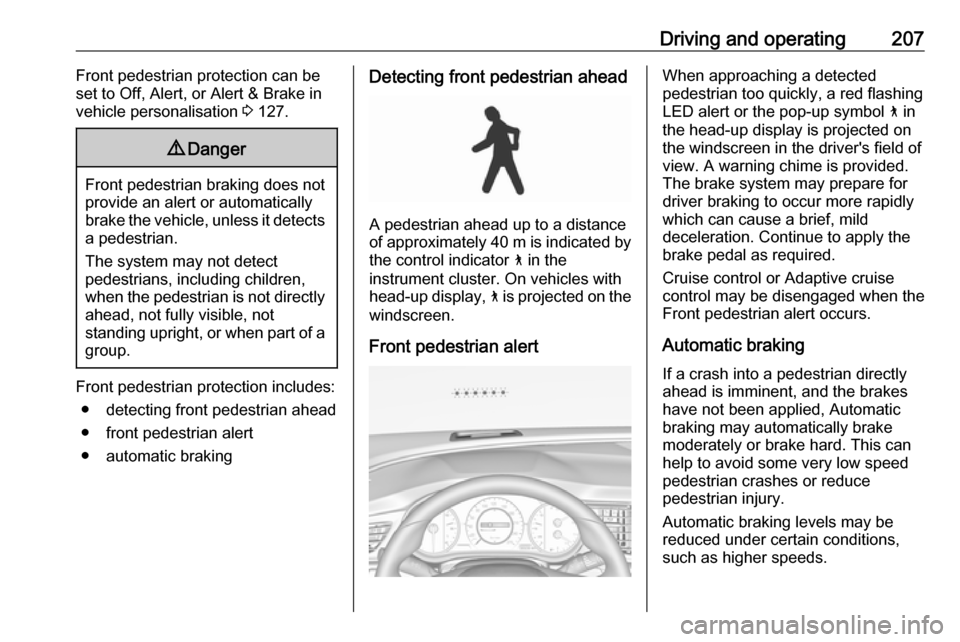
Detecting front pedestrian ahead
A pedestrian ahead up to a distance
of approximately 40 m is indicated by the control indicator 7 in the
instrument cluster. On vehicles with
head-up display, 7 is projected on the
windscreen.
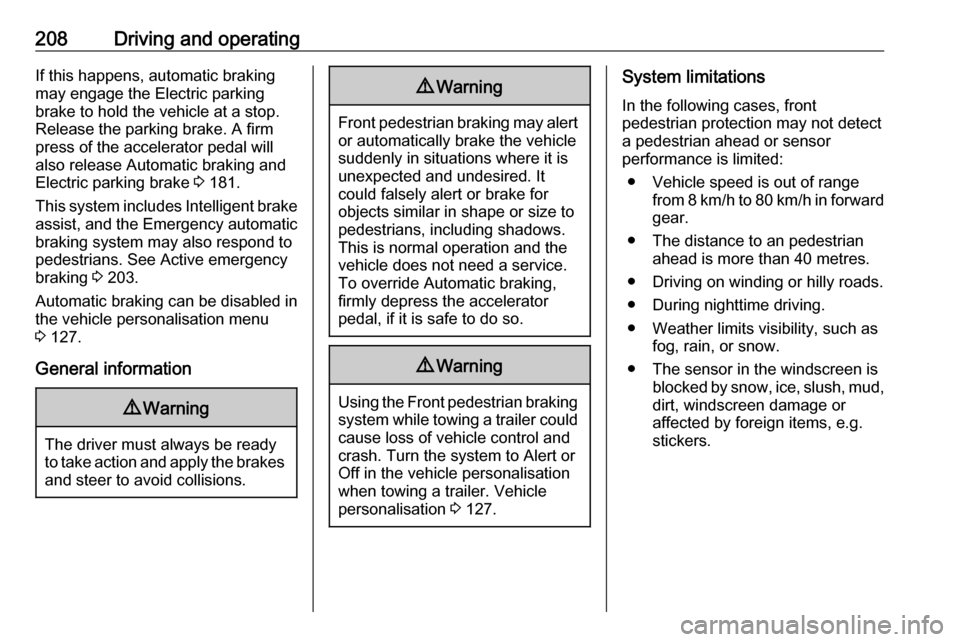
Front pedestrian alert
When approaching a detected
pedestrian too quickly, a red flashing
LED alert or the pop-up symbol 7 in
the head-up display is projected on the windscreen in the driver's field of
view. A warning chime is provided.
The brake system may prepare for
driver braking to occur more rapidly
which can cause a brief, mild
deceleration. Continue to apply the
brake pedal as required.
Cruise control or Adaptive cruise
control may be disengaged when the
Front pedestrian alert occurs.
Automatic braking If a crash into a pedestrian directly
ahead is imminent, and the brakes
have not been applied, Automatic
braking may automatically brake
moderately or brake hard. This can
help to avoid some very low speed
pedestrian crashes or reduce
pedestrian injury.
Automatic braking levels may be reduced under certain conditions,
such as higher speeds.
Page 210 of 329
208Driving and operatingIf this happens, automatic braking
may engage the Electric parking
brake to hold the vehicle at a stop.
Release the parking brake. A firm
press of the accelerator pedal will
also release Automatic braking and
Electric parking brake 3 181.
This system includes Intelligent brake assist, and the Emergency automatic
braking system may also respond to
pedestrians. See Active emergency
braking 3 203.
Automatic braking can be disabled in the vehicle personalisation menu
3 127.
General information9 Warning
The driver must always be ready
to take action and apply the brakes and steer to avoid collisions.
9 Warning
Front pedestrian braking may alert
or automatically brake the vehicle
suddenly in situations where it is
unexpected and undesired. It
could falsely alert or brake for
objects similar in shape or size to
pedestrians, including shadows.
This is normal operation and the
vehicle does not need a service.
To override Automatic braking,
firmly depress the accelerator
pedal, if it is safe to do so.
9 Warning
Using the Front pedestrian braking
system while towing a trailer couldcause loss of vehicle control and
crash. Turn the system to Alert or
Off in the vehicle personalisation
when towing a trailer. Vehicle
personalisation 3 127.
System limitations
In the following cases, front
pedestrian protection may not detect
a pedestrian ahead or sensor
performance is limited:
● Vehicle speed is out of range from 8 km/h to 80 km/h in forwardgear.
● The distance to an pedestrian ahead is more than 40 metres.
● Driving on winding or hilly roads.
● During nighttime driving.
● Weather limits visibility, such as fog, rain, or snow.
● The sensor in the windscreen is blocked by snow, ice, slush, mud,dirt, windscreen damage or
affected by foreign items, e.g.
stickers.
Page 241 of 329

Vehicle care239Vehicle careGeneral Information...................239
Accessories and vehicle modifications .......................... 239
Vehicle storage ........................240
End-of-life vehicle recovery .....240
Vehicle checks ........................... 241
Performing work ......................241
Bonnet ..................................... 241
Engine oil ................................. 242
Engine coolant ......................... 243
Washer fluid ............................ 244
Brakes ..................................... 244
Brake fluid ............................... 244
Vehicle battery ......................... 245
Diesel fuel system bleeding .....246
Wiper blade replacement ........246
Bulb replacement .......................247
Halogen headlights ..................247
LED headlights ........................ 249
Fog lights ................................. 249
Tail lights ................................. 251
Side turn lights ......................... 256
Number plate light ...................257
Interior lights ............................ 257
Instrument panel illumination ...257Electrical system ........................257
Fuses ....................................... 257
Engine compartment fuse box . 258
Instrument panel fuse box .......261
Vehicle tools .............................. 262
Tools ........................................ 262
Wheels and tyres .......................263
Winter tyres ............................. 263
Tyre designations ....................264
Tyre pressure .......................... 264
Tyre pressure monitoring system .................................... 265
Tread depth ............................. 268
Changing tyre and wheel size . 268
Wheel covers ........................... 268
Tyre chains .............................. 269
Tyre repair kit .......................... 269
Wheel changing .......................274
Spare wheel ............................ 276
Jump starting ............................. 278
Towing ....................................... 279
Towing the vehicle ...................279
Towing another vehicle ...........280
Appearance care .......................281
Exterior care ............................ 281
Interior care ............................. 283General Information
Accessories and vehiclemodifications
We recommend the use of genuine
parts and accessories and factory approved parts specific for your
vehicle type. We cannot assess or guarantee reliability of other products
- even if they have a regulatory or
otherwise granted approval.
Any modification, conversion or other changes made to standard vehicle
specifications (including, without
limitation, software modifications,
modifications of the electronic control
units) may invalidate the warranty
offered by Opel. Furthermore, such
changes may affect driver assistance
systems, fuel consumption, CO 2
emissions and other emissions of the
vehicle. They may also invalidate the
vehicle operating permit.
Page 246 of 329
244Vehicle careDepending on the engine, the
position of the coolant container may be different.9 Warning
Allow the engine to cool before
opening the cap. Carefully open
the cap, relieving the pressure
slowly.
To top up, use a 1:1 mixture of
released coolant concentrate mixed
with clean tap water. If no coolant
concentrate is available, use clean
tap water. Install the cap tightly. Have the coolant concentration checked
and have the cause of the coolant
loss remedied by a workshop.
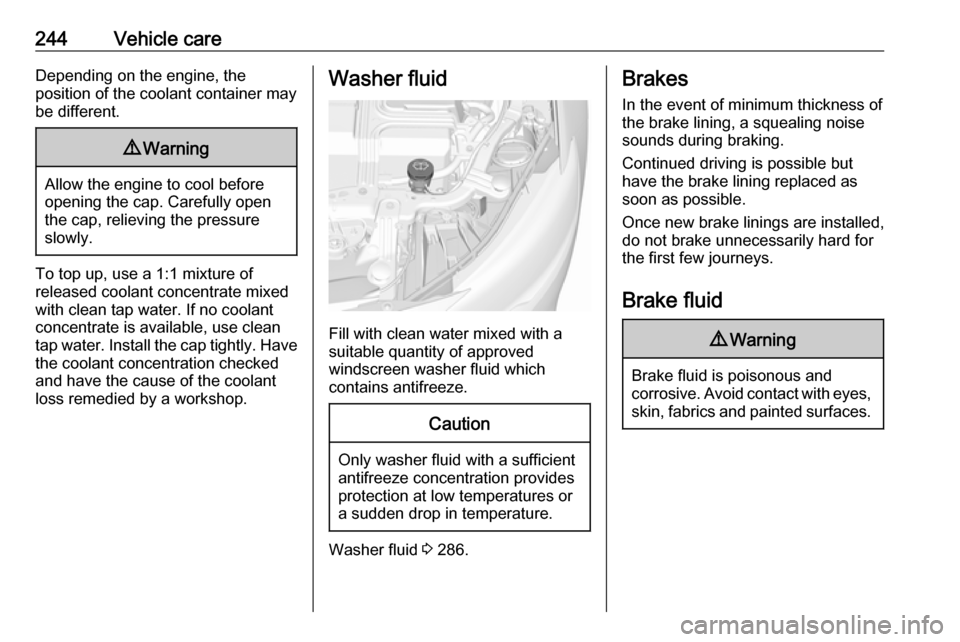
Washer fluid
Fill with clean water mixed with a
suitable quantity of approved
windscreen washer fluid which
contains antifreeze.
Caution
Only washer fluid with a sufficient
antifreeze concentration provides
protection at low temperatures or
a sudden drop in temperature.
Washer fluid 3 286.
Brakes
In the event of minimum thickness of
the brake lining, a squealing noise
sounds during braking.
Continued driving is possible but
have the brake lining replaced as
soon as possible.
Once new brake linings are installed,
do not brake unnecessarily hard for
the first few journeys.
Brake fluid9 Warning
Brake fluid is poisonous and
corrosive. Avoid contact with eyes, skin, fabrics and painted surfaces.
Page 320 of 329

318Customer information● Faults and defects in importantsystem components (e.g. lights,
brakes),
● System reactions in special driving situations (e.g. triggeringof an airbag, actuation of the
stability control systems),
● Information on events damaging the vehicle.
In special cases (e.g. if the vehicle
has detected a malfunction), it may be
necessary to save data that would
otherwise just be volatile.
When you use services, the operating data saved can be read together with
the vehicle identification number and
used if necessary. Staff working for
the service net-work (e.g. garages,
manufacturers) or third parties (e.g.
breakdown services) can read the
data from the vehicle. Services
include repair services, maintenance processes, warranty cases and
quality assurance measures.
Data is generally read via the OBD
(On-Board Diagnostics) port
prescribed by law in the vehicle. The operating data which has been read
out documents the technical conditionof the vehicle or individual
components and assists with fault
diagnosis, compliance with warranty
obligations and quality improvement.
This data, in particular information on component stress, technical events,
operator errors and other faults, is
transmitted to the manufacturer
where appropriate, together with the
vehicle identification number. The
manufacturer is also subject to
product liability. The manufacturer
potentially also needs operating data
from vehicles for product recalls.
Fault memories in the vehicle can be
reset by a service company when
carrying out servicing or repairs.
Comfort and infotainment
functions
Comfort settings and custom settings can be stored in the vehicle and
changed at any time.Depending on the equipment level in
question, these include
● Seat and steering wheel position settings,
● Chassis and air conditioning settings,
● Custom settings such as interior lighting.
You can input your own data in the
infotainment functions for your
vehicle as part of the selected
features.
Depending on the equipment level in
question, these include
● Multimedia data such as music, videos or photos for playback in
an integrated multimedia system,
● Address book data for use with an integrated hands-free system
or an integrated navigation
system,
● Input destinations,
● Data on the use of online services.
This data for comfort and
infotainment functions can be stored
locally in the vehicle or be kept on a
Page 324 of 329

322IndexAAccessories and vehicle modifications .......................... 239
Active bonnet ................................ 71
Active emergency braking ..........203
Adaptive cruise control .......113, 192
AdBlue ................................ 111, 172
Adjustable air vents ...................159
Airbag and belt tensioners .........108
Airbag deactivation ..............63, 108
Airbag label................................... 58
Airbag system .............................. 58
Air conditioning regular operation ................................ 161
Air conditioning system .............. 150
Air intake .................................... 160
Air vents...................................... 159
All-wheel drive ........................... 180
Antilock brake system ................ 180
Antilock brake system (ABS) .....110
Anti-theft alarm system ................34
Anti-theft locking system .............. 34
Appearance care ........................281
Armrest ................................... 53, 55
Armrest storage ........................... 74
Ashtrays ....................................... 97 Automatic anti-dazzle ..................39
Automatic dimming ......................38
Automatic light control ...............137
Automatic locking ........................27Automatic transmission .............175
Autostop ..................................... 167
Auxiliary heater ........................... 159
B Baselevel display ........................114
Battery discharge protection ......148
Battery voltage ........................... 126
Belts.............................................. 56 BlueInjection ............................... 172
Bonnet ....................................... 241
Brake and clutch fluid .................286
Brake and clutch system ...........109
Brake assist ............................... 182
Brake fluid .................................. 244
Brakes ............................... 180, 244
Breakdown.................................. 279
Bulb replacement ....................... 247
C Capacities .................................. 303
Cargo management system ........81
Catalytic converter .....................171
Central locking system ................25
Centre console lighting ..............147
Centre console storage ...............74
Changing tyre and wheel size ...268
Charging system ........................ 109
Child locks ................................... 28
Child restraint installation locations ................................... 67