towing OPEL INSIGNIA BREAK 2018.5 Manual user
[x] Cancel search | Manufacturer: OPEL, Model Year: 2018.5, Model line: INSIGNIA BREAK, Model: OPEL INSIGNIA BREAK 2018.5Pages: 329, PDF Size: 9.32 MB
Page 264 of 329
262Vehicle careNo.Circuit18Body control module19UREA module20Body control module21Body control module22Body control module23Electric steering wheel lock24Airbag25Diagnostic connector26Power outlet load compartment27EBCM valve28Police provision29–30–31Steering wheel controls32Ignition switch33Climate control34Central gateway moduleNo.Circuit35AUX/USB connector36Wireless charger37Rear wiper38Onstar39Display40Parking assist41Overhead console42RadioVehicle tools
Tools
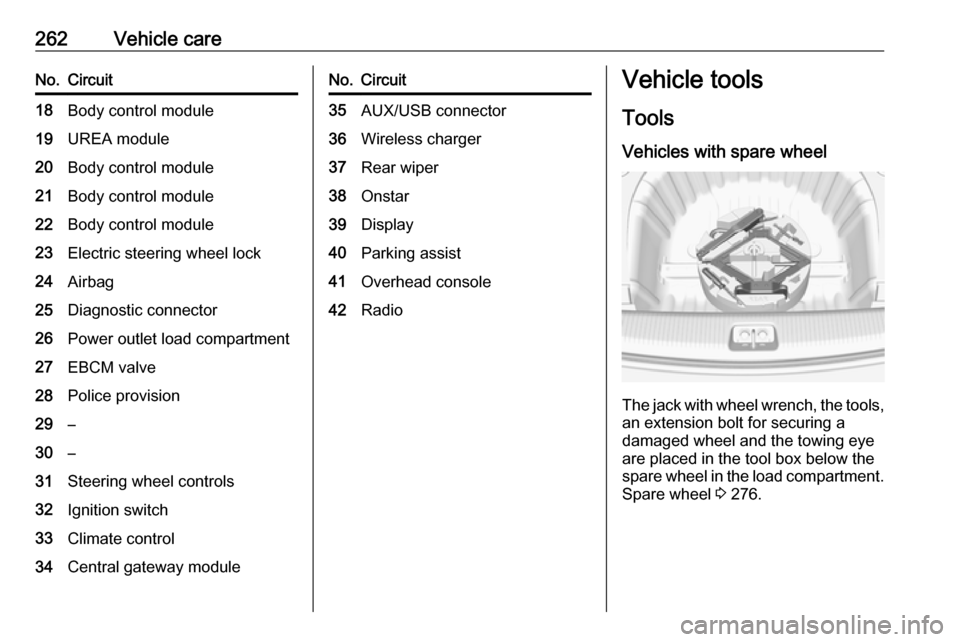
Vehicles with spare wheel
The jack with wheel wrench, the tools,
an extension bolt for securing a
damaged wheel and the towing eye
are placed in the tool box below the
spare wheel in the load compartment. Spare wheel 3 276.
Page 265 of 329
Vehicle care263Vehicles without spare wheel
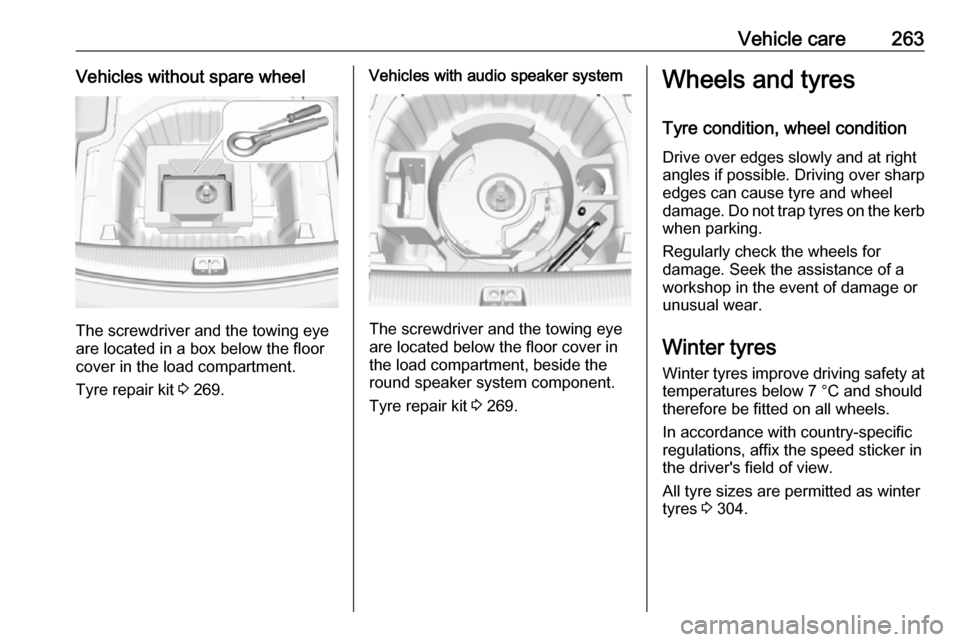
The screwdriver and the towing eye
are located in a box below the floor
cover in the load compartment.
Tyre repair kit 3 269.
Vehicles with audio speaker system
The screwdriver and the towing eye
are located below the floor cover in
the load compartment, beside the
round speaker system component.
Tyre repair kit 3 269.
Wheels and tyres
Tyre condition, wheel condition Drive over edges slowly and at right
angles if possible. Driving over sharp
edges can cause tyre and wheel
damage. Do not trap tyres on the kerb when parking.
Regularly check the wheels for
damage. Seek the assistance of a
workshop in the event of damage or
unusual wear.
Winter tyres
Winter tyres improve driving safety at temperatures below 7 °C and shouldtherefore be fitted on all wheels.
In accordance with country-specific
regulations, affix the speed sticker in
the driver's field of view.
All tyre sizes are permitted as winter
tyres 3 304.
Page 279 of 329

Vehicle care277To remove:1. Open the floor cover.
2. The spare wheel is secured with a
wing nut. Turn wing nut
anticlockwise and remove the
spare wheel.
Under the spare wheel there is the
box with vehicle tools.
3. When, after a wheel change, no wheel is placed in the spare wheelwell, secure the tool box by
turning right back the wing nut and
close the floor cover.
4. After wheel change back to full size wheel, place the spare wheel
outside up in the well and secure
with the wing nut.
Stowing the replaced full size
wheel in the spare wheel well
Secure a damaged full size wheel
facing upwards with the wing nut in
the spare wheel well after mounting
an extension bolt on the thread bolt.
The extension bolt is stowed with the
vehicle tools 3 262. To secure the
wheel:
1. Stick the extension bolt onto the thread bolt.
2. Store the damaged wheel outside
up in the spare wheel well and
secure it by turning the wing nut
clockwise on the extension bolt.
9 Warning
Storing a jack, a wheel or other
equipment in the load
compartment could cause injury if they are not fixed properly. During
a sudden stop or a collision, looseequipment could strike someone.
Store wheel, jack and tools always
in the original storage location and secure them by fixing.
Temporary spare wheel
Caution
The use of a spare wheel that issmaller than the other wheels or in combination with winter tyres
could affect driveability. Have the defective tyre replaced as soon as
possible.
Only mount one temporary spare
wheel. Do not drive faster than
80 km/h. Take curves slowly. Do not use for a long period of time.
If your vehicle gets a flat tyre on the
rear while towing another vehicle,
mount the temporary spare wheel in the front and the full tyre in the rear.
Tyre chains 3 269.
Page 281 of 329
Vehicle care279● The vehicles must not come intocontact with each other during
the jump starting process.
● Apply the parking brake, transmission in neutral,
automatic transmission in P.
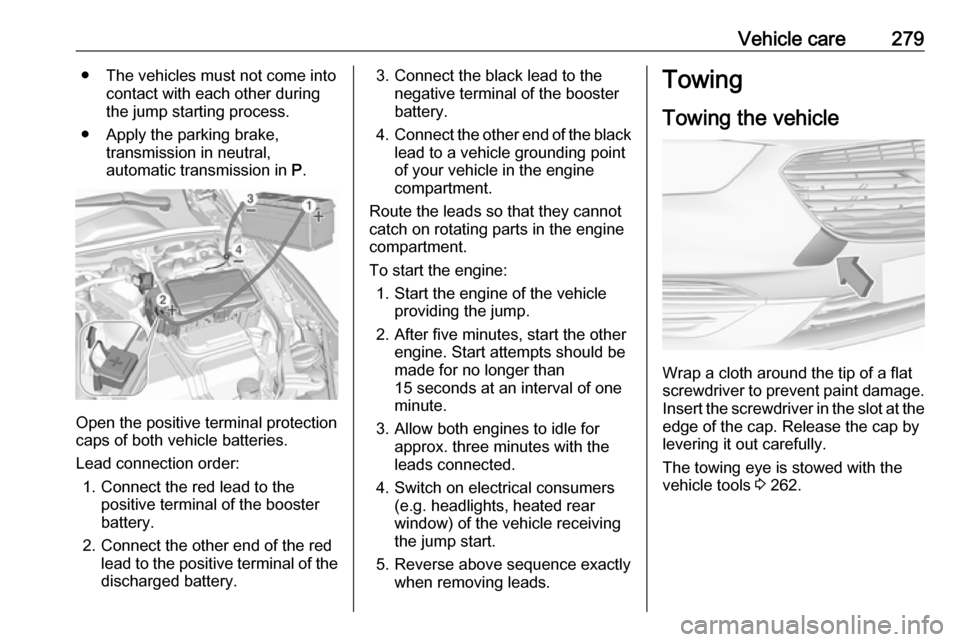
Open the positive terminal protection
caps of both vehicle batteries.
Lead connection order: 1. Connect the red lead to the positive terminal of the booster
battery.
2. Connect the other end of the red lead to the positive terminal of the
discharged battery.
3. Connect the black lead to the negative terminal of the boosterbattery.
4. Connect the other end of the black
lead to a vehicle grounding point
of your vehicle in the engine
compartment.
Route the leads so that they cannot
catch on rotating parts in the engine
compartment.
To start the engine: 1. Start the engine of the vehicle providing the jump.
2. After five minutes, start the other engine. Start attempts should be
made for no longer than
15 seconds at an interval of one
minute.
3. Allow both engines to idle for approx. three minutes with the
leads connected.
4. Switch on electrical consumers (e.g. headlights, heated rear
window) of the vehicle receiving
the jump start.
5. Reverse above sequence exactly when removing leads.Towing
Towing the vehicle
Wrap a cloth around the tip of a flat
screwdriver to prevent paint damage.
Insert the screwdriver in the slot at the
edge of the cap. Release the cap by
levering it out carefully.
The towing eye is stowed with the
vehicle tools 3 262.
Page 282 of 329
280Vehicle care
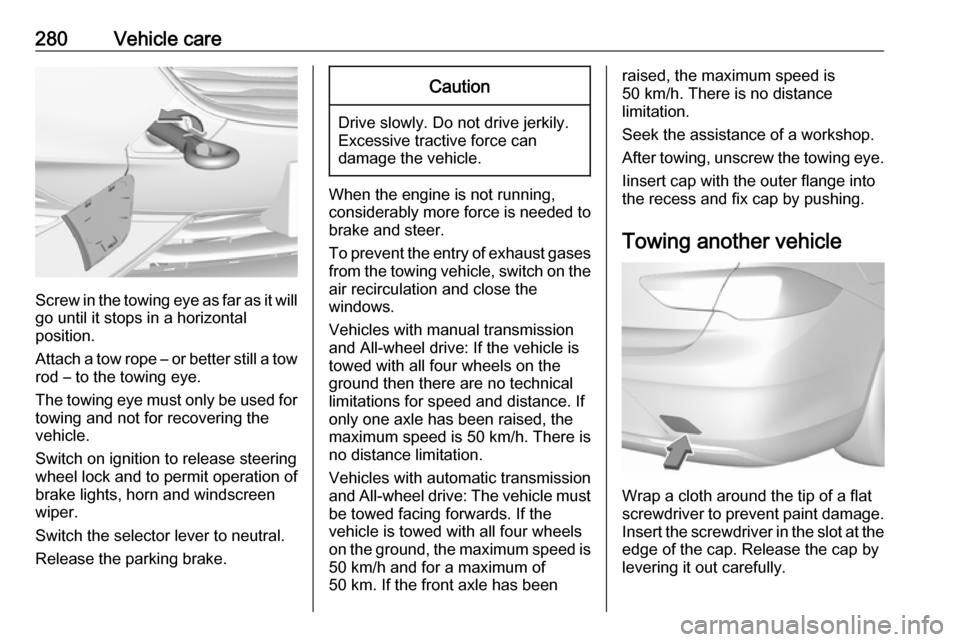
Screw in the towing eye as far as it will
go until it stops in a horizontal
position.
Attach a tow rope – or better still a tow
rod – to the towing eye.
The towing eye must only be used for towing and not for recovering the
vehicle.
Switch on ignition to release steering
wheel lock and to permit operation of
brake lights, horn and windscreen
wiper.
Switch the selector lever to neutral.
Release the parking brake.
Caution
Drive slowly. Do not drive jerkily.
Excessive tractive force can
damage the vehicle.
When the engine is not running,
considerably more force is needed to
brake and steer.
To prevent the entry of exhaust gases from the towing vehicle, switch on the
air recirculation and close the
windows.
Vehicles with manual transmission
and All-wheel drive: If the vehicle is
towed with all four wheels on the
ground then there are no technical
limitations for speed and distance. If
only one axle has been raised, the
maximum speed is 50 km/h. There is
no distance limitation.
Vehicles with automatic transmission and All-wheel drive: The vehicle must
be towed facing forwards. If the
vehicle is towed with all four wheels
on the ground, the maximum speed is 50 km/h and for a maximum of
50 km. If the front axle has been
raised, the maximum speed is
50 km/h. There is no distance
limitation.
Seek the assistance of a workshop.
After towing, unscrew the towing eye.
Iinsert cap with the outer flange into
the recess and fix cap by pushing.
Towing another vehicle
Wrap a cloth around the tip of a flat
screwdriver to prevent paint damage.
Insert the screwdriver in the slot at the
edge of the cap. Release the cap by
levering it out carefully.
Page 283 of 329

Vehicle care281The towing eye is stowed with the
vehicle tools 3 262.
Screw in the towing eye as far as it will
go until it stops in a horizontal
position.
The lashing eye at the rear
underneath the vehicle must never be used as a towing eye.
Attach a tow rope – or better still a tow
rod – to the towing eye.
The towing eye must only be used for towing and not for recovering a
vehicle.
Caution
Drive slowly. Do not drive jerkily.
Excessive tractive force can
damage the vehicle.
After towing, unscrew the towing eye.
Insert cap with the upper flange into
the recess and fix cap by pushing.
Appearance care
Exterior care LocksThe locks are lubricated at the factoryusing a high quality lock cylinder
grease. Use a de-icing agent only
when absolutely necessary, as this
has a degreasing effect and impairs
lock function. After using a de-icing
agent, have the locks regreased by a
workshop.
WashingThe paintwork of your vehicle is
exposed to environmental influences.
Wash and wax your vehicle regularly.
When using automatic vehicle
washes, select a programme that
includes waxing.
Bird droppings, dead insects, resin,
pollen and the like should be cleaned
off immediately, as they contain
aggressive constituents which can
cause paint damage.
Page 285 of 329

Vehicle care283Ice residues, pollution and continuous
wiping on dry windows will damage or
even destroy the wiper blades.
Sunroof Never clean with solvents or abrasive
agents, fuels, aggressive media
(e.g. paint cleaner, acetone-
containing solutions etc.), acidic or
highly alkaline media or abrasive
pads. Do not apply wax or polishing
agents to the sunroof.
Wheels and tyres
Do not use high-pressure jet
cleaners.
Clean rims with a pH-neutral wheel
cleaner.
Rims are painted and can be treated
with the same agents as the body.
Paintwork damageRectify minor paintwork damage with
a touch-up pen before rust forms.
Have more extensive damage or rust
areas repaired by a workshop.Underbody
Some areas of the vehicle underbody
have a PVC undercoating while other
critical areas have a durable
protective wax coating.
After the underbody is washed, check
the underbody and have it waxed if
necessary.
Bitumen/rubber materials could
damage the PVC coating. Have
underbody work carried out by a
workshop.
Before and after winter, wash the
underbody and have the protective
wax coating checked.
Liquid gas system9 Danger
Liquid gas is heavier than air and
can collect in sink points.
Take care when performing work
at the underbody in a pit.
For painting work and when using a
drying booth at a temperature above
60 °C, the liquid gas tank must be
removed.
Do not make any modifications to the
liquid gas system.
Towing equipment
Do not clean the coupling ball bar with a steam-jet or high-pressure jet
cleaner.
Interior care
Interior and upholstery
Only clean the vehicle interior,
including the instrument panel fascia
and panelling, with a dry cloth or
interior cleaner.
Clean the leather upholstery with
clear water and a soft cloth. In case of heavy soiling, use leather care.
The instrument cluster and the
displays should only be cleaned using
a soft damp cloth. If necessary use a
weak soap solution.
Page 291 of 329
Technical data289Technical dataVehicle identification..................289
Vehicle Identification Number ..289
Identification plate ...................289
Engine identification ................290
Vehicle data ............................... 291
Recommended fluids and lubricants ................................ 291
Engine data ............................. 294
Performance ............................ 296
Vehicle weight ......................... 299
Vehicle dimensions .................302
Capacities ................................ 303
Tyre pressures ........................ 304
Towing hitch installation dimensions ............................. 308Vehicle identification
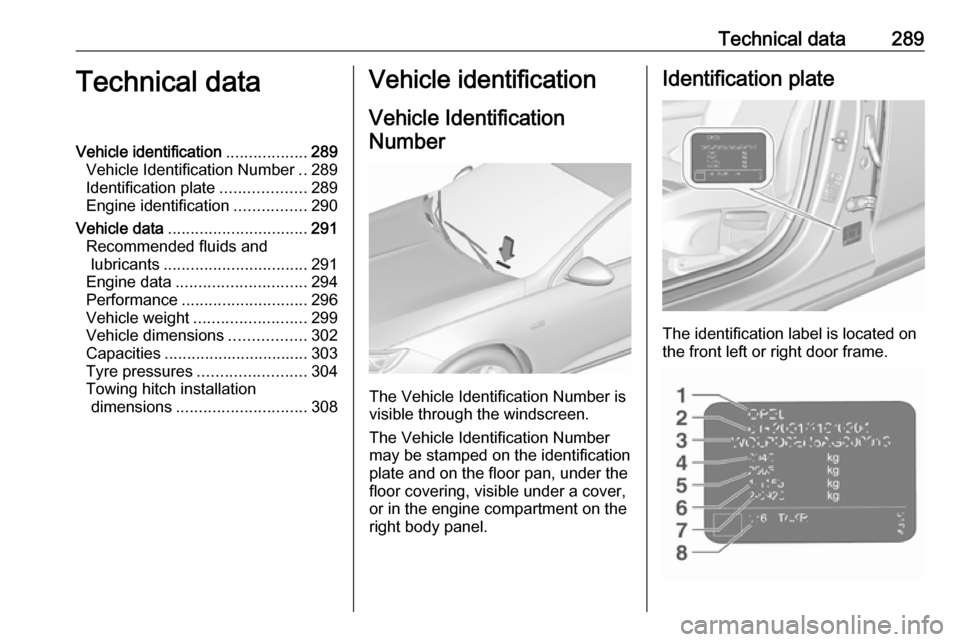
Vehicle IdentificationNumber
The Vehicle Identification Number is
visible through the windscreen.
The Vehicle Identification Number
may be stamped on the identification
plate and on the floor pan, under the floor covering, visible under a cover,
or in the engine compartment on the
right body panel.
Identification plate
The identification label is located on
the front left or right door frame.
Page 310 of 329

308Technical dataTowing hitch installation dimensions
Grandsport
Page 325 of 329

323Child restraints.............................. 64
Child restraint systems ................64
Climate control ............................. 16
Clock............................................. 93
Collision damage repair ..............314
Control indicators........................ 107
Control of the vehicle .................163
Controls ........................................ 89
Convex shape .............................. 37
Coolant and antifreeze ...............286
Cruise control ....................113, 189
Cupholders .................................. 73
Curtain airbag system .................. 62
Curve lighting.............................. 140
D Danger, Warnings and Cautions ...4
Daytime running lights ...............140
Declaration of conformity ............310
DEF ............................................ 172
Diesel exhaust fluid ....................172
Diesel fuel system bleeding .......246
Diesel particle filter ....................170
Door open .................................. 113
Doors ............................................ 28
Driver assistance systems ..........189
Driver Information Centre ...........114
Driving characteristics and towing tips .............................. 235
Driving hints ................................ 163E
Electric adjustment ......................37
Electrical system......................... 257
Electric parking brake .........109, 181
Electric parking brake fault .........109
Electronic climate control system 153
Electronic key system ...................22
Electronic Stability Control.......... 185
Electronic Stability Control and Traction Control system ..........110
Electronic Stability Control off..... 110
End-of-life vehicle recovery .......240
Engine compartment fuse box ...258
Engine coolant ........................... 243
Engine coolant temperature ......111
Engine coolant temperature gauge ..................................... 106
Engine data ............................... 294
Engine exhaust .......................... 170
Engine identification ...................290
Engine oil ................... 242, 286, 291
Engine oil pressure ....................111
Entry lighting .............................. 147
Event data recorders ..................317
Exit lighting ................................ 147
Exterior care .............................. 281
Exterior light ............................... 112
Exterior lighting ....................13, 136
Exterior mirrors ............................. 37F
First aid kit ................................... 84
Fixed air vents ........................... 160
Fog light ..................................... 112
Fog lights ................................... 249
Folding mirrors ............................. 37
Following distance ......................110
Following distance indication ......202
Forward collision alert................. 200
Front airbag system .....................61
Front fog lights ........................... 144
Front pedestrian protection ........206
Front seats.................................... 47
Front storage ................................ 74
Fuel............................................. 231
Fuel for diesel engines ..............232
Fuel for petrol engines ...............231
Fuel gauge ................................. 105
Funnel......................................... 233
Fuses ......................................... 257
G Gauges ....................................... 103
Gear shifting ............................... 110
General information ...................235
Glovebox ..................................... 73
H Halogen headlights ....................247
Hand brake ................................. 180
Hazard warning flashers ............143