tyre pressure OPEL INSIGNIA BREAK 2018.5 Manual user
[x] Cancel search | Manufacturer: OPEL, Model Year: 2018.5, Model line: INSIGNIA BREAK, Model: OPEL INSIGNIA BREAK 2018.5Pages: 329, PDF Size: 9.32 MB
Page 275 of 329
Vehicle care273If the pressure is obtained, correctto the prescribed tyre pressure byusing the compressor to increase
or decrease by opening the air
release valve (turn anticlockwise)
at the air filler hose.
12. Detach the tyre repair kit. Type 1: push catch on bracket to
remove sealant bottle from
bracket. Screw tyre inflation hose
to the free connection of sealant
bottle. This prevents sealant from
escaping.
Type 2: Sealant bottle can not be
removed from the compressor.
Have the sealant bottle replaced
by your workshop.
13. Stow tyre repair kit in the load compartment.
14. Remove any excess sealant using a cloth.
15. Take the label indicating maximum permitted speed from
the sealant bottle and affix in the
driver's field of view.
16. Continue driving immediately so that sealant is evenly distributedin the tyre. After driving approx.10 km (but no more than
10 minutes), stop and check tyre
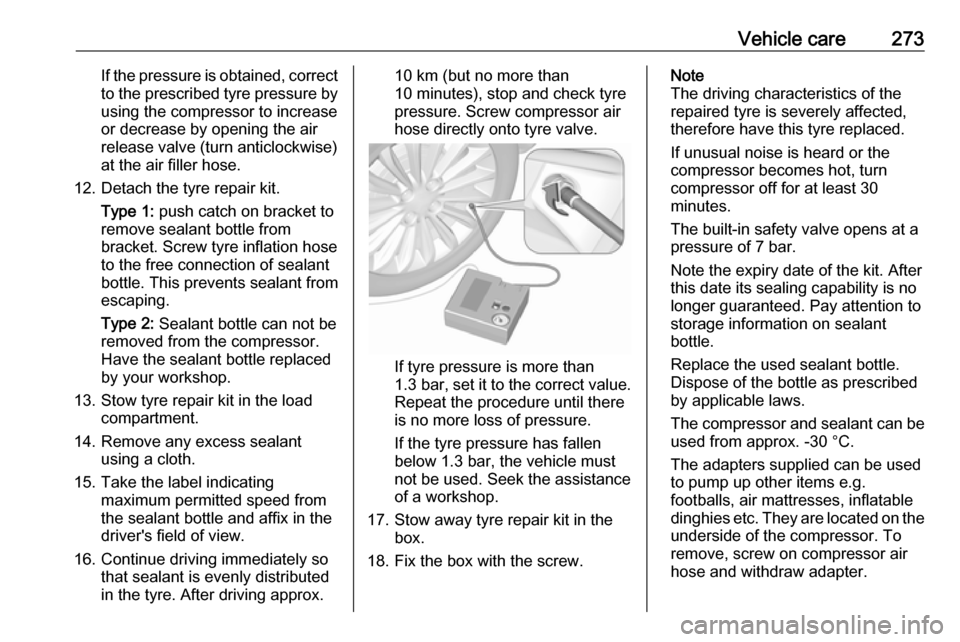
pressure. Screw compressor air
hose directly onto tyre valve.
If tyre pressure is more than
1.3 bar , set it to the correct value.
Repeat the procedure until there
is no more loss of pressure.
If the tyre pressure has fallen
below 1.3 bar, the vehicle must
not be used. Seek the assistance
of a workshop.
17. Stow away tyre repair kit in the box.
18. Fix the box with the screw.
Note
The driving characteristics of the
repaired tyre is severely affected,
therefore have this tyre replaced.
If unusual noise is heard or the
compressor becomes hot, turn
compressor off for at least 30
minutes.
The built-in safety valve opens at a
pressure of 7 bar.
Note the expiry date of the kit. After
this date its sealing capability is no
longer guaranteed. Pay attention to
storage information on sealant
bottle.
Replace the used sealant bottle. Dispose of the bottle as prescribed
by applicable laws.
The compressor and sealant can be used from approx. -30 °C.
The adapters supplied can be used
to pump up other items e.g.
footballs, air mattresses, inflatable
dinghies etc. They are located on the
underside of the compressor. To
remove, screw on compressor air hose and withdraw adapter.
Page 278 of 329
276Vehicle care10. Align the valve hole in the wheelcover with the tyre valve before
installing.
Install wheel nut caps.
11. Install vehicle jacking point cover.
12. Stow and secure the replaced wheel 3 276, the vehicle tools
3 262 and the adapter for the
locking wheel nuts 3 73.
13. Check the tyre pressure of the installed tyre and the wheel nut
torque as soon as possible.
Have the defective tyre renewed or
repaired as soon as possible.
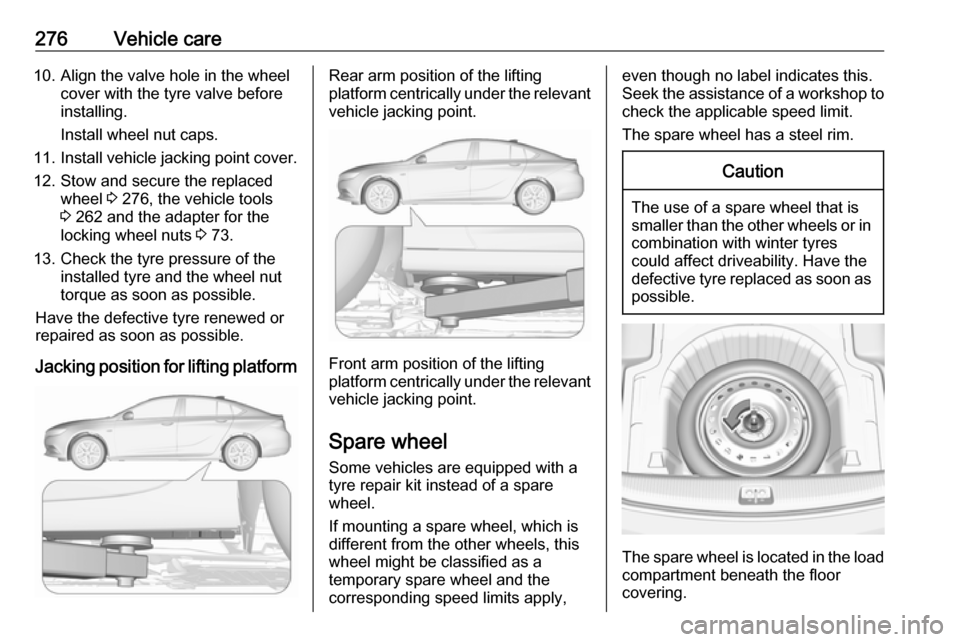
Jacking position for lifting platformRear arm position of the lifting
platform centrically under the relevant vehicle jacking point.
Front arm position of the lifting
platform centrically under the relevant vehicle jacking point.
Spare wheel Some vehicles are equipped with a
tyre repair kit instead of a spare
wheel.
If mounting a spare wheel, which is
different from the other wheels, this
wheel might be classified as a
temporary spare wheel and the
corresponding speed limits apply,
even though no label indicates this.
Seek the assistance of a workshop to
check the applicable speed limit.
The spare wheel has a steel rim.Caution
The use of a spare wheel that is smaller than the other wheels or in
combination with winter tyres
could affect driveability. Have the defective tyre replaced as soon as
possible.
The spare wheel is located in the load
compartment beneath the floor
covering.
Page 285 of 329

Vehicle care283Ice residues, pollution and continuous
wiping on dry windows will damage or
even destroy the wiper blades.
Sunroof Never clean with solvents or abrasive
agents, fuels, aggressive media
(e.g. paint cleaner, acetone-
containing solutions etc.), acidic or
highly alkaline media or abrasive
pads. Do not apply wax or polishing
agents to the sunroof.
Wheels and tyres
Do not use high-pressure jet
cleaners.
Clean rims with a pH-neutral wheel
cleaner.
Rims are painted and can be treated
with the same agents as the body.
Paintwork damageRectify minor paintwork damage with
a touch-up pen before rust forms.
Have more extensive damage or rust
areas repaired by a workshop.Underbody
Some areas of the vehicle underbody
have a PVC undercoating while other
critical areas have a durable
protective wax coating.
After the underbody is washed, check
the underbody and have it waxed if
necessary.
Bitumen/rubber materials could
damage the PVC coating. Have
underbody work carried out by a
workshop.
Before and after winter, wash the
underbody and have the protective
wax coating checked.
Liquid gas system9 Danger
Liquid gas is heavier than air and
can collect in sink points.
Take care when performing work
at the underbody in a pit.
For painting work and when using a
drying booth at a temperature above
60 °C, the liquid gas tank must be
removed.
Do not make any modifications to the
liquid gas system.
Towing equipment
Do not clean the coupling ball bar with a steam-jet or high-pressure jet
cleaner.
Interior care
Interior and upholstery
Only clean the vehicle interior,
including the instrument panel fascia
and panelling, with a dry cloth or
interior cleaner.
Clean the leather upholstery with
clear water and a soft cloth. In case of heavy soiling, use leather care.
The instrument cluster and the
displays should only be cleaned using
a soft damp cloth. If necessary use a
weak soap solution.
Page 291 of 329
Technical data289Technical dataVehicle identification..................289
Vehicle Identification Number ..289
Identification plate ...................289
Engine identification ................290
Vehicle data ............................... 291
Recommended fluids and lubricants ................................ 291
Engine data ............................. 294
Performance ............................ 296
Vehicle weight ......................... 299
Vehicle dimensions .................302
Capacities ................................ 303
Tyre pressures ........................ 304
Towing hitch installation dimensions ............................. 308Vehicle identification
Vehicle IdentificationNumber
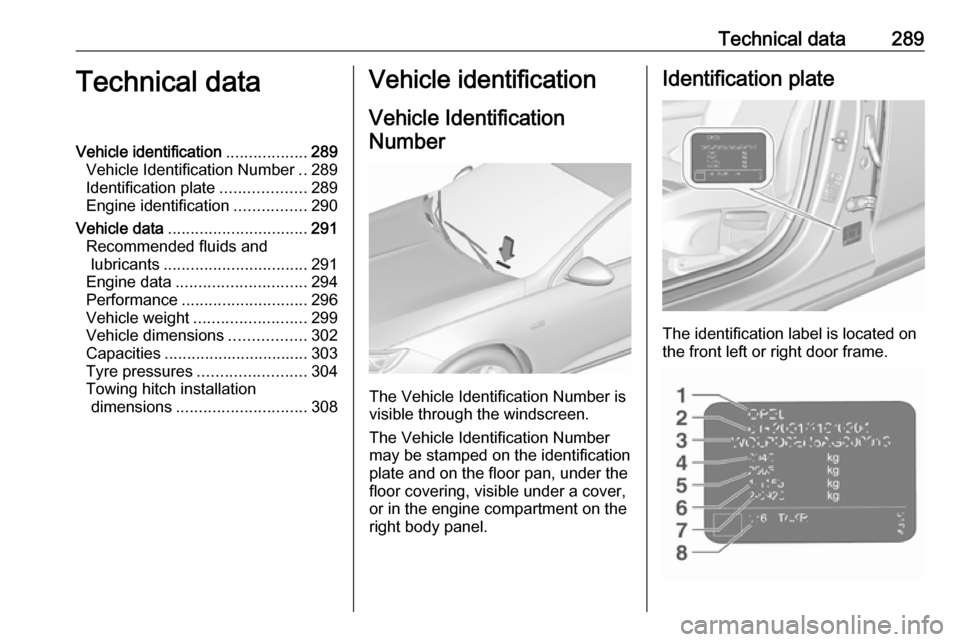
The Vehicle Identification Number is
visible through the windscreen.
The Vehicle Identification Number
may be stamped on the identification
plate and on the floor pan, under the floor covering, visible under a cover,
or in the engine compartment on the
right body panel.
Identification plate
The identification label is located on
the front left or right door frame.
Page 306 of 329

304Technical dataTyre pressures
Tyre pressures differ depending on
the model variant. The order of the
listed car models is as follows:
● Vehicles with Front-wheel drive
● Vehicles with All-wheel drive
Refer to the table header to find the
correct tyre pressure for your model.
Page 307 of 329

Technical data305Tyre pressures for vehicles with Front-wheel driveGrand Sport, Sports Tourer, Country TourerComfort with up to 3 peopleECO with up to 3 peopleWith full loadEngineTyresfrontrearfrontrearfrontrear[kPa/bar]
([psi])[kPa/bar]
([psi])[kPa/bar]
([psi])[kPa/bar]
([psi])[kPa/bar]
([psi])[kPa/bar]
([psi])B15XHL,
B15XHT,
B16DTE,
B16DTH215/60 R16,
225/55 R17,
215/55 R17,
235/45 R18,
235/50 R18 11)
,
245/45 R18220/2.2 (32)220/2.2 (32)270/2.7 (39)270/2.7 (39)240/2.4
(35)270/2.7
(39)B20DTH225/55 R17,
235/50 R18 11)
,
245/45 R18220/2.2 (32)220/2.2 (32)270/2.7 (39)270/2.7 (39)260/2.6
(38)290/2.9
(42)235/45 R18,
245/35 R20230/2.3 (33)230/2.3 (33)270/2.7 (39)270/2.7 (39)260/2.6
(38)290/2.9
(42)AllTemporary spare wheel
125/80 R16,
125/70 R17420/4.2 (60)420/4.2 (60)––420/4.2
(60)420/4.2
(60)11) Country Tourer only
Page 308 of 329

306Technical dataTyre pressures for vehicles with All-wheel drive
Grand Sport, Sports Tourer, Country TourerComfort with up to 3 peopleECO with up to 3 peopleWith full loadEngineTyresfrontrearfrontrearfrontrear[kPa/bar]
([psi])[kPa/bar]
([psi])[kPa/bar]
([psi])[kPa/bar]
([psi])[kPa/bar]
([psi])[kPa/bar]
([psi])B20NFT245/45 R18,
235/50 R18 11)
245/35 ZR20230/2.3 (33)230/2.3 (33)270/2.7 (39)270/2.7 (39)260/2.6 (38)290/2.9 (42)235/45 R18250/2.5 (36)250/2.5 (36)270/2.7 (39)270/2.7 (39)260/2.6 (38)290/2.9 (42)B20DTH225/55 R17,
245/45 R18,
235/50 R18 11)220/2.2 (32)220/2.2 (32)270/2.7 (39)270/2.7 (39)260/2.6 (38)290/2.9 (42)235/45 R18,
245/35 R20230/2.3 (33)230/2.3 (33)270/2.7 (39)270/2.7 (39)260/2.6 (38)290/2.9 (42)
Page 314 of 329

312Customer informationMaximum output: 20 EIRP dBm
Radio remote control transmitter
Robert Bosch GmbH
Robert Bosch Platz 1, 70839
Gerlingen, Germany
Operation frequency: 433.92 MHz
Maximum output: -4 dBm
Radio remote control receiver
Robert Bosch GmbH
Robert Bosch Platz 1, 70839
Gerlingen, Germany
Operation frequency: N/A
Maximum output: N/A
Tyre pressure sensors
Schrader Electronics Ltd.
11 Technology Park, Belfast Road,
Antrim BT41 1QS, Northern Ireland,
United Kingdom
Operation frequency: 433.92 MHz
Maximum output: 10 dBm
Page 319 of 329

Customer information317Verband der Automobilindustrie e.V.
AdBlue ®
is a registered trademark of
the VDA.Vehicle data recording
and privacy
Event data recorders
Electronic control units are installed in
your vehicle. Control units process
data which is received by vehicle
sensors, for example, or which they
generate themselves or exchange
amongst themselves. Some control
units are necessary for the safe
functioning of your vehicle, others
assist you while you drive (driver
assistance systems), while others
provide comfort or infotainment
functions.
Operating data in the vehicle Control units process data for
operation of the vehicle.This data includes, for example:
● Vehicle status information (e.g. wheel rotation rate, speed,
movement delay, lateral
acceleration, "seatbelts
fastened" display),
● Ambient conditions (e.g. temperature, rain sensor,
distance sensor).
Most of this data is volatile and is
processed only in the vehicle itself,
and not beyond the operating time.
Moreover, many control units include
data storage device (amongst others the vehicle key). This is used to allow
information to be documented
temporarily or permanently on vehicle condition, component stress,
maintenance requirements and
technical events and errors.
The following information, for
example, is stored:
● System component operating states (e.g. fill level, tyre
pressure, battery status),
● State of charge of the high voltage battery, estimated range
(in the case of electric vehicles),
Page 322 of 329

320Customer informationprocessing and use of personal data
for the purposes of preparation of services take place solely on the
basis of legal permission, e.g. in the
case of the eCall emergency
communication system or a
contractual agreement, or by virtue of
consent.
You can activate or deactivate the
services and functions (which are
subject to charges to some extent)
and, in some cases, the vehicle's
entire radio network connection. In
particular, this does not include
statutory functions and services such
as eCall.
Third party services If you make use of online services
from other providers (third parties),
these services are subject to the
liability and data protection and usage
conditions of the provider in question.
The manufacturer frequently has no
influence over the content exchanged
in this regard.Therefore, please note the nature,
scope and purpose of the collection
and use of personal data within the
scope of third party services provided
by the service provider in question.
Radio FrequencyIdentification (RFID)
RFID technology is used in some
vehicles for functions such as tyre
pressure monitoring and ignition
system security. It is also used in
connection with conveniences such
as radio remote controls and
electronic keys for door locking/
unlocking and starting, and in-vehicle transmitters for garage door openers.
RFID technology in Opel vehicles
does not use or record personal
information or link with any other Opel system containing personal
information.