bonnet OPEL INSIGNIA BREAK 2018.5 Manual user
[x] Cancel search | Manufacturer: OPEL, Model Year: 2018.5, Model line: INSIGNIA BREAK, Model: OPEL INSIGNIA BREAK 2018.5Pages: 329, PDF Size: 9.32 MB
Page 13 of 329

In brief111Power windows .....................40
2 Exterior mirrors .....................37
3 Central locking system ..........25
4 Side air vents ...................... 159
5 Cruise control .....................189
Speed limiter ....................... 190
Adaptive cruise control .......192
Forward collision alert .........200
6 Turn and lane-change
signals, headlight flash,
low/high beam, high beam
assist ................................... 143
Exit lighting ......................... 147
Parking lights ...................... 144
Buttons for Driver
Information Centre ..............114
7 Instruments ........................ 103
Driver Information Centre .... 114
8 Buttons for Driver
Information Centre ..............114
9 Head-up display ..................12210Windscreen wiper and
washer, headlight washer,
rear wiper and washer .........90
11 Centre air vents .................. 159
12 Hazard warning flashers ....143
13 Info-Display ........................ 121
14 Anti-theft alarm system
status LED ........................... 34
15 Electronic Stability Control . 185
Traction Control system .....184
16 Glovebox .............................. 73
17 Controls for Info-Display
operation ............................. 121
18 Climate control system ........ 150
19 Power outlet .......................... 95
20 Sport/Tour mode ................186
Parking assist/Advanced
parking assist .....................209
Lane keep assist ................229
Eco button for stop-start
system ................................. 167
21 Manual transmission ..........179
Automatic transmission ......17522Electric parking brake .........181
23 Power switch ....................... 164
24 Steering wheel adjustment ..89
25 Horn ..................................... 90
26 Bonnet release lever ..........241
27 Fuse box ............................ 261
28 Light switch ........................ 136
Headlight range
adjustment ......................... 139
Front/rear fog lights ............144
Instrument illumination .......145
29 Head-up display ..................122
Page 36 of 329
34Keys, doors and windowsVehicle security
Anti-theft locking system9 Warning
Do not use the system if there are
people in the vehicle! The doorscannot be unlocked from the
inside.
The system deadlocks all the doors. All doors must be closed otherwise
the system cannot be activated.
Unlocking the vehicle disables the
mechanical anti-theft locking system.
This is not possible with the central
locking button.
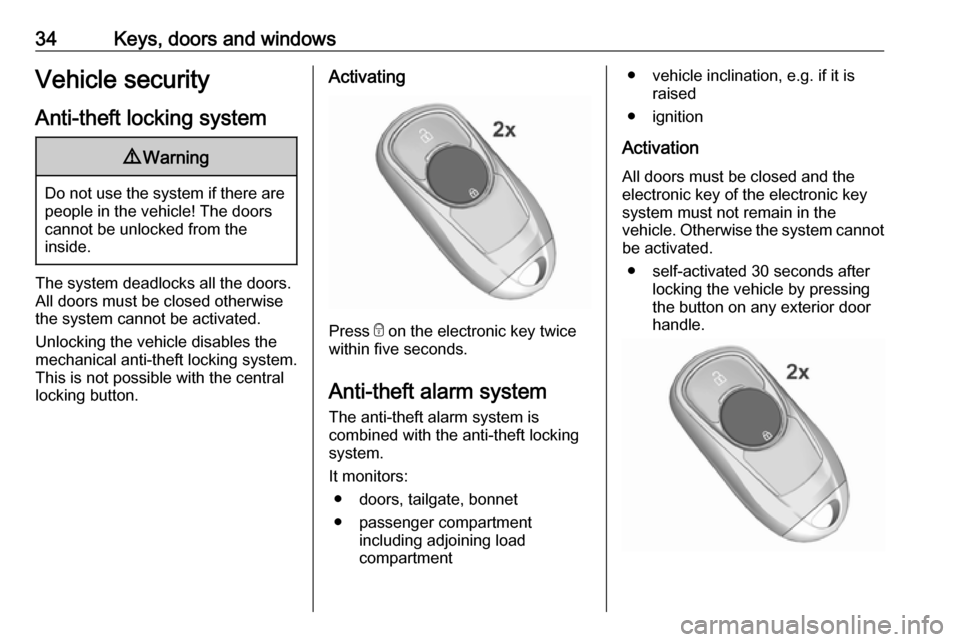
Activating
Press e on the electronic key twice
within five seconds.
Anti-theft alarm system
The anti-theft alarm system is
combined with the anti-theft locking
system.
It monitors: ● doors, tailgate, bonnet
● passenger compartment including adjoining load
compartment
● vehicle inclination, e.g. if it is raised
● ignition
Activation
All doors must be closed and the
electronic key of the electronic key
system must not remain in the
vehicle. Otherwise the system cannot be activated.
● self-activated 30 seconds after locking the vehicle by pressingthe button on any exterior door
handle.
Page 37 of 329
Keys, doors and windows35●directly by pressing e twice within
five seconds.
● with passive locking enabled: briefly activated after passive
locking occurs.
Note
Changes to the vehicle interior such
as the use of seat covers, and open
windows or sunroof, could impair the
function of passenger compartment
monitoring.
Activation without monitoring of
passenger compartment and
vehicle inclinationSwitch off the monitoring of
passenger compartment and vehicle
inclination when animals are being
left in the vehicle, because of high
volume ultrasonic signals or
movements triggering the alarm. Also switch off when the vehicle is on a
ferry or train.
1. Close tailgate, bonnet, windows and sunroof.
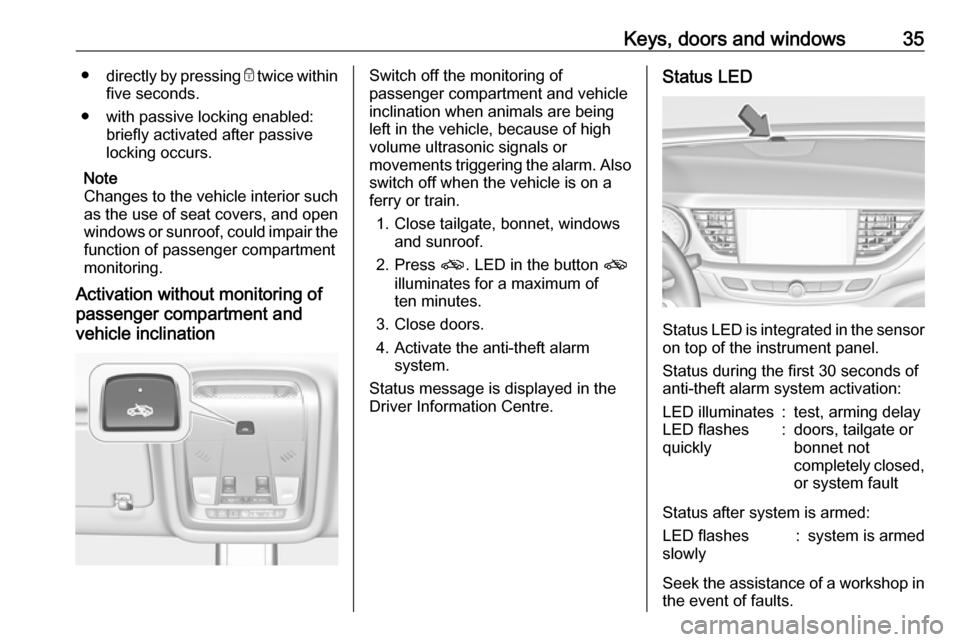
2. Press o. LED in the button o
illuminates for a maximum of
ten minutes.
3. Close doors.
4. Activate the anti-theft alarm system.
Status message is displayed in the
Driver Information Centre.Status LED
Status LED is integrated in the sensor
on top of the instrument panel.
Status during the first 30 seconds of
anti-theft alarm system activation:
LED illuminates:test, arming delayLED flashes
quickly:doors, tailgate or
bonnet not
completely closed,
or system fault
Status after system is armed:
LED flashes
slowly:system is armed
Seek the assistance of a workshop in the event of faults.
Page 47 of 329

Seats, restraints45Seats, restraintsHead restraints............................ 45
Front seats ................................... 47
Seat position .............................. 47
Manual seat adjustment ............48
Power seat adjustment ..............50
Armrest ...................................... 53
Heating ...................................... 54
Ventilating .................................. 54
Massage .................................... 55
Rear seats ................................... 55
Armrest ...................................... 55
Heating ...................................... 55
Seat belts ..................................... 56
Three-point seat belt .................57
Airbag system .............................. 58
Front airbag system ...................61
Side airbag system ....................62
Curtain airbag system ...............62
Airbag deactivation ....................63
Child restraints ............................. 64
Child restraint systems ..............64
Child restraint installation locations ................................... 67Pedestrian protection system ......71
Active bonnet ............................. 71Head restraints
Position9 Warning
Only drive with the head restraint
set to the proper position.
The upper edge of the head restraint
should be at upper head level. If this
is not possible for extremely tall
people, set to highest position, and
set to lowest position for small people.
Page 73 of 329

Seats, restraints71Pedestrian protection
system
Active bonnet
Pedestrian protection system can help to reduce the injury of
pedestrians in case of a front
collision.
When the sensors in the front bumper
detect a certain impact within the
speed range of 25 km/h to 50 km/h, the rear part of the bonnet will be lifted
to reduce pedestrians head injuries.
In addition the front bumper is
designed to reduce leg injuries of
pedestrians.
The active bonnet can be triggered
only once and remains in the raised
position. A message is displayed in
the Driver Information Centre.
Seek the assistance of a workshop as soon as possible, thereby adapting
the driving style, to have the
actuators, hinges and bonnet
replaced.9 Warning
Do not drive with the bonnet
raised.
9 Warning
After any frontal accident the front
bumper may appear to be intact,
however, the sensors may be
damaged. Consult a workshop to
verify proper functionality of the
sensors.
The system may not trigger under the following conditions:
● The impact is out of sensor range.
● The sensors are damaged or blocked by accessory parts.
● The bonnet is blocked by snow or
ice.
● The vehicle speed is not within the range.
● The object is too small.
Manually bonnet lowering9 Warning
After the system has triggered, the
hinges of the bonnet are hot. Do
not touch.
To manually lower the triggered
bonnet for driving to the next
workshop:
1. Pull the bonnet release lever.
2. Push the safety catch to left vehicle side.
3. Open the bonnet approx. 20 cm and lower it slowly without
engaging.
4. Push down bonnet with both hands at rear corners in small
steps alternating between right
and left side.
9 Warning
Be sure to keep away from the
edge of the bonnet to prevent
injuries.
Page 74 of 329

72Seats, restraints5.Check that the bonnet is engaged
at the rear.
6. Close bonnet at the front and check that it is engaged 3 241.
Page 170 of 329

168Driving and operatingDuring an Autostop, the heating and
brake performance will be
maintained.
Conditions for an Autostop
The stop-start system checks if each
of the following conditions is fulfilled:
● The stop-start system is not manually deactivated.
● The bonnet is fully closed.
● The driver's door is closed or the driver's seat belt is fastened.
● The vehicle battery is sufficiently charged and in good condition.
● The engine is warmed up.
● The engine coolant temperature is not too high.
● The engine exhaust temperature is not too high, e.g. after driving
with high engine load.
● The ambient temperature is above -5 °C.
● The climate control system allows an Autostop.
● The brake vacuum is sufficient.● The self-cleaning function of the diesel particle filter is not active.
● The vehicle was driven at least at
walking speed since the last
Autostop.
Otherwise an Autostop will be
inhibited.
The stop-start system will be
deactivated on inclines of 12% or
more.
Certain settings of the climate control
system may inhibit an Autostop. See
Climate control chapter for more
details 3 150.
Immediately after motorway driving,
an Autostop may be inhibited.
New vehicle running-in 3 163.
Vehicle battery discharge protection
To ensure reliable engine restarts, several battery discharge protection
features are implemented as part of
the stop-start system.
Power saving measures
During an Autostop, several electrical
features e.g. auxiliary electric heater
or heated rear window are disabled orswitched to a power saving mode.
The fan speed of the climate control
system is reduced to save power.
Restart of the engine by the driver
Vehicles with manual transmissionConventional restart
All engines have conventional restart.
Depress the clutch pedal without
depressing the brake pedal to restart
the engine.
On engines with late restart a
conventional restart is only possible
without depressed brake pedal.Late restart
All engines have late restart in
addition to conventional restart. Late
restart is only active on gradients up
to 5%.
● Depress the brake pedal.
● Depress the clutch pedal.
● Select first gear.
● Release the brake pedal to restart the engine.
Page 171 of 329

Driving and operating169Vehicles with automatic transmissionRelease the brake pedal or move
selector lever out of D into N or P to
restart the engine.
Restart of the engine by the stop-
start system
The selector lever must be in neutral
to enable an automatic restart.
If one of the following conditions
occurs during an Autostop, the
engine will be restarted automatically
by the stop-start system:
● The stop-start system is manually deactivated.
● The bonnet is opened.
● The driver's seat belt is unfastened and the driver's door
is opened.
● The engine temperature is too low.
● The charging level of the vehicle battery is below a defined level.
● The brake vacuum is not sufficient.
● The vehicle is driven at least at walking speed.● The climate control systemrequests an engine start.
● The air conditioning is manually switched on.
If the bonnet is not fully closed, a warning message is displayed in the
Driver Information Centre.
If an electrical accessory, e.g. a
portable CD player, is connected to
the power outlet, a brief power drop
during the restart might be noticeable.
Parking9 Warning
● Do not park the vehicle on an
easily ignitable surface. The
high temperature of the
exhaust system could ignite the
surface.
● Always apply the parking brake. Pull switch m for
approx. one second and check
if the control indicator m
illuminates.
The electric parking brake is applied when control indicator
m illuminates 3 109.
● Switch off the engine. ● If the vehicle is on a level surface or uphill slope, engage
first gear or set the selector
lever to position P before
switching off ignition. On an
uphill slope, turn the front
wheels away from the kerb.
If the vehicle is on a downhill
slope, engage reverse gear or
set the selector lever to position P before switching off ignition.
Turn the front wheels towards
the kerb.
● Close the windows and the sunroof.
● Switch off ignition with power button. Turn the steering wheel
until the steering wheel lock is
felt to engage.
Page 241 of 329

Vehicle care239Vehicle careGeneral Information...................239
Accessories and vehicle modifications .......................... 239
Vehicle storage ........................240
End-of-life vehicle recovery .....240
Vehicle checks ........................... 241
Performing work ......................241
Bonnet ..................................... 241
Engine oil ................................. 242
Engine coolant ......................... 243
Washer fluid ............................ 244
Brakes ..................................... 244
Brake fluid ............................... 244
Vehicle battery ......................... 245
Diesel fuel system bleeding .....246
Wiper blade replacement ........246
Bulb replacement .......................247
Halogen headlights ..................247
LED headlights ........................ 249
Fog lights ................................. 249
Tail lights ................................. 251
Side turn lights ......................... 256
Number plate light ...................257
Interior lights ............................ 257
Instrument panel illumination ...257Electrical system ........................257
Fuses ....................................... 257
Engine compartment fuse box . 258
Instrument panel fuse box .......261
Vehicle tools .............................. 262
Tools ........................................ 262
Wheels and tyres .......................263
Winter tyres ............................. 263
Tyre designations ....................264
Tyre pressure .......................... 264
Tyre pressure monitoring system .................................... 265
Tread depth ............................. 268
Changing tyre and wheel size . 268
Wheel covers ........................... 268
Tyre chains .............................. 269
Tyre repair kit .......................... 269
Wheel changing .......................274
Spare wheel ............................ 276
Jump starting ............................. 278
Towing ....................................... 279
Towing the vehicle ...................279
Towing another vehicle ...........280
Appearance care .......................281
Exterior care ............................ 281
Interior care ............................. 283General Information
Accessories and vehiclemodifications
We recommend the use of genuine
parts and accessories and factory approved parts specific for your
vehicle type. We cannot assess or guarantee reliability of other products
- even if they have a regulatory or
otherwise granted approval.
Any modification, conversion or other changes made to standard vehicle
specifications (including, without
limitation, software modifications,
modifications of the electronic control
units) may invalidate the warranty
offered by Opel. Furthermore, such
changes may affect driver assistance
systems, fuel consumption, CO 2
emissions and other emissions of the
vehicle. They may also invalidate the
vehicle operating permit.
Page 242 of 329

240Vehicle careCaution
When transporting the vehicle on
a train or on a recovery vehicle, the
mud flaps might be damaged.
Vehicle storage
Storage for a long period of time
If the vehicle is to be stored for several months:
● Wash and wax the vehicle.
● Have the wax in the engine compartment and underbody
checked.
● Clean and preserve the rubber seals.
● Fill up fuel tank completely.
● Change the engine oil.
● Drain the washer fluid reservoir.
● Check the coolant antifreeze and
corrosion protection.
● Adjust tyre pressure to the value specified for full load.
● Park the vehicle in a dry, wellventilated place. Engage first or
reverse gear or set selector lever
to P. Prevent the vehicle from
rolling.
● Do not apply the parking brake.
● Open the bonnet, close all doors and lock the vehicle.
● Disconnect the clamp from the negative terminal of the vehicle
battery. Beware that all systems
are not functional, e.g. anti-theft
alarm system.
Putting back into operation
When the vehicle is to be put back into
operation:
● Connect the clamp to the negative terminal of the vehicle
battery. Activate the electronics
of the power windows.
● Check tyre pressure.
● Fill up the washer fluid reservoir.
● Check the engine oil level.
● Check the coolant level.
● Fit the number plate if necessary.End-of-life vehicle recovery
Information on end-of-life vehicle
recovery centres and the recycling of
end-of-life vehicles is available on our website, where legally required. Only
entrust this work to an authorised
recycling centre.