automatic transmission OPEL INSIGNIA BREAK 2019.5 Owner's Guide
[x] Cancel search | Manufacturer: OPEL, Model Year: 2019.5, Model line: INSIGNIA BREAK, Model: OPEL INSIGNIA BREAK 2019.5Pages: 323, PDF Size: 9.49 MB
Page 212 of 323

210Driving and operatingDisplay indication
The instructions on the display show:
● General hints and warning messages.
● A hint when driving faster than 30 km/h during parking slot
searching mode.
● The demand to stop the vehicle, when a parking slot is detected.
● The direction of driving during the
parking manoeuvre.
● The demand to shift into reverse or first gear, or R or D with
automatic transmission.
● The demand to stop or to drive slowly.
● For some of the instructions a progress bar is shown in the
Driver Information Centre.
● The successful completion of the
parking manoeuvre indicated by
a pop-up symbol and a chime.
● The cancelling of a parking manoeuvre.Display priorities
Advanced parking assist indication in the Driver Information Centre can be
inhibited by vehicle messages with a
higher priority. After approving the
message 9 on the steering wheel,
advanced parking assist instructions
appear again and the parking
manoeuvre can be continued.
Deactivation
The system is deactivated by:
● a short press of (
● parking manoeuvre successfully ended
● driving faster than 30 km/h during
parking slot search
● driving faster than 8 km/h during parking guidance
● driver interference on steering wheel detected
● steep hill incline detected
● exceeding maximum number of gear changes: eight cycles when
parallel parking or five cycles
when perpendicular parking
● switching off the ignitionDeactivation by the driver or by the system during manoeuvring will beindicated by a message on the
display. Additionally, an acoustic
signal sounds.
Automatic transmission:
If advanced park assist is deactivated
during the parking manoeuvre or
manoeuvre is finished successfully,
the assist holds the vehicle in position
until one of the following conditions
occurs:
1. brake pedal is applied
2. electric parking brake is activated
3. selector lever is set to P
Fault
A message appears when:
● There is a fault in the system.● The driver did not successfully complete the parking
manoeuvre.
● The system is not operational.
● Any of the deactivation reasons described above apply.
Page 218 of 323

216Driving and operatingDeactivation
Panoramic view system is
deactivated:
● driving faster than 11 km/h
● touching the camera icon ë in
the Info Display
● shifting into neutral or P with automatic transmission
General information9 Warning
The panoramic view system does
not replace driver vision. It will not display children, pedestrians,
cyclists, crossing traffic, animals,
or any other objects outside of the camera view areas, e. g. below the
bumper, or underneath the
vehicle.
Do not drive or park the vehicle
using only the panoramic view
system.
Always check the surrounding of
the vehicle before driving.
9 Warning
Displayed images may be further
or closer than they appear. The
area displayed is limited and
objects that are close to either
edge of the bumper or under the
bumper are not displayed on the
screen.
9 Warning
The panoramic view cameras
have blind spot areas and will not
display all objects near the edges
of the vehicle. Folding side mirrors that are out of position will not
display the panoramic view
correctly.
Blind spots are represented as
hatched areas in the illuminations.
Dark areas show the views displayed by the panoramic view system.
Page 266 of 323
264Vehicle careilluminates. For the further three
wheels the system remains
operational.
The use of commercially available
liquid tyre repair kits can impair the
function of the system. Factory-
approved repair kits can be used.
Operating electronic devices or being close to facilities using similar wave
frequencies could disrupt the tyre
pressure monitoring system.
Each time the tyres are replaced, tyre
pressure monitoring system sensors
must be dismounted and serviced. For the screwed sensor, replace
valve core and sealing ring. For the
clipped sensor, replace complete
valve stem.
Vehicle loading status
Adjust tyre pressure to load condition according tyre information label or
tyre pressure chart 3 298, and select
the appropriate setting in Tyre Load
within the vehicle information menu
3 112. This setting determines the
reference pressures for the tyre
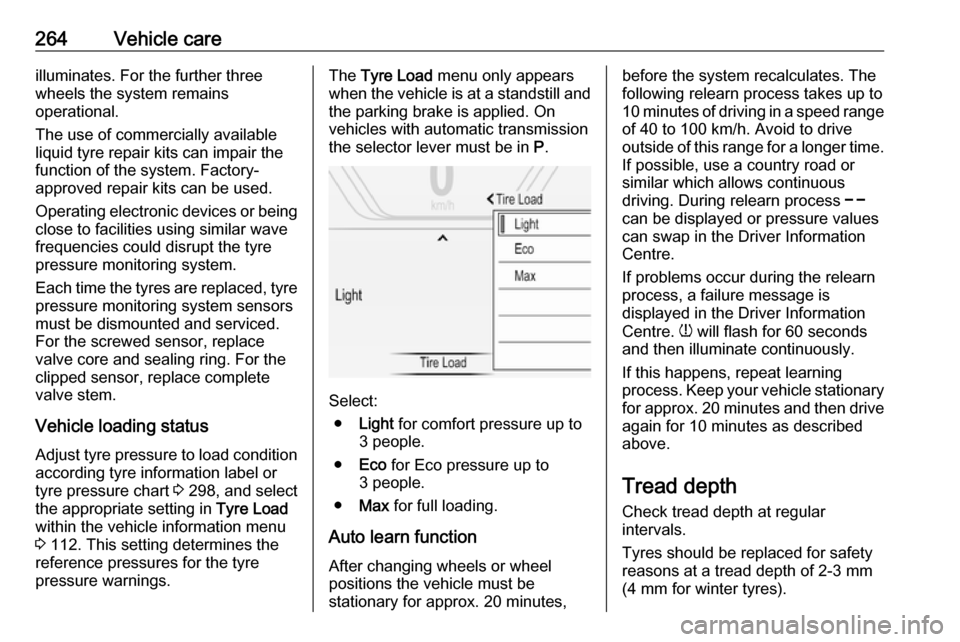
pressure warnings.The Tyre Load menu only appears
when the vehicle is at a standstill and the parking brake is applied. On
vehicles with automatic transmission
the selector lever must be in P.
Select:
● Light for comfort pressure up to
3 people.
● Eco for Eco pressure up to
3 people.
● Max for full loading.
Auto learn function After changing wheels or wheel
positions the vehicle must be
stationary for approx. 20 minutes,
before the system recalculates. The
following relearn process takes up to
10 minutes of driving in a speed range
of 40 to 100 km/h. Avoid to drive
outside of this range for a longer time.
If possible, use a country road or
similar which allows continuous
driving. During relearn process $
can be displayed or pressure values can swap in the Driver Information
Centre.
If problems occur during the relearn
process, a failure message is
displayed in the Driver Information
Centre. w will flash for 60 seconds
and then illuminate continuously.
If this happens, repeat learning
process. Keep your vehicle stationary for approx. 20 minutes and then drive
again for 10 minutes as described
above.
Tread depth
Check tread depth at regular
intervals.
Tyres should be replaced for safety
reasons at a tread depth of 2-3 mm
(4 mm for winter tyres).
Page 278 of 323
276Vehicle care● A discharged vehicle battery canalready freeze at a temperature
of 0 °C. Defrost the frozen vehicle
battery before connecting jump
leads.
● Wear eye protection and protective clothing when
handling a vehicle battery.
● Use a booster vehicle battery with the same voltage (12 V). Itscapacity (Ah) must not be muchless than that of the discharged
vehicle battery.
● Use jump leads with insulated terminals and a cross section of
at least 16 mm 2
(25 mm 2
for
diesel engines).
● Do not disconnect the discharged
vehicle battery from the vehicle.
● Switch off all unnecessary electrical consumers.
● Do not lean over the vehicle battery during jump starting.
● Do not allow the terminals of one
lead to touch those of the other
lead.● The vehicles must not come into contact with each other during
the jump starting process.
● Apply the parking brake, transmission in neutral,
automatic transmission in P.
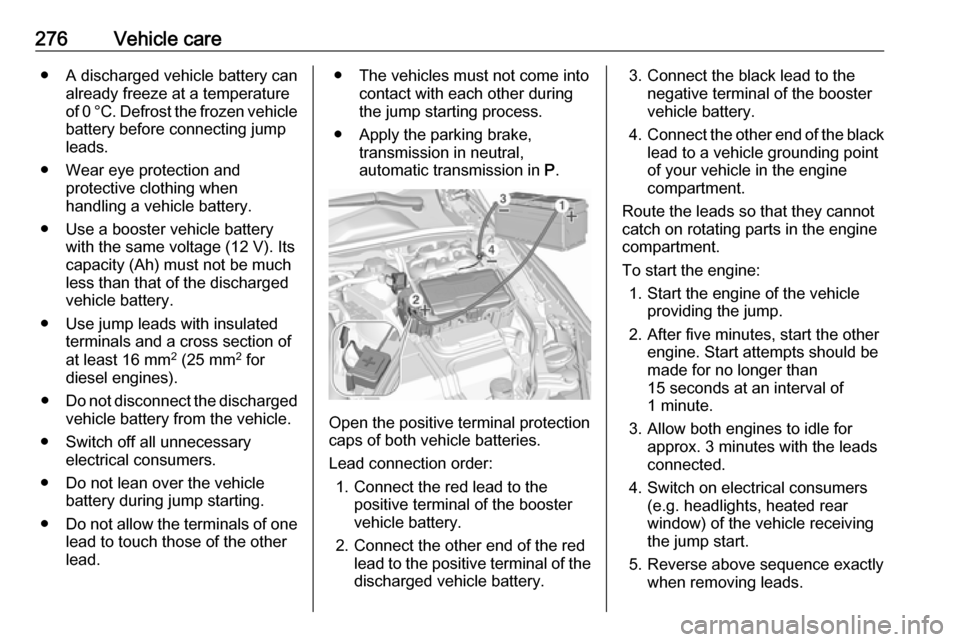
Open the positive terminal protection
caps of both vehicle batteries.
Lead connection order: 1. Connect the red lead to the positive terminal of the booster
vehicle battery.
2. Connect the other end of the red lead to the positive terminal of the
discharged vehicle battery.
3. Connect the black lead to the negative terminal of the boostervehicle battery.
4. Connect the other end of the black
lead to a vehicle grounding point
of your vehicle in the engine
compartment.
Route the leads so that they cannot
catch on rotating parts in the engine
compartment.
To start the engine: 1. Start the engine of the vehicle providing the jump.
2. After five minutes, start the other engine. Start attempts should be
made for no longer than
15 seconds at an interval of
1 minute.
3. Allow both engines to idle for approx. 3 minutes with the leads
connected.
4. Switch on electrical consumers (e.g. headlights, heated rear
window) of the vehicle receiving
the jump start.
5. Reverse above sequence exactly when removing leads.
Page 279 of 323

Vehicle care277Towing
Towing the vehicle
Wrap a cloth around the tip of a flat
screwdriver to prevent paint damage.
Insert the screwdriver in the slot at the
edge of the cap. Release the cap by
levering it out carefully.
The towing eye is stowed with the
vehicle tools 3 259.
Screw in the towing eye as far as it will
go until it stops in a horizontal
position.
Attach a tow rope – or better still a tow
rod – to the towing eye.
The towing eye must only be used for
towing and not for recovering the
vehicle.
Switch on ignition to release steering wheel lock and to permit operation of
brake lights, horn and windscreen
wiper.
Caution
Deactivate the driver assistance
systems like active emergency
braking 3 200, otherwise the
vehicle may automatically brake during towing.
Switch the selector lever to neutral.
Release the parking brake.
Caution
Drive slowly. Do not drive jerkily.
Excessive tractive force can
damage the vehicle.
When the engine is not running,
considerably more force is needed to
brake and steer.
To prevent the entry of exhaust gases from the towing vehicle, switch on the
air recirculation and close the
windows.
Vehicles with manual transmission
and All-wheel drive: If the vehicle is
towed with all four wheels on the
ground then there are no technical
Page 280 of 323
278Vehicle carelimitations for speed and distance. If
only one axle has been raised, the
maximum speed is 50 km/h. There is
no distance limitation.
Vehicles with automatic transmission
and All-wheel drive: The vehicle must
be towed facing forwards. If the
vehicle is towed with all four wheels
on the ground, the maximum speed is 50 km/h and for a maximum of
50 km. If the front axle has been
raised, the maximum speed is
50 km/h. There is no distance
limitation.
Seek the assistance of a workshop. After towing, unscrew the towing eye.
Iinsert cap with the outer flange into
the recess and fix cap by pushing.Towing another vehicle
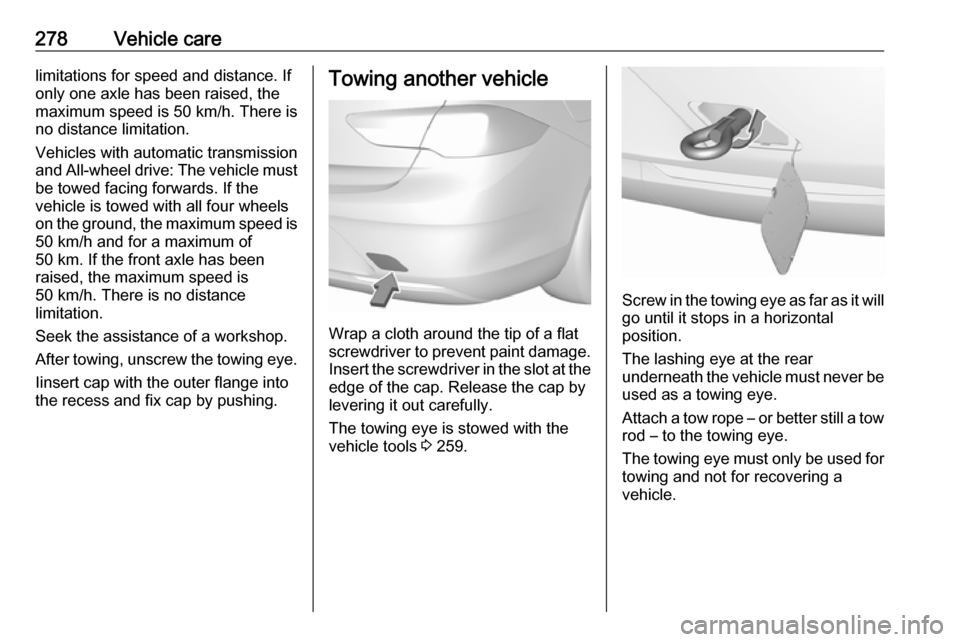
Wrap a cloth around the tip of a flat
screwdriver to prevent paint damage. Insert the screwdriver in the slot at the
edge of the cap. Release the cap by
levering it out carefully.
The towing eye is stowed with the
vehicle tools 3 259.
Screw in the towing eye as far as it will
go until it stops in a horizontal
position.
The lashing eye at the rear
underneath the vehicle must never be used as a towing eye.
Attach a tow rope – or better still a tow
rod – to the towing eye.
The towing eye must only be used for
towing and not for recovering a
vehicle.
Page 295 of 323
![OPEL INSIGNIA BREAK 2019.5 Owners Guide Technical data293Performance
Grand SportEngineD15XHLD15XHTD16SHTMaximum speed [km/h]Manual transmission210222235Automatic transmission–218232EngineD16DTID16DTH
D20DTH
FWD 3)D20DTH
AWD 4)
D20DTR
Ma](/img/37/18872/w960_18872-294.png "OPEL INSIGNIA BREAK 2019.5 Owners Guide Technical data293Performance
Grand SportEngineD15XHLD15XHTD16SHTMaximum speed [km/h]Manual transmission210222235Automatic transmission–218232EngineD16DTID16DTH
D20DTH
FWD 3)D20DTH
AWD 4)
D20DTR
Ma")
Technical data293Performance
Grand SportEngineD15XHLD15XHTD16SHTMaximum speed [km/h]Manual transmission210222235Automatic transmission–218232EngineD16DTID16DTH
D20DTH
FWD 3)D20DTH
AWD 4)
D20DTR
Maximum speed [km/h]Manual transmission205211226223–Automatic transmission–205223–2333)
Front wheel drive
4) All wheel drive
Page 296 of 323
![OPEL INSIGNIA BREAK 2019.5 Owners Guide 294Technical dataSports TourerEngineD15XHLD15XHTD16SHTMaximum speed [km/h]Manual transmission207218232Automatic transmission–214230EngineD16DTID16DTH
D20DTH
FWD 3)D20DTH
AWD 4)
D20DTR
Maximum spee](/img/37/18872/w960_18872-295.png "OPEL INSIGNIA BREAK 2019.5 Owners Guide 294Technical dataSports TourerEngineD15XHLD15XHTD16SHTMaximum speed [km/h]Manual transmission207218232Automatic transmission–214230EngineD16DTID16DTH
D20DTH
FWD 3)D20DTH
AWD 4)
D20DTR
Maximum spee")
294Technical dataSports TourerEngineD15XHLD15XHTD16SHTMaximum speed [km/h]Manual transmission207218232Automatic transmission–214230EngineD16DTID16DTH
D20DTH
FWD 3)D20DTH
AWD 4)
D20DTR
Maximum speed [km/h]Manual transmission202208223220–Automatic transmission–202220–2313)
Front wheel drive
4) All wheel drive
Page 297 of 323
![OPEL INSIGNIA BREAK 2019.5 Owners Guide Technical data295Country TourerEngineD16SHT
D20DTH
FWD 3)D20DTH
AWD 4)
D20DTR
Maximum speed [km/h]Manual transmission–220218–Automatic transmission227218–2283)
Front wheel drive
4) All wheel d](/img/37/18872/w960_18872-296.png "OPEL INSIGNIA BREAK 2019.5 Owners Guide Technical data295Country TourerEngineD16SHT
D20DTH
FWD 3)D20DTH
AWD 4)
D20DTR
Maximum speed [km/h]Manual transmission–220218–Automatic transmission227218–2283)
Front wheel drive
4) All wheel d")
Technical data295Country TourerEngineD16SHT
D20DTH
FWD 3)D20DTH
AWD 4)
D20DTR
Maximum speed [km/h]Manual transmission–220218–Automatic transmission227218–2283)
Front wheel drive
4) All wheel drive
Page 318 of 323

316IndexAAccessories and vehicle modifications .......................... 235
Active bonnet ................................ 71
Active emergency braking ..........200
Adaptive cruise control .......111, 185
AdBlue ................................ 109, 167
Adjustable air vents ...................154
Airbag and belt tensioners .........106
Airbag deactivation ..............63, 106
Airbag label................................... 58
Airbag system .............................. 58
Air conditioning regular operation ................................ 156
Air conditioning system .............. 145
Air intake .................................... 155
Air vents...................................... 154
All-wheel drive ........................... 174
Antilock brake system ................ 175
Antilock brake system (ABS) .....108
Anti-theft alarm system ................34
Anti-theft locking system .............. 34
Appearance care ........................279
Armrest ................................... 53, 55
Armrest storage ........................... 74
Ashtrays ....................................... 95 Automatic anti-dazzle ..................39
Automatic dimming ......................38
Automatic light control ...............135
Automatic locking ........................27Automatic transmission .............169
Autostop ..................................... 162
Auxiliary heater ........................... 154
B Baselevel display ........................112
Battery discharge protection ......144
Belts.............................................. 56 BlueInjection ............................... 167
Bonnet ....................................... 237
Brake and clutch fluid .................284
Brake and clutch system ...........107
Brake assist ............................... 177
Brake fluid .................................. 240
Brakes ............................... 175, 240
Breakdown.................................. 277
Bulb replacement ....................... 244
C Capacities .................................. 297
Cargo management system ........80
Catalytic converter .....................166
Central locking system ................25
Centre console lighting ..............143
Centre console storage ...............74
Changing tyre and wheel size ...265
Charging system ........................ 107
Child locks ................................... 28
Child restraint installation locations ................................... 67
Child restraints.............................. 64