airbag OPEL KARL 2017.5 Manual user
[x] Cancel search | Manufacturer: OPEL, Model Year: 2017.5, Model line: KARL, Model: OPEL KARL 2017.5Pages: 203, PDF Size: 5.4 MB
Page 46 of 203
44Seats, restraintsCS: NIKDY nepoužívejte dětský
zádržný systém instalovaný proti
směru jízdy na sedadle, které je
chráněno před sedadlem AKTIVNÍM
AIRBAGEM. Mohlo by dojít k
VÁŽNÉMU PORANĚNÍ nebo ÚMRTÍ
DÍTĚTE.
SK: NIKDY nepoužívajte detskú
sedačku otočenú vzad na sedadle
chránenom AKTÍVNYM AIRBAGOM,
pretože môže dôjsť k SMRTI alebo
VÁŽNYM ZRANENIAM DIEŤAŤA.
LT: JOKIU BŪDU nemontuokite atgal
atgręžtos vaiko tvirtinimo sistemos
sėdynėje, prieš kurią įrengta AKTYVI
ORO PAGALVĖ, nes VAIKAS GALI
ŽŪTI arba RIMTAI SUSIŽALOTI.
LV: NEKĀDĀ GADĪJUMĀ
neizmantojiet uz aizmuguri vērstu bērnu sēdeklīti sēdvietā, kas tiek
aizsargāta ar tās priekšā uzstādītu
AKTĪVU DROŠĪBAS SPILVENU, jo
pretējā gadījumā BĒRNS var gūt
SMAGAS TRAUMAS vai IET BOJĀ.
ET: ÄRGE kasutage tahapoole
suunatud lapseturvaistet istmel, mille
ees on AKTIIVSE TURVAPADJAGAkaitstud iste, sest see võib
põhjustada LAPSE SURMA või
TÕSISE VIGASTUSE.
MT: QATT tuża trażżin għat-tfal li
jħares lejn in-naħa ta’ wara fuq sit
protett b’AIRBAG ATTIV quddiemu;
dan jista’ jikkawża l-MEWT jew
ĠRIEĦI SERJI lit-TFAL.
GA: Ná húsáid srian sábháilteachta
linbh cúil RIAMH ar shuíochán a
bhfuil mála aeir ag feidhmiú os a
chomhair. Tá baol BÁIS nó GORTÚ
DONA don PHÁISTE ag baint leis.
Beyond the warning required by
ECE R94.02, for safety reasons a
forward-facing child restraint system
must only be used subject to the
instructions and restrictions in the
tables 3 49.
The airbag label is located on both
sides of the front passenger sun visor.
Airbag deactivation 3 46.Front airbag system
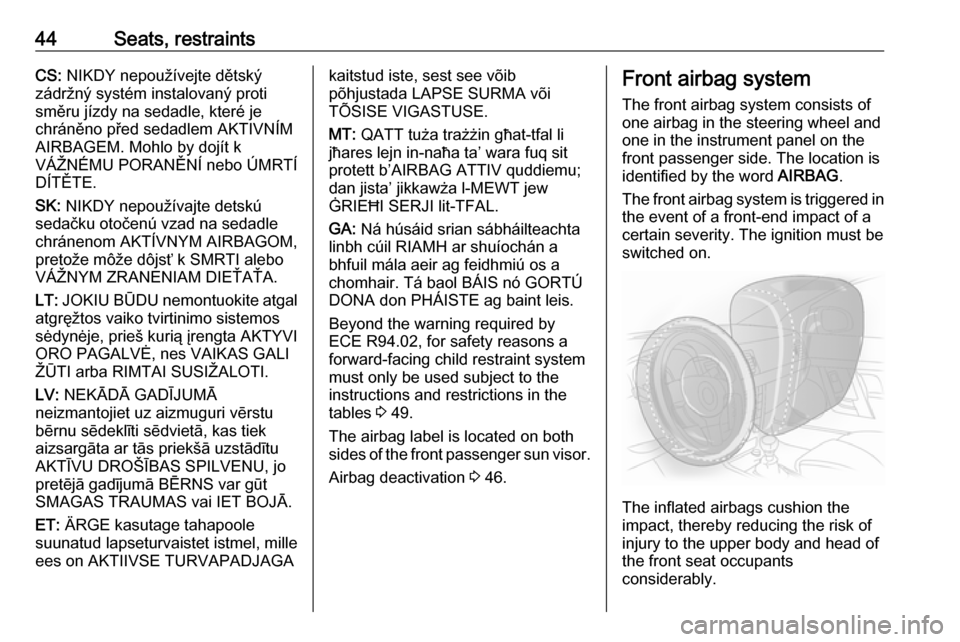
The front airbag system consists of
one airbag in the steering wheel and
one in the instrument panel on the
front passenger side. The location is
identified by the word AIRBAG.
The front airbag system is triggered in
the event of a front-end impact of a
certain severity. The ignition must be
switched on.
The inflated airbags cushion the
impact, thereby reducing the risk of
injury to the upper body and head of
the front seat occupants
considerably.
Page 47 of 203

Seats, restraints459Warning
Optimum protection is only
provided when the seat is in the
proper position.
Seat position 3 36.
Keep the area in which the airbag
inflates clear of obstructions.
Fit the seat belt correctly and
engage securely. Only then is the
airbag able to protect.
Side airbag system
The side airbag system consists of an
airbag in each front seat backrest.
The location is identified by the word
AIRBAG .
The side airbag system is triggered in the event of a side impact of a certain
severity. The ignition must be
switched on.
The inflated airbags cushion the
impact, thereby reducing the risk of
injury to the upper body and pelvis in
the event of a side-on collision
considerably.
9 Warning
Keep the area in which the airbag
inflates clear of obstructions.
Note
Only use protective seat covers that have been approved for the vehicle.Be careful not to cover the airbags.
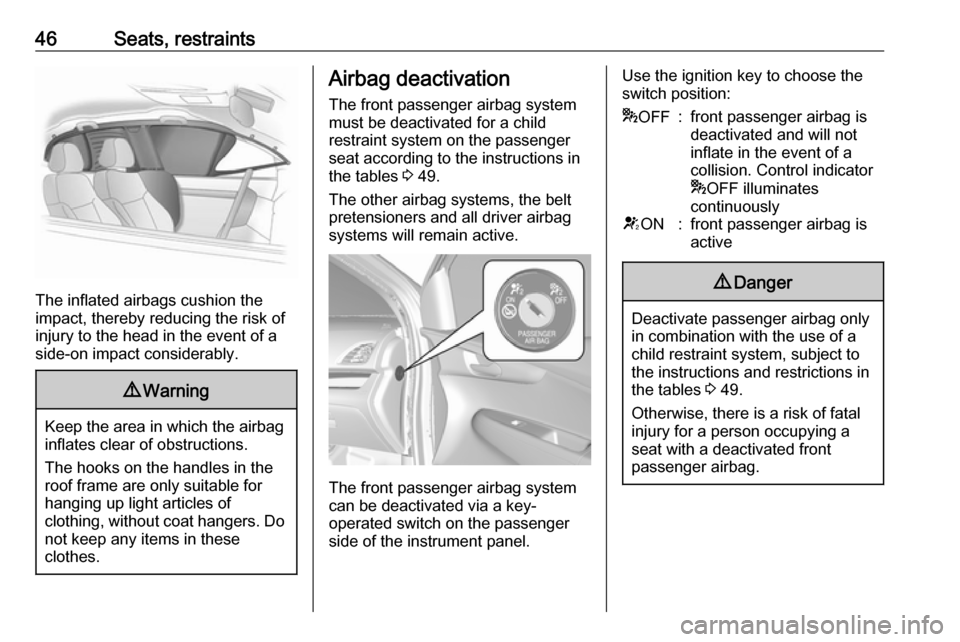
Curtain airbag system
The curtain airbag system consists of an airbag in the roof frame on each
side. The location is identified by the
word AIRBAG on the roof pillars.
The curtain airbag system is triggered
in the event of a side-on impact of a
certain severity. The ignition must be
switched on.
Page 48 of 203
46Seats, restraints
The inflated airbags cushion the
impact, thereby reducing the risk of
injury to the head in the event of a
side-on impact considerably.
9 Warning
Keep the area in which the airbag
inflates clear of obstructions.
The hooks on the handles in the
roof frame are only suitable for
hanging up light articles of
clothing, without coat hangers. Do not keep any items in these
clothes.
Airbag deactivation
The front passenger airbag system must be deactivated for a child
restraint system on the passenger
seat according to the instructions in
the tables 3 49.
The other airbag systems, the belt
pretensioners and all driver airbag
systems will remain active.
The front passenger airbag system
can be deactivated via a key-
operated switch on the passenger side of the instrument panel.
Use the ignition key to choose theswitch position:* OFF:front passenger airbag is
deactivated and will not
inflate in the event of a
collision. Control indicator
* OFF illuminates
continuouslyV ON:front passenger airbag is
active9 Danger
Deactivate passenger airbag only
in combination with the use of a
child restraint system, subject to
the instructions and restrictions in
the tables 3 49.
Otherwise, there is a risk of fatal
injury for a person occupying a
seat with a deactivated front
passenger airbag.
Page 49 of 203
Seats, restraints47
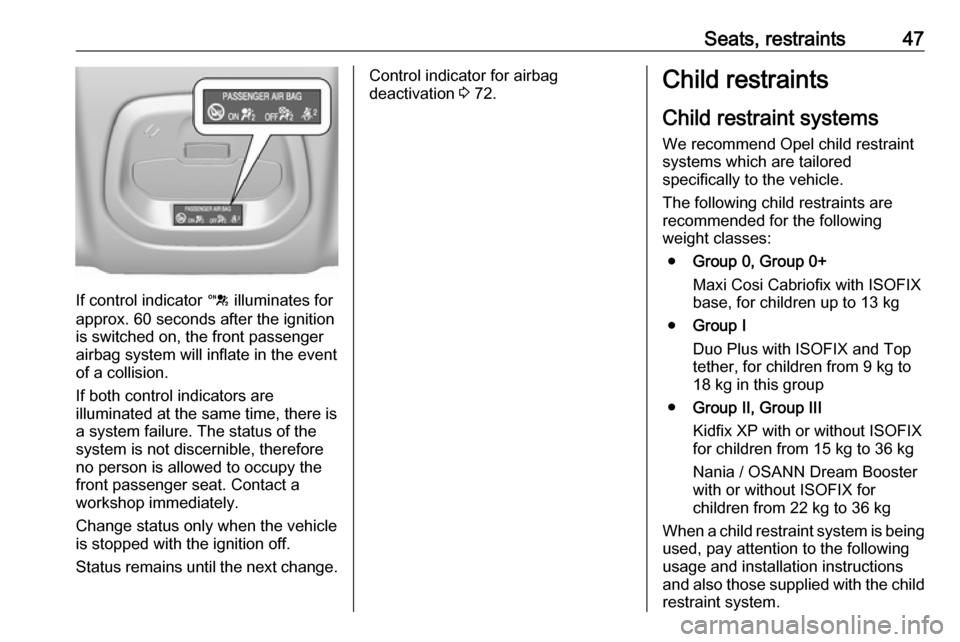
If control indicator d illuminates for
approx. 60 seconds after the ignition
is switched on, the front passenger
airbag system will inflate in the event
of a collision.
If both control indicators are
illuminated at the same time, there is
a system failure. The status of the
system is not discernible, therefore
no person is allowed to occupy the
front passenger seat. Contact a
workshop immediately.
Change status only when the vehicle
is stopped with the ignition off.
Status remains until the next change.
Control indicator for airbag
deactivation 3 72.Child restraints
Child restraint systems
We recommend Opel child restraint
systems which are tailored
specifically to the vehicle.
The following child restraints are
recommended for the following
weight classes:
● Group 0, Group 0+
Maxi Cosi Cabriofix with ISOFIX
base, for children up to 13 kg
● Group I
Duo Plus with ISOFIX and Top tether, for children from 9 kg to
18 kg in this group
● Group II, Group III
Kidfix XP with or without ISOFIX
for children from 15 kg to 36 kg
Nania / OSANN Dream Booster
with or without ISOFIX for
children from 22 kg to 36 kg
When a child restraint system is being
used, pay attention to the following
usage and installation instructions
and also those supplied with the child restraint system.
Page 50 of 203

48Seats, restraintsAlways comply with local or national
regulations. In some countries, the
use of child restraint systems is
forbidden on certain seats.9 Danger
If using a rear-facing child restraint
system on the front passenger
seat, the airbag system for the
front passenger seat must be
deactivated. This also applies to
certain forward-facing child
restraint systems as indicated in
the tables 3 49.
Airbag deactivation 3 46.
Airbag label 3 41.
Selecting the right system The rear seats are the most
convenient location to fasten a child
restraint system.
Children should travel facing
rearwards in the vehicle as long as
possible. This ensures that the child's
backbone, which is still very weak, is
under less strain in the event of an
accident.
Only use suitable restraint systems,
e.g. those that comply with valid
UN ECE regulations.
Ensure that the child restraint system to be installed is compatible with the
vehicle type. Refer to the tables on
the following pages, the instructions
supplied with the child restraint
system and the vehicle type list of
non-universal child restraint systems.
Ensure that the mounting location of
the child restraint system within the
vehicle is correct, see following
tables.
Remove rear head restraint before
mounting a child restraint system if
required.
Allow children to enter and exit the
vehicle only on the side facing away
from the traffic.
When the child restraint system is not in use, secure the seat with a seat belt
or remove it from the vehicle.
Child restraint systems could be
fastened with ISOFIX mounting
brackets, Top-tether if available,
and/or a three-point seat belt. Refer
to the following tables.Note
Do not affix anything on the child
restraint systems and do not cover
them with any other materials.
A child restraint system which has
been subjected to stress in an
accident must be replaced.
Page 51 of 203

Seats, restraints49Child restraint installation locations
Permissible options for fastening a child restraint system with a three-point seat belt
Weight class
On front passenger seat
On rear outboard seatsOn rear centre seat
activated airbagdeactivated airbagGroup 0: up to 10 kgXU 1U 2XGroup 0+: up to 13 kgXU1U2XGroup I: 9 to 18 kgXU1U 2, 3XGroup II: 15 to 25 kgXXU2, 3XGroup III: 22 to 36 kgXXU2, 3XU:universal suitability in conjunction with three-point seat beltX:no child restraint system permitted in this weight class1:adjust seat backrest as far as necessary to a vertical position to ensure that the belt runs forwards from the upper
anchorage point2:move the driver and/or passenger seat forwards and adjust seat backrest as far as necessary to a vertical positionto ensure that the child restraint system does not have any interference from the front seat backrest.3:adjust the respective headrest as necessary or remove if required.
Page 62 of 203

60Instruments and controlsInstruments and
controlsControls ....................................... 61
Steering wheel adjustment ........61
Steering wheel controls .............61
Heated steering wheel ...............61
Horn ........................................... 62
Windscreen wiper/washer .........62
Rear window wiper/washer .......63
Outside temperature ..................63
Clock ......................................... 63
Power outlets ............................. 65
Cigarette lighter ......................... 65
Ashtrays .................................... 65
Warning lights, gauges and indi‐ cators ........................................... 65
Instrument cluster ......................65
Speedometer ............................. 65
Odometer .................................. 66
Trip odometer ............................ 66
Tachometer ............................... 66
Fuel gauge ................................ 66
Fuel selector .............................. 67
Engine coolant temperature gauge ....................................... 68
Service display .......................... 68Control indicators ......................69
Turn signal ................................. 71
Seat belt reminder .....................72
Airbag and belt tensioners .........72
Airbag deactivation ....................72
Charging system .......................73
Malfunction indicator light ..........73
Service vehicle soon .................73
Brake and clutch system ...........73
Operate pedal ............................ 73
Antilock brake system (ABS) .....74
Gear shifting .............................. 74
Power steering .......................... 74
Lane departure warning ............74
Ultrasonic parking assist ...........74
Electronic Stability Control off ...74
Electronic Stability Control and Traction Control system ...........74
Traction Control system off .......75
Engine coolant temperature ......75
Tyre pressure monitoring system ...................................... 75
Engine oil pressure ....................75
Low fuel ..................................... 76
Immobiliser ................................ 76
Reduced engine power .............76
Exterior light .............................. 76
High beam ................................. 76
Fog light ..................................... 76
Rear fog light ............................. 76Cruise control............................ 76
Speed limiter ............................. 76
Bonnet open .............................. 76
Door open .................................. 77
Information displays .....................77
Driver Information Centre ..........77
Info display ................................ 82
Vehicle messages ........................83
Warning chimes .........................85
Battery voltage .......................... 85
Vehicle personalisation ................86
Telematics service .......................88
OnStar ....................................... 88
Page 73 of 203
Instruments and controls71Control indicators in the overheadconsole
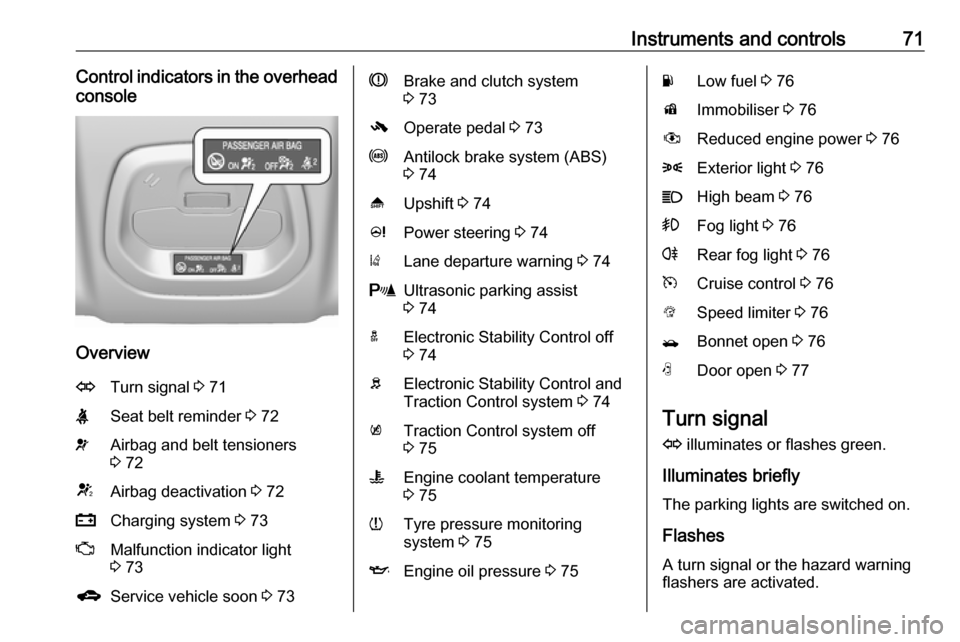
Overview
OTurn signal 3 71XSeat belt reminder 3 72vAirbag and belt tensioners
3 72VAirbag deactivation 3 72pCharging system 3 73ZMalfunction indicator light
3 73gService vehicle soon 3 73RBrake and clutch system
3 73-Operate pedal 3 73uAntilock brake system (ABS)
3 74[Upshift 3 74cPower steering 3 74)Lane departure warning 3 74rUltrasonic parking assist
3 74aElectronic Stability Control off
3 74bElectronic Stability Control and
Traction Control system 3 74kTraction Control system off
3 75WEngine coolant temperature
3 75wTyre pressure monitoring
system 3 75IEngine oil pressure 3 75YLow fuel 3 76dImmobiliser 3 76#Reduced engine power 3 768Exterior light 3 76CHigh beam 3 76>Fog light 3 76rRear fog light 3 76mCruise control 3 76LSpeed limiter 3 76/Bonnet open 3 76NDoor open 3 77
Turn signal
O illuminates or flashes green.
Illuminates briefly
The parking lights are switched on.
Flashes
A turn signal or the hazard warning
flashers are activated.
Page 74 of 203
72Instruments and controlsRapid flashing: failure of a turn signal
light or associated fuse.
Bulb replacement 3 145, Fuses
3 151.
Turn signals 3 95.
Seat belt reminder
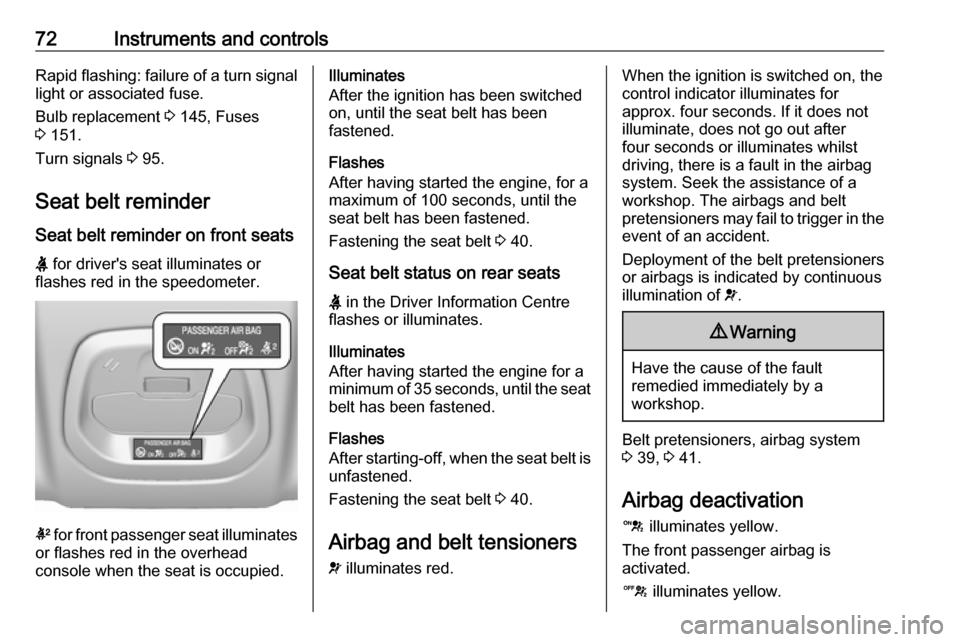
Seat belt reminder on front seats X for driver's seat illuminates or
flashes red in the speedometer.
k for front passenger seat illuminates
or flashes red in the overhead
console when the seat is occupied.
Illuminates
After the ignition has been switched on, until the seat belt has been
fastened.
Flashes
After having started the engine, for a
maximum of 100 seconds, until the
seat belt has been fastened.
Fastening the seat belt 3 40.
Seat belt status on rear seats
X in the Driver Information Centre
flashes or illuminates.
Illuminates
After having started the engine for a
minimum of 35 seconds, until the seat belt has been fastened.
Flashes
After starting-off, when the seat belt is
unfastened.
Fastening the seat belt 3 40.
Airbag and belt tensioners
v illuminates red.When the ignition is switched on, the
control indicator illuminates for
approx. four seconds. If it does not
illuminate, does not go out after
four seconds or illuminates whilst driving, there is a fault in the airbag
system. Seek the assistance of a
workshop. The airbags and belt
pretensioners may fail to trigger in the event of an accident.
Deployment of the belt pretensioners
or airbags is indicated by continuous
illumination of v.9 Warning
Have the cause of the fault
remedied immediately by a
workshop.
Belt pretensioners, airbag system
3 39, 3 41.
Airbag deactivation
d illuminates yellow.
The front passenger airbag is
activated.
c illuminates yellow.
Page 75 of 203
Instruments and controls73The front passenger airbag is
deactivated 3 46.9 Danger
Risk of fatal injury for a child using
a child restraint system together
with activated front passenger
airbag.
Risk of fatal injury for an adult
person with deactivated front
passenger airbag.
Charging system
p illuminates red.
Illuminates when the ignition is
switched on and extinguishes shortly
after the engine starts.
Illuminates when the engine is
running
Stop, switch off engine. Vehicle
battery is not charging. Engine
cooling may be interrupted. The
brake servo unit may cease to be
effective. Seek the assistance of a
workshop.
Malfunction indicator light
Z illuminates or flashes yellow.
Illuminates when the ignition is
switched on and extinguishes shortly
after the engine starts.
Illuminates when the engine is
running
Fault in the emission control system. The permitted emission limits may be exceeded. Seek the assistance of a
workshop immediately.
Flashes when the engine is
running
Fault that could lead to catalytic converter damage. Ease up on the
accelerator until the flashing stops.
Seek the assistance of a workshop
immediately.
Service vehicle soon
g illuminates yellow.
Additionally, a warning code is
displayed in the Driver Information
Centre.
The vehicle requires a service.Seek the assistance of a workshop. Vehicle messages 3 83.
Brake and clutch system
R illuminates red.
The brake and clutch fluid level is too low, when manual parking brake is
not applied 3 142.9 Warning
Stop. Do not continue your
journey. Consult a workshop.
Illuminates when the manual parking
brake is applied and ignition is
switched on 3 120.
Operate pedal - illuminates or flashes yellow.
Illuminates
Clutch pedal must be depressed to
start the engine in Autostop mode.
Stop-start system 3 111.