park assist OPEL KARL 2017.5 Manual user
[x] Cancel search | Manufacturer: OPEL, Model Year: 2017.5, Model line: KARL, Model: OPEL KARL 2017.5Pages: 203, PDF Size: 5.4 MB
Page 122 of 203
120Driving and operatingFault9Warning
If there is a fault in the ABS, the
wheels may be liable to lock due
to braking that is heavier than
normal. The advantages of ABS are no longer available. During
hard braking, the vehicle can no longer be steered and may
swerve.
Have the cause of the fault remedied
by a workshop.
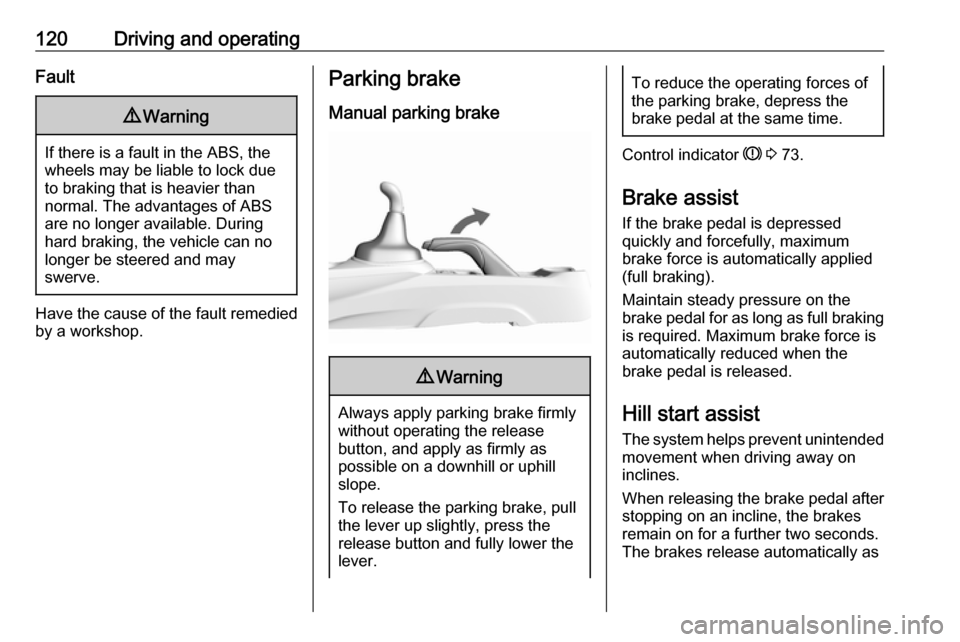
Parking brake
Manual parking brake9 Warning
Always apply parking brake firmly
without operating the release
button, and apply as firmly as
possible on a downhill or uphill
slope.
To release the parking brake, pull
the lever up slightly, press the
release button and fully lower the
lever.
To reduce the operating forces of
the parking brake, depress the
brake pedal at the same time.
Control indicator R 3 73.
Brake assist
If the brake pedal is depressed
quickly and forcefully, maximum
brake force is automatically applied
(full braking).
Maintain steady pressure on the
brake pedal for as long as full braking is required. Maximum brake force is
automatically reduced when the
brake pedal is released.
Hill start assist
The system helps prevent unintended movement when driving away on
inclines.
When releasing the brake pedal after
stopping on an incline, the brakes
remain on for a further two seconds.
The brakes release automatically as
Page 125 of 203
Driving and operating123ESC is reactivated by pressing t
again. If the TC system was
previously disabled, both TC and
ESC are reactivated. k and t
extinguish when TC and ESC are
reactivated.
ESC is also reactivated the next time
the ignition is switched on.
Fault
If there is a fault in the system, the control indicator b illuminates
continuously and a warning code
appears in the Driver Information
Centre. The system is not
operational.
Have the cause of the fault remedied
by a workshop.
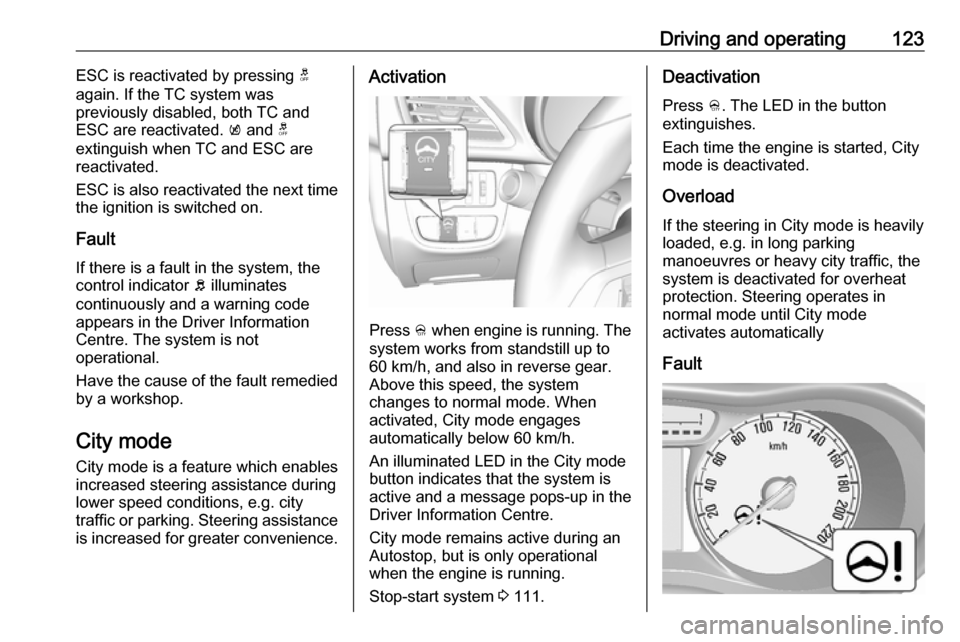
City mode City mode is a feature which enablesincreased steering assistance during
lower speed conditions, e.g. city
traffic or parking. Steering assistance
is increased for greater convenience.Activation
Press B when engine is running. The
system works from standstill up to
60 km/h, and also in reverse gear. Above this speed, the system
changes to normal mode. When
activated, City mode engages
automatically below 60 km/h.
An illuminated LED in the City mode
button indicates that the system is
active and a message pops-up in the
Driver Information Centre.
City mode remains active during an
Autostop, but is only operational when the engine is running.
Stop-start system 3 111.
Deactivation
Press B. The LED in the button
extinguishes.
Each time the engine is started, City
mode is deactivated.
Overload If the steering in City mode is heavily
loaded, e.g. in long parking
manoeuvres or heavy city traffic, the
system is deactivated for overheat
protection. Steering operates in
normal mode until City mode
activates automatically
Fault
Page 129 of 203

Driving and operating127By switching off the ignition, speed
limiter is also deactivated, but the
speed limit will be stored for next
speed limiter activation.
Parking assist
Rear parking assist9 Warning
It is the driver who bears full
responsibility for the parking
manoeuvre.
Always check the surrounding
area while reversing and using the rear parking assist system.
The rear parking assist makes
parking easier by measuring the
distance between the vehicle and
rear obstacles. It informs and warns
the driver by giving acoustic signals
and display indication.
The system has three ultrasonic
parking sensors in the rear bumper.
Activation
When reverse gear is engaged, the
system is ready to operate
automatically.
Indication
The system warns the driver with
acoustic signals against potentially
hazardous obstacles behind the
vehicle. The interval between the
sounds becomes shorter as the
vehicle gets closer to that obstacle.
When the distance is less than
approx. 40 cm, the sound is
continuous.
Deactivation
The system automatically switches
off when reverse gear is disengaged.
The system might not detect the
obstacle when the vehicle is driven above a 10 km/h.
Fault
In the event of a fault in the system,
control indicator r illuminates in the
instrument cluster 3 74.
Additionally if the system does not work due to temporary conditions like
snow covered sensors, r
illuminates.
Page 130 of 203

128Driving and operatingBasic notes on parking assist
systems9 Warning
Under certain circumstances,
various reflective surfaces on
objects or clothing as well as
external noise sources may cause the system to fail to detect
obstacles.
Special attention must be paid to
low obstacles which can damage
the lower part of the bumper.
Caution
Performance of the system can be reduced when sensors are
covered, e.g. by ice or snow.
Performance of the parking assist
system can be reduced due to
heavy loading.
Special conditions apply if there
are taller vehicles in the vicinity
(e.g. off-road vehicles, mini vans,
vans). Object identification and
correct distance indication in the
upper part of these vehicles
cannot be guaranteed.
Objects with a very small reflection
cross-section, e.g. objects of
narrow size or soft materials, may
not be detected by the system.
Parking assist systems do not
detect objects outside the
detection range.
Lane departure warning
The lane departure warning system
observes the lane markings between
which the vehicle is driving via a front camera. The system detects lane
changes and warns the driver in the
event of an unintended lane change
via visual and acoustic signals.
Criteria for the detection of an
unintended lane change are:
● No operation of turn signals.
● No brake pedal operation.
● No active accelerator operation or speeding-up.
● No active steering.
If the driver is performing these
actions, no warning will be issued.
Activation
The lane departure warning system is activated by pressing ). The
illuminated LED in the button
indicates that the system is switched
on. When control indicator ) in the
instrument cluster illuminates green, the system is ready to operate.
The system is only operable at
vehicle speeds above 56 km/h and if lane markings are available.
Page 132 of 203

130Driving and operatingCaution
Use of fuel that does not comply toEN 228 or equivalent can lead todeposits or engine damage.
Caution
Use of fuel with a lower octane
rating than the lowest possible
rating could lead to uncontrolled combustion and engine damage.
The engine specific requirements
regarding octane rating are given in
the engine data overview 3 184. A
country specific label at the fuel filler
flap can supersede the requirement.
Fuel additives outside Europe
Fuel should contain detergent
additives that help prevent engine
and fuel system deposits from
forming. Clean fuel injectors and
intake valves will allow the emission
control system to work properly.
Some fuel does not contain sufficient
quantities of additive to keep fuel
injectors and intake valves clean.
To make up for this lack of
detergency, add Fuel System
Treatment PLUS to the fuel tank at
every engine oil change or every
15,000 km, whichever occurs first. It
is available at your workshop.
Fuels containing oxygenates such as
ethers and ethanol, as well as
reformulated fuel, are available in
some cities. If these fuels comply with the previously described
specification, then they are
acceptable to use. However, E85
(85% ethanol) and other fuels
containing more than 15% ethanol
must be used only in FlexFuel
vehicles.Caution
Do not use fuel containing
methanol. It can corrode metal
parts in the fuel system and also
damage plastic and rubber parts.
This damage would not be
covered by the vehicle warranty.
Some fuels, mainly high octane
racing fuels, can contain an octane
enhancing additive called
methylcyclopentadienyl manganese
tricarbonyl (MMT). Do not use fuels or fuel additives with MMT as they can
reduce spark plug life and affect
emission control system
performance. The malfunction
indicator light Z may turn on 3 73. If
this occurs, seek the assistance of a
workshop.
Fuel for liquid gas operation Liquid gas is known as LPG
(Liquefied Petroleum Gas) or under
its French name GPL (Gaz de Pétrole
Liquéfié). LPG is also known as
Autogas.
LPG consists mainly of propane and
butane. The octane rating is between 105 and 115, depending on the
butane proportion. LPG is stored
liquid at around five to ten bar
pressure.
The boiling point depends on the
pressure and mixing ratio. At ambient
pressure, it is between -42 °C (pure
propane) and -0.5 °C (pure butane).
Page 134 of 203

132Driving and operatingDue to extreme temperatures in
combination with the gas
composition, it may take slightly
longer before the system switches
from petrol to gas mode.
In extreme situations, the system may
also switch back to petrol mode if the
minimum requirements are not
fulfilled. If conditions allow, it might be possible to manually switch back to
liquid gas operation.
Seek the assistance of a workshop in
the event of all other faults.Caution
Repairs and adjustments may only be made by trained specialists in
order to maintain the safety and
warranty on the LPG system.
Liquid gas is given a particular odour
(odorised) so that any leaks can be
detected easily.
9 Warning
If you smell gas in the vehicle or in
the immediate vicinity, switch to petrol mode immediately. No
smoking. No naked flames or
ignition sources.
If the gas odour persists, do not start
the engine. Have the cause of the
fault remedied by a workshop.
When using underground car parks,
follow the instructions of the operator
and local laws.
Note
In the event of an accident, switch off
the ignition and lights.
Refuelling9 Danger
Before refuelling, switch off
ignition and any external heaters
with combustion chambers.
Follow the operating and safety
instructions of the filling station
when refuelling.
Page 156 of 203
154Vehicle careAfter having changed defective fusesclose the fuse box cover and press
until it engages.
If the fuse box cover is not closed
correctly, malfunction may occur.
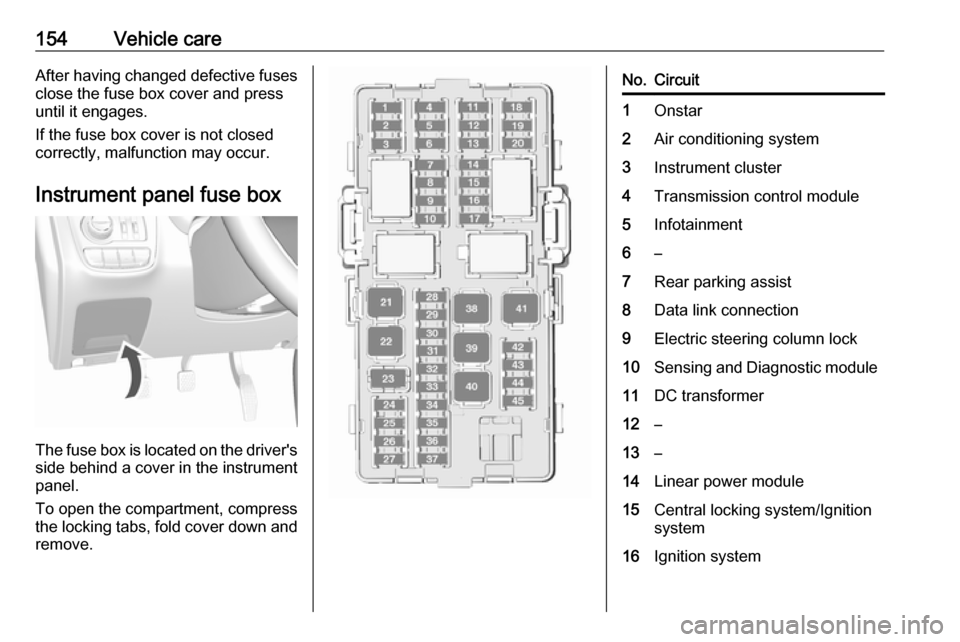
Instrument panel fuse box
The fuse box is located on the driver's
side behind a cover in the instrument
panel.
To open the compartment, compress
the locking tabs, fold cover down and
remove.
No.Circuit1Onstar2Air conditioning system3Instrument cluster4Transmission control module5Infotainment6–7Rear parking assist8Data link connection9Electric steering column lock10Sensing and Diagnostic module11DC transformer12–13–14Linear power module15Central locking system/Ignition
system16Ignition system
Page 158 of 203

156Vehicle careVehicles with spare wheel
The jack and the vehicle tools are in
the load compartment.
Wheels and tyres
Tyre condition, wheel condition Drive over edges slowly and at right
angles if possible. Driving over sharp
edges can cause tyre and wheel
damage. Do not trap tyres on the kerb when parking.
Regularly check the wheels for
damage. Seek the assistance of a
workshop in the event of damage or
unusual wear.
We recommend not swapping the
front wheels with the rear wheels and vice versa, as this can affect vehicle
stability. Always use less worn tyres on the rear axle.
Winter tyres
Winter tyres improve driving safety at temperatures below 7 °C and should
therefore be fitted on all wheels.
In accordance with country-specific
regulations, affix the speed sticker in
the driver's field of view.Tyre designations
E.g. 195/55 R 16 95 H195:tyre width, mm55:cross-section ratio (tyre height
to tyre width), %R:belt type: RadialRF:type: RunFlat16:wheel diameter, inches91:load index e.g. 91 is equivalent
to 615 kgH:speed code letter
Speed code letter:
Q:up to 160 km/hS:up to 180 km/hT:up to 190 km/hH:up to 210 km/hV:up to 240 km/hW:up to 270 km/h
Choose a tyre appropriate for the
maximum speed of your vehicle.
The maximum speed is achievable at kerb weight with driver (75 kg) plus
125 kg payload. Optional equipment
could reduce the maximum speed of
the vehicle.
Performance 3 185.
Page 200 of 203

198Instrument cluster ........................65
Instrument panel fuse box .........154
Instrument panel illumination .....150
Instrument panel illumination control ...................................... 96
Instrument panel overview ........... 10
Interior care ............................... 174
Interior lighting .............................. 96
Interior lights ........................ 97, 150
Interior mirrors .............................. 30
Introduction .................................... 3
ISOFIX child restraint systems ....52
J
Jump starting ............................. 170
K Key, memorised settings ..............23
Keys ............................................. 21
Keys, locks ................................... 21
L
Lane departure warning .......74, 128
Light switch .................................. 93
Load compartment ................26, 54
Load compartment cover .............56
Loading information .....................59
Low fuel ....................................... 76M
Malfunction indicator light ............73
Manual adjustment ......................29
Manual anti-dazzle ......................30
Manual mode ............................. 118
Manual transmission .................. 115
Manual transmission automated 116
Manual windows ..........................31
Memorised settings ......................23
Mirror adjustment ........................... 8
Mirrors ......................................... 29
Misted light covers .......................96
N
New vehicle running-in ..............109
Number plate light .....................150
O Object detection systems ...........127
Odometer ..................................... 66
Oil, engine .......................... 177, 181
OnStar .......................................... 88
Operate pedal ............................... 73
Outside temperature ....................63
Overrun cut-off ........................... 111
P Parking ................................ 20, 114
Parking assist ............................ 127
Parking brake ............................ 120
Parking lights ............................... 96Performance .............................. 185
Performing work ........................139
Pollen filter ................................. 106
Power outlets ............................... 65
Power steering.............................. 74
Power windows ............................ 31
Puncture ..................................... 165
R Radio Frequency Identification (RFID) ..................................... 195
Radio remote control ...................22
Reading lights .............................. 97
Rear doors ................................... 26
Rear floor storage cover ..............57
Rear fog light ......................... 76, 95
Rear window wiper/washer .......... 63
Recommended fluids and lubricants ........................ 177, 181
Reduced engine power ................76
Refuelling ................................... 132
Registered trademarks ...............194
Retained power off .....................110
Reversing lights ........................... 96
Ride control systems ..................121
Roof .............................................. 33
Roof load ...................................... 59
Roof rack ..................................... 58
Page 201 of 203

199SSafety belts ................................... 39
Seat adjustment ....................... 7, 37 Seat belt ........................................ 8
Seat belt reminder .......................72
Seat belts ..................................... 39
Seat heating ................................. 38
Seat position ................................ 36
Selector lever ............................. 117
Service ....................................... 107
Service display ............................ 68
Service information ....................176
Service vehicle soon .................... 73
Side airbag system ......................45
Sidelights ...................................... 93
Side turn signal lights ................149
Software acknowledgement .......192
Spare wheel ............................... 168
Speed limiter......................... 76, 125
Speedometer ............................... 65
Starting and operating ................109
Starting off ................................... 18
Starting the engine ............110, 116
Steering ...................................... 109
Steering wheel adjustment ......9, 61
Steering wheel controls ...............61
Stop-start system........................ 111
Storage ......................................... 53
Storage compartments .................53
Sunroof ........................................ 33Sun visors .................................... 33
Symbols ......................................... 4
T
Tachometer ................................. 66
Tail lights ................................... 148
Three-point seat belt .................... 40 Tools .......................................... 155
Top-tether fastening eyes ............52
Towing ........................................ 171
Towing the vehicle .....................171
Traction Control system ............. 121
Traction Control system off........... 75
Transmission ............................... 17
Transmission display .................116
Tread depth ............................... 161
Trip odometer .............................. 66
Turn and lane-change signals .....95
Turn signal ................................... 71
Tyre chains ................................ 162
Tyre designations ......................156
Tyre pressure ............................ 157
Tyre pressure monitoring system ............................... 75, 158
Tyre pressures ........................... 189
Tyre repair kit ............................. 162
U Ultrasonic parking assist ...... 74, 127
Upholstery .................................. 174
Using this manual ..........................3V
Valet mode ................................... 82
Vehicle battery ........................... 142
Vehicle checks............................ 139
Vehicle data ................................ 181
Vehicle data recording and privacy ..................................... 194
Vehicle dimensions .................... 187
Vehicle Identification Number ....179
Vehicle jack ................................ 155
Vehicle messages .......................83
Vehicle personalisation ...............86
Vehicle specific data ......................3
Vehicle storage ........................... 138
Vehicle tools ............................... 155
Vehicle unlocking ........................... 6
Vehicle weight ........................... 186
Ventilation ..................................... 99
W
Warning chimes ........................... 85
Warning lights ............................... 65
Warning triangle .......................... 57
Washer and wiper systems .........15
Washer fluid ............................... 142
Wheel changing .........................165
Wheel covers ............................. 162
Wheels and tyres .......................156
Windows ....................................... 31
Windscreen................................... 31