seats OPEL KARL 2017 Manual user
[x] Cancel search | Manufacturer: OPEL, Model Year: 2017, Model line: KARL, Model: OPEL KARL 2017Pages: 203, PDF Size: 5.39 MB
Page 54 of 203

52Seats, restraintsISOFIX child restraintsystems
Fasten vehicle-approved ISOFIX
child restraint systems to the ISOFIX
mounting brackets. Specific vehicle
ISOFIX child restraint system
positions are marked in the table by
IL.
ISOFIX mounting brackets on the
rear seats are indicated by the
ISOFIX logo on the backrest.
ISOFIX child restraint systems of
universal category positions are
marked in the table by IUF.
Remove rear head restraint before
mounting a child restraint system, if
required 3 35.
Route, attach, and tighten the top
tether according to your child restraint instructions.
Top-tether fastening eyes The vehicle has two fastening eyes
on the back of the rear seats.
Top-tether fastening eyes are marked
with the symbol : for a child seat.
In addition to the ISOFIX mounting,
fasten the Top-tether strap to the
Top-tether fastening eyes.
Route, attach, and tighten the top
tether according to your child restraint instructions.
ISOFIX child restraint systems of
universal category positions are
marked in the table by IUF.
Remove rear head restraint before
mounting a child restraint system, if
required 3 35.
Page 56 of 203

54StorageCentre console storage
The storage is used for small articles.
Load compartment
Load compartment extensionCaution
First fold up the rear seat cushion
before folding the rear seat
backrest.
Disregard may lead to damage to
the rear seat.
Note
To ensure sufficient room for rear
seat cushion operation, slide the
front seats forward and move the
front seat backrest upright.
1. Pull up the front of the rear seat cushion to release it.
2. Guide the rear of the rear seat cushion to an upright position.
3. Remove the rear seat head restraints 3 35.
Page 57 of 203

Storage55
4.Pull the release knob on top of the
rear backrest.
5. Fold down the backrest and insert
the rear seat head restraints into
the pockets.
6. Put the seat belts for the outboard
seats into the belt guides.
7. Adjust the front seats to the desired position.
To return the backrest to the original
position:
1. Lift the backrest up and pull out the seat belt from the belt guides.
Push backrest firmly into place.
9 Warning
When folding up, ensure that
backrests are securely engaged in position before driving. Failure to
do so may result in personal injury
or damage to the load or vehicle in the event of hard braking or a
collision.
Ensure the seat belts are not
pinched by the latch.
2. Reinstall the rear head restraints.
3. Place the rear part of the seat cushion in its original position.
Note
Make sure the seat belts are not
twisted or caught under the seat
cushion.
4. Push the front part of the seat cushion down firmly until it
latches.
The centre rear seat belt may lock
when you raise the backrest. If this
happens, allow the belt to go back all the way and repeat operation.
If the seat belt is still locked, fold down the seat cushion and try again.
To return the rear seat cushion, put
the rear part of the seat cushion in its original position ensuring that the
seat belt buckle straps are not twisted
Page 58 of 203

56Storageor caught under the seat cushion,
then push the front part of the seat
cushion firmly down until it latches.Caution
When returning rear seat backrest
to the upright position, place the
rear seat belt and buckles
between the rear seat backrest
and one cushion. Make sure the
rear seat belt and buckles do not
get pinched under the rear seat
cushion.
Ensure the seat belts are not twisted or caught in the seat
backrest and are arranged in their proper position.
To remove the rear seat cushion,
push the hinges in direction of arrow.
Load compartment cover Do not place heavy objects on thecover.Removing
Unhook retaining straps from tailgate.
Lift cover at the rear and push it
upwards at the front.
Remove the cover.
Stowing
When the load compartment is fully
loaded, stow the load compartment
cover on the rear seats or remove
from vehicle.
Fitting
Engage cover in side guides and fold downwards. Attach retaining straps to
tailgate.
Page 60 of 203
58StorageVehicles with tyre repair kit
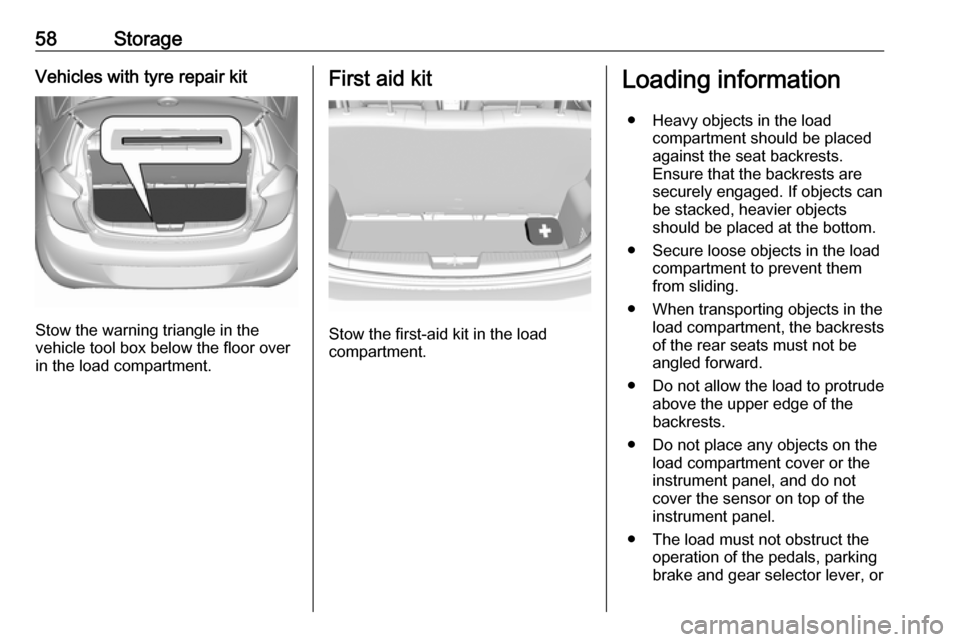
Stow the warning triangle in the
vehicle tool box below the floor over
in the load compartment.
First aid kit
Stow the first-aid kit in the load
compartment.
Loading information
● Heavy objects in the load compartment should be placed
against the seat backrests.
Ensure that the backrests are
securely engaged. If objects can
be stacked, heavier objects
should be placed at the bottom.
● Secure loose objects in the load compartment to prevent themfrom sliding.
● When transporting objects in the load compartment, the backrestsof the rear seats must not beangled forward.
● Do not allow the load to protrude above the upper edge of the
backrests.
● Do not place any objects on the load compartment cover or theinstrument panel, and do notcover the sensor on top of theinstrument panel.
● The load must not obstruct the operation of the pedals, parking
brake and gear selector lever, or
Page 74 of 203
72Instruments and controlsRapid flashing: failure of a turn signal
light or associated fuse.
Bulb replacement 3 145, Fuses
3 151.
Turn signals 3 95.
Seat belt reminder
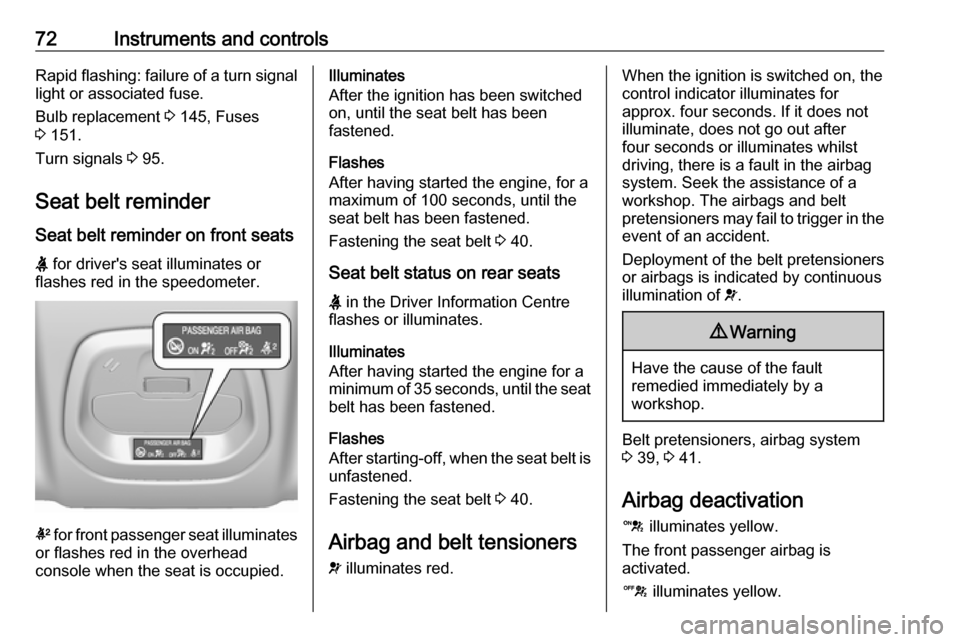
Seat belt reminder on front seats X for driver's seat illuminates or
flashes red in the speedometer.
k for front passenger seat illuminates
or flashes red in the overhead
console when the seat is occupied.
Illuminates
After the ignition has been switched on, until the seat belt has been
fastened.
Flashes
After having started the engine, for a
maximum of 100 seconds, until the
seat belt has been fastened.
Fastening the seat belt 3 40.
Seat belt status on rear seats
X in the Driver Information Centre
flashes or illuminates.
Illuminates
After having started the engine for a
minimum of 35 seconds, until the seat belt has been fastened.
Flashes
After starting-off, when the seat belt is
unfastened.
Fastening the seat belt 3 40.
Airbag and belt tensioners
v illuminates red.When the ignition is switched on, the
control indicator illuminates for
approx. four seconds. If it does not
illuminate, does not go out after
four seconds or illuminates whilst driving, there is a fault in the airbag
system. Seek the assistance of a
workshop. The airbags and belt
pretensioners may fail to trigger in the event of an accident.
Deployment of the belt pretensioners
or airbags is indicated by continuous
illumination of v.9 Warning
Have the cause of the fault
remedied immediately by a
workshop.
Belt pretensioners, airbag system
3 39, 3 41.
Airbag deactivation
d illuminates yellow.
The front passenger airbag is
activated.
c illuminates yellow.
Page 96 of 203
94LightingHeadlight range adjustment
Manual headlight range
adjustment
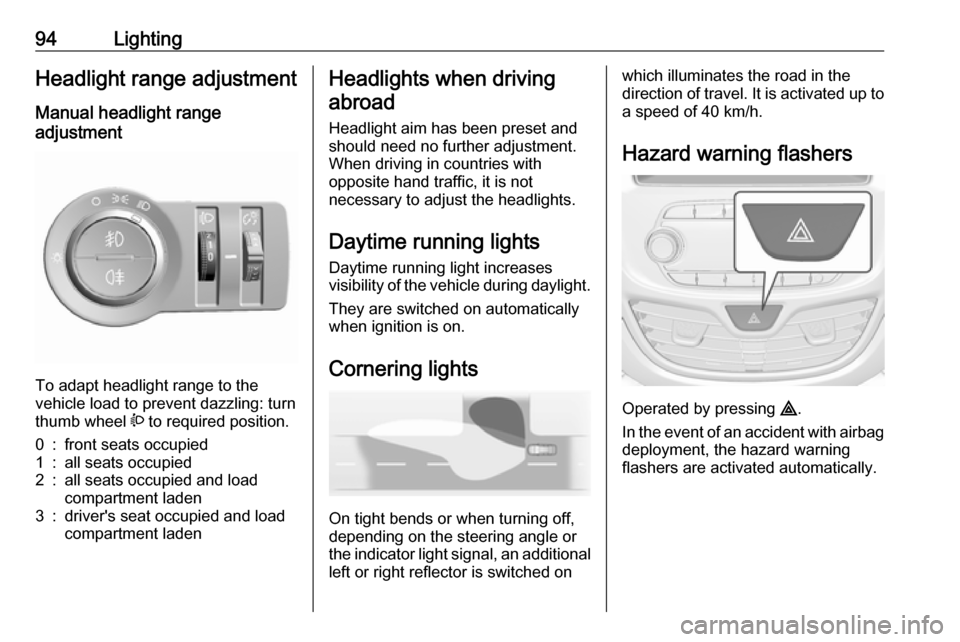
To adapt headlight range to the
vehicle load to prevent dazzling: turn
thumb wheel ? to required position.
0:front seats occupied1:all seats occupied2:all seats occupied and load
compartment laden3:driver's seat occupied and load
compartment ladenHeadlights when driving
abroad
Headlight aim has been preset and
should need no further adjustment.
When driving in countries with
opposite hand traffic, it is not
necessary to adjust the headlights.
Daytime running lights Daytime running light increases
visibility of the vehicle during daylight.
They are switched on automatically
when ignition is on.
Cornering lights
On tight bends or when turning off,
depending on the steering angle or
the indicator light signal, an additional left or right reflector is switched on
which illuminates the road in the
direction of travel. It is activated up to
a speed of 40 km/h.
Hazard warning flashers
Operated by pressing ¨
.
In the event of an accident with airbag
deployment, the hazard warning
flashers are activated automatically.
Page 101 of 203
Climate control99Climate controlClimate control systems...............99
Heating and ventilation system . 99
Air conditioning system ...........100
Electronic climate control system .................................... 102
Air vents ..................................... 106
Adjustable air vents .................106
Fixed air vents ......................... 106
Maintenance .............................. 107
Air intake ................................. 107
Pollen filter ............................... 107
Air conditioning regular operation ................................ 107
Service .................................... 107Climate control systems
Heating and ventilation system
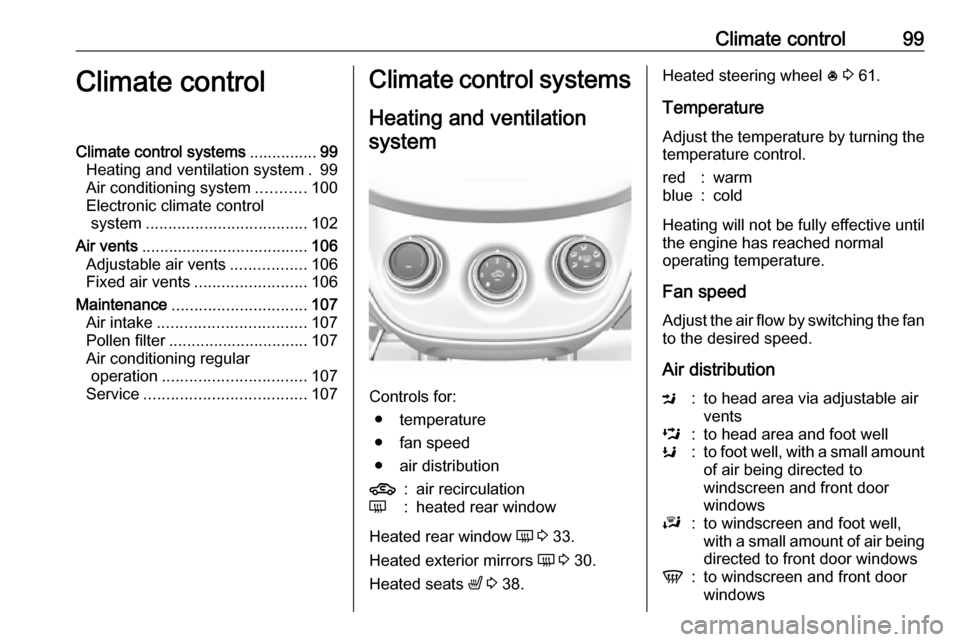
Controls for: ● temperature
● fan speed
● air distribution
4:air recirculationÜ:heated rear window
Heated rear window Ü 3 33.
Heated exterior mirrors Ü 3 30.
Heated seats ß 3 38.
Heated steering wheel * 3 61.
Temperature
Adjust the temperature by turning the
temperature control.red:warmblue:cold
Heating will not be fully effective until
the engine has reached normal
operating temperature.
Fan speed
Adjust the air flow by switching the fan
to the desired speed.
Air distribution
M:to head area via adjustable air
ventsL:to head area and foot wellK:to foot well, with a small amount of air being directed to
windscreen and front door
windowsJ:to windscreen and foot well,
with a small amount of air being
directed to front door windowsV:to windscreen and front door
windows
Page 102 of 203
100Climate controlIntermediate settings are possible.Demisting and defrosting the
windows
● Set air distribution control to V.
● Set temperature control to warmest level.
● Set fan speed to highest speed.
● Switch on heated rear window Ü.
● Open side air vents as required and direct them towards door
windows.
● For simultaneous warming of the
foot well, set air distribution
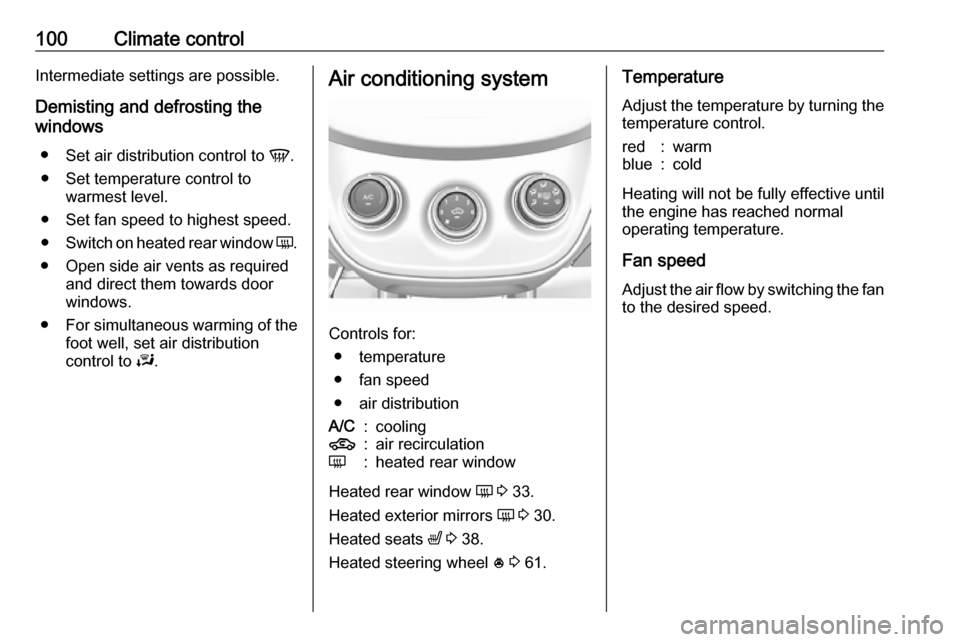
control to J.Air conditioning system
Controls for:
● temperature
● fan speed
● air distribution
A/C:cooling4:air recirculationÜ:heated rear window
Heated rear window Ü 3 33.
Heated exterior mirrors Ü 3 30.
Heated seats ß 3 38.
Heated steering wheel * 3 61.
Temperature
Adjust the temperature by turning the
temperature control.red:warmblue:cold
Heating will not be fully effective until
the engine has reached normal
operating temperature.
Fan speed
Adjust the air flow by switching the fan
to the desired speed.
Page 104 of 203
102Climate controlDemisting and defrosting the
windows V
● Set air distribution control to V.
● Set temperature control to warmest level.
● Set fan speed to highest level.
● Switch on heated rear window Ü.
● Open side air vents as required and direct them towards the doorwindows.
If air distribution is set to V, A/C
operates and air recirculation mode
will be set to demisting/defrosting
regardless of indicator status.
Note
If V is pressed while the engine is
running, an Autostop will be inhibited
until V is pressed again.
If V is pressed while the engine is
in an Autostop, the engine will restart
automatically.
Stop-start system 3 111.Electronic climate control
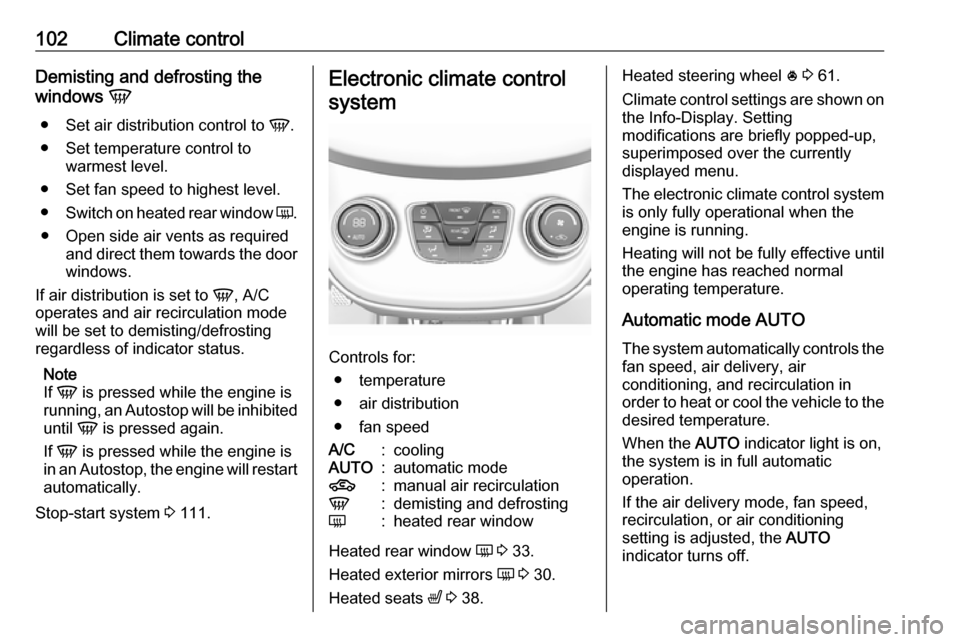
system
Controls for: ● temperature
● air distribution
● fan speed
A/C:coolingAUTO:automatic mode4:manual air recirculationV:demisting and defrostingÜ:heated rear window
Heated rear window Ü 3 33.
Heated exterior mirrors Ü 3 30.
Heated seats ß 3 38.
Heated steering wheel * 3 61.
Climate control settings are shown on the Info-Display. Setting
modifications are briefly popped-up,
superimposed over the currently
displayed menu.
The electronic climate control system
is only fully operational when the
engine is running.
Heating will not be fully effective until
the engine has reached normal
operating temperature.
Automatic mode AUTO
The system automatically controls the
fan speed, air delivery, air
conditioning, and recirculation in
order to heat or cool the vehicle to the desired temperature.
When the AUTO indicator light is on,
the system is in full automatic
operation.
If the air delivery mode, fan speed,
recirculation, or air conditioning
setting is adjusted, the AUTO
indicator turns off.