belt OPEL KARL 2018.5 Manual user
[x] Cancel search | Manufacturer: OPEL, Model Year: 2018.5, Model line: KARL, Model: OPEL KARL 2018.5Pages: 203, PDF Size: 5.64 MB
Page 88 of 203

86Instruments and controlsNo.Vehicle message77Service lane departure warning79Top up engine oil81Service transmission / trans‐
mission malfunction
Manual transmission auto‐
mated 3 11782Change engine oil soon84Engine power reduced89Service vehicle soon90Service brake assist95Service airbag145Check washer fluid level151Press clutch to start174Low vehicle battery258Parking assist offVehicle messages on
Colour Info Display
Some important messages appear
additionally in the
Colour Info Display. Some messages only pop-up for a few seconds.
Warning chimes
If several warnings appear at the
same time, only one warning chime
will sound.
When starting the engine or whilst driving
The warning chime regarding
unfastened seat belts has priority
over any other warning chime.
● If seat belt is not fastened.
● If a door or the tailgate is not fully
closed when starting off.
● If a certain speed is exceeded with parking brake applied.
● If a programmed speed is exceeded.
● If a warning message appears in the Driver Information Centre orInfo Display.● If the parking assist detects an object.
● If unintended lane change occurs.
● If a fault in the automatic locking system is detected.
When the vehicle is parked and/or the driver's door is opened
● With exterior lights on.
During an Autostop ● If the driver's door is opened.
Battery voltage When the vehicle battery voltage is
running low, the warning code 174 will
appear in the Driver Information
Centre.
1. Switch off immediately any electrical consumers which are
not required for a safe drive, e.g.
Page 93 of 203

Instruments and controls91breakdown, a flat tyre and empty fuel
tank, press Z to establish a
connection to an advisor.
Emergency services
In the case of an emergency situation,
press [ and talk to an advisor. The
advisor then contacts emergency or
assistance service providers and
directs them to your vehicle.
In the case of an accident with
activation of airbags or belt
tensioners, an automatic emergency
call is established. The advisor is
immediately connected to your
vehicle to see whether help is
needed.
Wi-Fi hotspot
The Wi-Fi hotspot of the vehicle
provides internet connectivity with a
maximum speed of 4G/LTE.
Note
The Wi-Fi hotspot functionality is not
available for all markets.
Note
Some mobile devices connect to Wi- Fi hotspots automatically and use
mobile data capacity in thebackground, even if they are not in
use. This includes automatic
updates, downloads, as well as
programme or app synchronisation
traffic. The data volume purchased
via OnStar might be consumed
rapidly. Turn off automatic
synchronisations in the settings of
your device.
Up to seven devices may be
connected.
To connect a mobile device with the
Wi-Fi hotspot:
1. Press j and then select Wi-Fi
settings on the Info Display. The
settings displayed include the Wi-
Fi hotspot name (SSID),
password and connection type.
2. Start a Wi-Fi network search on your mobile device.
3. Select your vehicle hotspot (SSID) when listed.
4. When prompted, enter the password on your mobile device.
Note
To change the SSID or password,
press Z and talk to an advisor or log
in to your account.To switch off the Wi-Fi hotspot
functionality, press Z to call an
advisor.
Smartphone app
With the myOpel smartphone app,
some vehicle functions can be
operated remotely.
The following functions are available: ● Lock or unlock vehicle.
● Honk horn or flash lights.
● Check fuel level, engine oil life and tyre pressure (only with tyre
pressure monitoring system).
● Send navigation destination to the vehicle, if equipped with a
built-in navigation system.
● Locate vehicle on a map.
● Manage Wi-Fi settings.
To operate these functions, download the app from App Store ®
or
Google Play™ Store.
Page 109 of 203

Climate control107Fixed air ventsAdditional air vents are located
beneath the windscreen and door windows and in the foot wells.Maintenance
Air intake
The air intake in front of the
windscreen in the engine
compartment must be kept clear to
allow air intake. Remove any leaves,
dirt or snow.
Air conditioning regular
operation
In order to ensure continuously
efficient performance, cooling must
be operated for a few minutes once a
month, irrespective of the weather
and time of year. Operation with
cooling is not possible when the
outside temperature is too low.
Service For optimal cooling performance, it is recommended to annually check the
climate control system, starting
three years after initial vehicle
registration, including:
● functionality and pressure test
● heating functionality
● leakage check
● check of drive belts
● cleaning of condenser and evaporator drainage
● performance check
Note
Refrigerant R-134a contains
fluorinated greenhouse gases.
Page 114 of 203
112Driving and operatingDeactivation
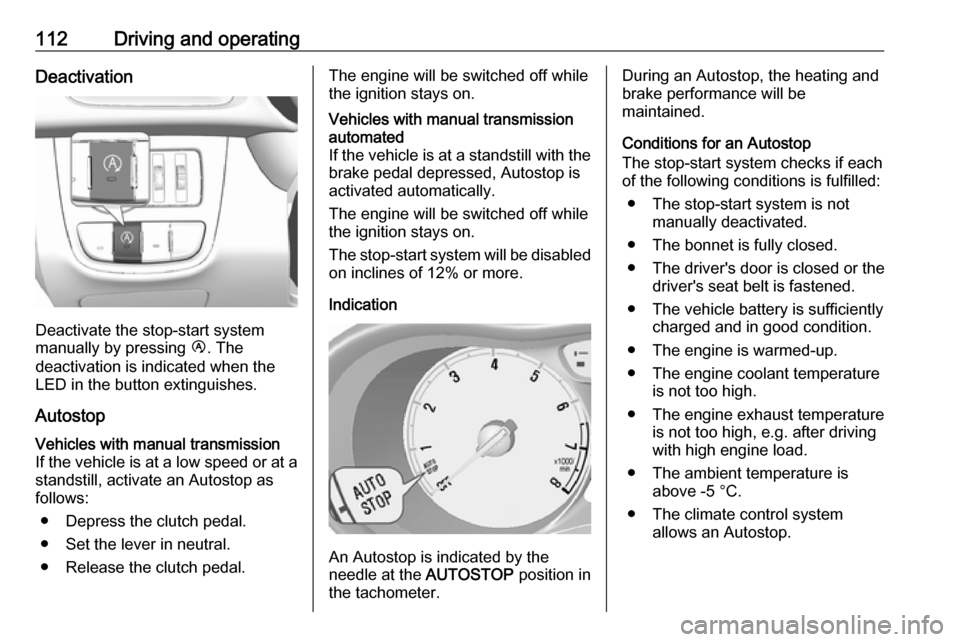
Deactivate the stop-start system
manually by pressing Ï. The
deactivation is indicated when the
LED in the button extinguishes.
Autostop
Vehicles with manual transmission
If the vehicle is at a low speed or at a
standstill, activate an Autostop as
follows:
● Depress the clutch pedal.
● Set the lever in neutral.
● Release the clutch pedal.The engine will be switched off while
the ignition stays on.Vehicles with manual transmission
automated
If the vehicle is at a standstill with the brake pedal depressed, Autostop is
activated automatically.
The engine will be switched off while
the ignition stays on.
The stop-start system will be disabled
on inclines of 12% or more.
Indication
An Autostop is indicated by the
needle at the AUTOSTOP position in
the tachometer.
During an Autostop, the heating and
brake performance will be
maintained.
Conditions for an Autostop
The stop-start system checks if each
of the following conditions is fulfilled:
● The stop-start system is not manually deactivated.
● The bonnet is fully closed.
● The driver's door is closed or the driver's seat belt is fastened.
● The vehicle battery is sufficiently charged and in good condition.
● The engine is warmed-up.
● The engine coolant temperature is not too high.
● The engine exhaust temperature is not too high, e.g. after driving
with high engine load.
● The ambient temperature is above -5 °C.
● The climate control system allows an Autostop.
Page 115 of 203

Driving and operating113● The brake vacuum is sufficient.
● The vehicle was driven at least at
walking speed since the last
Autostop.
Otherwise an Autostop will be
inhibited.
Certain settings of the climate control
system may inhibit an Autostop. See
"Climate control" chapter for further information 3 103.
Immediately after motorway driving
an Autostop may be inhibited.
New vehicle running-in 3 109.
Vehicle battery discharge protection
To ensure reliable engine restarts,
several vehicle battery discharge
protection features are implemented
as part of the stop-start system.
Power saving measures
During an Autostop, several electrical
features, e.g., the rear window
heating, are disabled or switched into
a power saving mode. The fan speed of the climate control system is
reduced to save power.Restart of the engine by the driverVehicles with manual transmission
Depress the clutch pedal to restart the
engine.
If the selector lever is shifted out of
neutral before depressing the clutch
pedal first, control indicator -
illuminates or is shown as a symbol in the Driver Information Centre.
Control indicator - 3 74.Vehicles with manual transmission
automated
Release the brake pedal or move
selector lever out of D to restart the
engine.
Restart of the engine by the stop-
start system
The selector lever must be in neutral
to enable an automatic restart.
If one of the following conditions
occurs during an Autostop, the
engine will be restarted automatically
by the stop-start system:
● The stop-start system is manually deactivated.
● The bonnet is opened.
● The driver's seat belt is unfastened and the driver's door
is opened.
● The engine temperature is too low.
● The charging level of the vehicle battery is below a defined level.
● The brake vacuum is not sufficient.
● The vehicle is driven at least at walking speed.
● The climate control system requests an engine start.
● The air conditioning is manually switched on.
If the bonnet is not fully closed, a warning message is displayed in the
Driver Information Centre.
If an electrical accessory, e.g. a
portable CD player, is connected to
the power outlet, a brief power drop
during restart might be noticeable.
Page 156 of 203

154Vehicle careVehicles with spare wheel
The jack and the vehicle tools are in
the load compartment.
Wheels and tyres
Tyre condition, wheel condition Drive over edges slowly and at right
angles if possible. Driving over sharp
edges can cause tyre and wheel
damage. Do not trap tyres on the kerb when parking.
Regularly check the wheels for
damage. Seek the assistance of a
workshop in the event of damage or
unusual wear.
We recommend not swapping the
front wheels with the rear wheels and vice versa, as this can affect vehicle
stability. Always use less worn tyres on the rear axle.
Winter tyres
Winter tyres improve driving safety at temperatures below 7 °C and should
therefore be fitted on all wheels.
In accordance with country-specific
regulations, affix the speed sticker in
the driver's field of view.Tyre designations
E.g. 195/55 R 16 95 H195:tyre width, mm55:cross-section ratio (tyre height
to tyre width), %R:belt type: RadialRF:type: RunFlat16:wheel diameter, inches91:load index e.g. 91 is equivalent
to 615 kgH:speed code letter
Speed code letter:
Q:up to 160 km/hS:up to 180 km/hT:up to 190 km/hH:up to 210 km/hV:up to 240 km/hW:up to 270 km/h
Choose a tyre appropriate for the
maximum speed of your vehicle.
The maximum speed is achievable at kerb weight with driver (75 kg) plus
125 kg payload. Optional equipment
could reduce the maximum speed of
the vehicle.
Performance 3 183.
Page 174 of 203
172Vehicle careWheels and tyres
Do not use high-pressure jet
cleaners.
Clean rims with a pH-neutral wheel
cleaner.
Rims are painted and can be treated
with the same agents as the body.
Paintwork damageRectify minor paintwork damage witha touch-up pen before rust forms.
Have more extensive damage or rust
areas repaired by a workshop.
Underbody Some areas of the vehicle underbody
have a PVC undercoating while other
critical areas have a durable
protective wax coating.
After the underbody is washed, check the underbody and have it waxed if
necessary.
Bitumen / rubber materials could
damage the PVC coating. Have
underbody work carried out by a
workshop.Before and after winter, wash the
underbody and have the protective
wax coating checked.
Liquid gas system9 Danger
Liquid gas is heavier than air and
can collect in sink points.
Take care when performing work
at the underbody in a pit.
For painting work and when using a
drying booth at a temperature above
60 °C, the liquid gas tank must be
removed.
Do not make any modifications to the
liquid gas system.
Interior care
Interior and upholstery
Only clean the vehicle interior,
including the instrument panel fascia
and panelling, with a dry cloth or
interior cleaner.
Clean the leather upholstery with
clear water and a soft cloth. In case of heavy soiling, use leather care.
The instrument cluster and the
displays should only be cleaned using
a soft damp cloth. If necessary use a
weak soap solution.
Clean fabric upholstery with a
vacuum cleaner and brush. Remove
stains with an upholstery cleaner.
Clothing fabrics may not be
colourfast. This could cause visible
discolourations, especially on light- coloured upholstery. Removable
stains and discolourations should be
cleaned as soon as possible.
Clean seat belts with lukewarm water or interior cleaner.Caution
Close Velcro fasteners as open
Velcro fasteners on clothing could damage seat upholstery.
The same applies to clothing with
sharp-edged objects, like zips or
belts or studded jeans.
Page 194 of 203

192Customer informationEnGIS Technologies, Inc.
BringGo ®
is a registered trademark of
EnGIS Technologies, Inc.Google Inc.
Android™ and Google Play™ Store
are trademarks of Google Inc.Stitcher Inc.
Stitcher™ is a trademark of Stitcher,
Inc.Verband der Automobilindustrie e.V.
AdBlue ®
is a registered trademark of
the VDA.Vehicle data recording
and privacy
Event data recorders
Electronic control units are installed in
your vehicle. Control units process
data which is received by vehicle
sensors, for example, or which they
generate themselves or exchange
amongst themselves. Some control
units are necessary for the safe
functioning of your vehicle, others
assist you while you drive (driver
assistance systems), while others
provide comfort or infotainment
functions.
Operating data in the vehicle Control units process data for
operation of the vehicle.This data includes, for example:
● Vehicle status information (e.g. wheel rotation rate, speed,
movement delay, lateral
acceleration, "seatbelts
fastened" display),
● Ambient conditions (e.g. temperature, rain sensor,
distance sensor).
Most of this data is volatile and is
processed only in the vehicle itself,
and not beyond the operating time.
Moreover, many control units include
data storage device (amongst others the vehicle key). This is used to allow
information to be documented
temporarily or permanently on vehicle
condition, component stress,
maintenance requirements and
technical events and errors.
The following information, for
example, is stored:
● System component operating states (e.g. fill level, tyre
pressure, battery status),
● State of charge of the high voltage battery, estimated range(in the case of electric vehicles),
Page 198 of 203

196IndexAAccessories and vehicle modifications .......................... 135
Adjustable air vents ...................106
Airbag and belt tensioners ...........73
Airbag deactivation ................46, 73
Airbag label................................... 41 Airbag system .............................. 41
Air conditioning regular operation ................................ 107
Air conditioning system .............. 101
Air intake .................................... 107
Air vents...................................... 106
Antilock brake system ................ 119
Antilock brake system (ABS) .......75
Anti-theft alarm system ................27
Appearance care ........................170
Ashtrays ....................................... 65
Autostop ..................................... 111
B Battery discharge protection ........99
Battery voltage ............................. 86
Belts.............................................. 39
Bonnet ....................................... 137
Bonnet open ................................. 77
Brake and clutch fluid .................175
Brake and clutch system .............74
Brake assist ............................... 120
Brake fluid .................................. 140Brakes ............................... 119, 140
Breakdown.................................. 169
Bulb replacement ....................... 143
C Capacities .................................. 185
Catalytic converter .....................115
Central locking system ................23
Centre console storage ...............54
Centre high-mounted brake light 147
Changing tyre and wheel size ...159
Charging system .......................... 74
Child locks ................................... 25
Child restraint installation locations ................................... 50
Child restraints.............................. 47
Child restraint systems ................47
Cigarette lighter ........................... 65
City mode ................................... 123
Climate control ............................. 17
Climate control systems .............100
Clock ............................................ 63
Code ............................................. 84
Control indicators.......................... 70
Control of the vehicle .................108
Controls ........................................ 61
Coolant and antifreeze ...............175
Cornering lights ............................ 95
Cruise control ...................... 77, 124
Page 201 of 203

199SSafety belts ................................... 39
Seat adjustment ....................... 7, 37 Seat belt ........................................ 8
Seat belt reminder .......................73
Seat belts ..................................... 39
Seat heating ................................. 38
Seat position ................................ 36
Selector lever ............................. 117
Service ....................................... 107
Service display ............................ 69
Service information ....................174
Service vehicle soon .................... 74
Side airbag system ......................45
Sidelights ...................................... 94
Side turn lights ........................... 147
Software acknowledgement .......190
Spare wheel ............................... 166
Speed limiter......................... 77, 125
Speedometer ............................... 65
Starting and operating ................109
Starting off ................................... 18
Starting the engine ............110, 116
Steering ...................................... 109
Steering wheel adjustment ......9, 61
Steering wheel controls ...............61
Stop-start system........................ 111
Storage ......................................... 53
Storage compartments .................53
Sunroof ........................................ 33Sun visors .................................... 33
Symbols ......................................... 4
T
Tachometer ................................. 66
Tail lights ................................... 146
Three-point seat belt .................... 40
Tools .......................................... 153
Towing ........................................ 169
Towing the vehicle .....................169
Traction Control system ............. 121
Traction Control system off........... 76
Transmission ............................... 17
Transmission display .................116
Tread depth ............................... 159
Trip odometer .............................. 66
Turn lights .............................. 72, 96
Tyre chains ................................ 160
Tyre designations ......................154
Tyre pressure ............................ 155
Tyre pressure monitoring system ............................... 76, 156
Tyre pressures ........................... 186
Tyre repair kit ............................. 160
U Ultrasonic parking assist ...... 75, 127
Upholstery .................................. 172
Using this manual ..........................3V
Valet mode ................................... 83
Vehicle battery ........................... 140
Vehicle checks............................ 137
Vehicle data ................................ 179
Vehicle data recording and privacy ..................................... 192
Vehicle dimensions .................... 184
Vehicle Identification Number ....177
Vehicle jack ................................ 153
Vehicle messages .......................84
Vehicle personalisation ...............87
Vehicle specific data ......................3
Vehicle storage ........................... 136
Vehicle tools ............................... 153
Vehicle unlocking ........................... 6
Vehicle weight ........................... 183
Ventilation ................................... 100
W
Warning chimes ........................... 86
Warning lights ............................... 65
Warning triangle .......................... 57
Washer and wiper systems .........15
Washer fluid ............................... 140
Wheel changing .........................163
Wheel covers ............................. 160
Wheels and tyres .......................154
Windows ....................................... 30
Windscreen................................... 30