steering wheel OPEL KARL 2018.5 Manual user
[x] Cancel search | Manufacturer: OPEL, Model Year: 2018.5, Model line: KARL, Model: OPEL KARL 2018.5Pages: 203, PDF Size: 5.64 MB
Page 112 of 203

110Driving and operating0:ignition off: Some functions
remain active until key is
removed or driver's door is
opened, provided the ignition was
on previously1:accessory power mode: Steering wheel lock released, some
electrical functions are operable,
ignition is off2:ignition on power mode: Ignition
is on. Control indicators
illuminate and most electrical
functions are operable3:engine start: Release key after
starting procedure beginsSteering wheel lock
Remove key from ignition switch and
turn steering wheel until it engages.
Retained power off The following electronic systems areoperable until the driver's door is
opened or at the latest for
10 minutes after the ignition is
switched off:
● power windows
● power outlets
● power sunroof
Power to the Infotainment system will continue to operate for 30 minutes oruntil the key is removed from the
ignition switch, regardless of whether
any door is opened.Starting the engine
Turn key to position 1 to release the
steering wheel lock.
Manual transmission: operate clutch
and brake pedal.
Manual transmission automated:
operate brake pedal.
Do not operate the accelerator pedal. Turn key briefly to position 3 and
release: an automatic procedure
operates the starter after a brief
delay, until the engine is running. See
"Automatic Starter Control".
Page 116 of 203

114Driving and operatingParking9Warning
● Do not park the vehicle on an
easily ignitable surface. The
high temperature of the
exhaust system could ignite the
surface.
● Always apply the parking brake. Activate the manual
parking brake without pressing the release button. Apply as
firmly as possible on a downhill slope or uphill slope. Depress
brake pedal at the same time to
reduce operating force.
● Switch off the engine.
● If the vehicle is on a level surface or uphill slope, engage
first gear before removing the ignition key. On an uphill slope,
turn the front wheels away from
the kerb.
If the vehicle is on a downhill
slope, engage reverse gear
before removing the ignition
key. Turn the front wheels
towards the kerb.
● Close the windows and the sunroof.
● Remove the ignition key from the ignition switch. Turn the
steering wheel until the
steering wheel lock is felt to
engage.
For vehicles with manual
transmission automated, the key
can only be removed from the
ignition switch when the parking
brake is applied.
● Lock the vehicle.
● Activate the anti-theft alarm system.
● The engine cooling fans may run
after the engine has been
switched off 3 137.
Caution
After running at high engine
speeds or with high engine loads,
operate the engine briefly at a low
load or run in neutral for
approx. 30 seconds before
switching off, in order to protect
the turbocharger.
Note
In the event of an accident with
airbag deployment, the engine is
switched off automatically if the
vehicle comes to a standstill within a
certain time.
Page 155 of 203

Vehicle care153No.Circuit17–18Instrument cluster19–20Headlight range adjustment21Power windows, front22Power windows, rear23–24Manual transmission auto‐
mated module25Auxiliary power outlet26Sunroof27Central gateway module28Body control module 829Body control module 730Body control module 631Body control module 532Body control module 4No.Circuit33Body control module 334Body control module 235Body control module 136–37Steering wheel control LED38–39Logistic/DC transformer40Power window, driver41Blower42Seat heating, front43Air conditioning module44Heated steering wheel45–Vehicle tools
Tools
Vehicles without spare
The vehicle tools are in the
compartment under the floor cover in
the load compartment.
Page 162 of 203
160Vehicle careWheel coversWheel covers and tyres that are
factory approved for the respective
vehicle and comply with all of the
relevant wheel and tyre combination
requirements must be used.
If the wheel covers and tyres used are
not factory approved, the tyres must
not have a rim protection ridge.
Wheel covers must not impair brake
cooling.9 Warning
Use of unsuitable tyres or wheel
covers could lead to sudden
pressure loss and thereby
accidents.
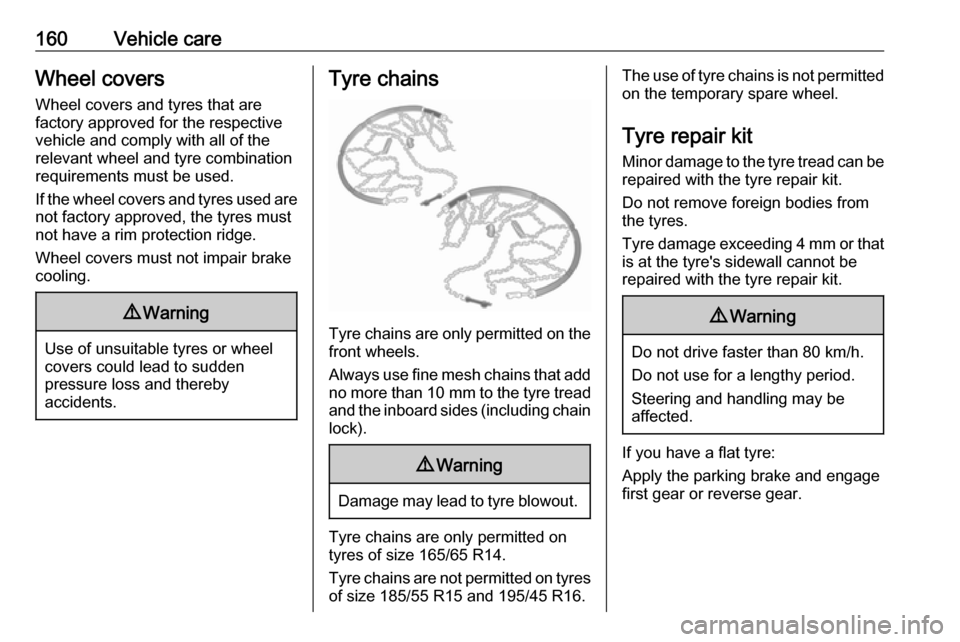
Tyre chains
Tyre chains are only permitted on the
front wheels.
Always use fine mesh chains that add no more than 10 mm to the tyre tread
and the inboard sides (including chain lock).
9 Warning
Damage may lead to tyre blowout.
Tyre chains are only permitted on
tyres of size 165/65 R14.
Tyre chains are not permitted on tyres of size 185/55 R15 and 195/45 R16.
The use of tyre chains is not permitted on the temporary spare wheel.
Tyre repair kit Minor damage to the tyre tread can be
repaired with the tyre repair kit.
Do not remove foreign bodies from
the tyres.
Tyre damage exceeding 4 mm or that is at the tyre's sidewall cannot be
repaired with the tyre repair kit.9 Warning
Do not drive faster than 80 km/h.
Do not use for a lengthy period.
Steering and handling may be
affected.
If you have a flat tyre:
Apply the parking brake and engage
first gear or reverse gear.
Page 172 of 203
170Vehicle care
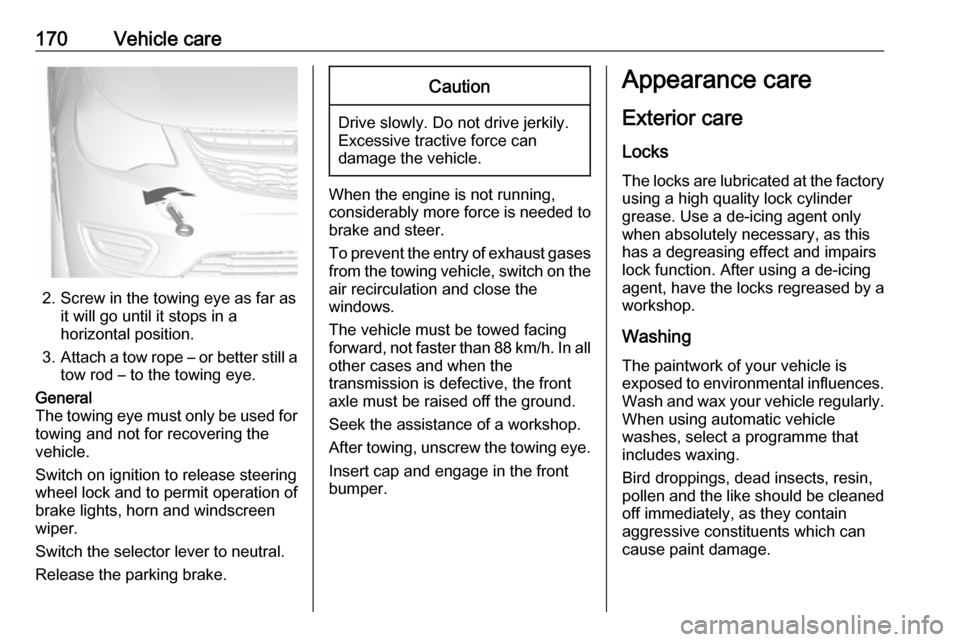
2. Screw in the towing eye as far asit will go until it stops in a
horizontal position.
3. Attach a tow rope – or better still a
tow rod – to the towing eye.
General
The towing eye must only be used for
towing and not for recovering the
vehicle.
Switch on ignition to release steering
wheel lock and to permit operation of
brake lights, horn and windscreen
wiper.
Switch the selector lever to neutral.
Release the parking brake.Caution
Drive slowly. Do not drive jerkily.
Excessive tractive force can
damage the vehicle.
When the engine is not running,
considerably more force is needed to
brake and steer.
To prevent the entry of exhaust gases from the towing vehicle, switch on the
air recirculation and close the
windows.
The vehicle must be towed facing
forward, not faster than 88 km/h. In all
other cases and when the
transmission is defective, the front
axle must be raised off the ground.
Seek the assistance of a workshop.
After towing, unscrew the towing eye.
Insert cap and engage in the front
bumper.
Appearance care
Exterior care
Locks The locks are lubricated at the factoryusing a high quality lock cylinder
grease. Use a de-icing agent only
when absolutely necessary, as this
has a degreasing effect and impairs
lock function. After using a de-icing
agent, have the locks regreased by a workshop.
Washing The paintwork of your vehicle is
exposed to environmental influences.
Wash and wax your vehicle regularly. When using automatic vehicle
washes, select a programme that
includes waxing.
Bird droppings, dead insects, resin,
pollen and the like should be cleaned
off immediately, as they contain
aggressive constituents which can
cause paint damage.
Page 195 of 203

Customer information193● Faults and defects in importantsystem components (e.g. lights,
brakes),
● System reactions in special driving situations (e.g. triggeringof an airbag, actuation of the
stability control systems),
● Information on events damaging the vehicle.
In special cases (e.g. if the vehicle
has detected a malfunction), it may be
necessary to save data that would
otherwise just be volatile.
When you use services, the operating
data saved can be read together with the vehicle identification number andused if necessary. Staff working for
the service net-work (e.g. garages,
manufacturers) or third parties (e.g.
breakdown services) can read the
data from the vehicle. Services
include repair services, maintenance
processes, warranty cases and
quality assurance measures.
Data is generally read via the OBD
(On-Board Diagnostics) port
prescribed by law in the vehicle. The operating data which has been read
out documents the technical conditionof the vehicle or individual
components and assists with fault
diagnosis, compliance with warranty
obligations and quality improvement.
This data, in particular information on
component stress, technical events,
operator errors and other faults, is
transmitted to the manufacturer
where appropriate, together with the vehicle identification number. The
manufacturer is also subject to
product liability. The manufacturer
potentially also needs operating data
from vehicles for product recalls.
Fault memories in the vehicle can be
reset by a service company when
carrying out servicing or repairs.
Comfort and infotainment
functions
Comfort settings and custom settings can be stored in the vehicle and
changed at any time.Depending on the equipment level in
question, these include
● Seat and steering wheel position settings,
● Chassis and air conditioning settings,
● Custom settings such as interior lighting.
You can input your own data in the
infotainment functions for your
vehicle as part of the selected
features.
Depending on the equipment level in
question, these include
● Multimedia data such as music, videos or photos for playback in
an integrated multimedia system,
● Address book data for use with an integrated hands-free system
or an integrated navigation
system,
● Input destinations,
● Data on the use of online services.
This data for comfort and
infotainment functions can be stored
locally in the vehicle or be kept on a
Page 199 of 203

197Cupholders .................................. 53
Curtain airbag system .................. 46
D
Danger, Warnings and Cautions ...4
Daytime running lights .................95
Declaration of conformity ............187
Door open .................................... 78
Doors ............................................ 26
Driver assistance systems ..........124
Driver Information Centre .............78
Driving hints ................................ 108
E Electric adjustment ......................29
Electrical system......................... 149
Electronic climate control system 103
Electronic driving programmes ..118
Electronic Stability Control.......... 122
Electronic Stability Control and Traction Control system ............75
Electronic Stability Control off....... 75
End-of-life vehicle recovery .......136
Engine compartment fuse box ...150
Engine coolant ........................... 139
Engine coolant temperature ........76
Engine coolant temperature gauge ....................................... 68
Engine data ............................... 182
Engine exhaust .......................... 115
Engine identification ...................178Engine oil ................... 138, 175, 179
Engine oil pressure ......................76
Event data recorders ..................192
Exit lighting .................................. 98
Exterior care .............................. 170
Exterior light ................................. 77
Exterior lighting ......................14, 94
Exterior mirrors ............................. 29
F Fault ........................................... 118
First aid ......................................... 58
First aid kit ................................... 58
Fixed air vents ........................... 107
Fog light ....................................... 77
Fog lights ................................... 145
Folding mirrors ............................. 29
Front airbag system .....................44
Front doors ................................... 25
Front fog lights ............................. 96
Front seats.................................... 36
Front turn lights .......................... 145
Fuel............................................. 129
Fuel for liquid gas operation .......131
Fuel for petrol engines ...............129
Fuel gauge ................................... 66 Fuel selector ................................ 67
Fuses ......................................... 149G
Gauges ......................................... 65
Gear shifting ................................. 75
Glovebox ..................................... 53
H Halogen headlights ....................143
Hand brake ......................... 119, 120
Hazard warning flashers ..............95
Headlight flash ............................. 94
Headlight range adjustment ........95
Headlights..................................... 94 Headlights when driving abroad ..95
Head restraint adjustment .............8
Head restraints ............................ 35
Heated mirrors ............................. 29
Heated rear window ..................... 32
Heated steering wheel .................61
Heating ........................................ 38
Heating and ventilation system . 100
High beam ............................. 77, 94
Hill start assist ........................... 120
Horn ....................................... 15, 62
I Identification plate .....................178
Ignition switch positions .............109
Immobiliser ............................ 28, 77
Indicators ...................................... 65
Info Display ................................... 83
Information displays...................... 78
Page 201 of 203

199SSafety belts ................................... 39
Seat adjustment ....................... 7, 37 Seat belt ........................................ 8
Seat belt reminder .......................73
Seat belts ..................................... 39
Seat heating ................................. 38
Seat position ................................ 36
Selector lever ............................. 117
Service ....................................... 107
Service display ............................ 69
Service information ....................174
Service vehicle soon .................... 74
Side airbag system ......................45
Sidelights ...................................... 94
Side turn lights ........................... 147
Software acknowledgement .......190
Spare wheel ............................... 166
Speed limiter......................... 77, 125
Speedometer ............................... 65
Starting and operating ................109
Starting off ................................... 18
Starting the engine ............110, 116
Steering ...................................... 109
Steering wheel adjustment ......9, 61
Steering wheel controls ...............61
Stop-start system........................ 111
Storage ......................................... 53
Storage compartments .................53
Sunroof ........................................ 33Sun visors .................................... 33
Symbols ......................................... 4
T
Tachometer ................................. 66
Tail lights ................................... 146
Three-point seat belt .................... 40
Tools .......................................... 153
Towing ........................................ 169
Towing the vehicle .....................169
Traction Control system ............. 121
Traction Control system off........... 76
Transmission ............................... 17
Transmission display .................116
Tread depth ............................... 159
Trip odometer .............................. 66
Turn lights .............................. 72, 96
Tyre chains ................................ 160
Tyre designations ......................154
Tyre pressure ............................ 155
Tyre pressure monitoring system ............................... 76, 156
Tyre pressures ........................... 186
Tyre repair kit ............................. 160
U Ultrasonic parking assist ...... 75, 127
Upholstery .................................. 172
Using this manual ..........................3V
Valet mode ................................... 83
Vehicle battery ........................... 140
Vehicle checks............................ 137
Vehicle data ................................ 179
Vehicle data recording and privacy ..................................... 192
Vehicle dimensions .................... 184
Vehicle Identification Number ....177
Vehicle jack ................................ 153
Vehicle messages .......................84
Vehicle personalisation ...............87
Vehicle specific data ......................3
Vehicle storage ........................... 136
Vehicle tools ............................... 153
Vehicle unlocking ........................... 6
Vehicle weight ........................... 183
Ventilation ................................... 100
W
Warning chimes ........................... 86
Warning lights ............................... 65
Warning triangle .......................... 57
Washer and wiper systems .........15
Washer fluid ............................... 140
Wheel changing .........................163
Wheel covers ............................. 160
Wheels and tyres .......................154
Windows ....................................... 30
Windscreen................................... 30