heating OPEL KARL 2018 Manual user
[x] Cancel search | Manufacturer: OPEL, Model Year: 2018, Model line: KARL, Model: OPEL KARL 2018Pages: 203, PDF Size: 5.44 MB
Page 101 of 203
Climate control99Climate controlClimate control systems...............99
Heating and ventilation system . 99
Air conditioning system ...........100
Electronic climate control system .................................... 102
Air vents ..................................... 105
Adjustable air vents .................105
Fixed air vents ......................... 106
Maintenance .............................. 106
Air intake ................................. 106
Pollen filter ............................... 106
Air conditioning regular operation ................................ 106
Service .................................... 107Climate control systems
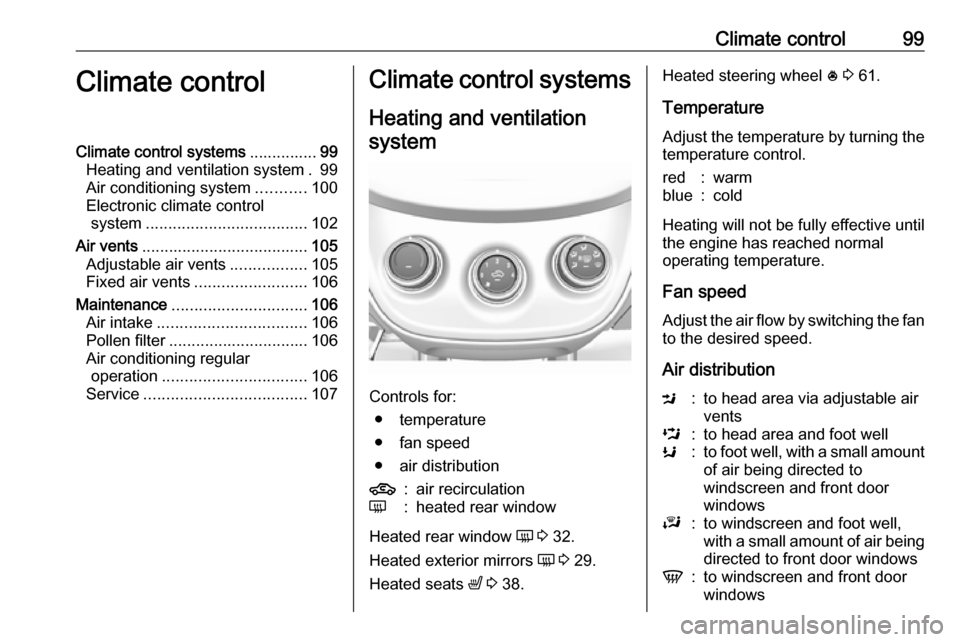
Heating and ventilation system
Controls for: ● temperature
● fan speed
● air distribution
4:air recirculationÜ:heated rear window
Heated rear window Ü 3 32.
Heated exterior mirrors Ü 3 29.
Heated seats ß 3 38.
Heated steering wheel * 3 61.
Temperature
Adjust the temperature by turning the
temperature control.red:warmblue:cold
Heating will not be fully effective until
the engine has reached normal
operating temperature.
Fan speed
Adjust the air flow by switching the fan
to the desired speed.
Air distribution
M:to head area via adjustable air
ventsL:to head area and foot wellK:to foot well, with a small amount of air being directed to
windscreen and front door
windowsJ:to windscreen and foot well,
with a small amount of air being
directed to front door windowsV:to windscreen and front door
windows
Page 102 of 203
100Climate controlIntermediate settings are possible.Demisting and defrosting the
windows
● Set air distribution control to V.
● Set temperature control to warmest level.
● Set fan speed to highest speed.
● Switch on heated rear window Ü.
● Open side air vents as required and direct them towards door
windows.
● For simultaneous warming of the
foot well, set air distribution
control to J.Air conditioning system
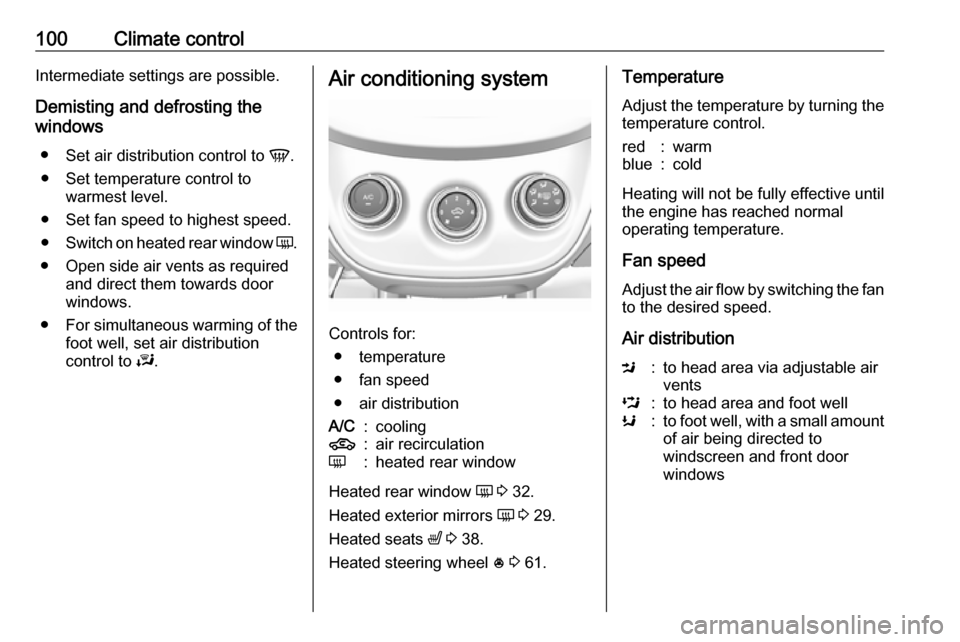
Controls for:
● temperature
● fan speed
● air distribution
A/C:cooling4:air recirculationÜ:heated rear window
Heated rear window Ü 3 32.
Heated exterior mirrors Ü 3 29.
Heated seats ß 3 38.
Heated steering wheel * 3 61.
Temperature
Adjust the temperature by turning the
temperature control.red:warmblue:cold
Heating will not be fully effective until
the engine has reached normal
operating temperature.
Fan speed
Adjust the air flow by switching the fan
to the desired speed.
Air distribution
M:to head area via adjustable air
ventsL:to head area and foot wellK:to foot well, with a small amount of air being directed to
windscreen and front door
windows
Page 104 of 203

102Climate controlIf air distribution is set to V, A/C
operates and air recirculation mode will be set to demisting/defrosting
regardless of indicator status.
Note
If V is pressed while the engine is
running, an Autostop will be inhibited
until V is pressed again.
If V is pressed while the engine is
in an Autostop, the engine will restart
automatically.
Stop-start system 3 111.
Electronic climate control systemControls for: ● temperature
● air distribution
● fan speedA/C:coolingAUTO:automatic mode4:manual air recirculationV:demisting and defrostingÜ:heated rear window
Heated rear window Ü 3 32.
Heated exterior mirrors Ü 3 29.
Heated seats ß 3 38.
Heated steering wheel * 3 61.
Climate control settings are shown on the Info-Display. Setting
modifications are briefly popped-up,
superimposed over the currently
displayed menu.
The electronic climate control system
is only fully operational when the
engine is running.
Heating will not be fully effective until
the engine has reached normal
operating temperature.
Automatic mode AUTO
The system automatically controls the
fan speed, air delivery, air
conditioning, and recirculation in
order to heat or cool the vehicle to the desired temperature.
When the AUTO indicator light is on,
the system is in full automatic
operation.
If the air delivery mode, fan speed,
recirculation, or air conditioning
setting is adjusted, the AUTO
indicator turns off.
To improve fuel efficiency and to cool
the vehicle faster, recirculation may
be automatically selected in warm
weather. The recirculation light will
not come on. Press 4 to select
recirculation; press it again to select
outside air.
To turn off the system, press power m.
Page 105 of 203

Climate control103Basic setting for maximum comfort:● Press AUTO. The LED in the
button illuminates to indicate
activation.
● Open all air vents to allow optimised air distribution in
Automatic mode.
● Set the preselected temperature.
Recommended temperature is
22 °C.
Temperature preselection
Set temperature to the desired value. It is indicated on the display in thetemperature control.
For reasons of comfort, change
temperature only in small increments.
If the minimum temperature Lo is set,
the climate control system runs at
maximum cooling, if cooling A/C is
active.
If the maximum temperature Hi is set,
the climate control system runs at
maximum heating.
Recommended temperature is 22 °C .Note
If A/C is switched on, reducing the
set cabin temperature can cause the
engine to restart from an Autostop or inhibit an Autostop.
Stop-start system 3 111.
Demisting and defrosting the
windows V
● Press V. The LED in the button
illuminates to indicate activation.
● Temperature and air distribution are set automatically and the fan
runs at high speed.
● Switch on heated rear window Ü.
● To return to previous mode: press V. To return to Automatic
mode: press AUTO.
Note
If V is pressed while the engine is
running, an Autostop will be inhibited
until V is pressed again.
If V is pressed while the engine is
in an Autostop, the engine will restart automatically.
Stop-start system 3 111.Air recirculation system 4
Press 4 to activate air recirculation
mode. The LED in the button
illuminates to indicate activation.
Press 4 again to deactivate air
recirculation mode.9 Warning
Driving with recirculation mode for
a prolonged period of time can
make you sleepy. Periodically turn
to the outside air mode for fresh
air.
The exchange of fresh air is
reduced in air recirculation mode.
In operation without cooling the air humidity increases, so the
windows may mist up. The quality
of the passenger compartment air
deteriorates, which may cause the
vehicle occupants to feel drowsy.
In warm and very humid ambient air
conditions, the windscreen may mist
up from outside, when cold air is
directed towards it. If windscreen
mists up from outside, activate
windscreen wiper and deactivate V.
Page 109 of 203

Climate control107ServiceFor optimal cooling performance, it is
recommended to annually check the
climate control system, starting
three years after initial vehicle
registration, including:
● functionality and pressure test
● heating functionality
● leakage check
● check of drive belts
● cleaning of condenser and evaporator drainage
● performance check
Note
Refrigerant R-134a contains
fluorinated greenhouse gases.
Page 114 of 203

112Driving and operatingDeactivation
Deactivate the stop-start system
manually by pressing Ï. The
deactivation is indicated when the
LED in the button extinguishes.
Autostop
Vehicles with manual transmission
If the vehicle is at a low speed or at a
standstill, activate an Autostop as
follows:
● Depress the clutch pedal.
● Set the lever in neutral.
● Release the clutch pedal.The engine will be switched off while
the ignition stays on.Vehicles with manual transmission
automated
If the vehicle is at a standstill with the brake pedal depressed, Autostop is
activated automatically.
The engine will be switched off while
the ignition stays on.
The stop-start system will be disabled
on inclines of 15% or more.
Indication
An Autostop is indicated by the
needle at the AUTOSTOP position in
the tachometer.
During an Autostop, the heating and
brake performance will be
maintained.
Conditions for an Autostop
The stop-start system checks if each
of the following conditions is fulfilled:
● The stop-start system is not manually deactivated.
● The bonnet is fully closed.
● The driver's door is closed or the driver's seat belt is fastened.
● The vehicle battery is sufficiently charged and in good condition.
● The engine is warmed-up.
● The engine coolant temperature is not too high.
● The engine exhaust temperature is not too high, e.g. after driving
with high engine load.
● The ambient temperature is above -5 °C.
● The climate control system allows an Autostop.
Page 115 of 203

Driving and operating113● The brake vacuum is sufficient.
● The vehicle was driven at least at
walking speed since the last
Autostop.
Otherwise an Autostop will be
inhibited.
Certain settings of the climate control
system may inhibit an Autostop. See
"Climate control" chapter for further information 3 102.
Immediately after motorway driving
an Autostop may be inhibited.
New vehicle running-in 3 109.
Vehicle battery discharge protection
To ensure reliable engine restarts,
several vehicle battery discharge
protection features are implemented
as part of the stop-start system.
Power saving measures
During an Autostop, several electrical
features, e.g., the rear window
heating, are disabled or switched into
a power saving mode. The fan speed of the climate control system is
reduced to save power.Restart of the engine by the driverVehicles with manual transmission
Depress the clutch pedal to restart the
engine.
If the selector lever is shifted out of
neutral before depressing the clutch
pedal first, control indicator -
illuminates or is shown as a symbol in the Driver Information Centre.
Control indicator - 3 73.Vehicles with manual transmission
automated
Release the brake pedal or move
selector lever out of D to restart the
engine.
Restart of the engine by the stop-
start system
The selector lever must be in neutral
to enable an automatic restart.
If one of the following conditions
occurs during an Autostop, the
engine will be restarted automatically
by the stop-start system:
● The stop-start system is manually deactivated.
● The bonnet is opened.
● The driver's seat belt is unfastened and the driver's door
is opened.
● The engine temperature is too low.
● The charging level of the vehicle battery is below a defined level.
● The brake vacuum is not sufficient.
● The vehicle is driven at least at walking speed.
● The climate control system requests an engine start.
● The air conditioning is manually switched on.
If the bonnet is not fully closed, a warning message is displayed in the
Driver Information Centre.
If an electrical accessory, e.g. a
portable CD player, is connected to
the power outlet, a brief power drop
during restart might be noticeable.
Page 157 of 203
Vehicle care155No.Circuit33Body control module 334Body control module 235Body control module 136–37Steering wheel control LED38–39Logistic/DC transformer40Power window, driver41Blower42Seat heating, front43Air conditioning module44Heated steering wheel45–Vehicle tools
Tools
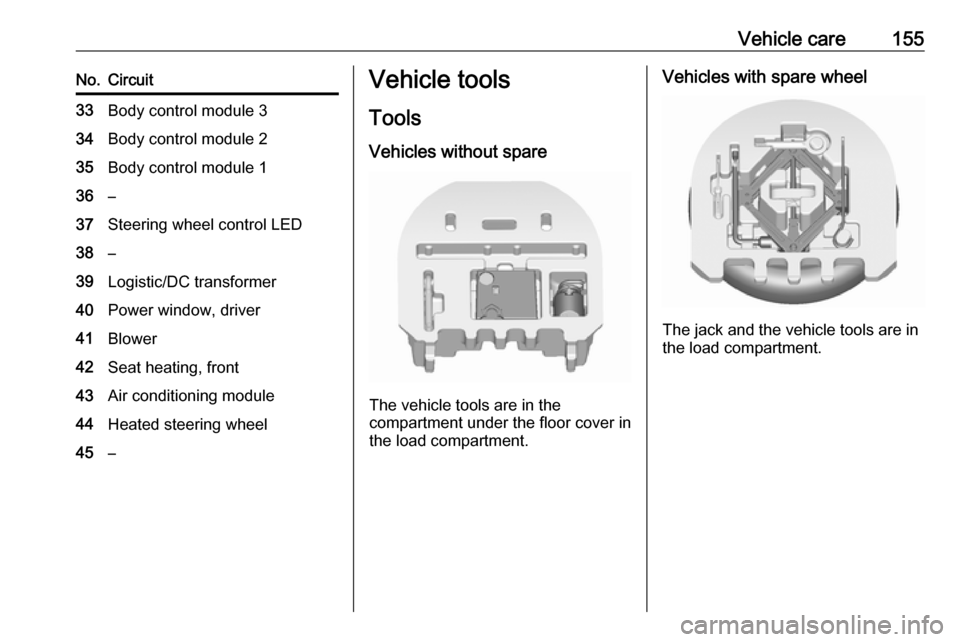
Vehicles without spare
The vehicle tools are in the
compartment under the floor cover in
the load compartment.
Vehicles with spare wheel
The jack and the vehicle tools are in
the load compartment.
Page 175 of 203

Vehicle care173Thoroughly rinse and leather-off the
vehicle. Rinse leather frequently. Use
separate leathers for painted and
glass surfaces: remnants of wax on the windows will impair vision.
Do not use hard objects to remove
spots of tar. Use tar removal spray on
painted surfaces.
Exterior lights
Headlight and other light covers are
made of plastic. Do not use any
abrasive or caustic agents, do not use
an ice scraper, and do not clean them
dry.
Polishing and waxing
Wax painted parts of the vehicle
regularly (at the latest when water no longer beads). Otherwise, the
paintwork will dry out.
Polishing is necessary only if the paint
has become dull or if solid deposits
have become attached to it.
Paintwork polish with silicone forms a
protective film, making waxing
unnecessary.Unpainted plastic body parts must not be treated with wax or polishing
agents.
Windows and windscreen wiper
blades
Use a soft lint-free cloth or chamois leather together with window cleaner
and insect remover.
When cleaning the rear window from
inside, always wipe in parallel to the
heating element to prevent damage.
For mechanical removal of ice, use a
sharp-edged ice scraper. Press the
scraper firmly against the glass so
that no dirt can get under it and
scratch the glass.
Clean smearing wiper blades with a
soft cloth and window cleaner.
Sunroof
Never clean with solvents or abrasive agents, fuels, aggressive media (e.g.
paint cleaner, acetone-containing solutions etc.), acidic or highly
alkaline media or abrasive pads. Do
not apply wax or polishing agents to
the sunroof.Wheels and tyres
Do not use high-pressure jet
cleaners.
Clean rims with a pH-neutral wheel
cleaner.
Rims are painted and can be treated
with the same agents as the body.
Paintwork damageRectify minor paintwork damage witha touch-up pen before rust forms.
Have more extensive damage or rust
areas repaired by a workshop.
Underbody Some areas of the vehicle underbody
have a PVC undercoating while other
critical areas have a durable
protective wax coating.
After the underbody is washed, check
the underbody and have it waxed if
necessary.
Bitumen/rubber materials could
damage the PVC coating. Have
underbody work carried out by a
workshop.
Page 199 of 203

197Cupholders .................................. 53
Curtain airbag system .................. 45
D
Danger, Warnings and Cautions ...4
Daytime running lights .................94
Declaration of conformity ............189
Door open .................................... 77
Doors ............................................ 26
Driver assistance systems ..........124
Driver Information Centre .............77
Driving hints ................................ 108
E Electric adjustment ......................29
Electrical system......................... 150
Electronic climate control system 102
Electronic driving programmes ..118
Electronic Stability Control.......... 122
Electronic Stability Control and Traction Control system ............74
Electronic Stability Control off....... 74
End-of-life vehicle recovery .......138
Engine compartment fuse box ...152
Engine coolant ........................... 141
Engine coolant temperature ........75
Engine coolant temperature gauge ....................................... 68
Engine data ............................... 184
Engine exhaust .......................... 115
Engine identification ...................180Engine oil ................... 140, 176, 181
Engine oil pressure ......................75
Event data recorders ..................195
Exit lighting .................................. 97
Exterior care .............................. 172
Exterior light ................................. 76
Exterior lighting ......................14, 93
Exterior mirrors ............................. 29
F Fault ........................................... 118
First aid ......................................... 58
First aid kit ................................... 58
Fixed air vents ........................... 106
Fog light ....................................... 76
Fog lights ................................... 146
Folding mirrors ............................. 29
Front airbag system .....................44
Front doors ................................... 25
Front fog lights ............................. 95
Front seats.................................... 36
Front turn signal lights ...............147
Fuel............................................. 129
Fuel consumption - CO 2-
Emissions ............................... 136
Fuel for liquid gas operation .......130
Fuel for petrol engines ...............129
Fuel gauge ................................... 66 Fuel selector ................................ 67
Fuses ......................................... 150G
Gauges ......................................... 65
Gear shifting ................................. 74
Glovebox ..................................... 53
H
Halogen headlights ....................145
Hand brake ......................... 119, 120
Hazard warning flashers ..............94
Headlight flash ............................. 93
Headlight range adjustment ........94
Headlights..................................... 93
Headlights when driving abroad ..94
Head restraint adjustment .............8
Head restraints ............................ 35
Heated mirrors ............................. 29
Heated rear window ..................... 32
Heated steering wheel .................61
Heating ........................................ 38
Heating and ventilation system ...99
High beam ............................. 76, 93
Hill start assist ........................... 120
Horn ....................................... 15, 62
I
Identification plate .....................180
Ignition switch positions .............109
Immobiliser ............................ 28, 76
Indicators ...................................... 65
Info display ................................... 82
Information displays...................... 77